
Latest News
A substantial wage hike on the cards for government employees in 2025 – Chairman of the Expert Committee on Public Service Salary Disparities


Chairman of the Expert Committee on Public Service Salary Disparities, Udaya R. Seneviratne said that the basic salary of public service employees will be increased by a minimum of 24% for primary-level service categories. Salaries will gradually increase from an average of 24% to 50%, for all government officials depending on current fiscal feasibility he added.
Mr. Seneviratne further said in light of prevailing inflation and economic conditions, a cost of living allowance of Rs. 25,000 will remain unchanged for three years and will be provided to all government employees for three consecutive years, starting from January 2025, with 2025 being considered the base year.
He emphasized that regardless of which government is in power, there is a pressing need to increase the salaries of public servants. These proposals were made to address and eliminate salary disparities, taking into account past trade union protests within the public service. Accordingly, the proposals have received approval from both the Cabinet and the Treasury.
Chairman of the Expert Committee on Public Service Salary Disparities, Udaya R. Seneviratne shared these views during a press conference titled “Collective Path to a Stable Country” held today (22) at the Presidential Media Centre.
Mr. Seneviratne stated that the basic salary for the primary-level service category employees will be Rs. 30,000.00, with the total salary, including the cost of living allowance, amounting to Rs. 55,000.00.
Public service plays a vital role in the development of Sri Lanka and is also the driving force of development. The restructuring efforts are prioritized to address the current challenges in the public sector. The Presidential Expert Committee on Public Service Salary Disparities has presented a comprehensive program aimed at creating a satisfying work environment for public servants, delivering excellent service to the people, and positioning the public service as a key driver of economic development.
He also said that action will be taken to provide the cost of living allowance of Rs. 12,500 each for the pensioners from January 2025 and measures will also be taken to award the claimed salary increment for the government officials who retired prior to the year 2020 and revise their pension accordingly.
Further, action will be taken to provide benefit through the Budget 2025 in step wise based on the current fiscal viability.
To enhance the effectiveness and efficiency of the Public Service and provide exceptional service to the public, a scientific work study will be conducted in 2025. This study will inform a comprehensive program to restructure the Public Service as needed. A thorough assessment of the required number of employees will also be carried out based on this evaluation.
Appropriate performance indicators (KPIs) will be introduced for government employees, and a system for granting annual salary increments based on performance progress will be developed. Additionally, methods for providing incentives and other non-financial benefits based on performance will be implemented.
To enhance the quality of public service and ensure a distinctive government service for taxpayers under the current tax policy, a competitive recruitment system will be established. This system will be based on the Sri Lanka Qualification Framework (SLQF) and National Vocational Qualification (NVQ). This approach aims to ensure that qualified individuals are placed in appropriate roles, creating a more effective and efficient public service.
The government’s capital investment program for E-Governance will prioritize the digitization and automation of the Public Service, with a focus on incorporating technology in every possible aspect over the next three years, starting in 2025.
Special attention will be given to implementing E-Governance across government ministries and institutions, beginning with Grama Niladhari offices. This initiative aims to enhance the performance of revenue-generating institutions and those providing public services.
Over the next three years, efforts will be made to restructure identified public institutions from their traditional departmental model—dependent on the General Treasury for many years—into an innovative enterprise model.
These institutions will be transformed into Public Quoted Companies with a democratic governance structure, where ownership is divided as 30% government shares, 30% investor shares, 30% public shares through stock market listing, and 10% employee shares.
Government officials who are eligible for pensions and are assigned to these new institutions will have their pensions deferred until they reach age 60. They will receive other benefits during their service in these institutions.
Measures will be introduced to optimize the delivery of certain government services by outsourcing these services to external providers. This approach aims to reduce government expenditures and encourage private sector involvement. It will help avoid unnecessary recruitment in the Public Service and enable private providers to offer more effective services. As a result, economic services will be expanded.
To ease the financial burden on government employees, the Agrahara Medical Insurance Scheme will be restructured to lower their health expenses. The plan is to maximize benefits through the scheme, with each government employee, including pensioners, contributing Rs. 1,000 per month.
Additionally, the National Insurance Trust Fund, which administers the Agrahara scheme, will enhance medical services for government employees. This will involve modernizing the national hospital system and gradually upgrading selected government hospitals with special amenities for employees.
Due to the high demand for Sri Lankans abroad, many are migrating for employment and higher education, drawn by the country’s reputation for free education and skilled human resources. As a result, Sri Lanka loses valuable talent and significant foreign exchange is spent on overseas education. A large number of eligible students miss out on opportunities to study at state universities due to limitations in free higher education, forcing parents to cover high costs for private institutions and international universities. The trend of university students leaving the country is increasing due to insufficient economic benefits.
To address these issues, it is proposed to secure free higher education, grant legal and administrative independence to universities, and offer affordable courses by effectively utilizing physical and human resources. This will develop additional revenue streams and benefit all stakeholders. By improving this system and integrating with foreign universities and training institutions, Sri Lanka could become a Centre for Knowledge, expanding opportunities for international students to complete their education in Sri Lanka and becoming a leading sector for foreign exchange earnings.
Sri Lanka has achieved a notable position in health indicators due to its establishment of free health services, leading to increased international recognition for its healthcare services and professionals. However, the migration of health professionals is rising due to international demand. To address this, there is potential to transform Sri Lanka into a centre for internationally recognized health services by elevating the quality of free healthcare provided.
Strategies will be developed to deliver healthcare to both local and foreign communities efficiently and economically. This includes managing free healthcare facilities securely and introducing healthcare innovations that leverage existing physical and human resources.
Similarly, Ayurvedic medical services can be enhanced to generate economic benefits. It is proposed to capitalize on Sri Lanka’s potential to become a leading centre in healthcare-based tourism.
[PMD]

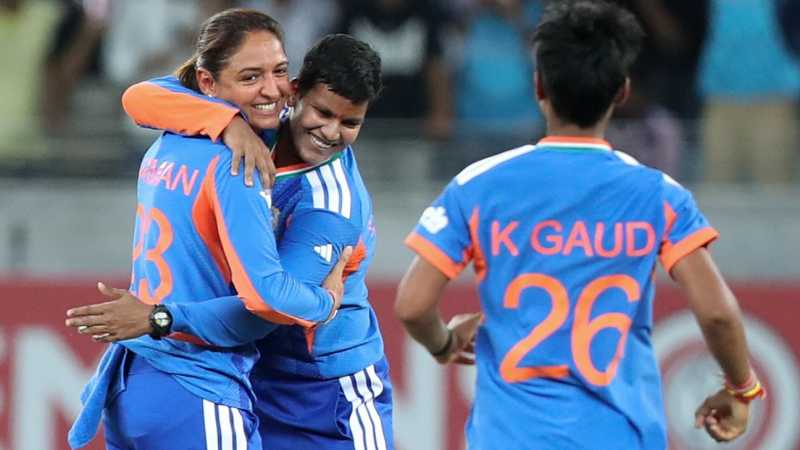
Pakistan were bowled out for 55, their lowest total in T20I cricke. A collapse where they lost six wickets for eight runs in 29 balls set them so far back that they couldn’t even bat out 20 overs. Harmanpreet Kaur, who broke new ground by becoming the first player – male or female – to lead her team 150 times in T20Is, had the time of her life celebrating each wicket and eventually scoring the winning runs as well.
Shree Charani shines
Old-fashioned left-arm spin is having a resurgence. India men have found Manav Suthar. India women already had N Shree Charanin. The No. 1-ranked T20I bowler in the world picked up two wickets in her first over on Saturday.
The flight on the ball drew Gull Feroza out of her crease. The drift in had her looking leg side. The dip and the turn resulted in a leading edge and a simple catch to point. The bowler did everything right. The batter did everything wrong. Shawaal Zulfiqar was the only Pakistan batter to put any kind of pressure on India. Charani had her lbw for 14 off 14 and from there it was a procession.
Pakistan’s batting troubles
Playing their 200th T20I, Pakistan went from 27 for 0 to 35 for 6 before the innings was halfway done. They could not find a risk-free way to score runs, absorbing long periods of dot balls and trying to get out of it by playing low-percentage shots, often against the turn, on a Dubai pitch that was offering plenty of it. Only the openers got to double digits and only Zulfiqar was able to score a run a ball.
Rawat’s support act
Prema Rawat finished with figures of 4-0-9-3. Nineteen of her 24 balls were dots. All of that is remarkable considering she is a legspinner, whose release points tend to be just shy of the perpendicular. Like Shane Warne. From there, they turn their wrist over and it can either be awesome or awful. Rawat’s release point is perpendicular, maybe even beyond it, like Rashid Khan’s. And she doesn’t turn her wrist. For the most part, she just flicks the ball out the front of her hand. This gives her better control at the cost of big turn and in T20Is, that trade-off is well worth it. Nobody could hit Rawat off her line and length and when Sadaf Shamas tried, she got bowled off her pads.
A simple enough chase
Scores:
India Women 57 for 3 in 8.4 overs (Shafali Verma 12, Harmanpreet Kaur 18*, Deepti Sharma 12*; Fatima Sana 3-17) beat Pakistan Women in 18.1 overs 55 (Muneesha Ali 13, Shawal Zulfiqar 14, Shafali Verma 1-10, Shree Charani 3-07, Deepti Sharma 2-05, Prema Rawat 3-09) by seven wickets
(Cricinfo)
Latest News
Sun directly overhead Bentota, Thiniyawala, Iththakanda, Udawalawe, and Kataragama about 12.08 noon t9day (06)

The sun is going to be directly over the latitudes of Sri Lanka from 28th of August to 07th of September due to its apparent southward relative motion.
The nearest places of Sri Lanka over which the sun is
overhead today (06) are Bentota, Thiniyawala, Iththakanda, Udawalawe, and Kataragama about 12.08 noon

Rumesh Tharanga created history in emphatic fashion, winning the men’s javelin at the Diamond League Final in Brussels to become the country’s first Diamond League champion.
The recently crowned Commonwealth champion sealed the prestigious Diamond Trophy with a superb third-round throw of 89.04 metres, producing yet another major performance on the biggest stage.
Tharanga became the first Sri Lakan to win a top position at a global competition conducted under the auspice of World Athletics.
The victory also extended Tharanga’s extraordinary run of form, giving him his 12th victory in his last 13 competitions. His only defeat during that sequence came earlier in the season, underlining the consistency that has made him one of the outstanding performers in world javelin this year.
Tharanga’s winning effort was enough to keep a determined international field at bay, with Poland’s Dawid Wegner producing a lifetime best of 87.47m to take the silver medal. Trinidad and Tobago’s Keshorn Walcott completed the podium in third place.

Shree Charani, Prema Rawat spin Pakistan out for 55 in one-sided contest

Sun directly overhead Bentota, Thiniyawala, Iththakanda, Udawalawe, and Kataragama about 12.08 noon t9day (06)

Showers above 75 mm are likely at some places in the Uva and Eastern provinces.

Tharanga creates history with Diamond League crown in Brussels

UN welcomes Lanka’s anti-graft drive, seeks end to impunity

Dispute which triggered listed company director being detained at BIA resolved

‘Dates have the highest sugar content to fight Coronavirus’

Sunday Island 27 December – Headlines

#SundayIsland 17th December – Headlines

Sunday Island – 28th March

Sunday Island Headlines – 21 March

Sunday Island – 21st February – Headlines
-

 Features6 days ago
When Sri Lankan stories find their own voice
-

 News6 days ago
BASL takes exception to Justice Ganepola being denied a place in SC
-

 News3 days ago
Denied of promotion to SC despite vacancies, justice Gurusinghe retires
-

 Latest News4 days ago
Grade 5 scholarship exam results released
-

 News3 days ago
22A: SC urged to suspend hearing, appoint full bench
-

 Midweek Review4 days ago
The local and global dynamics of Sri Lanka’s 22nd Amendment
-

 News4 days ago
Ai-CHA expands Lankan footprint with new Negombo outlet
-

 Business6 days ago
ADB-funded Thalaiyadi plant serves as blueprint for vulnerable dry zones in Sri Lanka