
News
Prez poll 2024: Sharply divided SLFP pulling in different directions


By Shamindra Ferdinando
Jaffna District SLFP parliamentarian Angajan Ramanathan yesterday (06) said that he would decide whom to support at the forthcoming presidential election depending on the response of independent candidate Ranil Wickremesinghe and SJB leader Sajith Premadasa to his proposals.
Lawmaker Ramanathan said so when The Island asked him what he would do as the solitary SLFPer elected under the hand symbol at the last general election held in August 2020.
Acknowledging that the 13 SLFPers who had been elected and appointed on the SLPP National List were divided over the party’s stance at the presidential poll, MP Ramanathan said that he recently handed over a set of proposals, based on aspirations of those living in the Jaffna electorate, to President Ranil Wickremesinghe.
MP Ramanathan said: “President Wickremesinghe, during his visit to Jaffna late last week visited my political office there. People’s proposals were handed over to him. The President responded positively. I’ll be handing over the same set of proposals to SJB leader today.”
Responding to another question, MP Ramanathan said that he wouldn’t discuss their proposals with other Jaffna-based political parties. “I have no intention to do so,” the Deputy Chairperson of Committees said.
Having unsuccessfully contested Jaffna on the UPFA ticket at the 2010 and 2015 general elections, Ramanathan first entered Parliament in 2015 on the UPFA National List. Ramanathan switched his allegiance to Maithripala Sirisena’s SLFP at the 2020 general election.
Meanwhile, a section of the SLFP led by General Secretary of the Party Dayasiri Jayasekera following lengthy deliberations has decided to back SJB leader Sajith Premadasa’s candidature at the presidential election.
The SLFP and SJB will finalize their agreement at the Waters Edge today (07). General Secretary of the UPFA Thilanga Sumathipala, too, has pledged his support to this endeavour.
Lawmaker Jayasekera told The Island that it would be a grave blunder on the part of those who enjoy ministerial perks to believe the voters would follow them.
Acknowledging that of the 14-member parliamentary group, the majority backed President Wickremesinghe’s candidature, the former Yahapalana Minister said those who voted for them wouldn’t be swayed and the party was confident of their continuous support.
MP Jayasekera pointed out that the SLPP secured a staggering 145 seats at the last general election, with the backing of the SLFP. Unfortunately, that party quite conveniently had forgottten the SLFP’s contribution and acted in such a brazen manner much to the disappointment of those who expected a genuine change.
“We are at crossroads,” MP Jayasekera said, urging the electorate to be mindful of President Wickremesinghe’s machinations. Whatever Wickremesinghe’s ministers say, voters should be aware of the danger in case the UNP leader won the election with the backing of an utterly corrupt section of the ruling party.
One-time SLFP Chairman and ex-General Secretary as well as current Senior Vice President Prof. Rohana Lakshman said that the party followed, what he called, a proper consultation process before reaching consensus on Premadasa’s candidature.
Prof. Lakshman said that he didn’t want to support Wijeyadasa Rajapakshe though the former leader Sirisena did so. “We had no option but to take a decision in the wake of the Election Commission declaring the date of the presidential election,” Prof. Lakshman said.
Asked whether the party considered fielding its own candidate after legal challenge against their original choice the then Justice Minister Rajapakshe, Prof. Lakshman said that they felt such a move as unrealistic due to post-Aragalaya realignment of political parties.
Both MP Jayasekera and Prof. Lakshman said that President Wickremesinghe, backed by the SLPP, posed a massive threat to the democratic system. Their project should be thwarted at any cost, they declared, urging the voters to rally around the SJB candidate.
Prof. Lakshman said that those who betrayed the party for ministerial portfolios and other perks and privileges squandered a golden opportunity to present a united face to the electorate. The bottom line is they treacherously held onto positions at the expense of the party, thereby undermined the very principles of the party, Prof. Lakshman said.


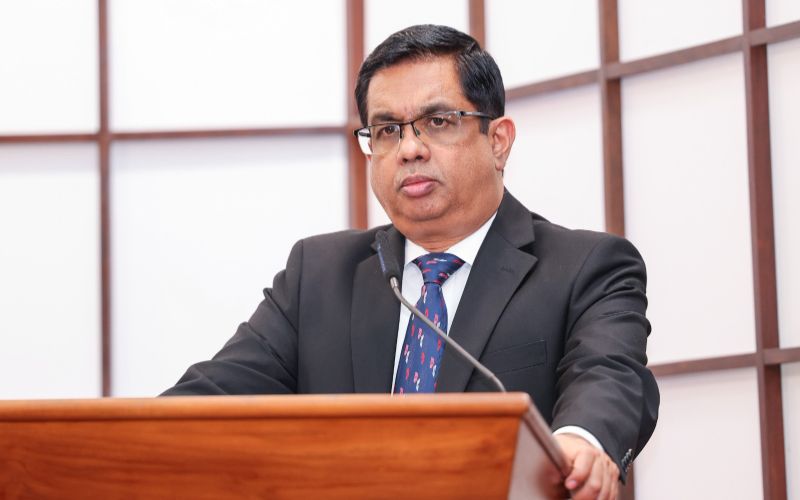
The Memorandum of Understanding (MoU) relating to the project to provide technological solutions to prevent wild elephants from being hit by trains was signed yesterday (01) afternoon at the President’s Media Centre, under the patronage of Secretary to the President Dr Nandika Sanath Kumanayake.
Coordinated through the “Clean Sri Lanka” programme, the project is being implemented as a public-private partnership, with the Railway Department, the Department of Wildlife Conservation and the Forest Conservation Department working together, with full financial support from People’s Bank.
The system consists of three-beam detection, passive infrared (PIR) sensors, automatic temperature sensors and a tamper alarm system to detect animals weighing more than 20 kilogrammes and unauthorised interference. Signal lights (red/yellow/green) installed on either side of the railway tracks, together with a special screen installed inside the locomotive cab, will alert the driver in advance to the exact location of an elephant.
A demonstration test of the system was successfully conducted at the Pinnawala Elephant Orphanage premises in the presence of the relevant officials, following which a report on the system was prepared.
The system will be implemented as a pilot project from next month at 13 locations where wild elephant accidents are frequent. A newly developed website is also scheduled to be launched to enable the progress of the project to be viewed live.
Additional General Manager of Railways P.D.S.B. Chandrasena, Director General of Wildlife Conservation M.S.L.R.P. Marasinghe, Conservator General of Forests S.C. Palamakuumbura and Chairman of People’s Bank Chandana Guniyangoda signed the relevant MoU. Officials from the Clean Sri Lanka Secretariat, including Presidential Additional Secretary (Clean Sri Lanka) Engineer S.P.C. Sugeeshwara, as well as senior officials from the Railway Department, Department of Wildlife Conservation, Forest Conservation Department and People’s Bank, were also present.
[President’s Media Division]

The Commissioner General of Examinations has announced that the results of the 2026 Grade 5 Scholarship Examination have been released online, and can be viewed on the department’s official website: www.doenets.lk

Prime Minister Dr. Harini Amarasuriya departed Sri Lanka on Monday, 31 August, to undertake an official visit to Bhutan to participate in the Global Conscious Food Systems Summit, scheduled to be held in Bhutan.
During her visit, Prime Minister Dr Amarasuriya participated in the opening plenary of the Summit on 1 September, where she delivered a keynote address under the theme “Rising to the Moment: Igniting Consciousness to Address the Polycrisis.”
The Prime Minister will also engage in discussions with international leaders and representatives on strengthening cooperation towards sustainable food systems, food security and resilient communities.

[Prime Minister’s Media Division]

MoU signed for technology to prevent wild elephant-train collisions

Grade 5 scholarship exam results released

Prime Minister participates in Global Conscious Food Systems Summit in Bhutan

Bouchier century sets England up for record 282-run chase against Ireland

Muneeba, Pakistan’s spinners knock Thailand out of Asia Cup

Showers will occur in the Western and Sabaragamuwa provinces and in Galle, Matara, Kandy and Nuwara-Eliya districts

‘Dates have the highest sugar content to fight Coronavirus’

Sunday Island 27 December – Headlines

#SundayIsland 17th December – Headlines

Sunday Island – 28th March

Sunday Island Headlines – 21 March

Sunday Island – 21st February – Headlines
-

 News6 days ago
Eight politicians in drug kingpin probe
-

 Features4 days ago
“Wrap Me Up in My Blazer”— A Gentlemanly Bradby Reminiscence
-

 Business6 days ago
Sri Lanka opens up: A new season of direct connectivity
-

 Features6 days ago
Redefining ageing in Sri Lanka
-
 Latest News6 days ago
Nepal-Tibet floods: What happened, what caused them and who is missing?
-

 Features3 days ago
When Sri Lankan stories find their own voice
-

 Editorial7 days ago
Unfolding El Niño and burning issues
-

 Editorial6 days ago
The toxic legacy of two lakes