
Latest News
War heroes and dependents are being cared for by Defence Ministry- General Kamal Gunaratne (Rtd)

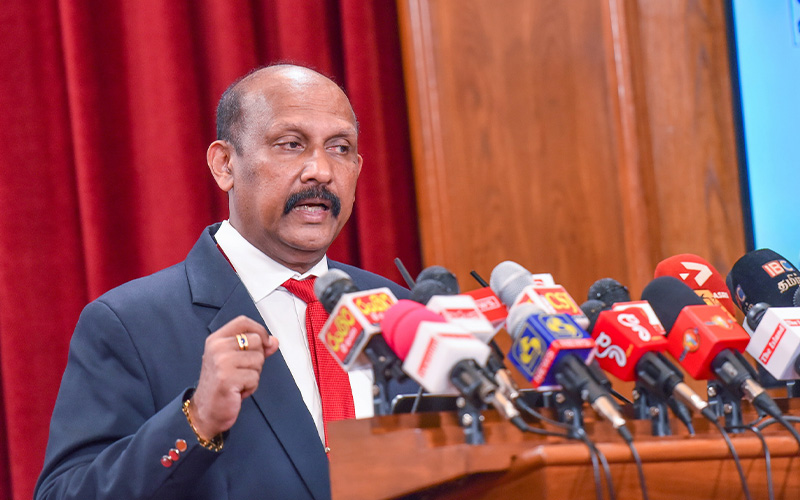
Secretary to the Ministry of Defence General Kamal Gunaratne (Rtd) announced that the Ministry of Defence has implemented several measures, including allowances, medical rehabilitation, and lifelong care, to ensure justice for all soldiers disabled during the war. He highlighted that over the past two years, the Ministry of Defence has taken numerous steps to stabilize the country both economically and politically, providing a safe and secure environment for the people.
General (retired) Kamal Gunaratne made these statements at a news conference titled ‘Two Years of Progress and Way Forward’. He emphasized that the Ministry of Defence, guided by the vision of ‘a peaceful land where everyone is protected,’ has been instrumental in these advancements.
Addressing the media briefing Gen. Gunaratne said,
“It must be noted that the Ministry of Defence plays a leading role in preventing human trafficking and illegal drug trafficking. The three armed forces, including the Navy, have been pivotal in combating the drug menace, which has received significant attention recently, through the arrest of drug traffickers and the seizure of narcotics.
In 2023 alone, the tri-forces operations resulted in the seizure of nearly 560 kg of heroin, 3350 kg of cannabis, 5220 kg of Kerala cannabis, 60 kg of crystal methamphetamine, 151,000 drug capsules, and 6650 litres of illicit liquor. By July 2024, approximately 270 kg of heroin, 3640 kg of cannabis, 12,720 kg of Kerala cannabis, 150 kg of crystal methamphetamine, 43,600 drug capsules, and 5000 litres of illicit liquor had been seized.
The contribution of the armed forces in ending the Thirty Year War remains unforgettable. In addition to honouring the fallen war heroes, we must protect those who survived but were injured. Among the 60,000 war heroes wounded in the war, approximately 10,000 are bed-ridden or confined to wheelchairs. Rehabilitation centres have been established in Attidiya, Anuradhapura, Kamburupitiya, and Kurunegala to provide medical rehabilitation and lifelong care for these war heroes.
Additionally, the dependents of military personnel who died before the age of 55 while serving the country, as well as those who retired due to medical reasons, will receive a fixed monthly allowance equivalent to the salary and allowances those individuals were receiving while they were alive. This measure ensures that justice is served for all soldiers disabled during the war.
Rakna Arakshaka Lanka Ltd has provided re-employment opportunities to over 3,000 soldiers retiring from military service. Given the current situation in the Red Sea, there is now an opportunity to deploy 550 Sea Marshals, and recruitment for these positions is currently underway.
Furthermore, the quality of educational facilities at Sir John Kotelawala Defence University has been significantly enhanced, allowing more students to pursue their education. The recruitment of civilian medical students has also commenced. It is noteworthy that more than 1,000 out-patients receive free treatment daily at the Kotelawala Defence University Hospital, which was established for the clinical training of medical students.
It must be noted that the recruitment of medical students to Sir John Kotelawala Defence University is conducted solely on the basis of the Z score recommended by the University Grants Commission, and only highly skilled, professional, and accomplished professors have been appointed as lecturers.
I would also like to mention that since 2012 to date 286 foreign students have been enrolled at Sir John Kotelawala Defence University due to its high standard of education.
Additionally, the United Nations has made the necessary arrangements to resume the peacekeeping missions that had been suspended. So far, a contingent of 301 troops has been deployed for peacekeeping duties in Lebanon, South Sudan, and the Central African Republic.
Furthermore, the National Task Force Against Human Trafficking operates under my chairmanship. This task force has taken all necessary steps to combat human trafficking in Sri Lanka, enabling the country to maintain the US State Department’s Tier 2 status for three consecutive years.
Furthermore, measures have been taken to address the issue of Sri Lankans being forcibly held in Myanmar and exploited in online scams. Our focus has been on rescuing these individuals, which has recently gained significant attention. Consequently, we successfully rescued 40 individuals and brought them back to Sri Lanka. However, another group of people has travelled to this area through brokers in Dubai, and 54 more individuals remain to be rescued.
In this regard, I have discussed the matter with the Prime Minister and the National Defence Secretary of Myanmar. Diplomatic requests and appeals were made, both officially and as a former military officer, to secure their release. The Defence Secretary of Myanmar has informed me that the Prime Minister has advised to intervene and take all necessary steps to address this issue.
Additionally, there is a concern regarding former military personnel caught in the Ukraine-Russia conflict. We are collaborating with the Ministry of Defence of Russia on this matter. We have also requested the Russian Embassy to notify the Ministry of Defence if any ex-military personnel have applied for tourist visas to Russia.
In addition to this, the Ministry of Defence also oversees disaster management activities in the country. The National Building Research Organization (NBRO) serves as the National Centre for Landslide Risk Management under the Disaster Management Division of the Ministry of Defence. Currently, NBRO is identifying and monitoring landslide-prone areas in Sri Lanka, issuing early warnings, and conducting mitigation activities. The “Landslide Risk Reduction through Stabilization Techniques” project, implemented by NBRO with financial support from the Asian Infrastructure Investment Bank (AIIB), is working on stabilizing 128 landslide sites. So far, stabilization has been completed at 46 of these sites.
Furthermore, the three armed forces are providing labour for various religious shrines and school renovations across the country upon request and will continue to do so in the future. They are also actively involved in disaster response, including immediate actions to reduce the impact of natural disasters, rescuing affected individuals, providing relief, preparing for disaster situations, implementing mitigation strategies, and resettling displaced persons. They identify vulnerable areas and evacuate people to minimise loss of life, though property damage.
Meanwhile, at the request of the Ministry of Health, the Army is providing labour for the construction of a ten-storey building at Matara Hospital, and the Navy is contributing labour for the construction of a ten-storey building at the Lady Ridgeway Children’s Hospital. Additionally, the six-storey building of the Maharagama Apeksha Hospital, constructed with the labour contribution of the Air Force, is almost complete and is scheduled to be commissioned next week.
Deputy Vice-Chancellor of Sir John Kotelawala Defence University, Major General C.A. Wickramasinghe, Defence Ministry Senior Assistant Secretary A.M.C.W.P. Abeykoon, and several other officials participated in this event.

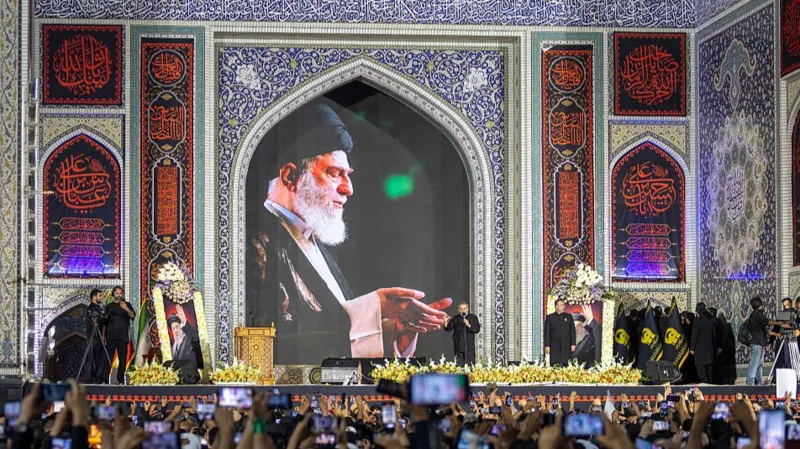
The US and Iran again traded strikes in exchanges that continued into Thursday, as observers reported a “dramatic” drop in the number of ships travelling through the Strait of Hormuz.
The US says it hit 90 military targets, some near the Strait. Iran says 14 people have been killed in the past two days.
State media also reported that targets near the Bushehr nuclear power plant were hit, citing the deputy governor of the province. The US has not commented on the latest strikes.
Iran said it targeted US assets in Kuwait, Bahrain and Qatar in response. Later on Thursday, Tehran launched more strikes on sites in Kuwait, Jordan and Iraq, state-linked media reported.
Separately, huge crowds gathered as Iran’s late supreme leader, Ayatollah Ali Khamenei, was buried after six days of funeral events.
Crowds massed on the streets of Mashhad in north-eastern Iran waving Iranian flags, while some were pictured holding signs carrying death threats directed at US President Donald Trump.
Khamenei was killed on 28 February during the first hours of US and Israeli strikes against Iran.
Iran’s foreign ministry denounced the latest US strikes as a “grave war crime”, describing the US administration as “evil and psychopathic”
Bridges and a railway route connecting Tehran to the city of Mashhad, where the late supreme leader’s funeral is being held, were also damaged, the foreign ministry said.
Iran’s health ministry said 14 people had been killed and 78 people injured across five provinces.
Gulf nations reported Iranian attacks following the US strikes, with explosions in Bahrain’s capital Manama, Kuwait intercepting missiles and drones, and Qatar issuing a security alert.
Later on Thursday, explosions were heard in Iran’s southern port of Konarak, with a local official telling Iran’s official news agency a navy site was attacked by an “enemy”.
However a US defence official told the BBC it had not carried out any strikes in Iran in recent hours.
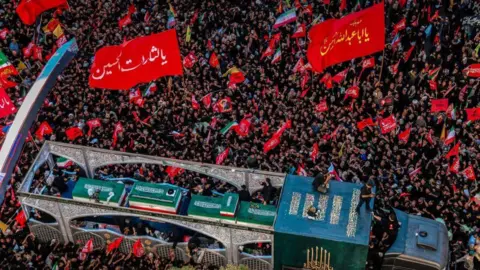
The funeral of Iran’s late supreme leader Ali Khamenei is being held in the city of Mashhad [BBC]
Iran’s parliamentary speaker Mohammad Bagher Ghalibaf, who is also the country’s chief negotiator with the US, said on X that America “still hasn’t learned that bullying and breaking promises are no longer cost-free”.
“Let me put it plainly: if you strike, you’ll get hit,” he wrote, adding that the Strait of Hormuz will only open under Iranian arrangements – not “American threats”.
US Central Command (Centcom) said the most recent round of strikes was carried out to “further degrade Iran’s ability to attack commercial shipping and innocent civilian mariners” in the vital waterway.
In a statement, it said it had struck 90 Iranian military targets, which included air defense systems and military logistics infrastructure along Iran’s coastline.
“The latest strikes follow successful execution of offensive strikes in Iran the night before,” Centcom added.
Phil Belcher, marine director at Intertanko, an international organisation for independent tanker owners, said the number of ships travelling through the Strait via the southern route closer to Oman was now in “single figures” following the step up in hostilities.
Belcher added that the overall daily figure of about 30 ships was down from about 70 a week ago and well below the normal number of 130 ships that was seen before the Iran war began earlier this year.
He told BBC Radio 4’s Today programme that there had been an “exuberance of optimism” around shipping in the region following the signing of the SMemorandum Of Understanding between Iran and the US last month, but now the mood has changed.
“This cycle of violence, this cycle of up-and-down, positive-negative news, it’s having an enormous impact both on business and on the seafarers themselves,” he said.
On Wednesday night Iranian state TV reported eight explosions in Bandar Abbas, and said two missiles had hit the ports of both Sirik and Jask – also in southern Iran.
It added that two projectiles had hit the island of Abu Musa, which has been the subject of a longstanding ownership dispute between Iran and the United Arab Emirates.
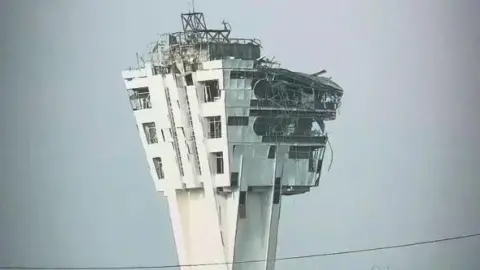
The extent of damage from the US strikes is not yet known, but Iranian media have reported power cuts in Chabahar and a fire at an Islamic Revolutionary Guard Corps (IRGC) barracks in Bushehr. Images on social media showed damage to a marine control tower in Chabahar.
Earlier on Wednesday, Centcom wrote in a statement that it held Iran accountable for “recent unjustified aggression against commercial shipping and civilian crews freely navigating a vital international waterway.”
President Trump said late on Wednesday that Iran had “called a little while ago” and wanted to make a deal “so badly”.
Trump added: “I just don’t know if they’re worthy of making a deal – I don’t know that they’re going to honour the deal, that’s the problem.”
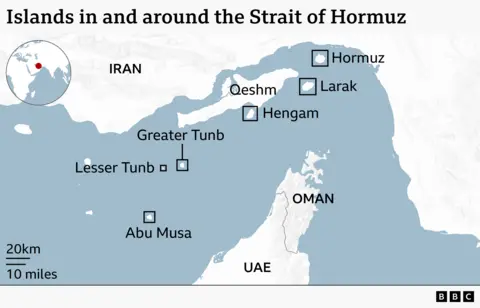
The current flare up has been the worst exchange of strikes between the US and Iran since the deal – known as a memorandum of understanding (MoU) – was signed on 17 June.
Trump said the ceasefire agreement signed last month with Iran was now “over”. He told reporters: “I don’t want to deal with them anymore, they’re scum. You know what scum is? They’re scum. They’re sick people.”
In response, Iran’s Foreign Minister Abbas Araghchi said in a post on X: “We do not answer vulgarity with vulgarity, but with action: fearlessly and with great valour.”
The deal between the US and Iran included 14 points, among them a 60-day period for a ceasefire during which negotiations should continue, the safe passage of vessels through the Strait of Hormuz and the US lifting sanctions on Iran.
The 60-day period for negotiations is not yet up, but Trump said he saw further talks as “a waste of time”.
[BBC]
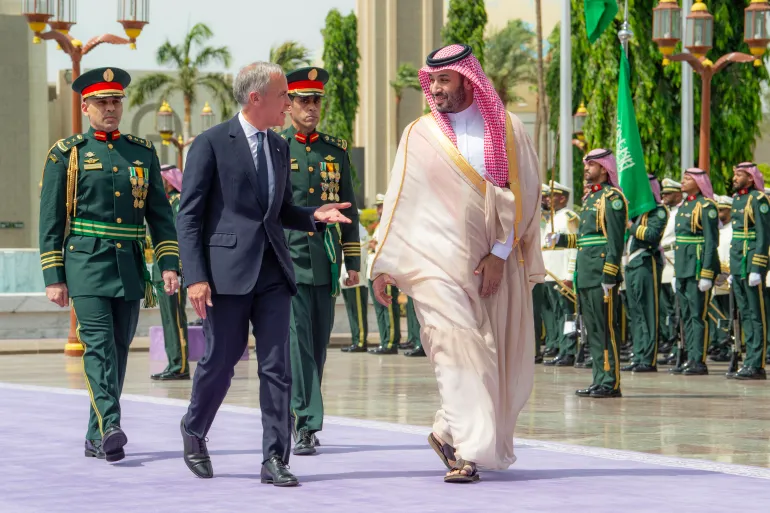
Canadian Prime Minister Mark Carney paid a visit to Saudi Arabia, marking the first state visit in more than a quarter-century as Ottawa and Riyadh explore deeper mining and energy ties.
Carney visited on Thursday, on the heels of the NATO summit in Turkiye, doubling down on calls to diversify trade relationships as United States President Donald Trump imposed tariffs that have weighed on the Canadian economy. The visit included agreements covering mining, energy and artificial intelligence, which Carney’s office said would be finalised next year.
The two countries signed 13 new agreements and memorandums of understanding (MoUs) covering areas including health and defence. The agreements are worth $1bn. Among the deals are agreements that would help Canadian companies develop mining and clean energy projects in Saudi Arabia.
During his visit, Carney also met with Amin Nasser, head of state oil giant Saudi Aramco. On energy, Carney’s office said the two countries are working together on agreements related to liquefied natural gas, hydrogen and carbon capture and storage.
Carney’s office also said he would lead “a delegation of Canada’s pension funds” as part of efforts to invest in Saudi Arabia’s energy and AI sectors.
In talks with Saudi Crown Prince Mohammed bin Salman, Carney signed agreements aimed at expanding several key partnerships between the two nations following years of strained relations under former Prime Minister Justin Trudeau.
Trudeau, Carney’s predecessor, had been critical of Saudi Arabia’s treatment of human rights activists, including Saudi writer Raif Badawi and his sister, Samar. In response, Saudi Arabia expelled the Canadian ambassador and cut trade and investment ties in 2018.
Ottawa and Riyadh began restoring diplomatic ties in 2023.
Carney was asked by reporters about the decision to re-engage with Saudi Arabia, to which he responded:
“Engaging with the country doesn’t mean that we agree with everything that a country is doing.”
“We are actively engaging with key partners around the world,” Carney said.
“Lecturing countries from afar is an ineffective strategy. It’s satisfying, but it’s ineffective.”
Carney was also asked about ongoing negotiations with the United States. Reporters pressed him on whether there had been any progress in trade negotiations with Trump amid tensions surrounding the North American Free Trade Agreement. “I’ll keep you posted,” Carney said.
[Aljazeera]

Kylian Mbappe and Ousmane Dembele were on target as France surged past Morocco 2-0 to book their place in the World Cup semifinals.
Mbappe curled in his eighth goal of the tournament on 60 minutes on Thursday before Dembele doubled Les Bleus’ lead six minutes later to settle a clinical victory at the Gillette Stadium outside Boston.
The win sends the 2018 champions into a last-four showdown against either Spain or Belgium in Arlington, Texas on Tuesday.
African champions Morocco had been tipped to pose a serious threat to France’s hopes of reaching a third consecutive World Cup final.
But Didier Deschamps’ men were always in control against a limited Morocco side who failed to register a single shot on goal until an 83rd-minute free-kick by Azzedine Ounahi was parried away by France goalkeeper Mike Maignan.
France, though, struggled to find a breakthrough, and missed the opportunity to take the lead on 28 minutes when Mbappe saw a penalty saved by Morocco goalkeeper Yassine Bounou.
Mbappe had won the penalty after being brought down by Noussair Mazraoui but was forced to wait several minutes before being allowed to take the kick after a protracted VAR check.
Morocco managed to hold out to half-time, but it was always only a matter of time before France’s relentless pressure paid off.
The breakthrough came on the hour mark, with Mbappe bending a brilliant right-foot shot past Bounou from the edge of the area.
Paris Saint-Germain star Dembele made the game safe in the 66th minute, striding forward menacingly from midfield before steering a low finish into the bottom corner.
France now await the winner of Friday’s quarterfinal in Los Angeles between European champions Spain and Belgium.
[Aljazeera]

Tensions erupt in Indian state after 11-year-old raped and murdered

US and Iran trade attacks as Khamenei is buried

Several spells of showers will occur in the Western, Sabaragamuwa and North-western provinces and in Galle, Matara, Kandy and Nuwara-Eliya districts

Canadian PM visits Saudi Arabia to strengthen energy, mining partnerships

Mbappe and Dembele net as France beat Morocco to reach World Cup semifinal

Sallay’s wife further complains to HRC over continuing violation of husband’s FRs by CID

‘Dates have the highest sugar content to fight Coronavirus’

Sunday Island 27 December – Headlines

#SundayIsland 17th December – Headlines

Sunday Island – 28th March

Sunday Island Headlines – 21 March

Sunday Island – 21st February – Headlines
-

 News5 days ago
Singapore-based Buddhist monk marks nearly four decades of humanitarian service
-

 News6 days ago
Freedom 250: US Embassy celebrates America’s 250th Independence Day through magic of American cinema
-

 News4 days ago
AI concerned over proposed SL military deployment in Haiti
-
 News7 days ago
UNEP support pledged to strengthen Sri Lanka’s Environmental Priorities
-

 Midweek Review2 days ago
Unexpected focus on ‘pieces of tin’ worn by military men
-

 Features5 days ago
The NPP’s New Challenge: Balancing Easter Lawfare and Economic Welfare
-
 Latest News3 days ago
Nyamhuri and Ngarava stun Bangladesh by defending 141
-

 Latest News6 days ago
Ukrainian suspect hunted by police after Monaco bomb attack was ‘disguised as a man’