
Editorial
Kleptocrats and file trick


Wednesday 24th July, 2024
No Sri Lankan election is complete without the so-called file trick (the act of displaying dossiers which are said to contain information about persons allegedly involved in corruption). The JVP/NPP claims to have slews of such files.
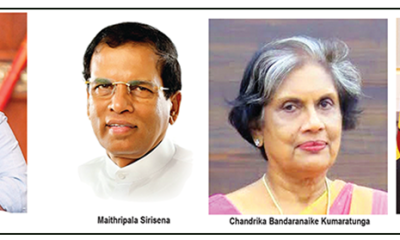
In the run-up to the 2015 presidential election, the then President Mahinda Rajapaksa claimed to have several files on his archrival, Maithripala Sirisena, and the latter pledged to throw the Rajapaksas behind bars for their corrupt deals and abuse of power and set up an anti-corruption secretariat and a special police unit for that purpose. Sirisena won the presidency but nobody was sent to jail, and three years later he and the Rajapaksas kissed and made up. So much for the files on corruption!
JVP/NPP leader Anura Kumara Dissanayake has recently claimed that Ranil Wickremesinghe, as the Prime Minister, caused the Yahapalana government’s anti-corruption drive to wither on the vine after two prominent UNPers had been found to be involved in corrupt deals. Why did he wait so long to reveal that to the public? Why did the JVP prop up the UNP-led Yahapalana administration with such corrupt elements in its ranks?
Dissanayake said, in Japan, of all places, the other day, that he had two ‘files’ on President Wickremesinghe himself. Why doesn’t he reveal to the public what is in those files ahead of the upcoming presidential election? It is high time he did so. If the UNP is confident that the JVP is propagating a lie to discredit Wickremesinghe, why doesn’t it dare Dissanayake to disclose what is in those files?
President Wickremesinghe has reportedly said the anti-corruption secretariat had 400 files but legal action was initiated only in respect of 40 of them; the files the JVP was displaying were ‘empty’. The original files were with him and the JVP had only copies of them, he has said. Has he opted not to reveal information contained in those ‘original files’ because he is dependent on the corrupt in the SLPP to retain his hold on power?
Was it information in those original dossiers that prompted Wickremesinghe to make so bold as to vilify Mahinda Rajapaksa in Parliament about six years ago? One may recall that in 2018, the then UNP MPs burst into a noisy protest with Prime Minister Wickremesinghe himself asking, “Kauda hora (who is the thief)?” and others chanting in chorus, “Mahinda hora (thief).” Not to be outdone, the dissident UPFA MPs belonging to what was called the Joint Opposition invaded the Well of the House, with one of them asking, “Kauda hora?”, and the other Rajapaksa loyalists shouting, “Ranil hora.” (Videos of these protests are available on the Internet.) Today, Ranil and Mahinda are savouring power, together, and their acolytes are in the government and the Opposition.
While Dissanayake is travelling around the world, promising to bring those who have amassed ill-gotten wealth to justice, under a JVP/NPP government, Sunil Handunnetti, described as the shadow Finance Minister of the JVP-led alliance has revealed a plan to launch a programme to attract funds from the public including those that have gone unaccounted for, in case the JVP/NPP forming a government. The government and the SJB have accused the JVP/NPP of planning to facilitate money laundering with state assistance while promising to trace and confiscate all illegal assets. If the JVP/NPP is planning to do what Handunnetti says, then of what use will the files that Dissanayake claims to have in his possession be?
Dissanayake and Wickremesinghe, we repeat, ought to disclose information about corruption in the files they claim to have. Let them be asked to fish or cut bait.



Friday 29th May, 2026
How long the Provincial Councils (PCs) will remain unelected is anybody’s guess. All of them are currently under the provincial Governors appointed by the President. There have been five Presidents and four governments since the conclusion of the last PC elections held on a staggered basis between 2012 and 2014. The JVP-NPP government is under increasing pressure to hold the much-delayed PC polls. The NPP’s National Policy Framework, A Thriving Nation: A Beautiful Life, promises to hold the PC elections within one year of forming a government. But the government is now wary of holding elections because its performance at last year’s local LG polls fell below its expectations just seven months after its spectacular win at the 2024 general election.
The Opposition has sought to capitalise on what is described as the government’s fear of elections. It is cranking up pressure on the JVP/NPP to stop trotting out lame excuses and hold the PC elections.
JVP General Secretary Tilvin Silva caused quite a stir the other day by declaring that funds allocated by Budget 2026 for the PC elections had been spent on disaster relief and therefore PC elections could not be held this year. The Opposition and Election monitors lashed out at the government for its efforts to postpone the PC polls on some flimsy pretext. The NPP politicians have since claimed there are funds for elections but stopped short of specifying when the PC polls will be held.
Now, the Election Commission says it is ready to conduct the PC polls soon if Parliament passes a law, enabling it to do so under the PR system instead of the Mixed Proportional system. The Treasury says it is ready to release funds. The Opposition says it is ready to face an election, but the JVP/NPP is not ready. It is unbecoming of a government that flaunts its two-thirds majority in Parliament to postpone elections.
Ironically, the Opposition political parties that castigate the JVP-NPP government for delaying the PC polls helped the UNP-led Yahapalana government amend the Provincial Council Elections Act in a deplorable manner and postpone the PC polls indefinitely. The JVP fully backed the Yahapalana administration, which avoided an election in 2017 for fear of suffering a midterm electoral defeat.
At a Joint Opposition media briefing on Wednesday, the UNP proposed that all Opposition parties close ranks and form a common electoral front to defeat the government in the next PC polls. That strategy has worked in the cooperative society elections, where the Opposition turned the tables on the government in many areas. Those contests serve as electoral weather vanes, indicating the direction of political winds. Opposition parties have gained control of many cooperative societies by preventing a split in the anti-government vote. That is no mean achievement for the Opposition.
However, the dynamics of contests and voting patterns do not remain constant at different elections, and therefore the question is how advisable it is to extrapolate a trend from the cooperative society elections and political alignments related to them.
The difficulty of bringing Opposition parties under one banner became evident on Wednesday itself. The SJB and the SLPP were not represented at the Opposition media briefing, according to press reports. It may be too early to say whether they, too, will join the grand Opposition alliance in the offing, but bringing a diverse group of politicians together to contest elections is a Herculean task.
Electoral alliances, formed by strange bedfellows with competing ambitions and espousing different ideologies are fissiparous and fragile. They tend to collapse even after being elected to power, plunging political institutions into chaos. History is full of such instances. The fate that befell the so-called National Unity government, or the Yahapalana administration, as it was popularly known, is a case in point. Three years into office, the uneasy alliance between the UNP and the SLFP collapsed, rendering that government dysfunctional to the extent of endangering national security. It is hoped that the government will muster the courage to hold the PC polls before long and that no councils will end up hung.
Thursday 28th May, 2026
The JVP-NPP government would have the public believe that the economy is resilient enough to absorb external shocks, and the rupee is stabilising. True, the rupee has staged a countertrend rally recently, but the situation is far from rosy. Anything is possible in this topsy-turvy world, with US President Donald Trump acting whimsically. Much more therefore needs to be done to strengthen the rupee. This requires a truly national effort. Sadly, the government and the Opposition are at daggers drawn, and do not see eye to eye even on crucial economic issues.
Opposition politicians parade their supposed knowledge of economic affairs in Parliament, which is full of backseat drivers who claim to know the way but cannot drive. They keep on telling the public what they think is wrong with the economy. There is absolutely no need for them to do so, for the country’s economic problems and their root causes are all too well known. What the public wants to know is how the Opposition proposes to solve them.
Interestingly, the SLPP, which mismanaged the economy and bankrupted the country, is also critical of the incumbent government’s economic performance. Its leaders are lecturing the government on how to run the economy. What it is doing is like a bankrupt businessman conducting lectures on business management.
While out of power, the JVP/NPP also lectured previous governments on how to manage the economy. Its leaders would even brag that raising funds to settle the country’s external debt was child’s play, but now they are struggling to increase the forex inflow and navigate a host of other economic issues. Some of them even claimed they would be able to build the country’s foreign currency reserves by asking their supporters residing overseas to send in dollars. Between saying and doing, many a pair of shoes is said to be worn out.
The JVP was prominent among the political parties that resisted President Ranil Wickremesinghe’s modus operandi to put the economy back on an even keel during the previous government. It also berated the IMF and pledged to renegotiate the ongoing bailout programme if voted into power. It opposed tax and tariff increases and demanded that relief be granted to the public even at the expense of the economic recovery measures. It insulted Wickremesinghe, claiming that he was too old to rule the country and derisively called him Seeya (grandpa). Today, in a strange twist of fate, the JVP-led NPP government has chosen to pursue Wickremesinghe’s economic policies (‘Seeyanomics’?). It is jacking up taxes and tariffs and curtailing state expenditure in a desperate bid to boost revenue.
President Wickremesinghe got his act together on the economic front, and made tough decisions, regardless of their political consequences, and straightened up the economy, but he could not win the last presidential election because he succumbed to the arrogance of power and blundered on the political front, shielding as he did crooks of all sorts. Other political leaders, especially President Anura Kumara Dissanayake should learn from Wickremesinghe’s experience.
The Opposition’s right to criticise the government and its policies, economic or otherwise, cannot be questioned. It must act as a countervailing force against the party in power, but it should stop playing politics with the economy and allow the government to do what needs to be done to shore up the country’s foreign currency reserves and strengthen the rupee.
A strategy to mitigate the adverse impact of external pressures on the country’s foreign currency reserves consists in curtailing the foreign exchange outflow. The need for import restrictions, etc., cannot be overstated. Governments usually fight shy of adopting such drastic yet essential measures, fearing political consequences and protests by their political rivals. Procrastination worsens crises. This is why a consensual approach is needed to resolve existential issues facing the nation.
Wednesday 27th May, 2026
The Parliamentary Select Committee (PSC) on Reviewing Election Laws, which recently had its first meeting under the chairmanship of the Minister of Public Administration, Provincial Councils and Local Government, Prof. A. H. M. H. Abayarathna, has reportedly decided to seek public views on the election law review process. Reviewing election laws as well as modernising them to reflect present-day needs is a long-felt need. The PSC deserves the fullest public cooperation.
The PSC has been tasked with reviewing election laws, including the Registration of Electors Act, the Local Authorities Elections Ordinance, the Parliamentary Elections Act, the Presidential Elections Act, as well as amendments to those laws over the years and special legislative provisions relevant to their implementation. It will also evaluate the need to revise, amend and consolidate the laws and to recommend necessary reforms and amendments to the current legal framework governing elections. It has the authority to summon any individual, order the submission of any document or report and obtain evidence either in writing or orally.
Much is being spoken these days about law’s delays and ongoing efforts to clear a massive backlog of court cases. Of equal concern are the flaws in laws, and complaints abound that they even stand in the way of effective enforcement. There is a need for a wider public discussion on these issues. However, the focus of this comment is on some glaring deficiencies in election laws and how they have adversely impacted people’s franchise, a fundamental component of representative democracy.
An unauthorised change effected to election laws has had a corrosive effect on the Constitution itself. It has enabled the political parties and their leaders to circumvent the Constitution and abuse the National List (NL) mechanism to catapult persons of their choice to Parliament. There is hardly any political party that has not benefited from it.
Article 99A of the Constitution allows the persons whose names are included in the lists submitted to the Commissioner of Elections or in any nomination paper submitted in respect of any electoral district by political parties or independent groups at elections to be appointed to Parliament via the NL. This provision led to the sordid practice of many defeated candidates entering Parliament. One may recall that UNP leader Ranil Wickremesinghe, who failed to secure enough votes at the 2020 general election to represent the people of Colombo, entered Parliament via the NL, became President and exercised control over all three tiers of government, Parliament, the provincial councils and the local government authorities. True, he was instrumental in managing the worst-ever economic crisis, and the country gained from his NL appointment, which however is the exception that proves the rule. Even incompetent persons can enter Parliament via the NL.
A UNP government did something even worse in 1988, when a general election was held under the Proportional Representation (PR) system for the first time in this country. It introduced Section 64(5) of the Parliament Elections Act, inter alia, as an urgent Bill, severely eroding the essence of the constitutional provisions pertaining to the NL and people’s franchise. Parliament Elections Act, No 1 of 1981, as amended in 1988, allows ‘any member’ of a political party to be appointed to fill an NL vacancy. This section has enabled political parties to make NL appointments, as stipulated by the Constitution, and then engineer vacancies and bring in persons of their choice as NL MPs. It is now a fait accompli because there is no legal provision for post-enactment judicial review of legislation. Worse, it has been alleged that the words, “any person” were inserted after the ratification of the amendment Bill.
It is hoped that the PSC, tasked with reviewing election laws, will care to ensure that the Parliamentary Elections Act is rid of the questionable section that adversely impacts franchise and even undermines the Constitution.
There is also a need to overhaul the Provincial Council Elections (Amendment) Act, which was stuffed with unauthorised sections at the committee stage in 2017 to pave the way for the indefinite postponement of the Provincial Council elections. What Parliament passed was a textbook Christmas Tree Bill.

Tickner five-for wraps up innings win for New Zealand

Ambidextrous spinner Shashini Gimhani in Sri Lanka’s T20 World Cup squad

Pakistan’s famous cheerleader ‘Chacha Cricket’ to retire this year

South Africa Women’s maiden tour to Zimbabwe to feature five T20Is

Navy renders assistance to bring injured fisherman ashore

Applications called to recruit 400 public officers as Digital Champions for the Public Impact Champions Network

‘Dates have the highest sugar content to fight Coronavirus’

Sunday Island 27 December – Headlines

#SundayIsland 17th December – Headlines

Sunday Island – 28th March

Sunday Island Headlines – 21 March

Sunday Island – 21st February – Headlines
-

 News6 days ago
All-New GRAVITE launches at LKR 6.99 Mn
-
 Features6 days ago
The NPP’s pivot to the past
-
 News5 days ago
Police probe underway to ascertain links between criminals deported from UAE and local politicians
-
 News4 days ago
Easter Sunday carnage: Court told Maulana’s statement cannot be accepted without cross-examination
-
 Features6 days ago
End of Peacekeeping
-
 Opinion4 days ago
Undermining the democratic political framework
-

 News4 days ago
UK passport holder hiding here wants to have deportation order rescinded to leave without blemish
-

 News5 days ago
Dickoya double murder suspect arrested