
Midweek Review
Understanding Sinhala Buddhism: Lessons from the Recent Past

By Prabhat Sirisena
Leiden University
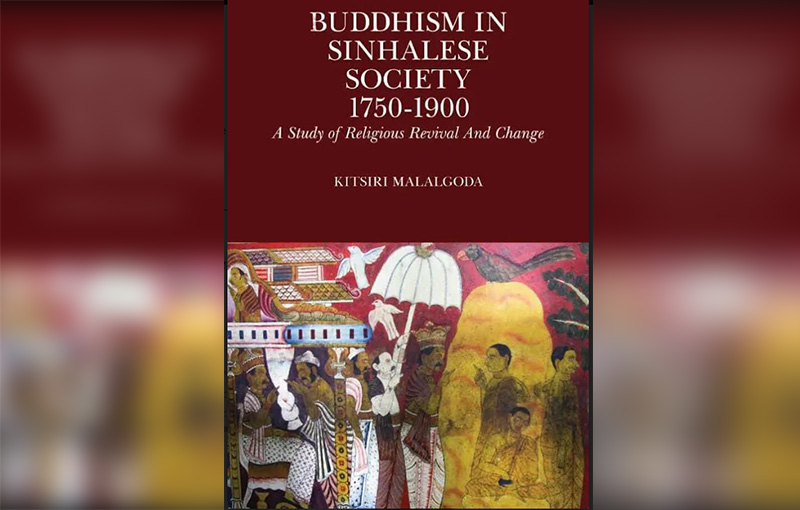
Review of Buddhism in Sinhalese Society 1750-1900: A Study of Religious Revival And Change by Kitsiri Malagoda, Colombo, Tambapanni Academic Publishers, 2023, 300pp. ISBN: 9786245529094
Sri Lankan Buddhists are spoiled for choice these days. Depending on where your faith lies and what tugs at your heart, it seems you can choose the flavour of Theravada Buddhism that suits you best: from the traditional temple Buddhism of the great sects of Kandy to the radical orthopraxy of ascetic Buddhism in remote forest monasteries, and from the devotional Buddhism of Mahamevuna to the contrarian, eclectic mix of teachings at Umandawa, the variety can be dazzling—so much so that one could be excused for thinking that this lack of homogeneity is a sign of decay.
Kitsiri Malalgoda, in his classic study Buddhism in Sinhalese Society 1750–1900 shows us that there is nothing new with these ebbs and flows in the sāsana. Buddhism has always been plural in the island. It has also been resilient, perhaps because of that very plurality. Whenever all hope seemed to have been lost—as in the low points during the colonial period Malalgoda talks about in great detail—the religion has managed to sprout back into life. This, I think, is the biggest lesson for us in the present day from Malalgoda’s book that deals with our recent past: we are not just creators, but heirs, of multiple Buddhisms.
Malalgoda tells this story in two parts. The first part begins with an exploration of the form of Buddhism one could witness in the last decades of the Kandyan kingdom, prior to its conquest by the British in 1815. Here we find the unique quasi-monastic character of gaṇinnānse—a religious specialist that is not a layman but not quite a monk, and also not found before or since in our history. The emergence of the Silvat Samāgama in this period, led by the charismatic elder Venerable Saraṇaṃkara, initiated a series of monastic reforms that reverberates to this day. Ironically, the Dutch colonial conquestors also played a vital role in that reform, facilitating the introduction of higher ordination (upasampadā) from historical Siyam (Thailand). The Sangha, however, does not remain a unitary institution: there is conflict within the Siyam sect, and between the classes, resulting in more sects (and sub-sects!) that reject Siyam authority. There are even monks plotting to assassinate the king, a habit that the post-independence Sangha cannot claim to have entirely rid itself of, if the events in 1950s were an indication. In fact, the political machinations of monastic institutions and the religious meddlings of political operators is a key theme that runs through the study.
The colourful and detailed story of Sinhala Buddhism related by Malalgoda takes a new turn in the second part of the book, with the arrival of so-called Protestant Buddhism. In this phase in the late 19th century, we find Buddhists learning new tricks from their colonial masters, sometimes beating them at their own game, but also seemingly changing Buddhism in the process. An organized, rational, and intellectual Buddhism begins to take root, with Anagarika Dharmapala and the theosophists at its forefront, using institutions such as schools and the press to proselytize novel interpretations and practices that can better withstand the challenges of its day. By this time, Kandy had given way to Colombo as the Buddhist epicentre of the country. In many ways, the forms of Buddhism we see today have all been heavily influenced by the reforms Malalgoda discusses in these chapters.
Reading about this recent history is a humbling experience, in that it questions our ideas of decline and revival. As we get to know the events that unfolded during these difficult times for Buddhism in the country, we develop a deeper appreciation for the difficulty in identifying what is progress or regress while we are engaged in living through that process. Well-intentioned actions towards the betterment of the sāsana do not necessarily lead to beneficial results, simply because it is humanly impossible to have an objective perspective, especially into the future. Alternatively, blessings may come in forms we do not recognise, and what is reviled by the Buddhist populace today might be the very thing that ensures the teachings survive for future generations. This is a lesson we cannot afford to ignore, and one that Malalgoda imparts in exquisite detail.
Buddhism in Sinhalese Society has its origins in Malalgoda’s doctoral studies at Oxford in the late 1960s. First published in 1976 by the University of California Press, over the years, it has gained a reputation as one of the most comprehensive and meticulous works on Sri Lankan Buddhism. Getting a copy of it, however, has not been easy as of late. There are international copies available in digital format for astronomical fees, but thankfully, Tambapanni Academic Publishers have now released a Sri Lankan paperback edition at a very reasonable price. This is a book that deserves a place on the shelf of anyone interested in Sri Lankan Buddhism.
Prabhath Sirisena is a visiting researcher at the Leiden University Institute for Area Studies.


“My tongue in English chains.
I return, after a generation, to you.
I am at the end
of my Dravidic tether
hunger for you unassuaged
I falter, stumble.”
– Indian poet R. Parthasarathy
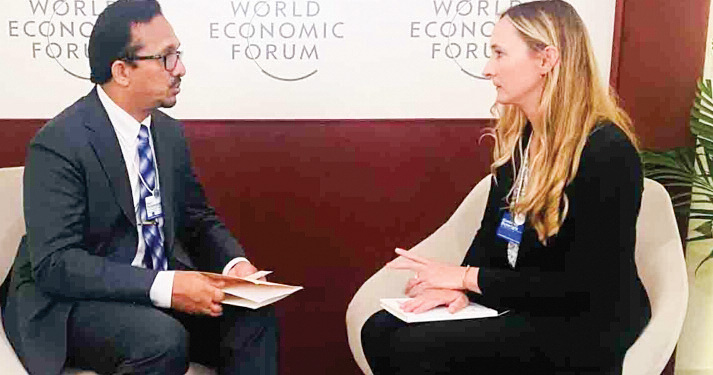
 When Minister Sunil Handunnetti addressed the World Economic Forum’s ‘Is Asia’s Century at Risk?’ discussion as part of the Annual Meeting of the New Champions 2025 in June 2025, I listened carefully both to him and the questions that were posed to him by the moderator. The subsequent trolling and extremely negative reactions to his use of English were so distasteful that I opted not to comment on it at the time. The noise that followed also meant that a meaningful conversation based on that event on the utility of learning a powerful global language and how our politics on the global stage might be carried out more successfully in that language was lost on our people and pundits, barring a few commentaries.
Now Handunnetti has reopened the conversation, this time in Sri Lanka’s parliament in November 2025, on the utility of mastering English particularly for young entrepreneurs. In his intervention, he also makes a plea not to mock his struggle at learning English given that he comes from a background which lacked the privilege to master the language in his youth. His clear intervention makes much sense.
The same ilk that ridiculed him when he spoke at WEF is laughing at him yet again on his pronunciation, incomplete sentences, claiming that he is bringing shame to the country and so on and so forth. As usual, such loud, politically motivated and retrograde critics miss the larger picture. Many of these people are also among those who cannot hold a conversation in any of the globally accepted versions of English. Moreover, their conceit about the so-called ‘correct’ use of English seems to suggest the existence of an ideal English type when it comes to pronunciation and basic articulation. I thought of writing this commentary now in a situation when the minister himself is asking for help ‘in finding a solution’ in his parliamentary speech even though his government is not known to be amenable to critical reflection from anyone who is not a party member.
The remarks at the WEF and in Sri Lanka’s parliament are very different at a fundamental level, although both are worthy of consideration – within the realm of rationality, not in the depths of vulgar emotion and political mudslinging.
The problem with Handunnetti’s remarks at WEF was not his accent or pronunciation. After all, whatever he said could be clearly understood if listened to carefully. In that sense, his use of English fulfilled one of the most fundamental roles of language – that of communication. Its lack of finesse, as a result of the speaker being someone who does not use the language professionally or personally on a regular basis, is only natural and cannot be held against him. This said, there are many issues that his remarks flagged that were mostly drowned out by the noise of his critics.
Given that Handunnetti’s communication was clear, it also showed much that was not meant to be exposed. He simply did not respond to the questions that were posed to him. More bluntly, a Sinhala speaker can describe the intervention as yanne koheda, malle pol , which literally means, when asked ‘Where are you going?’, the answer is ‘There are coconuts in the bag’.
He spoke from a prepared text which his staff must have put together for him. However, it was far off the mark from the questions that were being directly posed to him. The issue here is that his staff appears to have not had any coordination with the forum organisers to ascertain and decide on the nature of questions that would be posed to the Minister for which answers could have been provided based on both global conditions, local situations and government policy. After all, this is a senior minister of an independent country and he has the right to know and control, when possible, what he is dealing with in an international forum.
This manner of working is fairly routine in such international fora. On the one hand, it is extremely unfortunate that his staff did not do the required homework and obviously the minister himself did not follow up, demonstrating negligence, a want for common sense, preparedness and experience among all concerned. On the other hand, the government needs to have a policy on who it sends to such events. For instance, should a minister attend a certain event, or should the government be represented by an official or consultant who can speak not only fluently, but also with authority on the subject matter. That is, such speakers need to be very familiar with the global issues concerned and not mere political rhetoric aimed at local audiences.
Other than Handunnetti, I have seen, heard and also heard of how poorly our politicians, political appointees and even officials perform at international meetings (some of which are closed door) bringing ridicule and disastrous consequences to the country. None of them are, however, held responsible.
Such reflective considerations are simple yet essential and pragmatic policy matters on how the government should work in these conditions. If this had been undertaken, the WEF event might have been better handled with better global press for the government. Nevertheless, this was not only a matter of English. For one thing, Handunnetti and his staff could have requested for the availability of simultaneous translation from Sinhala to English for which pre-knowledge of questions would have been useful. This is all too common too. At the UN General Assembly in September, President Dissanayake spoke in Sinhala and made a decent presentation.
The pertinent question is this; had Handunetti had the option of talking in Sinhala, would the interaction have been any better? That is extremely doubtful, barring the fluency of language use. This is because Handunnetti, like most other politicians past and present, are good at rhetoric but not convincing where substance is concerned, particularly when it comes to global issues. It is for this reason that such leaders need competent staff and consultants, and not mere party loyalists and yes men, which is an unfortunate situation that has engulfed the whole government.
What about the speech in parliament? Again, as in the WEF event, his presentation was crystal clear and, in this instance, contextually sensible. But he did not have to make that speech in English at all when decent simultaneous translation services were available. In so far as content was concerned, he made a sound argument considering local conditions which he knows well. The minister’s argument is about the need to ensure that young entrepreneurs be taught English so that they can deal with the world and bring investments into the country, among other things. This should actually be the norm, not only for young entrepreneurs, but for all who are interested in widening their employment and investment opportunities beyond this country and in accessing knowledge for which Sinhala and Tamil alone do not suffice.
As far as I am concerned, Handunetti’s argument is important because in parliament, it can be construed as a policy prerogative. Significantly, he asked the Minister of Education to make this possible in the educational reforms that the government is contemplating.
He went further, appealing to his detractors not to mock his struggle in learning English, and instead to become part of the solution. However, in my opinion, there is no need for the Minister to carry this chip on his shoulder. Why should the minister concern himself with being mocked for poor use of English? But there is a gap that his plea should have also addressed. What prevented him from mastering English in his youth goes far deeper than the lack of a privileged upbringing.
The fact of the matter is, the facilities that were available in schools and universities to learn English were not taken seriously and were often looked down upon as kaduwa by the political spectrum he represents and nationalist elements for whom the utilitarian value of English was not self-evident. I say this with responsibility because this was a considerable part of the reality in my time as an undergraduate and also throughout the time I taught in Sri Lanka.
Much earlier in my youth, swayed by the rhetoric of Sinhala language nationalism, my own mastery of English was also delayed even though my background is vastly different from the minister. I too was mocked, when two important schools in Kandy – Trinity College and St. Anthony’s College – refused to accept me to Grade 1 as my English was wanting. This was nearly 20 years after independence. I, however, opted to move on from the blatant discrimination, and mastered the language, although I probably had better opportunities and saw the world through a vastly different lens than the minister. If the minister’s commitment was also based on these social and political realities and the role people like him had played in negating our English language training particularly in universities, his plea would have sounded far more genuine.
If both these remarks and the contexts in which they were made say something about the way we can use English in our country, it is this: On one hand, the government needs to make sure it has a pragmatic policy in place when it sends representatives to international events which takes into account both a person’s language skills and his breadth of knowledge of the subject matter. On the other hand, it needs to find a way to ensure that English is taught to everyone successfully from kindergarten to university as a tool for inclusion, knowledge and communication and not a weapon of exclusion as is often the case.
This can only bear fruit if the failures, lapses and strengths of the country’s English language teaching efforts are taken into cognizance. Lamentably, division and discrimination are still the main emotional considerations on which English is being popularly used as the trolls of the minister’s English usage have shown. It is indeed regrettable that their small-mindedness prevents them from realizing that the Brits have long lost their long undisputed ownership over the English language along with the Empire itself. It is no longer in the hands of the colonial masters. So why allow it to be wielded by a privileged few mired in misplaced notions of elitism?
Clandestine visit to Speaker’s residence:
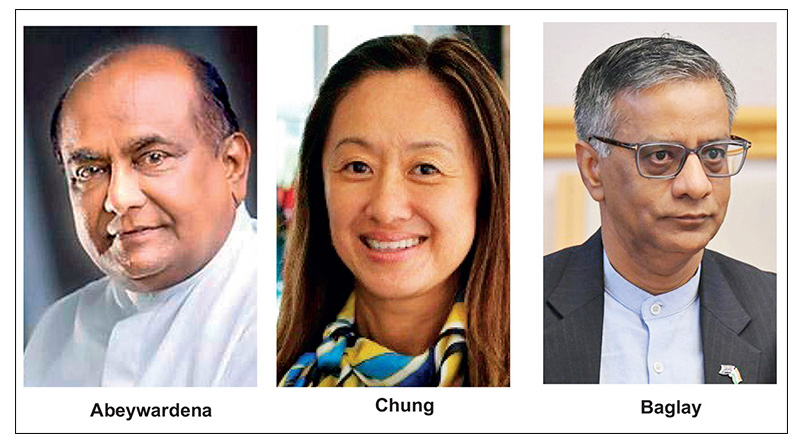
Finally, former Speaker Mahinda Yapa Abeywardena has set the record straight with regard to a controversial but never properly investigated bid to swear in him as interim President. Abeywardena has disclosed the circumstances leading to the proposal made by external powers on the morning of 13 July, 2022, amidst a large scale staged protest outside the Speaker’s official residence, situated close to Parliament.
Lastly, the former parliamentarian has revealed that it was then Indian High Commissioner, in Colombo, Gopal Baglay (May 2022 to December 2023) who asked him to accept the presidency immediately. Professor Sunanda Maddumabandara, who served as Senior Advisor (media) to President Ranil Wickremesinghe (July 2022 to September 2024), disclosed Baglay’s direct intervention in his latest work, titled ‘Aragalaye Balaya’ (Power of Aragalaya).
Prof. Maddumabandara quoted Abeywardena as having received a startling assurance that if he agreed to accept the country’s leadership, the situation would be brought under control, within 45 minutes. Baglay had assured Abeywardena that there is absolutely no harm in him succeeding President Gotabaya Rajapaksa, in view of the developing situation.
The author told the writer that only a person who had direct control over the violent protest campaign could have given such an assurance at a time when the whole country was in a flux.
One-time Vice Chancellor of the Kelaniya University, Prof. Maddumabandara, launched ‘Aragalaye Balaya’ at the Sri Lanka Foundation on 20 November. In spite of an invitation extended to former President Gotabaya Rajapaksa, the ousted leader hadn’t attended the event, though UNP leader Ranil Wickremesinghe was there. Maybe Gotabaya felt the futility of trying to expose the truth against evil forces ranged against them, who still continue to control the despicable agenda.
Obviously, the author has received the blessings of Abeywardena and Wickremesinghe to disclose a key aspect in the overall project that exploited the growing resentment of the people to engineer change of Sri Lankan leadership.
The declaration of Baglay’s intervention has contradicted claims by National Freedom Front (NFF) leader Wimal Weerawansa (Nine: The hidden story) and award-winning writer Sena Thoradeniya (Galle Face Protest: System change for anarchy) alleged that US Ambassador Julie Chung made that scandalous proposal to Speaker Abeywardena. Weerawansa and Thoradeniya launched their books on 25 April and 05 July, 2023, at the Sri Lanka Foundation and the National Library and Documentation Services Board, Independence Square, respectively. Both slipped in accusing Ambassador Chung of making an abortive bid to replace Gotabaya Rajapaksa with Mahinda Yapa Abeywardena.
Ambassador Chung categorically denied Weerawansa’s allegation soon after the launch of ‘Nine: The hidden story’ but stopped short of indicating that the proposal was made by someone else. Chung had no option but to keep quiet as she couldn’t, in response to Weerawansa’s claim, have disclosed Baglay’s intervention, under any circumstances, as India was then a full collaborator with Western designs here for its share of spoils. Weerawansa, Thoradeniya and Maddumabandara agree that Aragalaya had been a joint US-Indian project and it couldn’t have succeeded without their intervention. Let me reproduce the US Ambassador’s response to Weerawansa, who, at the time of the launch, served as an SLPP lawmaker, having contested the 2020 August parliamentary election on the SLPP ticket.
“I am disappointed that an MP has made baseless allegations and spread outright lies in a book that should be labelled ‘fiction’. For 75 years, the US [and Sri Lanka] have shared commitments to democracy, sovereignty, and prosperity – a partnership and future we continue to build together,” Chung tweeted Wednesday 26 April, evening, 24 hours after Weerawansa’s book launch.
Interestingly, Gotabaya Rajapaksa has been silent on the issue in his memoirs ‘The Conspiracy to oust me from Presidency,’ launched on 07 March, 2024.
What must be noted is that our fake Marxists, now entrenched in power, were all part and parcel of Aragalaya.
A clandestine meeting
Abeywardena should receive the appreciation of all for refusing to accept the offer made by Baglay, on behalf of India and the US. He had the courage to tell Baglay that he couldn’t accept the presidency as such a move violated the Constitution. In our post-independence history, no other politician received such an offer from foreign powers. When Baglay stepped up pressure, Abeywardena explained that he wouldn’t change his decision.
Maddumabandara, based on the observations made by Abeywardena, referred to the Indian High Commissioner entering the Speaker’s Official residence, unannounced, at a time protesters blocked the road leading to the compound. The author raised the possibility of Baglay having been in direct touch with those spearheading the high profile political project.
Clearly Abeywardena hadn’t held back anything. The former Speaker appeared to have responded to those who found fault with him for not responding to allegations, directed at him, by revealing everything to Maddumabandara, whom he described in his address, at the book launch, as a friend for over five decades.
At the time, soon after Baglay’s departure from the Speaker’s official residence, alleged co-conspirators Ven. Omalpe Sobitha, accompanied by Senior Professor of the Sinhala Faculty at the Colombo University, Ven. Agalakada Sirisumana, health sector trade union leader Ravi Kumudesh, and several Catholic priests, arrived at the Speaker’s residence where they repeated the Indian High Commissioner’s offer. Abeywardena repeated his previous response despite Sobitha Thera acting in a threatening manner towards him to accept their dirty offer. Shouldn’t they all be investigated in line with a comprehensive probe?
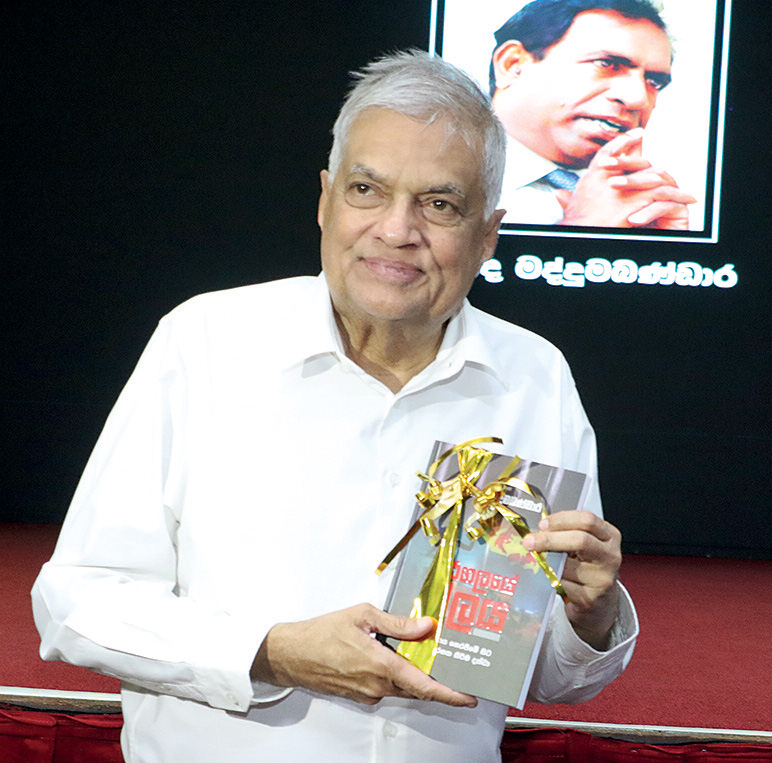
Ex-President Wickremesinghe with a copy of Aragalaye Balaya he received from its author, Prof. Professor Sunanda Maddumabandara, at the Sri Lanka Foundation recently (pic by Nishan S Priyantha)
On the basis of what Abeywardena had disclosed to him, Maddumabanadara also questioned the circumstances of the deployment of the elite Special Task Force (STF) contingent at the compound. The author asked whether that deployment, without the knowledge of the Speaker, took place with the intervention of Baglay.
Aragalaye Balaya
is a must read for those who are genuinely interested in knowing the unvarnished truth. Whatever the deficiencies and inadequacies on the part of the Gotabaya Rajapaksa administration, external powers had engineered a change of government. The writer discussed the issues that had been raised by Prof. Maddumabandara and, in response to one specific query, the author asserted that in spite of India offering support to Gotabaya Rajapaksa earlier to get Ranil Wickremesinghe elected as the President by Parliament to succeed him , the latter didn’t agree with the move. Then both the US and India agreed to bring in the Speaker as the Head of State, at least for an interim period.
If Speaker Abeywardena accepted the offer made by India, on behalf of those backing the dastardly US backed project, the country could have experienced far reaching changes and the last presidential election may not have been held in September, 2004.
After the conclusion of his extraordinary assignment in Colombo, Baglay received appointment as New Delhi’s HC in Canberra. Before Colombo, Baglay served in Indian missions in Ukraine, Russia, the United Kingdom, Nepal and Pakistan (as Deputy High Commissioner).
Baglay served in New Delhi, in the office of the Prime Minister of India, and in the Ministry of External Affairs as its spokesperson, and in various other positions related to India’s ties with her neighbours, Europe and multilateral organisations.
Wouldn’t it be interesting to examine who deceived Weerawansa and Thoradeniya who identified US Ambassador Chung as the secret visitor to the Speaker’s residence. Her high-profile role in support of the project throughout the period 31 March to end of July, 2022, obviously made her an attractive target but the fact remains it was Baglay who brought pressure on the then Speaker. Mahinda Yapa Abeywardena’s clarification has given a new twist to “Aragalaya’ and India’s diabolical role.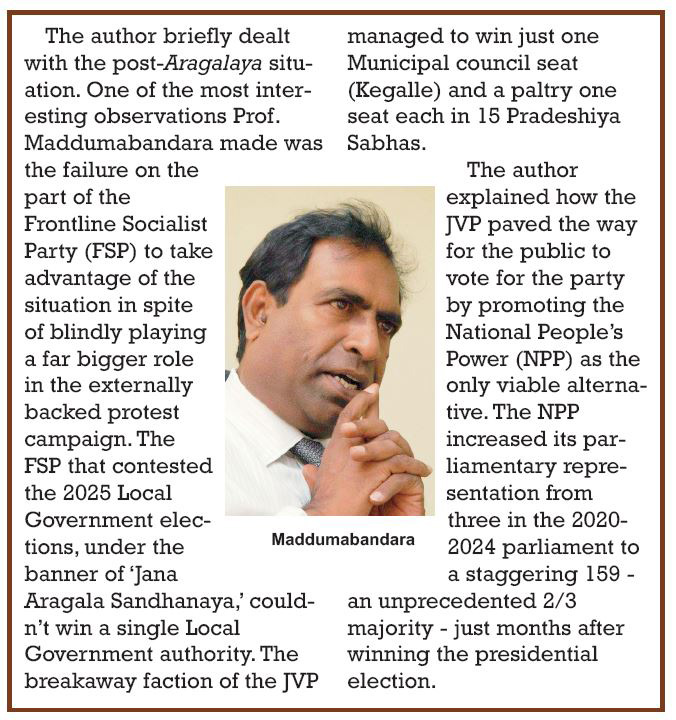
Absence of investigations
Sri Lanka never really wanted to probe the foreign backed political plot to seize power by extra-parliamentary means. Although some incidents had been investigated, the powers that be ensured that the overall project remained uninvestigated. In fact, Baglay’s name was never mentioned regarding the developments, directly or indirectly, linked to the devious political project. If not for Prof. Maddumabandara taking trouble to deal with the contentious issue of regime change, Baglay’s role may never have come to light. Ambassador Chung would have remained the target of all those who found fault with US interventions. Let me be clear, the revelation of Baglay’s clandestine meeting with the Speaker didn’t dilute the role played by the US in Gotabaya Rajapaksa’s removal.
If Prof. Maddumabandara propagated lies, both the author and Abeywardana should be appropriately dealt with. Aragalaye Balaya failed to receive the desired or anticipated public attention. Those who issue media statements at the drop of a hat conveniently refrained from commenting on the Indian role. Even Abeywardena remained silent though he could have at least set the record straight after Ambassador Chung was accused of secretly meeting the Speaker. Abeywardena could have leaked the information through media close to him. Gotabaya Rajapaksa and Ranil Wickremesinghe, too, could have done the same but all decided against revealing the truth.
A proper investigation should cover the period beginning with the declaration made by Gotabaya Rajapaksa’s government, in April 2022, regarding the unilateral decision to suspend debt repayment. But attention should be paid to the failure on the part of the government to decide against seeking assistance from the International Monetary Fund (IMF) to overcome the crisis. Those who pushed Gotabaya Rajapaksa to adopt, what they called, a domestic solution to the crisis created the environment for the ultimate collapse that paved the way for external interventions. Quite large and generous Indian assistance provided to Sri Lanka at that time should be examined against the backdrop of a larger frightening picture. In other words, India was literally running with the sheep while hunting with the hounds. Whatever the criticism directed at India over its role in regime change operation, prompt, massive and unprecedented post-Cyclone Ditwah assistance, provided by New Delhi, saved Sri Lanka. Rapid Indian response made a huge impact on Sri Lanka’s overall response after having failed to act on a specific 12 November weather alert.
It would be pertinent to mention that all governments, and the useless Parliament, never wanted the public to know the truth regarding regime change project. Prof. Maddumabandara discussed the role played by vital sections of the armed forces, lawyers and the media in the overall project that facilitated external operations to force Gotabaya Rajapaksa out of office. The author failed to question Wickremesinghe’s failure to launch a comprehensive investigation, with the backing of the SLPP, immediately after he received appointment as the President. There seems to be a tacit understanding between Wickremesinghe and the SLPP that elected him as the President not to initiate an investigation. Ideally, political parties represented in Parliament should have formed a Special Parliamentary Select Committee (PSC) to investigate the developments during 2019 to the end of 2022. Those who had moved court against the destruction of their property, during the May 2022 violence directed at the SLPP, quietly withdrew that case on the promise of a fresh comprehensive investigation. This assurance given by the Wickremesinghe government was meant to bring an end to the judicial process.
When the writer raised the need to investigate external interventions, the Human Rights Commission of Sri Lanka (HRCSL) sidestepped the issue. Shame on the so-called independent commission, which shows it is anything but independent.
Sumanthiran’s proposal
Since the eradication of the Liberation Tigers of Tamil Eelam (LTTE) in May 2009, the now defunct Tamil National Alliance’s (TNA) priority had been convincing successive governments to withdraw the armed forces/ substantially reduce their strength in the Northern and Eastern Provinces. The Illankai Thamil Arasu Kadchi (ITAK)-led TNA, as well as other Tamil political parties, Western powers, civil society, Tamil groups, based overseas, wanted the armed forces out of the N and E regions.
Abeywardena also revealed how the then ITAK lawmaker, M.A. Sumanthiran, during a tense meeting chaired by him, in Parliament, also on 13 July, 2022, proposed the withdrawal of the armed forces from the N and E for redeployment in Colombo. The author, without hesitation, alleged that the lawmaker was taking advantage of the situation to achieve their longstanding wish. The then Speaker also disclosed that Chief Opposition Whip Lakshman Kiriella and other party leaders leaving the meeting as soon as the armed forces reported the protesters smashing the first line of defence established to protect the Parliament. However, leaders of minority parties had remained unruffled as the situation continued to deteriorate and external powers stepped up efforts to get rid of both Gotabaya Rajapaksa and Ranil Wickremesinghe to pave the way for an administration loyal and subservient to them. Foreign powers seemed to have been convinced that Speaker Abeywardena was the best person to run the country, the way they wanted, or till the Aragalaya mob captured the House.
The Author referred to the role played by the media, including social media platforms, to promote Gotabaya Rajapaksa’s successor. Maddumamabandara referred to the Hindustan Times coverage to emphasise the despicable role played by a section of the media to manipulate the rapid developments that were taking place. The author also dealt with the role played by the Janatha Vimukthi Peramuna (JVP) in the project with the focus on how that party intensified its actions immediately after Gotabaya Rajapaksa stepped down.
Disputed assessment
The Author identified Ministers Bimal Rathnayaka, Sunil Handunetti and K.D. Lal Kantha as the persons who spearheaded the JVP bid to seize control of Parliament. Maddumabanda unflinchingly compared the operation, mounted against Gotabaya Rajapaksa, with the regime change operations carried out in Iraq, Libya, Egypt and Ukraine. Asserting that governments loyal to the US-led Western block had been installed in those countries, the author seemed to have wrongly assumed that external powers failed to succeed in Sri Lanka (pages 109 and 110). That assertion is utterly wrong. Perhaps, the author for some unexplained reasons accepted what took place here. Nothing can be further from the truth than the regime change operation failed (page 110) due to the actions of Gotabaya Rajapaksa, Mahinda Yapa Abeywardana and Ranil Wickremesinghe. In case, the author goes for a second print, he should seriously consider making appropriate corrections as the current dispensation pursues an agenda in consultation with the US and India.
The signing of seven Memorandums of Understanding (MoUs) with India, including one on defence, and growing political-defence-economic ties with the US, have underscored that the JVP-led National People’s Power (NPP) may not have been the first choice of the US-India combine but it is certainly acceptable to them now.
The bottom line is that a democratically elected President, and government, had been ousted through unconstitutional means and Sri Lanka meekly accepted that situation without protest. In retrospect, the political party system here has been subverted and changed to such an extent, irreparable damage has been caused to public confidence. External powers have proved that Sri Lanka can be influenced at every level, without exception, and the 2022 ‘Aragalaya’ is a case in point. The country is in such a pathetic state, political parties represented in Parliament and those waiting for an opportunity to enter the House somehow at any cost remain vulnerable to external designs and influence.
Cyclone Ditwah has worsened the situation. The country has been further weakened with no hope of early recovery. Although the death toll is much smaller compared to that of the 2004 tsunami, economic devastation is massive and possibly irreversible and irreparable.
By Shamindra Ferdinando
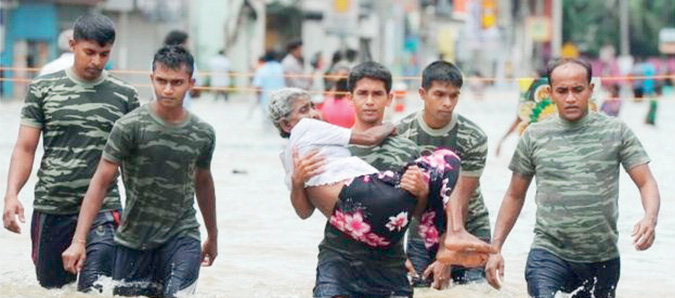
Over the desolate watery wastes,
Dulling the glow of the fabled Gem,
There opens a rainbow of opportunity,
For the peoples North and South,
To not only meet and greet,
But build a rock-solid bridge,
Of mutual help and solidarity,
As one undivided suffering flesh,
And we are moved to say urgently-
‘All you who wax so lyrically,
Of a united nation and reconciliation,
Grab this bridge-building opportunity.’
By Lynn Ockersz

Level III landslide early warnings issued to the Districts of Kandy, Kegalle, Kurunegala and Matale extended

“We cannot allow flooding to become a part of the daily lives of the people in the Colombo District” – PM

Russia gifts 35 tonnes of Humanitarian Aid to Sri Lanka

Sri Lanka squad named for ACC Men’s U19 Asia Cup

Hospital CCTV helps clear long jumper of doping

Tickner and Rae bowl West Indies out for 205 to give New Zealand the edge

‘Dates have the highest sugar content to fight Coronavirus’

Sunday Island 27 December – Headlines

#SundayIsland 17th December – Headlines

Sunday Island – 28th March

Sunday Island Headlines – 21 March

Sunday Island – 21st February – Headlines
-

 News3 days ago
Over 35,000 drug offenders nabbed in 36 days
-
 News7 days ago
Level III landslide early warning continue to be in force in the districts of Kandy, Kegalle, Kurunegala and Matale
-
 Business5 days ago
LOLC Finance Factoring powers business growth
-

 News5 days ago
CPC delegation meets JVP for talks on disaster response
-
 News2 days ago
Cyclone Ditwah leaves Sri Lanka’s biodiversity in ruins: Top scientist warns of unseen ecological disaster
-
 News5 days ago
A 6th Year Accolade: The Eternal Opulence of My Fair Lady
-

 News3 days ago
Rising water level in Malwathu Oya triggers alert in Thanthirimale
-
 Features4 days ago
The Catastrophic Impact of Tropical Cyclone Ditwah on Sri Lanka: