
Sports
McCoy and Charles thump South Africa to give West Indies series sweep

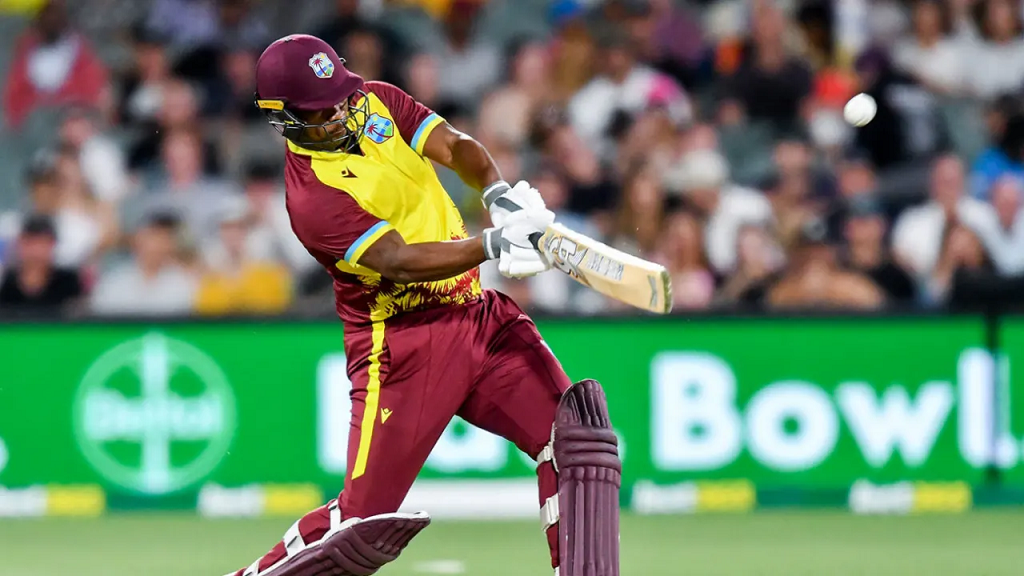
West Indies swept the three-T20I series against South Africa to conclude their T20 World Cup preparations in the most commanding way possible. South Africa, on the other hand, have won just two of their last 11 completed T20I matches since the last T20 World Cup, and have lost series to West Indies twice and Australia once, and enter the global competition on the back foot.
If there’s any consolation, it’s that none of South Africa’s powerhouse middle order of Aiden Markram, Heinrich Klaasen, David Miller and Tristan Stubbs were part of this series, but all will return for the World Cup. Still, there remain concerns over Quinton de Kock, who scored 64 runs in three innings and didn’t have a good time of it at the BBL, the SA20 and the IPL earlier, while also appearing to pick up a back injury on Sunday; and Ryan Rickelton, who managed only 43 runs in three innings.
Equally, Anrich Nortje’s economy rate of 12.16 through the series and the absence of any wickets to his name raises questions over his readiness for international cricket after an almost-nine-month absence following a lower-back stress fracture. But he is part of South Africa’s final squad for the World Cup.
West Indies head to Trinidad to play Australia in a warm-up match before their first World Cup match in Guyana, and they appear as ready as they can be. They have won four out of five series since the last T20 World Cup, and beat South Africa 3-0 for the first time in this one. After defending totals of 175 and 207 to win the series, they were made to chase and hunted down 164 inside 14 overs to ease past South Africa again.
Obed McCoy added to the T20 World Cup squad in place of the injured Jason Holder, was the most successful bowler in the final match with 3 for 39, while stand-in captain Brandon King finished as the series’ leading run-scorer.
It was against South Africa, 15 months ago, that Johnson Charles made the case to reclaim his spot in the T20I squad with 118 off just 46 balls in a T20I in Centurion. But since then, it has been lean going for him. Charles went ten innings without crossing fifty, and questions over his T20 World Cup-squad involvement were more than just whispers.
But he silenced those questions with a knock of complete assurance and authority to bring up his fifth T20I half-century, and set the platform for another West Indies win. Charles’ takedown of South Africa’s fastest, Nortje and Gerald Coetzee, was most impressive. He scored 25 runs off just ten balls from Nortje, and 22 off four from Coetzee, including three successive sixes. Only three of his 69 runs came in singles, and even though he was dismissed in the seventh over, he had already put the result beyond doubt.
After taking three wickets in each of his last three games, left-arm spinner Gudakesh Motie seemed set for a similar haul after two exceptional overs. He was brought on immediately after the powerplay, and displayed good changes of pace to have de Kock trapped lbw, as the latter played a reverse sweep too early and was given out.
In Motie’s next over, Matthew Breetzke hit the ball back over the bowler’s head. It looked like a clean strike but wasn’t timed as well as he intended, and Shamar Joseph took a good catch inside the boundary rope to end a disappointing tour for the CSA T20’s top run-scorer for the 2023-24 season.
After two overs, Motie had 2 for 5, but his day didn’t finish as well as he would have hoped. He conceded 11 runs off his final over, as Rassie van der Dussen hit him for two sixes, and he wasn’t used again.
Excluded from South Africa’s T20 World Cup squad but asked to captain them in this series, van der Dussen has not had the easiest few months. But he had a strong last say on this tour. Van der Dussen scored a 30-ball fifty to take South Africa from 50 for 4 to 163 for 7, and demonstrated strong hitting skills straight down the ground. All five of his sixes were scored in the V between long-off and long-on, and his 77-run fifth-wicket stand with Wiaan Mulder was the difference between a South African collapse and a semblance of competitiveness.
Van der Dussen’s knock could have ended on 9 when he dragged a Hayden Walsh Jnr delivery from outside off to long-on, where Kyle Mayers was waiting for the catch. He took it cleanly but misjudged how close his back foot was to the boundary rope and stepped over it with the ball in hand. Van der Dussen was the first to gesture that he had earned six.
Six overs later, Mulder mis-hit a McCoy slower ball to long-on, where Mayers was ready to take the catch two-handed, with more than enough space behind him to tumble, hold on and avoid giving away a boundary.
With the bat, Mayers cracked four sixes in an unbeaten knock of 36, helping wrap the chase up after Charles had laid the foundation. But Mayers remains a reserve player in the West Indies T20 World Cup squad.
Brief scores:
West Indies 165/2 in 13.5 overs (Brandon King 44, Johnson Charles 69, Kyle Mayers 36*; Gerald Coetzee 1-37, Nqabayomzi Peter 1-27) beat South Africa 163/7 in 20 overs (Rassie van der Dussen 51, Wiaan Mulder 36; Shamar Joseph 2-26, Obed McCoy 3-39, Gudakesh Motie 2-21) by eight wickets











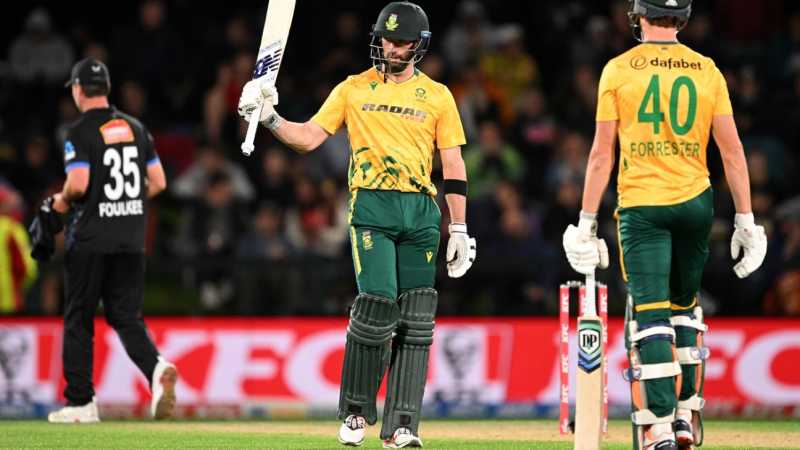
South Africa won their first away T20I series under Shukri Conrad, and second successive bilateral series, with a convincing performance over New Zealand in Christchurch. Put in to bat, they posted the highest total of the series of 187 for 4- and defended it with a six-player attack to seal the series 3-2.
After poor batting performances in the second and third T20Is,2 South Africa went from good to better in the next two. Three of South Africa’s four highest partnerships of the series came in this match, and they have unearthed a potential future star in Connor Esterhuizen. He scored back-to-back fifties in matches four and five and anchored their efforts in the decider. While Zak Foulkes and Josh Clarkson were economical, the rest of their attack conceded at over nine runs an over. Offspinner Cole McConchie’s 0 for 48 was the most expensive.
New Zealand were without their first choice top five and also had to do without Tom Latham, who was due to lead them but fractured his thumb in the third T20I. They were never really in the chase against a disciplined South African effort. None of their batters scored more than Bevan Jacobs’ 36 and they only had one partnership which threatened: 52 between Jimmy Neesham and Jacobs for the fifth wicket.
Overall it was a messy affair on both sides, with nine dropped catches in the game, the most for any men’s T20I as per ESPNCricinfo’s ball-by-ball data logs since June 2018
Rubin Hermann has been involved in half of South Africa’s top stands and looked set for a big one today. Early in his innings, Hermann took down Ben Sears no matter what length he bowled and took 14 runs off four balls. Later, he showed his strength against spin when he joined Esterhuizen in targeting McConchie. But then Hermann did not hit a boundary for 12 balls and needed to take it on. When Sears went hard length, Hermann pulled but got his timing wrong and skied the ball towards mid-off. Nick Kelly ran from mid-on, made his ground and then stuck out one hand to take a superman catch, flying low to the ground. Hermann was out for 39, and the second-wicket partnership was broken on 59.
While Hermann’s promise only peeped through, Esterhuizen went from excellent to exceptional and topped up his maiden international half-century from game four with a new career-best: 75 off 33 balls in the finale. His on-side dominance was on display, as he scored 52 runs in that half of the ground, including five of his six sixes. The biggest ones came off McConchie who he hit back over his head, then over midwicket and over square leg. In total, Esterhuizen scored 21 runs off 8 balls but wasn’t shy to show what he could do against the quicks either. In the last two overs, he took 25 runs off Kyle Jamieson and Sears. His innings ended when he tried to send a Sears full toss to Neesham with two balls to go and he ended the series with a total of 200 runs, 100 more than his nearest competitor, Devon Conway.
It’s been a tough few months for Jason Smith. He only played one game at the T20 World Cup, despite being a first-choice pick in the squad and has not managed to get one score over 20 in five innings on this tour. And then things seemed to become tougher. Smith was at extra cover when Dane Cleaver, on 1, backed away from a Gerald Coetzee ball and smashed it to him. It was hit hard and could have taken some holding onto but Smith let it burst through his hands. Luckily for him, three overs later, the chance to do better came. Ottneil Baartman drew a leading edge from a Cleaver and the ball looped to him at point. He made no mistake and Cleaver was dismissed for 22. New Zealand were 46 for 2 after the powerplay and well behind the chase.
Contrastingly, Coetzee has had a wonderful 10 days after missing out on T20 World Cup selection and recovering from a torn pec muscle. He finished as the joint leading wicket taker, and the one with the lowest economy rate in the series. In today’s match, he didn’t concede a boundary until the final ball he bowled, and by then New Zealand were out of the game. Coetzee bowled two overs with the new ball, for 11 runs, and should have Cleaver’s wicket and then returned for the 17th and 19th overs. His penultimate over was a mix of quick short balls with the odd change of pace and cost two runs. Reward came in his last over, when he had Josh Clarkson caught off a leading edge at cover and McConchie caught at long-on trying to clear the ropes off a cross seam ball. Coetzee finished with 2 for 21 in four overs.
Brief scores:
South Africa 187 for 4 in 20 overs (Tony de Zorzi 12, Wiaan Mulder 31, Rubin Hermann 39, Connor Esterhuizen 75, Dian Foresster 21*; Zak Foulkes 1-22, Ben Sears 2-37, Josh Clarkson 1-14) beat New Zealand 154 for 8 in 20 overs (Tim Robinson 25, Dane Cleaver 22 , Nick Kelley 14, Bevan Jacobs 36, James Neesham 24, Josh Clarkson 13; Gerald Coetzee 2-21, Wiaan Mulder 2-28, Ottneil Baartman 2-33, Keshav Maharaj 1-35)by 33 runs
(Cricinfo)



Kingswood College are riding high on confidence after ending a decades-long wait for victory against arch rivals Dharmaraja in their annual Big Match, but the Kandy school has little time to celebrate as they now shift focus towards securing promotion to Division I in the Under-19 Schools Cricket tournament.
Following their historic triumph on Sunday, Kingswood will next compete in the knockout stage of the Division II Tier ‘A’ competition. Victories in both the quarter-final and semi-final will secure the much-anticipated promotion to the Division I of the premier Under-19 cricket tournament.
Kingswood had spent several seasons in Division II before coming under the guidance of coach Susantha Basnayaka. Their steady progress over the last few years saw them reach the final of the Division II Tier B tournament last season, which earned them promotion to the Tier ‘A’ segment. That gradual development has now placed them on the brink of Division I status.
The school has also gained recognition for producing players capable of performing at the national junior level. One such product is Kavija Gamage, who represented Sri Lanka at the last ICC Under-19 Youth World Cup.
Gamage delivered a remarkable all-round performance to lead Kingswood’s historic win — their first Big Match victory over Dharmaraja in more than 60 years — and was undoubtedly the standout performer of the contest.
No player in the big match season had dominated a game as comprehensively as Gamage, whose contributions with both bat and ball helped Kingswood punch above their weight against a side competing in a higher division.
Despite Kingswood’s growing strength, Dharmaraja entered the encounter as favourites, having held the Big Match trophy for an unprecedented 68 years.
Gamage’s influence was felt from the very first innings. Batting on a difficult surface, he produced a superb knock of 112 — the only score above 20 in the Kingswood innings. His 149-ball effort included 13 fours and two sixes as Kingswood struggled against the bowling of Sasith Bandara (5/80), Sumeda Prasad (2/37) and Keshan Gunawardhana (3/53).
Coach Basnayaka later described the innings as the turning point of the match.
”The century in the first innings was the turning point. We were six wickets down for 99 runs at one stage. Kavija’s century helped us recover and post a formidable total on a difficult wicket,” Basnayaka told The Island.
In the second innings, Kingswood adopted a more aggressive approach as they aimed to accelerate the scoring before declaring. Gamage once again rose to the occasion.
”Our plan was to score as much as possible in the first 15 overs in the morning and declare. Kavija was in his 90s at the end of those overs and we decided to declare after he reached the century,” Basnayaka explained.
Opening batsman Aadhel Sheriff provided excellent support during that phase. Sheriff — the team’s leading run scorer of the season with more than 700 runs — shared a valuable 70-run stand with Gamage for the third wicket.
Gamage went on to complete his second century of the match with an unbeaten 100 off just 80 deliveries, striking six fours and five sixes as Kingswood declared soon afterwards.
Dharmaraja, chasing the target, were eventually bowled out for 166. Spinner Kenula Pihilianga delivered a match-winning spell to claim a remarkable match haul of 11 wickets, while Gamage capped off his outstanding performance by finishing with eight wickets in the match.
While Kingswood now look ahead to the possibility of earning promotion to Division I, Dharmaraja face a contrasting challenge. They currently sit at the bottom of their Division I Tier ‘B’ group and are battling to avoid relegation.
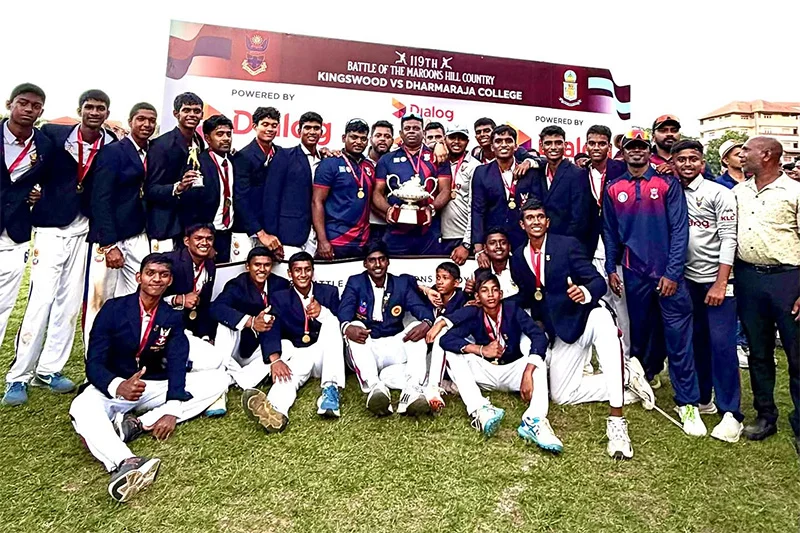
Kingswood team celebrate after recording a historic victory. Coach Susantha Basnayaka is seen in the centre with the trophy.
by Reemus Fernando

Esterhuizen, bowlers lead South Africa to 3-2 series win

IPL captains’ meeting: What’s on the agenda?

Russia launches 948 drones at Ukraine in largest attack over 24-hour period

Oil at $150 will trigger global recession, says boss of financial giant BlackRock

Showers will occur at several places in the Western and Sabaragamuwa provinces and in Galle and Matara districts after 2.00 pm

Senior citizens above 70 years to receive March allowances on Thursday (26)

‘Dates have the highest sugar content to fight Coronavirus’

Sunday Island 27 December – Headlines

#SundayIsland 17th December – Headlines

Sunday Island – 28th March

Sunday Island Headlines – 21 March

Sunday Island – 21st February – Headlines
-

 Features3 days ago
Trincomalee oil tank farm: An engineering marvel
-

 News7 days ago
Bailey Bridge inaugurated at Chilaw
-

 News6 days ago
CIABOC tells court Kapila gave Rs 60 mn to MR and Rs. 20 mn to Priyankara
-

 News7 days ago
Pay hike demand: CEB workers climb down from 40 % to 15–20%
-

 Features6 days ago
Science and diplomacy in a changing world
-

 Features3 days ago
The scientist who was finally heard
-

 News5 days ago
Colombo, Oslo steps up efforts to strengthen bilateral cooperation in key environmental priority areas
-

 News3 days ago
Substandard coal deepens energy crisis, warns former CEB Chief