
Latest News
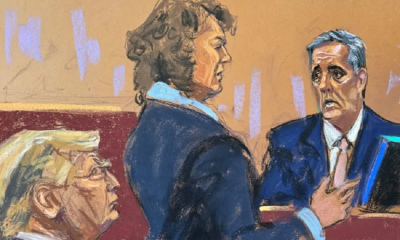
Trump lawyer clashes with Michael Cohen in hush-money trial

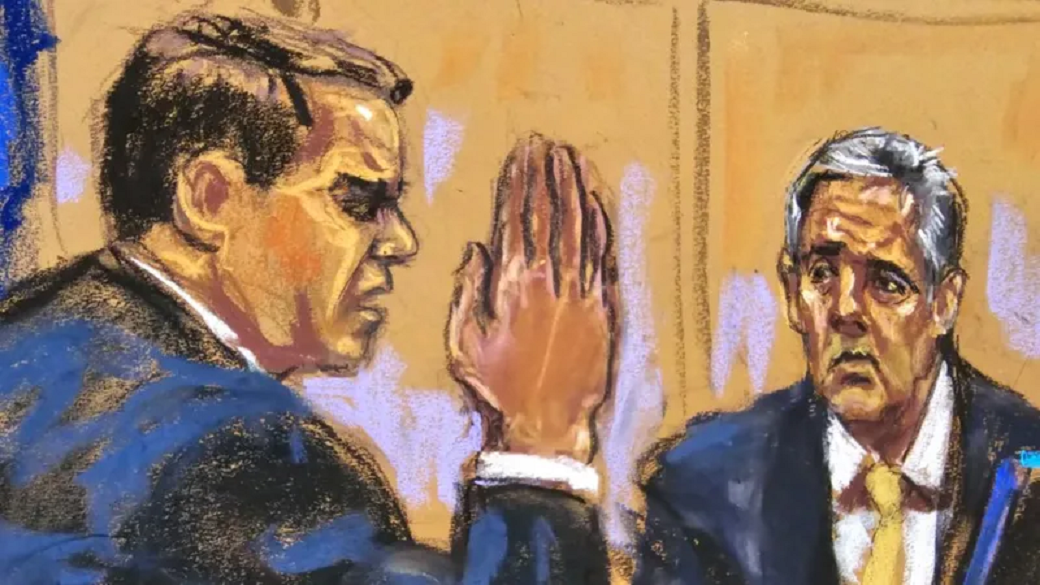
Tensions – and voices – rose on Thursday as Donald Trump’s lawyer hit back against prosecutors, accusing their star witness repeatedly of lying.
On the most tense day yet of cross-examination, Michael Cohen, Mr Trump’s former fixer, described talking to the former president directly about a hush-money payment to an adult-film star.
But attorney Todd Blanche all but shouted Cohen’s testimony was “a lie.”
Records, he said, show Cohen called Mr Trump’s bodyguard about a prank caller.
Mr Blanche’s alternate theory of the phone call was designed to sow doubt on Cohen’s third day on the stand, as the jury watched the furious exchange with intense focus.
Following the heated moment, Mr Blanche stormed back to the defence table and sat down next to his client. When the judge announced an afternoon recess, there was a collective exhale in the room.
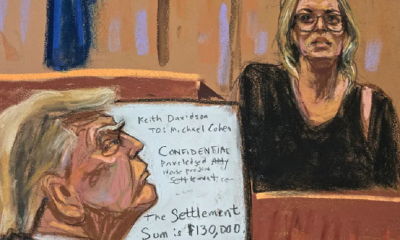
Mr Trump is charged with 34 felony counts of falsifying business records, for allegedly disguising payments to Cohen as legal expenses when they were in fact reimbursements for paying off film star Stormy Daniels, who claims she had sex with him.
Prosecutors allege Mr Trump sought to keep damaging information from the public to protect his 2016 presidential campaign. Mr Trump has pleaded not guilty to all counts and denied having sex with Ms. Daniels.
On the stand Thursday under pressure, Cohen maintained that his previous testimony was true, and that he spoke to Mr Trump about the payout to Ms. Daniels on a call on 24 October 2016.
Earlier this week, prosecutors asked Cohen about the call to help establish Mr Trump’s alleged direct knowledge of the payoff scheme. Cohen testified that he kept his boss aware during every step of the process of paying Ms Daniels.
As the man at the centre of the payout, Cohen’s testimony is crucial for prosecutors to prove whether or not Mr Trump had knowledge of the allegedly fraudulent reimbursement plan.
But Cohen’s criminal record, history of lying to Congress, and profane public criticism of Mr Trump makes him a flawed witness.
Mr Trump’s team seized on Cohen’s credibility issues for nearly two days and sought to paint him as a liar with a vendetta against Mr Trump.
On Thursday morning, Mr Blanche played recordings from Mr Cohen’s podcast, Mea Culpa, where the witness expressed a desire to see the former president go through the booking process and said of Mr Trump, “I want this man to go down.”
Mr Blanche also confronted Cohen with an X post where he called the former president “Dumbass Donald.”
“Does the outcome of this trial affect you personally?” Mr Blanche asked him.
“Yes,” Cohen replied.
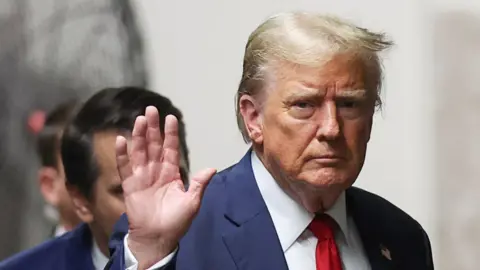
The president’s attorney pressed Cohen repeatedly about his guilty plea for lying to Congress, and aggressively questioned Cohen about previous statements that he did not believe prior tax evasion charges he pleaded guilty to were fair.
Several hours of similar questioning all led to the dramatic showdown over the 24 October 2016 phone call.
Mr Blanche first asked Cohen if he recalled receiving harassing calls in late October 2016. Cohen confirmed he had.
Mr Blanche then displayed communications between Cohen and Mr Trump’s bodyguard, Keith Schiller, on 24 October discussing how to deal with the prank calls.
Amid their discussions about the prank caller, is a call between Cohen and Mr Schiller, that Cohen previously testified he made to discuss the payout to Ms Daniels with Mr Trump. That call lasted a minute and 36 seconds.
Mr Blanche expressed scepticism that Cohen could have discussed both the prank caller and the six-figure payout in such a brief period.
But Cohen countered that part of that call was about “the 14-year-old” who was behind the calls. He knew that Mr Schiller was with their boss at the time, and the call was about more than just the harassment, he said.
Cohen insisted he always ran “everything by the boss” immediately, and that he did so on that call.
The response drew a dramatic reaction from Mr Blanche: “That. Was. A. Lie,” he declared loudly.
Numerous Republican members of Congress filled the benches behind Mr Trump on Tuesday in a show of partisan support.
A Trump campaign spokeswoman attended, as did his son, Eric Trump.
Reps. Matt Gaetz of Florida, Lauren Boebert of Colorado, and Andy Biggs were among the entourage, which was so large that some lawmakers had to sit in the back of the courtroom.
Cohen’s testimony has piqued public interest. The line to get into court stretched down the block Thursday morning, and journalists and members of the public had hired line sitters to save them a spot overnight.
One line sitter, whose employer did not show, offered others in line $400 for her spot.
Despite the immense public interest, however, the defendant did not express much enthusiasm in the courtroom: Mr Trump sat back silently in his seat for most of the morning session. At a few points, he focused intently on the cross-examination.
Though one of his biggest public nemesis sat just a few feet to his right, most of the time, Mr Trump just stared straight ahead.
“I think it was a very interesting day,” Mr Trump told the waiting cameras as he left the courtroom. “A fascinating day.”
(BBC)










Father Emir Sheikh Hamad bin Khalifa Al Thani, the architect of Qatar’s remarkable transformation into an ultra-wealthy modern nation with global influence, has been laid to rest in Doha following his death at the age of 74.
Sheikh Hamad’s death was announced on Sunday morning, and his simple funeral ceremony was held after the daily evening prayer at sunset at the Imam Muhammad ibn Abd al-Wahhab Mosque in the capital.
Mourners wearing traditional Qatari dress stood with their hands clasped in front of them during a funeral prayer, facing the shrouded body of Sheikh Hamad.
Afterwards, close family members, including his son and successor as emir, Sheikh Tamim bin Hamad Al Thani, carried his body out of the mosque. Sheikh Hamad was laid to rest at the Lusail Cemetery north of Doha.
Al Jazeera’s Zein Basravi said the ceremony was “a humble event” and Sheikh Hamad was “buried in a simple grave”.
“The simplicity really is in keeping with Islamic tradition but also emblematic of how the father emir carried himself in his life,” Basravi said. “He did not concern himself with the trappings of wealth but was focused on the welfare of his own people.”
During Sheikh Hamad’s reign from 1995 to 2013, Qatar’s gross domestic product rose more than 24-fold, largely because of his focus on developing the country’s massive gas resources. By 2006, the small nation had become the world’s largest exporter of liquefied natural gas (LNG).
[Aljazeera]
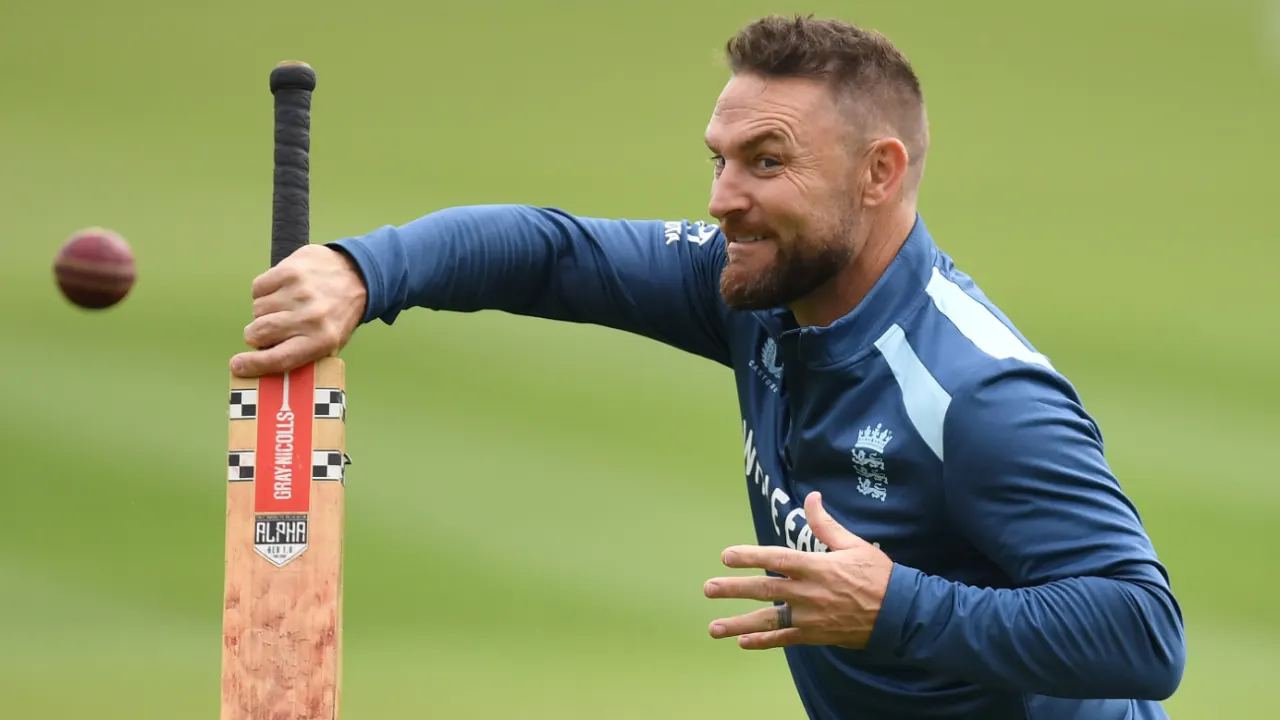
The ECB has sacked Brendon McCullum as England’s Test head coach but he will remain in charge of their white-ball teams. The decision leaves England’s Test team without a captain or a coach and comes barely three months after McCullum was publicly backed to continue despite overseeing a 4-1 defeat to Australia in last winter’s Ashes series.
McCullum described himself as “gutted” to lose a job that he had “absolutely loved”. He said in a statement: “Of course I’m gutted not to be continuing, but I respect the decision. My focus now is on giving everything I’ve got to the white-ball teams and helping England keep moving forward… I wish the Test team nothing but success.”
Richard Gould, the ECB’s chief executive, insisted in March that McCullum could “evolve” and learn from the mistakes made in Australia, saying that sacking him would have been the “easy” option. But only three Test matches later, in the wake of a 2-1 home defeat to New Zealand, the ECB has done exactly that, with Gould saying “the time is right” with next summer’s Ashes less than 12 months away.
“Brendon breathed new life into England Men’s Test team during an exciting period which saw some amazing victories, and we’re grateful for all he has given to the role,” Gould said. “We now believe that the time is right to make a change for the Test team as we target victory in the Ashes next summer.”
McCullum took charge of England’s Test team in 2022 and, along with captain Ben Stokes, inspired a run of 10 wins in his 11 matches in charge, as England played with uncharacteristic and unprecedented attacking flair. But results have tailed off badly since, and he leaves the job without a series win over either Australia or India.
Overall, McCullum’s record as Test coach stands at 27 wins, two draws, and 20 defeats, with seven of those losses coming in England’s last nine Test matches. His tenure both started and finished with home series against his native New Zealand: a 3-0 win in 2022, and defeat last month that culminated in Stokes’ sudden retirement.
McCullum said after England’s heavy defeat at Trent Bridge, where New Zealand clinched their series win, that his commitment to English cricket “has never wavered” and that he was “pretty sure the plan is that we just keep cracking on” when asked about his future as Test head coach.
But after a week of discussions with the ECB, he was informed on Saturday morning – before England’s fifth T20I against India in Southampton – that he would be removed from the Test job.
Rob Key, England’s managing director, decided two years ago to extend McCullum’s brief to include white-ball cricket when his contract was renewed until the end of 2027. McCullum now departs the Test job with over a year left to run on that deal, though will remain in charge of the white-ball teams until the end of next year’s 50-over World Cup in southern Africa.
The ECB said that the process to recruit a replacement for McCullum would begin immediately, and the decision means a return to the split coaching model that England used from 2022-24 when Matthew Mott was in charge of their white-ball teams. Potential candidates could include Andrew Flintoff, Richard Dawson, Ryan Campbell and Justin Langer.
Andy Flower, who coached England to three Ashes wins in 2009, 2010-11 and 2013, is also likely to be a target, though would need a lucrative contract to persuade him to resume a full-time international role given his success in the IPL with Royal Challengers Bengaluru.
Key said that it had been an “absolute privilege” to work with McCullum, and that he left the Test team “well-set and poised to achieve great things” despite recent results and the leadership vacuum. Harry Brook is the clear favourite to take over from Stokes as captain but the ECB must weigh up whether he can lead across formats.
McCullum had swerved questions about his own future on Saturday night after England’s win over India in Southampton sealed a 4-0 clean-sweep in the T20I series and took them to No. 1 in the ICC’s rankings in the format. His tenure as white-ball coach started with a group-stage exit at the Champions Trophy, though England reached the T20 World Cup semi-final in March.
“I’ve absolutely loved coaching the Test side and I’m incredibly proud of what we’ve achieved together,” McCullum said. “There’ve been some unbelievable highs and a few tough days along the way, but that’s all part of taking on a challenge like this. It’s been a privilege and an honour, and I’m grateful. Grateful to the players, the staff and the fans who supported us on the journey.
“I wish the Test team nothing but success. There’s a hell of a lot of talent in that dressing room and they’re a special bunch of lads. I’ll always be backing the boys, with a smile on my face, and hoping they keep taking the game on. I know they’ll continue to make people proud.”
[Cricinfo]
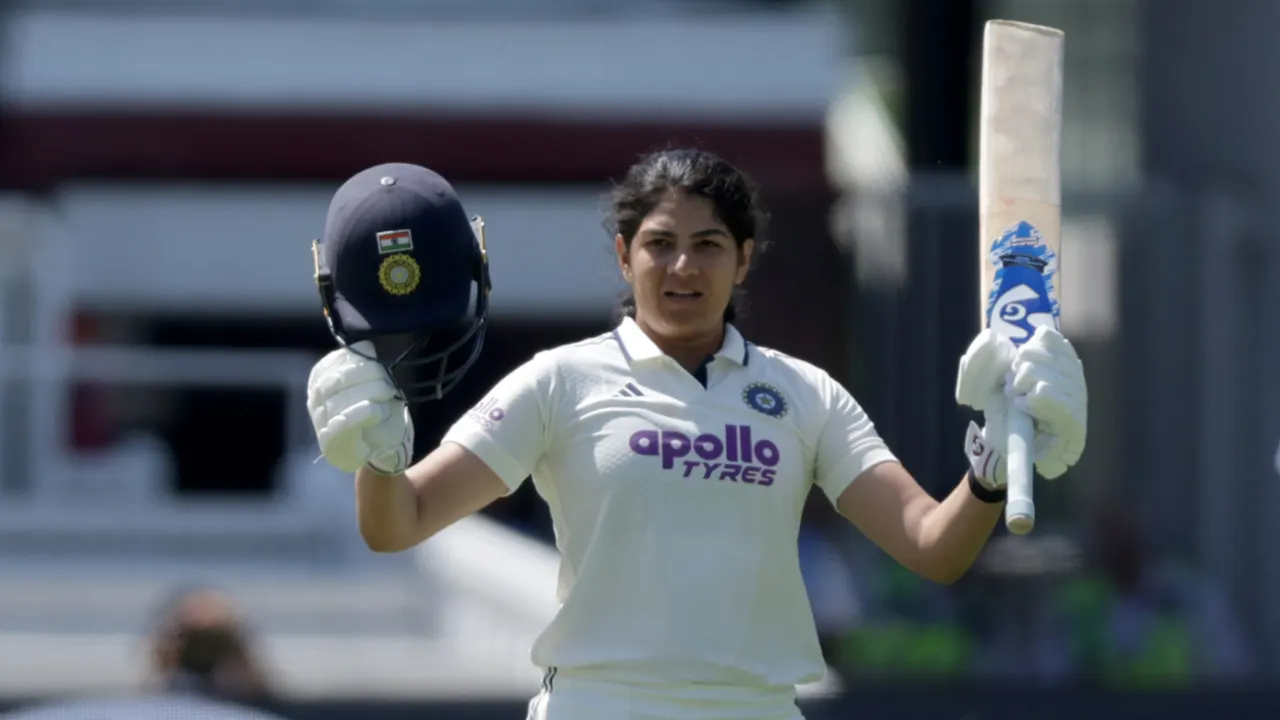
Yastika Bhatia followed India team-mate Kranti Gaud in etching her name onto the Lord’s Test honours boards with a maiden international century to guide India within touching distance of a massive victory over England in their historic match.
Sophie Ecclestone became the first Englishwoman named in the Lord’s Test bowling honours for her toil through 33.3 overs of India’s second innings to take 5 for 118, her fourth five-wicket haul in Tests. In all, Ecclestone bowled 55.2 overs for eight wickets, and her five-for came after Gaud won the race to be the first woman on the list with 5 for 37 on the second day.
Gaud continued her outstanding performance by ending the international careers of Tammy Beaumont and Heather Knight in a whimper, as England lurched to 59 for 5 in pursuit of 457. Amy Jones’ second half-century of the match offered enough resistance to ensure England take the match into a fourth and final day, but they do so still needing 327 runs with only four wickets in hand.
Beaumont, who announced two days before the match that this would be her last in an England shirt, fell for a first-ball duck to a beauty that nipped in, beat the inside edge and crashed into the top of off stump. Gaud curtailed her celebrations to join the India players in forming a guard of honour as Beaumont left the field.
Knight, who also announced that she would retire after this match two hours after leaving the field on Saturday evening, was also denied a fairytale farewell. With the match all but gone – India had set England the second-highest target in Women’s Test history – the best she could hope for was an individual innings of note. But she too fell to Gaud, caught at short leg by Richa Ghosh for 13.
Gaud, Sayali Satghare and Sneh Rana took two wickets apiece as Jones and Mady Villiers staged a 67-run stand for the sixth wicket.
Earlier, Bhatia had gone where fellow top-order batter Smriti Mandhana could not with her twin fifties in the match, falling 13 and 30 runs shy of her ton in each. Richa Ghosh also reached an unbeaten fifty, at which point India declared their second innings. Resuming on 39 not out with India one wicket down and leading by 269, Bhatia continued to grind England into submission.
She brought up her second Test fifty with an effortless drive down the ground off Lauren Bell and she punished Issy Wong for bowling too full and too wide by picking off boundaries with ease. She struck 14 fours all up and raised her ton off 145 balls with a drive off Wong through deep extra cover, punching the air in celebration as she ran a single.
The performance bookended a mixed tour of England for Bhatia, which began with a half-century in the opening T20I at Chelmsford – her first appearance in the format since April 2024 after undergoing knee surgery – and ended with a Test ton. In between, she made 41 runs in three innings of India’s T20 World Cup campaign, where they failed to make it out of the group stage.
Bhatia started the day surviving a failed attempt to drive at a Bell delivery which beat the inside edge and clipped off stump but didn’t dislodge the bails. She watched as Mandhana added just one to her overnight score of 69 before falling to Bell, well taken by wicketkeeper Amy Jones diving full-stretch to her right and collecting the ball millimetres above the turf.
Bell then accounted for Jemimah Rodrigues with one that jagged in to hit off stump. Soon after, she left the field suffering from abdominal muscle soreness, which kept her out of action for the remainder of the innings.
Cue Ecclestone, who had removed Shafali Verma on the second evening, to account for India captain Harmanpreet Kaur on this third day, although it took an England review to confirm Harmanpreet was plumb lbw.
Ecclestone had Deepti Sharma out in similar fashion, with one that turned in from outside off stump to hit Deepti on the back hip, before Bhatia holed out to extra cover. She claimed her fifth wicket bowling Sneh Rana with one that stayed low. She looked ready to collapse exhausted into her team-mates’ congratulatory embraces.
Richa, who relinquished the wicketkeeping gloves to Bhatia for this match, batted with freedom and was scoring at a run-a-ball when she was dropped on 43 by Wong at long-on off Ecclestone. She brought up her fifty with a single through the covers off Ecclestone, at which point Harmanpreet declared.
During the India innings, news broke of Brendon McCullum’s sacking as England Men’s Test head coach, continuing a theme of this summer where drama in those quarters has overshadowed the women’s events. Two weeks ago, Ben Stokes announced his international retirement in the middle of a Test against New Zealand, right as eventual T20 Women’s World Cup champions Australia were knocking India out of the tournament at Lord’s.
On this occasion, the England Women’s team might have welcomed the distraction as they crumbled. But for India, who comprehensively outplayed them, the limelight should be theirs.
Scores:
England Women 170 in 59.1 overs [Amy Jones 52; Kranti Gaud 5-37] and 130 for 6 in 40 overs (Amy Jones 52*; Sayali Satghare 2-19, Kranti Gaud 2-40) need 327 runs to beat India Women 285 in 74.5 overs [Smriti Mandhana 83, Harmanpreet Kaur 58, Deepti Sharma 57; Sophie Ecclestone 3-68] and 341 for 7 dec. in 86.3 overs (Smriti Mandhana 70, Yastika Bhatia 113, Richa Ghosh 50*; Sophie Ecclestone 5-118)
[Cricinfo]

Qatar’s Father Emir Sheikh Hamad bin Khalifa Al Thani laid to rest in Doha

Brendon McCullum removed from post as England Men’s Test coach

Yastika century, seamers put India on the brink of historic win at Lord’s

Showers will occur in the Sabaragamuwa, Western and North-western provinces and in Kandy, Nuwara-Eliya, Galle and Matara districts.

JSA opposes move to extend retirement ages of superior court judges

Next two weeks critical as dengue risk soars

‘Dates have the highest sugar content to fight Coronavirus’

Sunday Island 27 December – Headlines

#SundayIsland 17th December – Headlines

Sunday Island – 28th March

Sunday Island Headlines – 21 March

Sunday Island – 21st February – Headlines
-
 News3 days ago
Herath warns prospective migrant workers not to get fleeced by racketeers
-

 Midweek Review5 days ago
Unexpected focus on ‘pieces of tin’ worn by military men
-

 Features1 day ago
Prison riots and politics: NPP’s biggest challenge and Sri Lanka’s biggest opportunity
-
 Latest News6 days ago
Nyamhuri and Ngarava stun Bangladesh by defending 141
-

 Editorial2 days ago
What’s the world coming to?
-

 News4 days ago
Negombo Prison riot: Ensuring protection of prisoners fundamental responsibility of the state – UN
-
 Features3 days ago
Devanesan Annan – in Memoriam
-
 Foreign News3 days ago
Tensions erupt in Indian state after 11-year-old raped and murdered