
Latest News
Ukraine, brandy and EVs top the agenda on Xi’s charm offensive

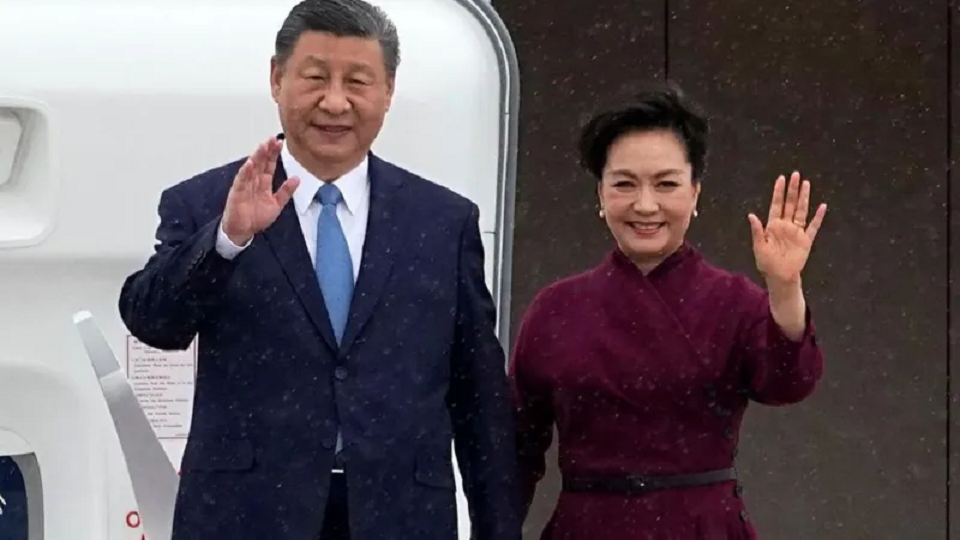
President Xi Jinping has hailed “new vistas” in China’s relationship with France on his first trip to Europe in five years – one that feels much like a charm offensive.
Mr Xi will be looking to avert the trade war that is looming with Brussels, driven by fears of cheap Chinese electric vehicles entering the European market.
The West also accuses China of helping Vladimir Putin wage war in Ukraine by supplying technology and equipment for the Russian military.
Both issues echo Washington’s words of warning to him in recent weeks, but it is not what Mr Xi wants his own people, or indeed those in France, to hear.
Instead, he is trying to win over the French and bolster China’s influence in Europe to counter any narrative coming from the United States.
He will also meet European Commission President Ursula von der Leyen during his visit to France. She has embraced a policy of “de-risking” from China, which includes tougher talk and cutting Europe’s dependence on Chinese imports and tech.
Later this week, he will make stops in Serbia and Hungary, allies of Moscow that have courted Chinese investment.
Mr Xi will spend most of Monday in talks with French President Emmanuel Macron.
Mr Macron will want to press Mr Xi on Beijing’s friendship with Moscow – and how far it is prepared to go to settle the war in Ukraine, especially as President Putin is scheduled to visit Beijing later this month.
The two will also discuss French brandy, China’s most imported type of spirit – Beijing is threatening to impose tariffs on it in response to the EU’s investigation into Chinese EVs.
That is an alarming prospect for French brandy makers who said last week that high tariffs would be a blow to the future of the industry.
Beijing is likely to be just as concerned about the results of the EU’s investigation into Chinese subsidies for EVs. Europe is a key market for China’s hugely successful electric car makers.
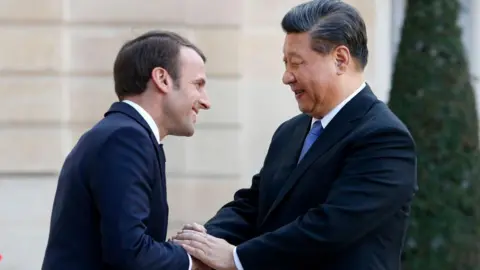
Mr Xi last visited Europe in 2019 (BBC)
So, winning over Mr Macron is key if Beijing is to, as China’s ambassador to France put it, “resist anti-China relations”.
To do that Mr Xi is highlighting the ties that bind Franco-Chinese relations together as the two celebrate 60 years of diplomatic relations.
The Chinese leader wrote an opinion column for the French newspaper Le Figaro and said he was coming to France with three messages: that Beijing was committed to opening up “new vistas” in its relationship with France; opening up “ever wider” to the world and to upholding world peace and stability.
Keeping with Beijing’s message, Chinese state media is also upbeat.
“China and France will light up their way forward with the torch of history, open a brighter future of China-France relations and make new contributions to world peace, stability and development,” said Xinhua.
It also highlighted President Xi’s love of French writers and artists and reported that his book has now been translated into French.
But there was also a word of caution: a Global Times editorial urged Europe to be independent and “especially not controlled by any third party”, a not-so-subtle reference to the US.
To put Paris in his corner, Mr Xi may see an opening with his French counterpart.
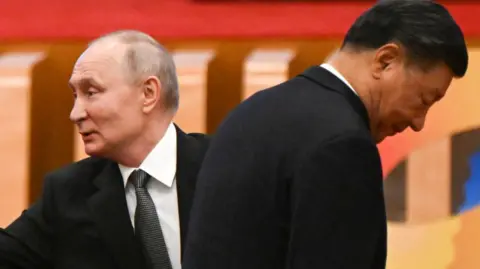
Beijing’s relationship with Moscow is a major source of contention (BBC)
President Macron has in the past pushed back on following US policies on China. He caused controversy during his trip to Beijing last year by saying Europe should not follow Washington “blindly” on Taiwan.
And while Mr Macron is one of the strongest backers of a raft of trade measures that have angered Beijing in recent weeks, he also wants Chinese companies to build their EV plants in France.
Even so, Mr Macron has proved he will be no pushover. Last week, as he was preparing to roll out the carpet for President Xi’s visit, he met Sikyong Penpa Tsering, the leader of the Tibetan government-in-exile, in Paris.
One of Mr Macron’s key priorities will also be to warn China of the danger of backing Russia in its invasion of Ukraine.
Like the United States, France and most of the EU want Beijing to stop supplying weapons components to Moscow.
“It is in our interest to get China to weigh in on the stability of the international order,” said Mr Macron in an interview with the Economist published on Thursday.
“We must, therefore, work with China to build peace,” he added.
President Xi has so far refused to do anything to stop Russia’s full-scale invasion of Ukraine.
In his Le Figaro opinion column he wrote that China “understands the repercussions of the Ukraine crisis on the people of Europe” and emphasised that Beijing is not “a party to or a participant in it”, adding that “China has been playing a constructive role in striving for peaceful settlement of the crisis”.
Whatever the outcomes of his visit to France, President Xi‘s visits to Hungary and Serbia will prove that China still has allies in the eastern corner of Europe.
(BBC)











The annual rugby encounter between Dharmaraja College and Kingswood College, played for the William Weerasinghe Memorial Trophy, is set to take place tomorrow (July 11, 2026), at 4:00 PM at the Bogambara Stadium, Kandy.
The official unveiling of the trophy took place this week at the Dharmaraja College premises with the participation of the Principals of the two schools, teachers-in-charge of sports, coaches, the Rugby teams, and several distinguished guests, including Dharmaraja College Old Boys’ Association President Mahesh Wijetunga, Kingswood College Old Boys’ Association President Muditha Abeykoon,
by S K SAMARANAYAKE

It has been reported quoting family sources that veteran singer Mariazelle Goonetilleke has passed away this morning (10) at the age of 68
She had been receiving treatment at the Kalubowila Teaching Hospital.
The US and Iran again traded strikes in exchanges that continued into Thursday, as observers reported a “dramatic” drop in the number of ships travelling through the Strait of Hormuz.
The US says it hit 90 military targets, some near the Strait. Iran says 14 people have been killed in the past two days.
State media also reported that targets near the Bushehr nuclear power plant were hit, citing the deputy governor of the province. The US has not commented on the latest strikes.
Iran said it targeted US assets in Kuwait, Bahrain and Qatar in response. Later on Thursday, Tehran launched more strikes on sites in Kuwait, Jordan and Iraq, state-linked media reported.
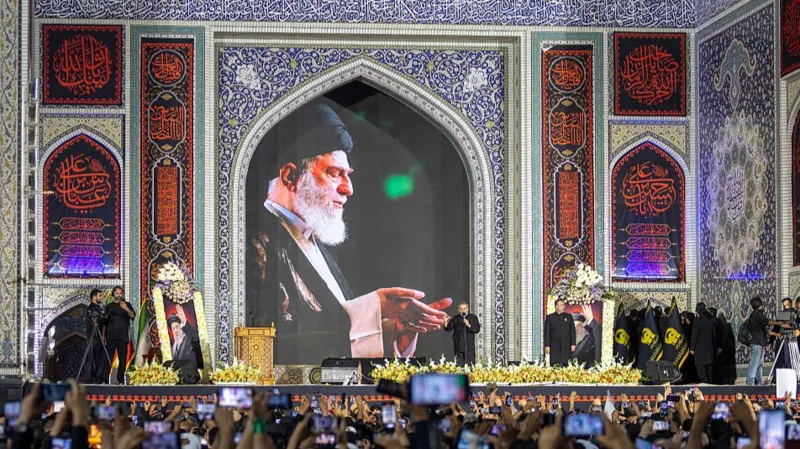
Separately, huge crowds gathered as Iran’s late supreme leader, Ayatollah Ali Khamenei, was buried after six days of funeral events.
Crowds massed on the streets of Mashhad in north-eastern Iran waving Iranian flags, while some were pictured holding signs carrying death threats directed at US President Donald Trump.
Khamenei was killed on 28 February during the first hours of US and Israeli strikes against Iran.
Iran’s foreign ministry denounced the latest US strikes as a “grave war crime”, describing the US administration as “evil and psychopathic”
Bridges and a railway route connecting Tehran to the city of Mashhad, where the late supreme leader’s funeral is being held, were also damaged, the foreign ministry said.
Iran’s health ministry said 14 people had been killed and 78 people injured across five provinces.
Gulf nations reported Iranian attacks following the US strikes, with explosions in Bahrain’s capital Manama, Kuwait intercepting missiles and drones, and Qatar issuing a security alert.
Later on Thursday, explosions were heard in Iran’s southern port of Konarak, with a local official telling Iran’s official news agency a navy site was attacked by an “enemy”.
However a US defence official told the BBC it had not carried out any strikes in Iran in recent hours.
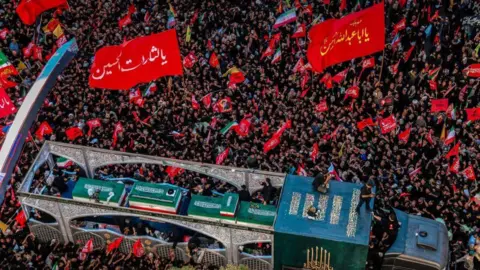
The funeral of Iran’s late supreme leader Ali Khamenei is being held in the city of Mashhad [BBC]
Iran’s parliamentary speaker Mohammad Bagher Ghalibaf, who is also the country’s chief negotiator with the US, said on X that America “still hasn’t learned that bullying and breaking promises are no longer cost-free”.
“Let me put it plainly: if you strike, you’ll get hit,” he wrote, adding that the Strait of Hormuz will only open under Iranian arrangements – not “American threats”.
US Central Command (Centcom) said the most recent round of strikes was carried out to “further degrade Iran’s ability to attack commercial shipping and innocent civilian mariners” in the vital waterway.
In a statement, it said it had struck 90 Iranian military targets, which included air defense systems and military logistics infrastructure along Iran’s coastline.
“The latest strikes follow successful execution of offensive strikes in Iran the night before,” Centcom added.
Phil Belcher, marine director at Intertanko, an international organisation for independent tanker owners, said the number of ships travelling through the Strait via the southern route closer to Oman was now in “single figures” following the step up in hostilities.
Belcher added that the overall daily figure of about 30 ships was down from about 70 a week ago and well below the normal number of 130 ships that was seen before the Iran war began earlier this year.
He told BBC Radio 4’s Today programme that there had been an “exuberance of optimism” around shipping in the region following the signing of the SMemorandum Of Understanding between Iran and the US last month, but now the mood has changed.
“This cycle of violence, this cycle of up-and-down, positive-negative news, it’s having an enormous impact both on business and on the seafarers themselves,” he said.
On Wednesday night Iranian state TV reported eight explosions in Bandar Abbas, and said two missiles had hit the ports of both Sirik and Jask – also in southern Iran.
It added that two projectiles had hit the island of Abu Musa, which has been the subject of a longstanding ownership dispute between Iran and the United Arab Emirates.
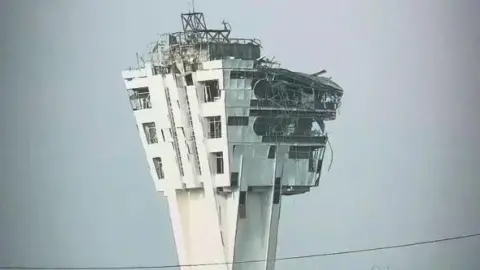
The extent of damage from the US strikes is not yet known, but Iranian media have reported power cuts in Chabahar and a fire at an Islamic Revolutionary Guard Corps (IRGC) barracks in Bushehr. Images on social media showed damage to a marine control tower in Chabahar.
Earlier on Wednesday, Centcom wrote in a statement that it held Iran accountable for “recent unjustified aggression against commercial shipping and civilian crews freely navigating a vital international waterway.”
President Trump said late on Wednesday that Iran had “called a little while ago” and wanted to make a deal “so badly”.
Trump added: “I just don’t know if they’re worthy of making a deal – I don’t know that they’re going to honour the deal, that’s the problem.”
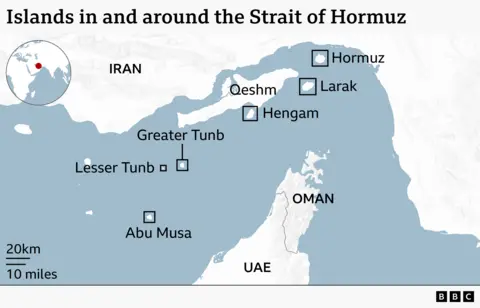
The current flare up has been the worst exchange of strikes between the US and Iran since the deal – known as a memorandum of understanding (MoU) – was signed on 17 June.
Trump said the ceasefire agreement signed last month with Iran was now “over”. He told reporters: “I don’t want to deal with them anymore, they’re scum. You know what scum is? They’re scum. They’re sick people.”
In response, Iran’s Foreign Minister Abbas Araghchi said in a post on X: “We do not answer vulgarity with vulgarity, but with action: fearlessly and with great valour.”
The deal between the US and Iran included 14 points, among them a 60-day period for a ceasefire during which negotiations should continue, the safe passage of vessels through the Strait of Hormuz and the US lifting sanctions on Iran.
The 60-day period for negotiations is not yet up, but Trump said he saw further talks as “a waste of time”.
[BBC]

Dharmaraja and Kingswood set for historic rugby clash on Saturday

Sri Lankan singer Mariazelle Goonetilleke passes away at the age of 68

Tensions erupt in Indian state after 11-year-old raped and murdered

US and Iran trade attacks as Khamenei is buried

Several spells of showers will occur in the Western, Sabaragamuwa and North-western provinces and in Galle, Matara, Kandy and Nuwara-Eliya districts

Canadian PM visits Saudi Arabia to strengthen energy, mining partnerships

‘Dates have the highest sugar content to fight Coronavirus’

Sunday Island 27 December – Headlines

#SundayIsland 17th December – Headlines

Sunday Island – 28th March

Sunday Island Headlines – 21 March

Sunday Island – 21st February – Headlines
-

 News6 days ago
Singapore-based Buddhist monk marks nearly four decades of humanitarian service
-

 News7 days ago
Freedom 250: US Embassy celebrates America’s 250th Independence Day through magic of American cinema
-

 News21 hours ago
Herath warns prospective migrant workers not to get fleeced by racketeers
-

 News5 days ago
AI concerned over proposed SL military deployment in Haiti
-

 Midweek Review3 days ago
Unexpected focus on ‘pieces of tin’ worn by military men
-
 Latest News4 days ago
Nyamhuri and Ngarava stun Bangladesh by defending 141
-

 Features6 days ago
The NPP’s New Challenge: Balancing Easter Lawfare and Economic Welfare
-

 News2 days ago
Negombo Prison riot: Ensuring protection of prisoners fundamental responsibility of the state – UN