
Features
MY FATHER

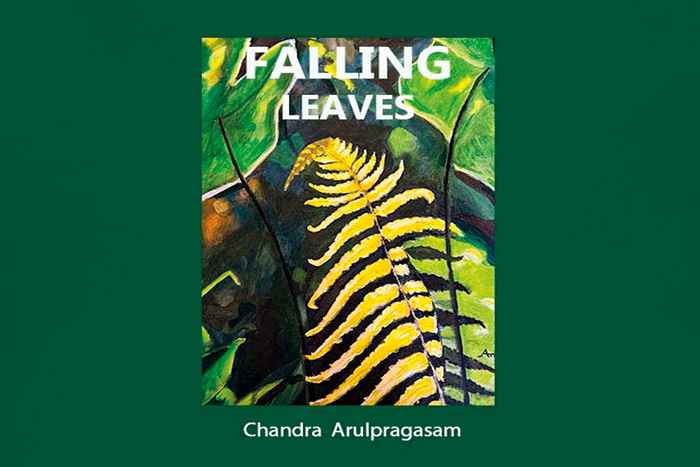
by LC Arulpragasam
(This is another excerpt from the book Falling Leaves, a part autobiographical anthology of articles by one of the last remaining members of the old Ceylon Civil Service, now living in Manila at age of over 95-years. A painting my the author adorns the book cover.)
My father was Dr. Albert Rajaratnam Arulpragasam. To my regret, I do not know much about him, because he kept to himself. He was born on June 12, 1890. He died in 1957 in Jaffna. By profession, he was a medical doctor working for the government of Ceylon, retiring at the age of 60 years. After a few years in Colombo, my parents retired to their home in Chundikuli (Jaffna) – a home he inherited from his sister. I (we) do not know much about my father, mainly because he was a very private, reticent and self-effacing man, who seemed reluctant to talk about his childhood or about his past. We, his children, must also be blamed for our lack of curiosity in regard to the man who quietly and uncomplainingly provided the means for us to go to the best schools and University in Ceylon and to embark on successful careers.
This lack of knowledge also arose partly because we were all the time in boardings and schools in Colombo, whereas my father was always stationed in the provinces, so that we never got to really know him. My sister, on the other hand, who spent a longer time at home, was able to dig out more stories from our reticent father. Hence, what I record below is information that I gleaned from my mother, who despite a lifetime lived with him did not know details of his past; and from my sister, who was close to him.
My father’s mother died giving birth to his sister (or soon after), when my father was just two or three years old. He and his baby sister were then sent off to their maternal grandfather’s home. My Dad’s father was a Postmaster by profession: he probably could not have undertaken to care for two baby children. He never remarried. As for my father, growing up in his grandparents’ home seems to have left an indelible imprint on his life and values. It also left a deep affection and loyalty to ‘look after’ his baby sister throughout her life. It may be that he had an unhappy childhood in this stern and austere home, which may be the reason for his reluctance to talk about his childhood: we shall never know.
His maternal grandfather with whom he grew up was the Reverend Seth Christmas, an Anglican clergyman. He was so named because he was born on Christmas day, given the name ‘Christmas’, and living up to his name, died on Christmas day! Growing up in the austere Reverend’s home seems to have instilled in my father certain ‘Christian’ values, as taught by the missionaries at that time.
Apart from the usual Christian commandments, they branded smoking and drinking alcohol as ‘sins’. When my father was told that my elder brother (who was already a medical doctor by then) was smoking, he confidently declared: ‘None of my children will ever drink or smoke!’ This hope and certitude was unfortunately betrayed by all three of his sons, who all smoked and drank!
This treatment of drinking as a sin is also illustrated by another story. At the usual ‘rag’ on initiation when entering Medical College, the seniors made the freshmen suffer all sorts of indignities. One of them was to drink half a bottle of arrack in one go. My father, true to his ‘Christian’ principles, refused to touch liquor. Try as they may, he refused to drink. Ultimately in disgust, they banged the bottle of arrack on his head and poured the contents over his head! Undoubtedly, silent obstinacy was one of his traits!
My father had his early education at St. John’s College, Jaffna. He thereafter finished his high-school education at Royal College, Colombo, which was the best school in those days. Fortunately for us, he insisted that all his sons attend Royal College too. He thereafter entered Medical College, and after obtaining his medical degree, joined government service as a doctor. My mother, going through his few personal things after his death, found the Gold Medal for Surgery, which he had won in Medical College. He seems to have won this over Sir Nicholas Attygalle (his batch-mate) who later became one of the the most recognized surgeons in Sri Lanka. This characterizes my father’s modesty, since neither his wife nor his children knew of this achievement before.
My father was not an impressive man, either in physical appearance (he was never smartly dressed) or in career achievement; nor was he worldly-wise. He was undoubtedly very intelligent – as seen by his achievements in medical college. This intelligence ran in his mother’s family: but so also did a strain of depression. For instance, his mother’s brother, S.K Rutnam (the husband of Dr. Mary H. Rutnam), despite obtaining an M.A. degree from Princeton University (USA) as early as 1915, ended his life in depression. Depression also seems to have run in other lines of the family, originating from my father’s mother’s side of the family.
I can list only some of the posts my father held as a government doctor – due to my lack of knowledge. As a bachelor, he seems to have served in different posts around Kurunegala in the North-Western Province. I know that he served as a doctor in the Jaffna hospital in 1927, since I was born during his stint there. He seems thereafter to have switched to the field of public health, after which he was posted as the junior doctor in Mandapam Camp, where I spent the first five years of my life.
He was then selected for a government scholarship to England for post-graduate studies in public health. On his return to Ceylon, he served as Medical Officer of Health in the Batticaloa District (during World War II) for five years. Thereafter, he was appointed as Port Health Officer in charge of all health measures in the port of Colombo, which was the busiest port in Asia at that time. When he was passed over for appointment as Director of Health Services in charge of the whole Department of Health, he opted for a transfer as Medical Superintendent of Mandapam Camp where he would be his own boss. This was a quarantine station located in South India in the charge of Ceylon government doctors, whose aim was to prevent infectious diseases such as smallpox and cholera being brought to Ceylon from India, mainly by plantation workers destined for the tea estates of Ceylon. He served in charge of Mandapam Camp for eight-10 years, until his retirement.
In the latter capacity, he was in charge of about 7,000 people covering about 700 acres of land. We lived in a posh house with all the modern amenities, a garden of more than two acres of land, two full-time gardeners and a swimming pool. He was also the boss of about 50 uniformed security guards (needed to keep the detainees under enforced quarantine), dressed in Indian military-style khaki uniforms, replete with puttees and turbans. These guards would salute him whenever he passed, even if on the other side of the road, springing to attention and saluting him in mid-flight. To which my father, a modest and self-effacing man, would respond with an embarrassed, downcast eyes-salute!
He was socially awkward in company – which was more than compensated for by my mother, who thrived on conversation. He was not really into sports, although he played soccer in his youth and played a passable game of tennis in his ‘forties. In Mandapam Camp in his fifties, having walked about two miles in the sun to the railway station (to pass the passengers in the Ceylon-bound train), he would come back home and recline in his easy chair, saying that he was ‘fagged’ (tired).
I have some funny stories to relate about his life as a young government doctor. When posted in a wild part of the country in British colonial times, patients would come to his clinics from remote villages. Once, looking down at his records, he called for the next patient – and a cow walked in! When posted in another remote town, he was assigned a government bungalow adjoining thick jungle. My father loved to have chickens pecking around his yard and enjoyed feeding them; whereafter, the chickens would spend the rest of the day foraging in the jungle.
One day, my father’s big boss from Colombo was coming on ‘inspection’. My father invited him to lunch, hoping to give him chicken curry. But when he went to look for his chickens, they were all away, foraging in the jungle. In desperation, he got out his shotgun and went into the jungle to hunt his own chickens!
When I grew up, I was amazed at the number of relatives whom my father had been financially supporting. He seems to have undertaken the responsibility of helping his mother’s sisters and their children. This was despite not having really known his mother, who must have died when he was barely two years old. He seems to have financed a nephew through medical school, while providing monthly financial aid to his two maternal aunts and their children. My mother did not object, because she knew that he considered this to be his duty: she also knew that although quiet, he was still a very stubborn man!
My father seems to have valued financial security more than making more money. He neither saved nor invested – even in a home. He seems to have spent his entire salary in supporting his children and his mother’s sisters and their families. My mother relates this example of his not caring for money. The government in those days accepted that while government doctors should work in the hospital during office-hours, they could thereafter see patients privately at home for a fee.
My father would not charge a fee even when patients were seeking to see him privately. My mother reported cases where he was called urgently to poor patients’ homes but still would not take a fee, despite bearing the cost of transport himself. Other doctors in the area were naturally upset, since all the patients were flocking to my father. He saw it as his duty as a doctor to treat all patients who came to him. The other doctors came to him to object, arguing that he should charge a fee – because he was offering unfair competition!
To overcome this dilemma, my father started working in the hospital till night, so that patients could see him free of charge. Finally to avoid this predicament altogether, he moved into the field of public health, where the Government provided an extra allowance in lieu of private practice. Instead of becoming a surgeon, he chose to move into a less-paying field, which paid enough for his needs -which included looking after his mother’s sisters and their families! He was not ambitious for himself: he was merely putting personal duty, as he saw it, before self.
I too had experience of his ‘money is not important’ thinking. I had by this time got into the Ceylon Civil Service. At the age of 27 years (in 1954), I was approached to be interviewed for the post of Marketing Manager at Unilevers (Lever Bros). I was selected for the post (as a trainee) and offered a salary (as a trainee) more than six times of that which I was earning in the Ceylon Civil Service.
Since I was undecided, I wrote to my father for advice. I did not expect the thundering reply that I received from my usually quiet and indulgent father: “I did not think that any of my sons would stoop to filthy lucre like this!” I was stung to the quick by this response, because I too had been brought up in his way of thinking! So I shamefacedly turned down the post – though I had other reasons too.
I remember that my father never touched me, either in love or in anger, beyond my age eight years. I cannot remember him ever cuddling or hugging me, although I heard that he did this when I was little. He always maintained a distance when we were older, seeming shy of his own children! On the other hand, he never raised his hand against me, nor ever beat or scold me or my siblings. Nor did he ever ask me to study, nor make any attempt to supervise or check on my studies – though I know that he was very interested in my school results, which were undoubtedly conveyed to him by my mother.
It is only when I reached maturity that I realized that he ‘ruled’ us not only by example, but also by expectation. I don’t think that he was subtle and devious enough to realize this: but he achieved this result without even trying! He lived by very high standards of duty and integrity: he merely expected us to do the same. These expectations filtered down to us not directly from him, but from various uncles and aunts, bringing a feeling of guilt if we did not live up to his high standards and expectations. He was not an impressive man either by outward appearance or career achievement, but as I grew older, I grew to respect him more and more for the highly principled man that he was.
He was a remote and uncommunicative father, whom we often reached only through my mother. This is with the exception of my sister who was more familiar with him because she grew up mostly at home. He was, however, very considerate and indulgent towards his children. Each time that I was leaving for school after the holidays at home, he would sidle up to me and without looking me in the eye (he was embarrassed), would shyly slip a wad of pocket money into my hand, saying stiffly “pocket money” and hurry away.
When I looked at the money, it was always too much. When I ran behind him to protest, he would hasten away in embarrassment. I had to go to my mother to ‘complain’ that it was too much, and give her ‘the excess’ to return to my Dad. I found out later that my elder brother too had habitually been doing the same.
I have to relate another episode that shows his indulgence towards his children. Once when I was at home on holiday (I must have been about 16 years old at that time – and a confirmed athlete and rugby player), I came to the verandah where he was reclining on his ‘easy chair’ to chat with him. I found him struggling to get out of his ‘easy chair’ in order to offer it to me, although there were many other chairs around! I had to entreat him repeatedly to please sit down in his own chair, in his own house!
I conclude with the following personal story, as a tribute to my father. After my degree, I undertook a survey of the Veddas, involving a walk of 250 miles through jungles and drinking dirty water. I consequently developed severe dysentery – and hardly managed to walk the 100 miles through jungles to get back to my starting point. When I finally returned to my starting point, I found that the person with whom I had left all my money (since I had no use for money in the jungle) had gambled it all away!
I was thus left with absolutely no money at all and unable to return to Colombo for urgent hospitalization. Sick, weak, desperate and almost collapsing, I spent the last 15 cents I had on bus fare to reach a place closer to Colombo. (I was foolishly trying to go towards Colombo – although I knew that I could not reach it!) In that God-forsaken place I came across a government dispensary at the edge of the jungle (near Padiyatalawa).
Meanwhile, night had fallen – and the dispensary was closed. I was desperate now, with no money even to feed myself. When I shouted for urgent medical help, a window opened and a double-barrel gun poked out, since this was a jungle outpost where bandits were at large. I shouted explanations in English, in order to sound ‘educated’. (I looked a bandit myself, clad in my khaki kit, which I had worn for months in a row, my slouch khaki hat and a four month beard).
Afraid and annoyed, the Apothecary shouted roughly, asking my name and what I wanted. When I gave my name (‘Arulpragasam’ was a very uncommon name at that time), he asked whether I was, by any chance, a relative of Dr. Arulpragasam. When I said that I was his son, his attitude changed completely. He said: “Come in, my son” – although he was a Sinhalese gentleman, and I was not his son.
He went on to say: “Your father was the best boss that I have ever worked for, and the most decent gentleman that I have ever known”. He gave me some food, and after treating me for dysentery, he even lent me money for a third class railway ticket (which was all he could afford) back to Colombo. Whenever I think of this episode, tears come to my eyes: for I remember that it was the name of my father that saved me on this most desperate day of my life!
My father died of a brain aneurism in Jaffna at the age of 67 years. He passed away before any of his sons could reach him, although my sister was able to do so. My father’s remains are buried in the graveyard at St. John’s Church, where he had worshipped as a boy. When the ‘Eelam war’ was over, I had the grave rebuilt and a new headstone installed. When I look at these photos now, it is with sadness: sadness because we did not show the love and respect for him that he had for us. He taught us, at least posthumously, what true love, integrity and duty really meant.
P.S. My father had endowed a prize at St. John’s College, Jaffna, for English Oratory. This was in honour of his father, Mr. Cornelius Arulpragasam. Jega (my brother) and I have augmented this endowment, renaming the prize as “The Cornelius and Dr. Arulpragasam Prize for English Oratory”. This prize serves to remind me of my father – and of my origins.







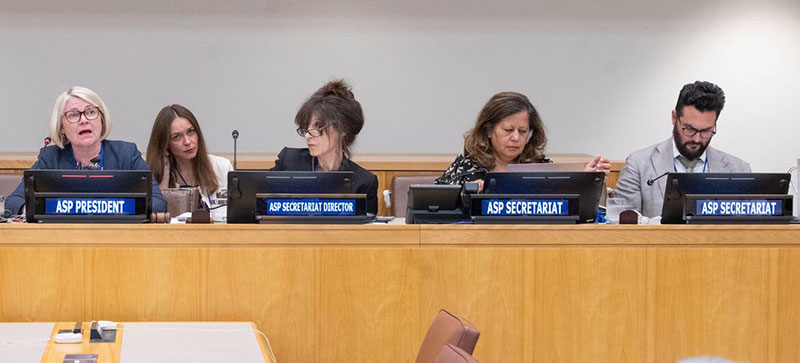
 US Secretary of State Marco Rubio’s warning to the International Criminal Court (ICC) was stark: ‘Either the ICC will end its threats, or we will end the ICC.’ It followed US central administration accusations that the court was unfairly targeting Americans on the basis of trumped-up war crimes charges.
However, a new plethora of sanctions has been clamped on the ICC by the US, which in turn has spurred accusations by sections of the world that the latter has unleashed an ‘assault’ on the international legal order.
What some of the sanctions would mean for the ICC was outlined by Rubio: ‘We will ban transactions with this rogue court, cutting off their resources and crippling their ability to operate against us.’
The ICC has shown consistency of purpose over the years. Despite some operational constraints it has indicted a large number of political strongmen from around the world, accused of war crimes and other governance excesses that come under its purview. Two such recent figures are: Russian President Vladimir Putin and Israeli Prime Minister Benjamin Netanyahu.
Rather than enjoy a mere nominal presence in the world community, the ICC has proved its effectiveness by detaining and bringing to justice scores of VIP politicians and others of their ilk who have been found guilty of human rights abuses and kindred excesses that come within the terms of reference of the ICC.
Accordingly, the international justice system would be stymied considerably as a result of the ICC being dis-empowered, particularly financially. Needless to say, potential and real perpetrators of the species of crime coming under the jurisdiction of the ICC would stand to gain most from such anarchic tendencies. That is, political repression globally would be enabled to enjoy a new lease of life.
A detailing of the types of crime coming under the purview of the ICC provides an idea of what it would cost the international community if the ICC’s operations are gravely hampered. They are mainly: genocide, war crimes, crimes against humanity and the crime of aggression.
That is, the part of the world to be worst affected would be the global South, since the latter is awash with the mentioned crimes. Needless to say, a chronically-disaffected South will sooner rather than later undermine the well being of the world dangerously. The world is already being put through these paces.
At the time of writing, ‘illegal migrants’ from the South, for example, are aggravating many a Western economy’s woes, besides creating for them acute law and order issues. The fact that these migrants’ presence goes on to become a virtual test of the migrant receiving states’ ability to forge domestic social inclusion in the face of jingoistic protests by mainly white supremacist groups is evidence of the latter. As is known, the US, to take just one example, has been up against this crisis for quite a while.
Accordingly, it will be in the best interests of the West if ‘illegal’ migrant arrivals on their shores are stemmed. If the socio-political and economic problems assailing the South are effectively managed through North-South collaborative, ‘trouble-shooting’ efforts the causes leading to ‘illegal’ migration and connected issues could be resolved at source as it were. For, it is the aggravation of the South’s material questions that lays the basis for the emergence of repressive and anti-democratic regimes in the hemisphere.
Until such time that the aforementioned issues in North-South relations are visited afresh and addressed urgently, a vibrantly functioning ICC would be needed. For, the latter would prove a deterrent to Southern political and military strongmen, highly prone to power abuse and like excesses, from coming into being in the wake of the South’s chronic material woes and the wars and conflicts that result from them.
It stands to reason then that the US would be acting in its own interests by enabling the ICC to perpetuate its mandate without hindrance. For a crop of issues that impinges negatively on internal law and order would be defused.
Meanwhile, there needs to be a meeting of minds among the rest of the West to put back in place a North-South dialogue process aimed at reducing some of the economic pressures that are weighing on the South.
Since economics usually drives politics it will be in the interests of the world community to scrutinizingly re-visit North-South issues of the past and put in place economic relief packages for Southern publics that would enable them to tide over their material hardships rather than permit the latter to aggravate into social disaffection and eventually armed militancy. It is the latter juncture that paves the way for the emergence of authoritarian rulers in the South who then go on to be a blight on their publics.
Accordingly, the Southern-based global development thinking of the past that envisaged a more equitable world economic order needs to be seen as an urgent need. That is, NAM’s international development paradigms need to be resuscitated to the extent possible.
It is unlikely that rightist governments of the West, such as the current Republican administration in the US, would find these projects feasible, but democratic states of Europe, led by perhaps the UK, are likely to think otherwise. For it would not be beneficial for the democratic world to be having on their hands repressive governments in the South who would be gravitating towards the major military and economic actors of the South, such as Iran and North Korea, who tend to be in constant power struggles with the West.
However, until such time that the mentioned, pro-people initiatives are given serious thought the ICC would need to be enabled by the international community to be in place comfortably and carry on with its mandate of bringing repressive rulers to book. Besides the ICC should pave the way for the peoples of the developing world to enjoy some substantial respite from the political repression and even terror which tend to be their lot.
Meanwhile, the wars of West Asia are relentlessly aggravating the economic hardships of people everywhere, driving the point home to enlightened sections that there is no alternative to peacemaking. A challenge is to convert the US under President Trump to this line of thinking.

 This week, I give you five simple, time-tested homemade remedies that help reduce the appearance of blemishes, control excess shine and leave your skin feeling softer and smoother.
The Honey and Lemon Brightening Dab:
For stubborn blemish marks, this is a classic. Mix one teaspoon of pure bee honey with three to four drops of fresh lemon juice. Apply gently, only on the affected spots, and leave for 10 minutes before rinsing with lukewarm water. While honey soothes and softens, lemon helps to brighten naturally. Use twice a week in the evening.
Besan and Rose Water Oil-Control Pack:
An ideal remedy to combat shine, especially on the T-zone. Take two teaspoons of besan (gram flour) and mix with sufficient rose water to form a smooth paste. Add a pinch of turmeric for its antiseptic goodness. Apply evenly, keep for 15 minutes and wash off. It absorbs excess oil without over-drying, leaving a beautiful matte finish.
Aloe Vera and Cucumber Ice Soother:
Blend fresh aloe vera gel with the juice of a grated cucumber and freeze the mixture in an ice tray. Each morning, wrap one cube in a soft muslin cloth and gently rub over a cleansed face for 30 seconds. It calms, tightens pores and imparts a baby-soft smoothness.
Oatmeal and Curd Gentle Polish:
Roughness and old blemish marks need gentle exfoliation. Combine one tablespoon of finely powdered oatmeal with one tablespoon of fresh curd (yoghurt). Massage very gently, in circular motions, for one minute, leave for five minutes and rinse. It removes dead cells and unveils softer, clearer skin.
Multani Mitti and Green Tea Magic Mask:
Brew some green tea and allow it to cool completely. Mix one and a half teaspoons of Multani Mitti (Fuller’s Earth) with the tea water to make a fine paste. Apply for 10 to 12 minutes – do not let it dry and crack completely – and wash off. It draws out impurities, fades blemishes and bestows a fresh, shine-free glow.
A Gentle Reminder:
As with any natural remedy, always do a patch test on your inner arm first. For those with oily or combination skin, avoid heavy coconut oil application and harsh scrubbing, as they tend to aggravate shine and blemishes.

 Dream of performing on a world stage? Well, here is your unique, golden opportunity!
The World Championships of Performing Arts (WCOPA) — the one and only official “Talent Olympics” — is the world’s premier global platform for aspiring singers, dancers, actors, models, instrumentalists, etc., to compete, shine and be discovered!
And, yes, this world stage is open to YOU, Sri Lankans living in Sri Lanka and overseas!
Held annually in glittering Las Vegas, WCOPA brings together over 70 countries, all competing for Gold, Silver and Bronze Medals, just like the traditional Olympics.

Lakisha Bernard: Will represent Team Sri Lanka at WCOPA 2027
Outstanding performers vie for the coveted titles of Junior and Senior Grand Champion Performer of the World, with winners and standout participants awarded over $500,000 in scholarships, cash awards and prizes to catapult their education and careers!
Sri Lanka is already making waves! At WCOPA 2026, Natharie Wickramasinghe, representing Team Sri Lanka, made the nation proud by winning a Bronze Medal in the Ethnic/Folklore Dance category!

Lakisha: Accomplished freelance Model and Fashion Design graduate
Recruitment for this prestigious competition is handled through a system of scouts and licensed National Directors — and this is where our very own Chris Rajendra, now based in Las Vegas, and National Director for Team Sri Lanka, comes into the scene.
If you are a singer, dancer, actor, model, instrumentalist — if you have talent burning inside you — contact Chris Rajendra today for registration and, who knows, you may find yourself in Las Vegas, and proudly draped in the Sri Lankan flag, at WCOPA 2027!
The contact address is: Chris Rajendra, wcopa.nationaldirector.sl@gmail.com
or chris.rajendra@gmail.com
Meanwhile, a star is born for 2027, in the form of Lakisha Bernard who is all set to represent Team Sri Lanka at WCOPA 2027.
Originally hailing from the sun-drenched coastal city of Colombo and now carving out her creative career in Canada, 22-year-old Lakisha is stepping into the international spotlight.
This accomplished freelance Model and Fashion Design graduate has officially been appointed as the Team Sri Lanka Promoter for Canada as she prepares to represent Team Sri Lanka at WCOPA in Las Vegas.
Lakisha brings a unique blend of high-fashion sensibility, captivating camera presence and expert garment design to the Team.
Having built her career, from local college shoots to high-glamour concepts, Lakisha’s inspiring journey embodies the true spirit of cultural bridge-building and creative resilience, bringing immense pride and recognition to Sri Lanka on the global stage.
WCOPA 2027 will be held at the legendary Westgate Hotel & Casino, Las Vegas, from 12th to 20th July – the very same iconic arena where the late, great Elvis Presley himself performed!
Your moment is now. Your stage is Las Vegas, so hurry and contact Chris Rajendra.

Showers or thundershowers will occur at most parts of the island

Prison rules to be revised over monks’ attire

AC President recuses himself from hearing prison attire case pertaining to Gnanasara Thera

Court orders steps to obtain INTERPOL Red Notice against Basil

CID informs Fort Magistrate’s Court investigation into money laundering case against Namal completed

No force used to make Gnanasara Thera wear prison garb – Prisons

‘Dates have the highest sugar content to fight Coronavirus’

Sunday Island 27 December – Headlines

#SundayIsland 17th December – Headlines

Sunday Island – 28th March

Sunday Island Headlines – 21 March

Sunday Island – 21st February – Headlines
-

 News6 days ago
NDB fraud Rs 60mn more than reported
-

 News6 days ago
Removing monk’s robes matter for Sangha to decide: Mahanayake Theras
-

 News5 days ago
NPP govt. reminded of its responsibilities as US warship leaves Colombo
-

 News4 days ago
Sri Lanka escalates anti-graft drive with Shiranthi’s jailing
-

 Latest News6 days ago
Farhan, Sadaqat help Pakistan ace 183 chase to go 1-0 up
-
 News6 days ago
BHC, Colombo: “LTTE remains a proscribed org. in the UK”
-

 Latest News4 days ago
Farhan and Sadaqat help Pakistan seal series in style
-

 News4 days ago
Iranian ships stranded, Lanka fears US sanctions