
Sports
Sri Lanka still rich with the legacy that Simpkin left behind


By a Special Sports Correspondent
Sri Lanka cannot help but recall the name of George Simpkin when it prepares players for international rugby assignments. The islanders are now preparing for the upcoming Division 1 tournament of the Asian Men’s Rugby Championships. There is still only speculation about who would be the likely coach. But already, three names are being floated in conversations within the rugby fraternity and even in some sections of the media; these names are Sanath Martis, Nilfer Ibrahim and Dushanth Lewke.
From what we hear as ‘news’ doing the rounds is that Sri Lanka Rugby (SLR) is yet to make that announcement. From what we’ve heard as unofficial news it seems that SLR is, this time around, banking on home grown coaches over foreigners in the build up to this international rugby event. We remember the days when the SLR always overlooked home coaches and signed contracts with foreign coaches in the wake of international tournaments. There was a time in this island when most of the local clubs had foreign coaches and also foreign players. Then what the SLR did was get one of these foreign coaches to handle the national side. This is understandable because when an expatriate rugby coach works with a club side and follows domestic rugby for an entire season he starts understanding the strengths and weaknesses of all the players featuring in the league tournament. Our protagonist in today’s article is Simpkin who initially visited Sri Lanka thanks to a coaching stint with the Chinese national side. He then ended up taking over the reins and preparing the Kandy SC side. Eventually he was roped into take over the Sri Lanka national rugby team.
Simpkin was enterprising where ever he went to coach rugby. His first bit of work or assignment with SLR was to be the rugby consultant of the national side preparing for the 2002 Rugby Asiad. At the time he arrived in Sri Lanka the national team was having mixed fortunes; during the worst of the times Sri Lanka even losing to Asian giants Japan by a thumping score of 129-6 at the year 2002 Asian Games in Busan, South Korea. That same year, the results in rugby were disastrous at the Rugby Asiad; Sri Lanka losing to Thailand with a score of 70 points to nothing. That year, at the Dubai Sevens, Sri Lanka lost all its matches. That was the background in rugby when Simpkin began work here with Sri Lanka Rugby. Simpkins, a New Zealander, loved to set foot in volatile environments and turn things around. He did just that with the Sri Lanka rugby team and its players.
After a few months of working with the national side he was able to lift Sri Lanka’s game. In 2003 (The following year) Simpkin’s chargers gave fancied Hong Kong a tough time in a ‘Test’ match played at Nittawela. Sri Lanka went down fighting 36-22 in this match which was billed as an IRB/ARFU international rugby fixture. Simpkin was breathing in professionalism and commitment into the side and the players and the management were happily getting infected with this ‘positive’ virus. The New Zealander’s presence here sent out a signal to the rest of the Asian countries that Sri Lanka had put its rugby in order. Before coming to Sri Lanka, Simpkin had coaching stints with the national sides of Hong Kong, Fiji and China. He was also credited in introducing new rules to the seven-a-side version of rugby to speed up the game and was a recognized international figure in the sport of rugby union.
He always made Sri Lankan players believe that their legitimate place in the Asian rankings was either third or fourth. That meant Sri Lanka would always play in the Asian Rugby Championship; unlike now where the islanders have been relegated to the Division 1 tournament and are playing against unrecognized rugby playing nations.
At the time Simpkin was here in Sri Lanka as head coach, the island’s rugby players could even draw inspiration from their big brother Japan. The Japanese rugby team took credit for producing the highest point scorer of all time at the rugby world cup. That accolade went to Toru Kurihara who accumulated a mammoth 60 points in world cup rugby and the year was 2003. Just to underscore the strength of the Japanese team in the Asian circuit that year, the ‘Cherry Blossoms’ smashed the daylights out of Chinese Taipei; notching up a score of 155 points to 3 against their hapless opponents.
Despite Simpkin’s presence here in the island, SLR didn’t stop experimenting with local coaches. These coaches were mostly put in charge of preparing the national team for overseas seven-a-side rugby tournaments. Though Sri Lanka managed to produce sparks of brilliance here and there (In rugby sevens) the overall result was depressing and it demanded that the SLR started seriously thinking about having a permanent ‘head’ coach for rugby. Simpkin slotted in perfectly in this role. He was appointed as SLR’s technical consultant in 2004. The New Zealander accompanied the junior national side for the Asian Championships in 2004 as Technical Consultant. That side was coached by C.P.P Abeygunawardene and had the services of Martis (Mentioned above) as Assistant Coach.
Martis once told this writer, “When Simpkin is in the coaching team there is nothing much the others can do except follow his plan; which is always flawless”. The high point in Simpkin’s coaching stint here came during the qualifiers for the 2007 rugby world cup. In these matches held in 2005-6 Sri Lanka beat teams like Thailand, Singapore and Kazakhstan before going down fighting to Hong Kong.
There was another reason for Simpkin to visit Sri Lanka often; even if he wasn’t involved in rugby coaching. He was suffering from acute arthritis and benefited immensely through ayurvedic treatment which he received in Sri Lanka.
After his exit as the national coach, Sri Lanka rugby took a dip. The islanders were in the news for all the wrong reasons; Sri Lanka gained a black mark in the sport for producing a player guilty of taking a banned substance, some players were guilty of indiscipline for making rugby tours abroad as spectators when their presence was needed here to prepare for the Asian tournament. Several players made themselves unavailable for national duty and chose to play club rugby instead. SLR then experimented with a horde of foreigners as national coach after Simpkin and there was at least one who vanished without a trace during a national assignment.
Several years later, when rugby was lifting its head after the Covid pandemic, we head the sad news of Simpkin breathing his last. This rugby legend who was born on May 22, 1943 died in 2020; just a few days short of his 77th birthday. Sri Lanka still has fond memories of this New Zealander and the seeds that he sowed in this island have the potential to produce ‘a rich harvest’ in the field of rugby.


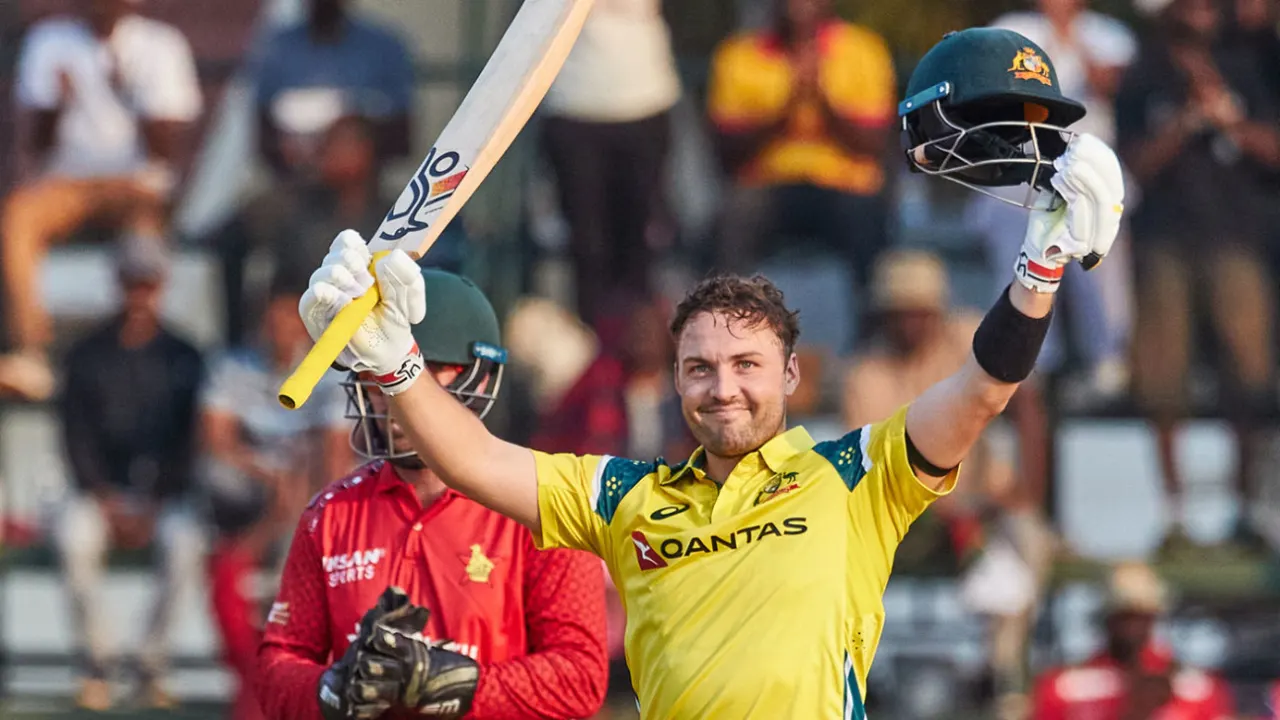
Australia concluded their first Zimbabwe tour after 12 years with a clean sweep of the hosts, who were unable to deliver a consolation win to a festive Harare crowd, as Nathan Ellis held his nerve alongside No. 11 Spencer Johnson in a match-winning tenth-wicket stand of 27. Zimbabwe do not have any internationals at home for the rest of the 2026 and, after posting their second-highest total batting first against Australia, saw the match slip from their grasp in the dramatic closing stages.
Pressure changed sides throughout the last quarter of the contest. Australia were cruising on 162 for 3 in the 26th over, when Brad Evans removed Alex Carey for the third of his four wickets and set the cat among the pigeons as wickets fell regularly. Josh Inglis was holding the chase together with his second ODI hundred but when he fell 45 were still needed. Then Ellis, who had earlier taken 3 for 50, put together a superbly-measured 36 not out to secure a thrilling win.
Their chase was built largely on the efforts of Inglis, who was the third Australian to reach a hundred in the series, after Matt Renshaw in the opening match and Travis Head in game two. In contrast, Zimbabwe did not have a century-marker, though Sikandar Raza and Craig Ervine scored two fifties each, including in this match and were the leading run scorers across the three matches.
Zimbabwe also had two of the three top bowlers and will know that it was in moments, not personnel terms, that they lost to Australia. In this match, there were four major ones. The first came when Innocent Kaia, batting well on 55, had to retire hurt with what looked like a hamstring injury to interrupt an 80-run fourth wicket stand with Ervine and stall Zimbabwe. The second was when Ervine, on 59, tried to accelerate with 10 overs left to go and holed out to long-on to spark a collapse of 4 for 22 which left Zimbabwe short of the 300 that was in their sights.
Then, in the field, Inglis, on 48, cut Ernest Masuku in the air to backward point and Wessly Madhevere leapt to his right but could not hold on. The drop proved costly even though Madhevere took a stunner to dismiss Carey. Madhevere’s biggest mistake was still to come. In the penultimate over when Ellis launched Masuku to deep midwicket, Madhevere got under the ball and spilled the chance.
With nine runs needed off the last six balls, Raza then gave Madhevere the ball, even though Graeme Cremer had an over in hand having caused problems in his first ODI in 2018. The first ball went for six and left Madhevere inconsolable at the end.
Inglis was in early after Evans struck twice in his first two overs. He had Head caught at deep backward square when he flicked off his pads and then found Mitchell Marsh’s inside edge to leave Australia were 25 for 2 in the fourth over. Inglis announced himself with a swivel pull that went for four and was brutal through the point area. He greeted Cremer’s return by sending his first ball – a full toss – through mid-on for four. But Cremer came back well and bowled Cooper Connolly with a classic leg break to announce his return in some style.
Inglis and Carey put on 85 for the fourth-wicket to keep Australia in control and Inglis’ big challenge came when Australia started to wobble. They were on 203 for 5 after 35 overs, 69 runs away from victory, and in the space of two overs Raza had Ollie Peake out lbw and Cremer got Xavier Bartlett with a googly. Then, Blessing Muzarabani was brought back to keep Australia under pressure and bounced Ellis, who fended him skywards but the chance fell out of Brendan Taylor’s reach. Muzarabani finished the series wicketless.
Inglis reached his century with a strong sweep against Cremer off his 94th ball and victory was still 55 runs away. When Raza bowled Inglis in the 42nd over, Zimbabwe were ahead in the contest but the management of their attack towards the end will raise questions. Muzarabani was bowled out after 44 overs and Evans with two overs to go. Cremer, despite his experience, was overlooked for his final over.
That won’t be the only area Zimbabwe will leave with questions. Their batting line-up underwhelmed in parts, especially after they chose to put runs on the board in the final match. They started off reasonably well and were on 34 without loss after six overs before their opening pair gave way.
Ben Curran’s poor returns in white-ball cricket continued when he gloved Johnson down leg and was caught behind for 7. His partner Brian Bennett didn’t fare much better. After showing promise with classy flicks off the pads and crunching pulls off short balls, Bennett skied a Ellis delivery to Head at midwicket to depart for 30. Bennett has not crossed 40 in his last eight ODI innings, despite getting several starts. Zimbabwe were 57 for 2 at the end of the powerplay.
Taylor took his time to get to a 16-ball nine before he was bowled by an Adam Zampa flipper and his form will also be a concern. Kaia, whose first runs had come off a thick inside edge, offered a chance on 27 when he was out of his crease early as Renshaw fired in a delivery down leg. Inglis fumbled and recovered but could not stump Kaia, who put the early jitters aside to play some classy strokes. He drove Renshaw through mid-on and pulled Johnson flat and hard to bisect the fielders in the deep. His fifty came just after the innings’ halfway mark, off 59 balls, and marked the first time he had crossed the milestone in 12 innings, since January 2023.
Kaia and Ervine got Zimbabwe into a good position and when Kaia retired on 148 for 3, it was up to Raza and Ervine to accelerate. They brought up the Zimbabwean 200 with 10 overs to go but the final flourish never came. Ervine was eager to up the ante but could not clear Renshaw at long-on and Madhevere sent an Ellis slower ball to cover to give Australia two wickets in two overs.
Evans showed glimpses of his finishing skills with back to back fours off Johnson but then top-edged a short ball to give Johnson a second wicket and Cremer was out lbw to a pinpoint Ellis yorker. Raza reached fifty soon after that and farmed strike for the final five overs to end unbeaten on 81 which gave Zimbabwe a competitive total, but agonisingly not quite enough.
Scores:
Australia 272 for 9 in 49.5 overs (Josh Inglis 103; Brad Evans 4-47, Graeme Cremer 2-53, Sikandar Raza 2-42) beat Zimbabwe 271 for 8 in 50 overs (Innocent Kaia 55 retired hurt,Craig Ervine 59, Sikandar Raza 81*; Spencer Johnson 2-50, Nathan Ellis 3-50, Adam Zampa 2-53) by one wicket
[Cricinfo]

Kenya’s Agnes Ngetich took a second off the women-only half-marathon world record on Sunday when she won the World Athletics Road Running Championships in Copenhagen, stopping the clock at one hour, five minutes, and 15 seconds.
Ngetich, who also broke the women-only 10km (6.2-mile) world record last year, pushed to the front from the outset on a sunny morning in the Danish capital and led until the end, finishing 50 seconds ahead of compatriot Veronica Loleo, who came in second.
The previous record was set by Peres Jepchirchir, another Kenyan, when she won the World Half Marathon title in Poland in 2020.
The overall women’s half-marathon world record is held by Ethiopia’s Letesenbet Gidey, who clocked 1:02:52 in 2021 at the mixed-gender Valencia Half Marathon in Spain.
Sunday’s win was the latest major title this year for the 25-year-old Ngetich, who also won the team half marathon in Copenhagen and the World Cross Country Championships in Florida in the US in January.
(Aljazeera)

Trophy row unlikely to repeat in Japan

Powerful explosions at Syrian army site near Aleppo injure at least four

Government committed to ensuring the rights of children with disabilities and providing equal opportunities – PM

Ellis and Inglis break Zimbabwe hearts to secure one-wicket thriller

Kenya’s Ngetich breaks women-only half-marathon world record by a second

Showers about 100 mm are likely at times in the Western, Sabaragamuwa and North-western provinces and in Galle, Matara, Kandy and Nuwara-Eliya Districts

‘Dates have the highest sugar content to fight Coronavirus’

Sunday Island 27 December – Headlines

#SundayIsland 17th December – Headlines

Sunday Island – 28th March

Sunday Island Headlines – 21 March

Sunday Island – 21st February – Headlines
-

 News5 days ago
US embassy won’t comment on IGP’s probe into joint drug raid
-

 News4 days ago
Bid for Basil’s extradition nears final stage: Police
-

 Features7 days ago
The emptying university: why are academics leaving?
-

 News3 days ago
Shanakiyan urges urgent action over reported death sentence for Lankan in Saudi Arabia
-

 Business5 days ago
All-new Bolero MaXX unveiled in Sri Lanka
-
 Opinion7 days ago
Who committed genocide and created mass graves in Sri Lanka?
-

 Opinion5 days ago
A journalist who wrote across the divide
-

 News2 days ago
Namal Rajapaksa Buddhist gambit fails, bail denied