Connect with us

Sports

Trophy row unlikely to repeat in Japan

Published

on

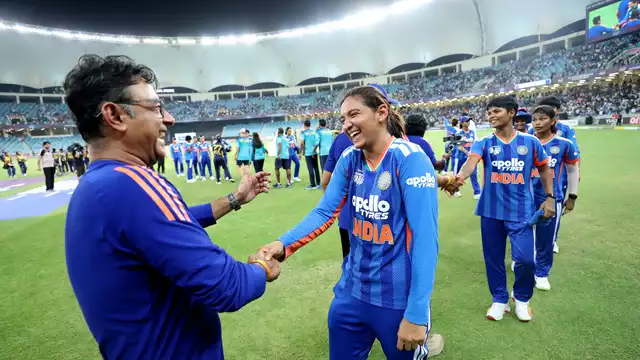
The Indian women’s team, like the men’s side a year ago, refused to accept the trophy from Mohsin Naqvi in Dubai [Cricbuzz]
Will the Asia Cup trophy fiasco play out in the Asian Games? That is the obvious question on everyone’s mind as the Indian women’s team, favourites for the gold medal, prepare to take on Sri Lanka. The Indian women’s team, like the men’s side a year ago, refused to accept the trophy from Mohsin Naqvi in Dubai last week.
There is always a chance that Naqvi, by virtue of being the president of the Asian Cricket Council (ACC), could be an invitee at the Games. Will he be accorded the privilege of presenting the medals in Nagoya? Chances are that he may, well, not be.
With India having strong diplomatic relations with Japan, Dubai is unlikely to be repeated in Nagoya. The two countries recently announced special measures to commemorate 75 years of friendship. As part of this, India, the World’s No. 1 side, agreed to play Japan.
For the reigning world champions to take on an associate nation, ranked 41st, is no ordinary gesture. It involved the governments of the two countries, besides, of course, the Board of Control for Cricket in India (BCCI) and the Japan Cricket Association (JCA) to work out the fixture. The September 22 game, thus, is far from being a routine bilateral match.

Neighbours Nepal, who have been a rising team in world cricket, have not had the opportunity of playing India in a bilateral international so far. Japan has been given such a significant opportunity, and unlikely the country will allow any embarrassment for the Indian side. The Naqvi-led ACC will have little say.
“That is my reading,” said a member of the ACC. “I think Japan will not allow it. India’s gesture of playing Japan will not go unacknowledged.”
The decision on the chief guest for the medal event will, of course, be the prerogative of the Olympic Council of Asia (OCA), but the Japanese Olympic Committee (JOC) and the Aichi-Nagoya Asian Games and Asian Para Games Organizing Committee (AINAGOC) will have a major say in the matter. Both bodies are expected to be mindful of India’s concerns.
The BCCI has stayed clear of the issue. After Friday’s AGM, Devajit Saikia said he would refrain from commenting on a hypothetical situation of India being on the podium and Naqvi presenting the medals. “The teams have to first reach the podium. We will take a call then, taking into account all prevailing factors at that moment. We will cross the bridge only when we reach it,” the BCCI secretary told ToI.
A delegation of the Indian Olympic Association (IOA) is in Nagoya, but sources within the IOA declined to discuss the matter. It is unlikely that the IOA has made a representation to the OCA, JOC or AINAGOC on the issue.
There is also no immediate information on whether Naqvi will travel to Japan at all. A spokesman for the Pakistan Cricket Board (PCB) told Cricbuzz that his visit to Japan is doubtful. “I don’t think so,” he replied to a query from this website. It may well be that the PCB spokesman may not have the travel plans of the country’s Interior Minister. In any case, Naqvi is known to make decisions at the last minute. He landed in Dubai just about 30 minutes before the Women’s Asia Cup final was due to end last Sunday.
The BCCI officials, however, will be there in Nagoya. Saikia himself confirmed that he would travel to Japan on October 1 and stay on for the men’s final, which will be held on October 3. The Indian men’s cricket team is scheduled to travel to Japan late on Saturday night. The two finals are on September 22 (women’s) and October 3.
As previously reported by Cricbuzz on August 12, India and Pakistan teams – both in men and women – are drawn to meet only in a medal contest – either for the gold or for bronze. There is also a possibility that there may be no India-Pakistan matches in Japan at all.


Continue Reading
Advertisement
Click to comment

Leave a Reply

Your email address will not be published. Required fields are marked *

Latest News

Mirabai Chanu wins Asian Games silver as Ri breaks weightlifting record

Published

on

By

L to R, India’s Mirabai Chanu, North Korea's Ri Song Gum and Luluk Diana Tri Wijayana of Indonesia pose on the podium at the medal ceremony for the weightlifting women's 49kg, September 23, 2026 (Aljazeera)

North Korean weightlifter Ri Song Gum has broken three world records en route to winning gold in the women’s 49kg (108lbs) competition, which saw India’s Mirabai Chanu win an elusive Asian Games medal by finishing second.

Ri gave North Korea its first gold of the games in Nagoya, Japan, on Wednesday, joining an elite club of four weightlifters who have won three Asian Games gold medals.

The 28-year-old hauled 94kg above her head in the opening snatch discipline – the first official segment of the competition where athletes lift a barbell from the floor to an overhead position in a single motion. The lift was 1kg heavier than the previous world record of 93kg.

Ri followed it up by breaking the world record twice in the 115kg clean and jerk – a two-part movement where a barbell is lifted from the floor to the shoulders and then pushed overhead. The 4ft-7in (139.7cm) weightlifter hoisted 116kg and 121kg above her head.

Ri’s total lift of 215kg obliterated the old world record total by 7kg.

She is the fourth lifter, and first woman, to win three Asian Games weightlifting golds and joined Iran’s Mohammad Nassiri (1966-74), South Korea’s Kim Tae-hyun (1990-98) and Iran’s Behdad Salimi (2010-18), who all won three gold medals. No athlete has won four weightlifting gold medals.

Ri joined an elite club of just four weightlifters who have won three Asian Games gold medals
Ri joined an elite club of just four weightlifters who have won three Asian Games gold medals [Aljazeera]

In the same category, India’s Chanu finally won an Asian Games medal at the third time of asking. She won a silver medal at the Tokyo Olympics in 2021.

The 32-year-old is India’s most decorated weightlifter, with three Commonwealth gold medals and a silver to her name, along with multiple global titles.

She lifted a total of 198kg after a snatch of 87kg and a clean and jerk of 111kg, while Indonesia’s Diana Tri Wijayana took bronze with a total of 191kg, comprising 88kg and 103kg.

Chanu’s silver also ended India’s 28-year wait for a weightlifting medal at the games since Karnam Malleswari won silver in 1998.

Mirabai Chanu Saikhom of India competes during the women's 49kg weightlifting final at the Asian Games in Nagoya, Japan, Wednesday, Sept. 23, 2026. (AP Photo/Dita Alangkara)
Mirabai Chanu during the women’s 49kg weightlifting final [Aljazeera]

(Aljazeera)

Continue Reading

Sports

No hiding place after another batting collapse

Published

on

Charith Asalanka’s dreadful run in the middle order continued as he fell for another low score at Chester-le-Street

Just when you thought Sri Lanka had finally turned a corner by bowling England out inside 49 overs for 265 and sensed an opportunity to register their first win of the tour, along came another batting horror show to bring everyone crashing back to earth.

Bowled out for 176 in 37 overs, Sri Lanka slumped to yet another humiliating defeat. The statistic that really rubs salt into the wounds is that after four games on tour, not a single Sri Lankan batter has managed a half-century.

Had this happened with Jofra Archer breathing fire and blowing the top order away for under 200 you could perhaps have understood. Had Gus Atkinson made the new ball talk and run through the batting, as often happens to subcontinental teams in northern England, there might have been some mitigation.

But when a part time off-spinner walks away with a maiden five wicket haul and career best figures, there is nowhere to hide. To put it bluntly, the batters should hang their heads in shame.

There was no character. There was no application. Most worryingly, there was precious little evidence of batsmen thinking on their feet.

Against spin, the sweep appears to have become the only scoring option in the playbook, while footwork seems to have been thrown out of the window. The sweep, conventional or reverse, can be a devastating weapon when produced unexpectedly, before the opposition has set a field for it. But when it becomes your staple diet, bowlers do not need to be rocket scientists to work you out. Sooner or later, the high risk stroke will bring about your downfall.

That was precisely what happened at Chester-le-Street on Tuesday night.

Charith Asalanka was once one of Sri Lanka’s finest finds, a batsman capable of holding the lower order together and dragging the side towards competitive totals. An ODI average of 41 and five hundreds speak volumes about his ability. Of late, however, he has been dismissed tamely far too often. You can only hope this does not become another case of a rich talent being allowed to drift away.

One of the few things that has worked consistently for Sri Lanka in limited overs cricket over the last 18 months has been the opening combination of Pathum Nissanka and Kusal Mendis. There is an old rule in sport: if it ain’t broken, don’t fix it.

Yet Mendis has been pushed down the order and Kamindu Mendis promoted to open, leaving you wondering what exactly Sri Lanka are trying to achieve. Kamindu is badly needed in the middle order, particularly against spin. Removing him from that role merely weakens an area that is already crying out for stability.

Amid the wreckage, there was at least one encouraging sign in leg-spinner Sachindu Colombage. Hailing from Negombo, the 28-year-old has hardly set domestic cricket alight in recent seasons, but his unusual action caused England problems, with several batsmen struggling to pick him. He marked his debut with three wickets and gave the selectors something to think about.

More significantly, his inclusion kept Wanindu Hasaranga on the sidelines. After what unfolded in the final T20I, perhaps that was no bad thing either.

Continue Reading

Sports

Madushani aims for personal best in Nagoya

Published

on

Madhushani Herath

by Reemus Fernando

Triple jumper Madushani Herath and the 4×400 metres mixed relay team face an uphill task as Sri Lanka’s track and field team begins its Asian Games campaign in Nagoya, Japan, today.

‎Bahrain, India and Kazakhstan, who claimed podium places in the mixed relay at the last edition, are joined by China, hosts Japan and Sri Lanka in what promises to be an intriguing battle for medals in the Games’ first relay event. Kazakhstan, China and India go in as favourites, having produced the leading times this season.

‎For Herath, 2026 has been a breakthrough year. She shattered the national record that had stood unchanged for seven years, with the national champion clearing a new mark of 13.68 metres earlier this season.

‎With a strong field of Uzbek, Chinese and host-nation athletes on show, Herath will need a top-level performance to secure a podium finish in the women’s triple jump. Uzbekistan’s Sharifa Davronova, a two-time World Junior Champion, leads the Asian rankings this season with a leap of 14.24 metres at the Asian Under-23 Championships in July, and she will look to defend the title she first won as a 17-year-old in China. At least three other athletes have also cleared the 14-metre mark this year — China’s Yi Li and Yingying Huang, and Japan’s Maoko Takashima.

‎Herath’s coach, Krishantha Kumara, said a personal best would be a realistic target for the former Nannapurawa M.V., Bibila athlete. “Anything can happen. We were targeting to peak during this period. She broke the national record during the preparation phase. However, we have set a realistic goal of her reaching a personal best,” Kumara said in an interview with ‘The Island’ on Wednesday.

‎The Asian Under-20 Championship silver medallist is currently an undergraduate at the University of Kelaniya.

Continue Reading

Trending