
News
Illicit artificial toddy trade deprives govt. of Rs. 80 billion in revenue annually

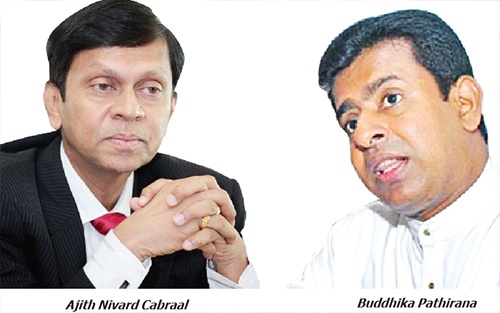
State Minister promises remedial action
By Saman Indrajith
One of the topics that kept reverberating throughout the budget debate that ended in parliament last Wednesday was the drain of excise revenue as a result of loopholes in the tax net by artificial toddy manufacturing businessmen.
Various facets of the issue were raised by SJB Matara District MP Buddhika Pathirana during the question time on three separate days highlighting the severity of the damage inflicted on the national economy by tax evading toddy businessmen who deprive the government coffers of a whopping Rs. 80 billion annually.
Following the disclosure by MP Pathriana, State Minister of Money & Capital Market and State Enterprise Reforms Ajith Nivard Cabraal promised remedial action.
Commissioner-General of Excise, Ariyadasa Bodaragama, acknowledged that there exists a tax leakage but he was wary of the figure of Rs. 80 billion.
Bodaragama is due to retire at the end of the month. Deputy Commissioner-General of the Inland Revenue Department, M. J. Gunasiri has been named as his successor.
Challenges before Gunasiri, as the new Excise Commissioner-General, are enormous, and whether he would be able to help Minister Cabraal deliver on his promise remains to be seen.
As Gunasiri earlier served as Deputy Commissioner-General Tax Administration (Corporate Small Entities & Non Corporate Sector) at the Inland Revenue Department, his expertise may be useful to remedy the situation. However, he has only three more months of service before his retirement. Unless he is given a service extension, the task of finding solutions to the tax evasion issue raised by Pathirana will probably have to wait till another Commissioner-General is appointed.
Pathirana told The Sunday Island that the government coffer is bound to lose over Rs. 80 billion a year due to tax evasion by artificial toddy manufacturers and the ramifications to the national economy are more acute if the health cost is also taken into account.
“We have seen many instances of serious health problems that illicit brewers caused to the people. Artificial toddy is produced by mixing urea, ammonia, nickel cadmium of old batteries and sugar. This harmful brew is sold at liquor shops and used for manufacturing ‘coconut arrack’ and vinegar.
“Suppose we overlook tipplers who consume the toxic brew knowingly or unknowingly, what about innocent consumers who buy vinegar? In Sri Lankan food culture, vinegar is an integral part. Imagine the number of people who get ill because they consume vinegar made of artificial toddy,” the MP said.
“The artificial toddy industry is well-rooted in coastal areas in the south. If one checks the number of trees tapped and the number of liters of toddy being sold, it is a very simple calculation to understand how much artificial toddy is being consumed. Only around one and a half litres of toddy could be tapped from a single coconut palm. As per reports of coconut researchers, the amount could vary slightly due to factors such as climate, humidity and season. The amount being sold by license holders varies from the actual amount extracted from palms. A difference is in the region of 60,000-70,000 litres. So, it is obvious that toddy comes from other sources”, he noted.
There have been raids by police and STF but toddy businessmen continue to ply their trade because the police cannot take the culprits before courts as per Sections 49, 50 and 52 of the Excise Ordinance. They have to hand over the suspects and the equipment to excise officers, who most of the time do not produce the suspects in courts but release them after filing a Technical Crime Report (TCR), the parliamentarian further said.
“Under the TCR, the racketeers only have to pay a small sum by way of a composition fee. The TCR is actually one of the loopholes these businessmen get out so easily. I pointed out all these to the government. I hope Minister Cabraal will act as promised. I also pointed out to him that there are not only excise officers but some finance ministry officials who benefit from the artificial toddy business. I hope and pray that the minister will be able to remedy this situation,” Pathirana added.
President of the Nawa Sinhala Rawaya, Ven Magalkande Sudattha Thera said the illicit toddy industry is thriving despite isolated raids. The police and the STF conducted successful raids in many areas in the recent past. Thereafter, the police hand over the suspects and equipment to the Excise Department for legal action. Excise Department officials file a TCR and release them on a composition fee.
Many illicit toddy producers have licences for toddy tapping. So finding sugar, ammonia, yeast, batteries in toddy amounts to only a technical error; it becomes a technical crime if they suspect that the manufacturer had purposefully mixed them with toddy or produced toddy using them as ingredients. During a recent raid, the police found three bags containing 25 kilos of ammonia to be used to produce toddy. How could the government ensure public safety when poison is being sold in bottles in the name of toddy, the prelate asked.
President of the consumer watchdog National Movement for Consumer Rights Protection, Ranjith Withanage said that old mobile phone batteries were also being used in the fermentation process of artificial toddy.
He said a countrywide survey conducted by his organisation revealed that discarded mobile phone batteries and power banks and chemicals such as urea were used to produce artificial toddy.
“We have information that such toddy is being sold to produce coconut arrack and vinegar. Arrack and vinegar made from artificial toddy were sold in the market while those responsible for preventing consumers from such harmful products have done nothing so far to raid shops and places that sold them”, he asserted.
Withanage said that local arrack and vinegar made from artificial toddy have been identified as one of the main causes of chronic kidney diseases.
He further said the government loses over Rs 180 billion a year due to the illicit liquor and tobacco (Rs. 100 billion on illicit liquor and tobacco and Rs. 80 billion on illicit toddy).
“We expected the government to present budget proposals to counter the loss of revenue, but there was none”, he added.
Excise Department spokesman, Deputy Commissioner, Kapila Kumarasinghe said there were instances where toddy manufacturers were caught for using illegal methods to increase the volume of alcohol. Water, sugar, urea, yeast and salt are being used to get a high content of ammonia in toddy.
He said that toddy is being sold in taverns as fresh toddy and bottled toddy after pasteurizing so that they could be kept for one to two weeks. Toddy is also being sold for the production of vinegar. If toddy with additives are used to distill arrack, the machines extract only the alcohol and the additives are discarded as ‘spent-wash’. The distilling machines are calibrated only to extract alcohol, and not other elements in the raw materials.
In the most popular brands of arrack sold in the market, there is only three percent toddy and 97 percent water, ethanol and rectified spirits. Adding alien items during production is illegal,” he warned, adding that the Excise Department with its available resources is fighting hard not only against the artificial toddy industry but also other narcotics and drugs, he said.
Excise Commissioner General Bodaragama acknowledged there was a significant loss of excise revenue due to various tactics used by toddy manufacturers.
He said that there is a leakage of tax revenue but assured that he was certain that it could not be Rs. 80 billion.
State Minister of Money & Capital Market and State Enterprise Reforms Ajith Nivard Cabraal told The Sunday Island that Pathirana had raised this issue several times in Parliament and he had already instructed Secretary to the Ministry of Finance and the Excise Department officers to submit a comprehensive report to him on the matter.
The toddy industry extends from Kalutara, Gampaha, Puttalam, Badulla, Moneragala, Hambantota, Anuradhapura to the Northern and Eastern provinces. As at Dec. 31, 2019, there were 3,094 licensed toddy tappers and 32 licensed toddy producers in the country.
“There could be many more engaged in supportive services for their livelihood but we have no exact details on them”, he noted.
“Pathirana made constructive suggestions and we took note of them. We are thankful to his efforts and are determined to remedy the situation. I intend to study this matter first with my officials. I assure you that this would be studied properly and necessary action initiated”, the Minister assured.


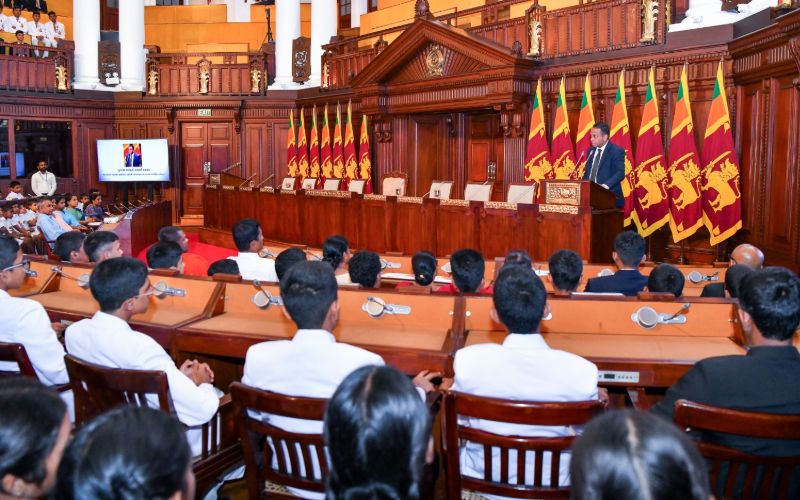
Marking the completion of two years of the ‘Vision’ Programme, students from Pinnawala Central College and Matale Siri Seevali College were given an opportunity on Thursday (24) to visit the Presidential Secretariat.
The ‘Vision’ Programme was launched for schoolchildren jointly by the Presidential Secretariat, the Ministry of Education and the Department of Communication of the Parliament of Sri Lanka.
Following a visit to the former Parliament building at the Presidential Secretariat, the students were also briefed on the history of Parliament.
The role of the President’s Fund and its importance to schoolchildren were explained by Senior Additional Secretary to the President Roshan Gamage.
The ‘Vision’ commemorative book, featuring the two-year journey of the ‘Vision’ Programme and its special activities, was also presented to the participating schools.
As part of the programme, valuable plants were also presented to the schools as a symbolic gesture underscoring the importance of environmental conservation.
Director General of Public Relations Dharmasiri Gamage, the Director and Assistant Director of the Tri-Services Security Coordination Unit, the principals and teaching staff of Pinnawala Central College and Matale Siri Seevali College, and students were among those present on the occasion.
President’s Media Division (PMD)


Opposition and SJB Leader Sajith Premadasa yesterday vowed that an SJB government would repeal the 22nd Amendment (22A) to the Constitution.Premadasa made the pledge while addressing thousands of SJB supporters who gathered near Parliament to protest against 22A.
Addressing the rally at Polduwa Junction, Battaramulla, Premadasa said the proposed constitutional amendment would undermine democracy and judicial independence and enable the concentration of political power in the Executive.
“Even if they pass it, under an SJB government we will scrap it,” Premadasa told the gathering, claiming that 22A was aimed at paving the way for a one-party state and placing the State under the control of a single political party.
Braving the rain, Premadasa said they had gathered there peacefully and had no intention of resorting to violence.
“We have gathered here to protect democracy,” he said, challenging the government to hold Provincial Council elections if it was confident of facing the people.
Premadasa said the SJB was prepared to work with any democratic and clean political force committed to the country’s progress and public welfare, amid ongoing discussions on cooperation among Opposition parties, including the United National Party.
Premadasa also accused groups aligned with the government of attempting to discourage people from attending the protest through statements and other measures.
SJB General Secretary Ranjith Madduma Bandara said the protest had been organised against the proposed amendment, which the party had opposed on the grounds that it could pave the way for authoritarianism.
The demonstration began around 9 a.m. at Polduwa Junction and coincided with Parliament taking up the proposed 22nd Amendment for debate. Proceedings on the Bill are scheduled to continue today (25).
The Supreme Court has determined that the proposed amendment does not require approval at a referendum and could be passed with a special majority in Parliament.
Meanwhile, traffic congestion was reported on roads surrounding Parliament and Polduwa Junction following the demonstration.
Security was also tightened in and around the Parliamentary complex, with a heavy police presence observed at Polduwa Junction and near the main entrance to Parliament.

Two retired female Navy petty officers were ordered to be remanded until October 5 over their alleged involvement in the abduction and disappearance of two women in Trincomalee during the war.
Trincomalee Chief Magistrate M.S.M. Samsudeen yesterday ordered that the two suspects be remanded and directed that they be produced for an identification parade on October 5.
The suspects, residents of Chilaw and Haputale, were arrested after appearing before the CID in connection with another court case. They were subsequently produced before the Trincomalee Magistrate’s Court.
The court was informed that the investigation concerned the alleged abduction of Sasikumar Thenmoli and Mary Delsia, residents of Paalaiyootru, Trincomalee, on or around May 13, 2008.
The CID told court that information uncovered during its investigations indicated that the two women had allegedly been detained at an underground location known as the “Gun Site” at the Trincomalee Naval Base while the two suspects were serving in the Navy. The women were subsequently reported missing.
Further investigations into the alleged abduction and disappearance of the two women are continuing.

‘Vision’ Programme Marks Two Years

Costa Rica minister fired for unapproved meeting with Trump in US

At least 41 die as boat capsizes in DRC’s Lake Tanganyika

Showers will occur at times in the Western, Sabaragamuwa, Southern, Central and North-western provinces

Sajith vows to scrap 22A under future govt.

Two retired female Navy officers remanded over disappearance of two women during war

‘Dates have the highest sugar content to fight Coronavirus’

Sunday Island 27 December – Headlines

#SundayIsland 17th December – Headlines

Sunday Island – 28th March

Sunday Island Headlines – 21 March

Sunday Island – 21st February – Headlines
-

 News6 days ago
Shanakiyan urges urgent action over reported death sentence for Lankan in Saudi Arabia
-

 News5 days ago
Namal Rajapaksa Buddhist gambit fails, bail denied
-

 Features5 days ago
Why the spelling Sri Lankan names in English vary
-

 Features5 days ago
Three bands, a new identity: Sri Lankan wolf snake recognised as distinct species
-

 Business5 days ago
SLIIT holds largest-ever convocation
-

 News5 days ago
Govt monitors reported Saudi death sentence – Foreign Ministry
-

 News5 days ago
Vehicle prices drop by up to Rs. 1 mn, says importers’ body
-

 Business5 days ago
All-new Bolero MaXX Pik-Up unveiled in Lanka