
News
KOICA tackles unemployment here

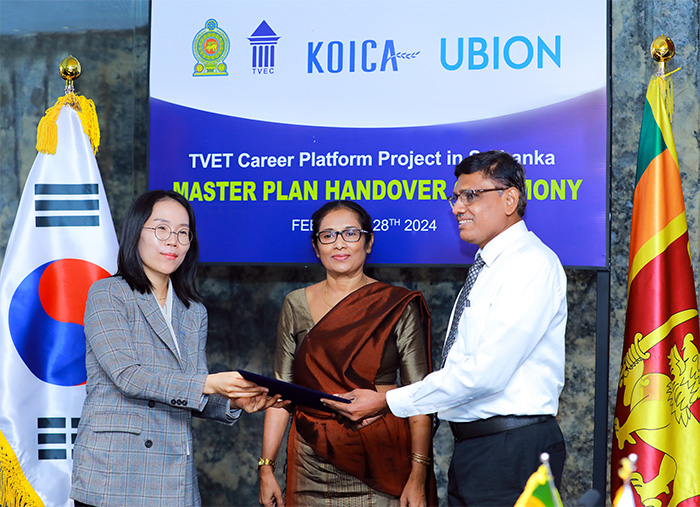
…USD 6 mn provided in support of the project
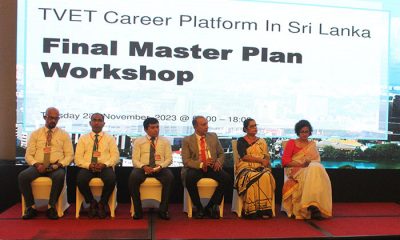
South Korea has funded the preparation of a master plan for Tertiary and Vocational Education and Training (TVET).
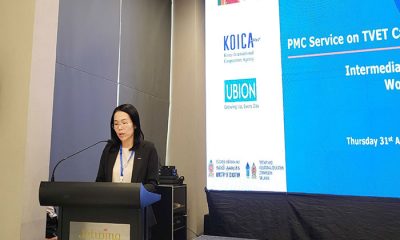
It has been developed by Korea International Cooperation Agency (KOICA), Project Management Consultant experts from UBION, and professionals in the TVET sector. On behalf of the Sri Lankan government, the Director General of the Tertiary and Vocational Education Commission received the master plan to initiate the development of TVET career platform.
The ceremony was held recently at the Skills Development and Vocational Education Division of the Ministry of Education with the presence of Secretary of the Ministry of Education Mrs. Wasantha Perera, Director General of TVEC Dr. K.A. Lalithadheera and Country Director of KOICA Ms. Kim Myung Jin.
Earlier KOICA provided a grant aid worth USD 6 mn to the Ministry of Education and Tertiary and Vocational Training Commission to implement the TVET career platform.
KOICA spokesperson said that the project was meant to address youth unemployment through the development of an ICT-based career platform for TVET trainees. “We have invested significantly in strengthening the capacities of the service providers, including the policy makers, career guidance professionals, and administrators attached to the platform,” the official said.
The career platform is designed to provide career guidance for the TVET trainees and prospective students of NVQ Levels 5, 6 and 7 representing courses under 4 major sectors: construction, manufacturing, tourism, and ICT. In this specific career platform, trainees will receive career guidance and job support through Career Guidance Officers and create an environment of decent job opportunities by sharing employment information among companies, institutions, and trainees. The platform is designed with the expectation of expanding the user scope in the future aligning with the trends in the labor market.
Ms. Kim Myung Jin and many other invitees representing public and private sector organizations.
During the ceremony, the Country Director of KOICA, Ms. Kim Myung Jin stated “Today, we witness a remarkable milestone in the development of the TVET sector in Sri Lanka. National Education Policy Framework for 2020 – 2030 declares that career guidance at key stages is mandatory for all sectors of education.
Therefore, the platform offered under this project is a very timely approach and support. Education is a catalyst for the long-term development of a country. Korean Government and KOICA stand in solidarity with Sri Lanka in this time of need and will continue to support for development of the country.”








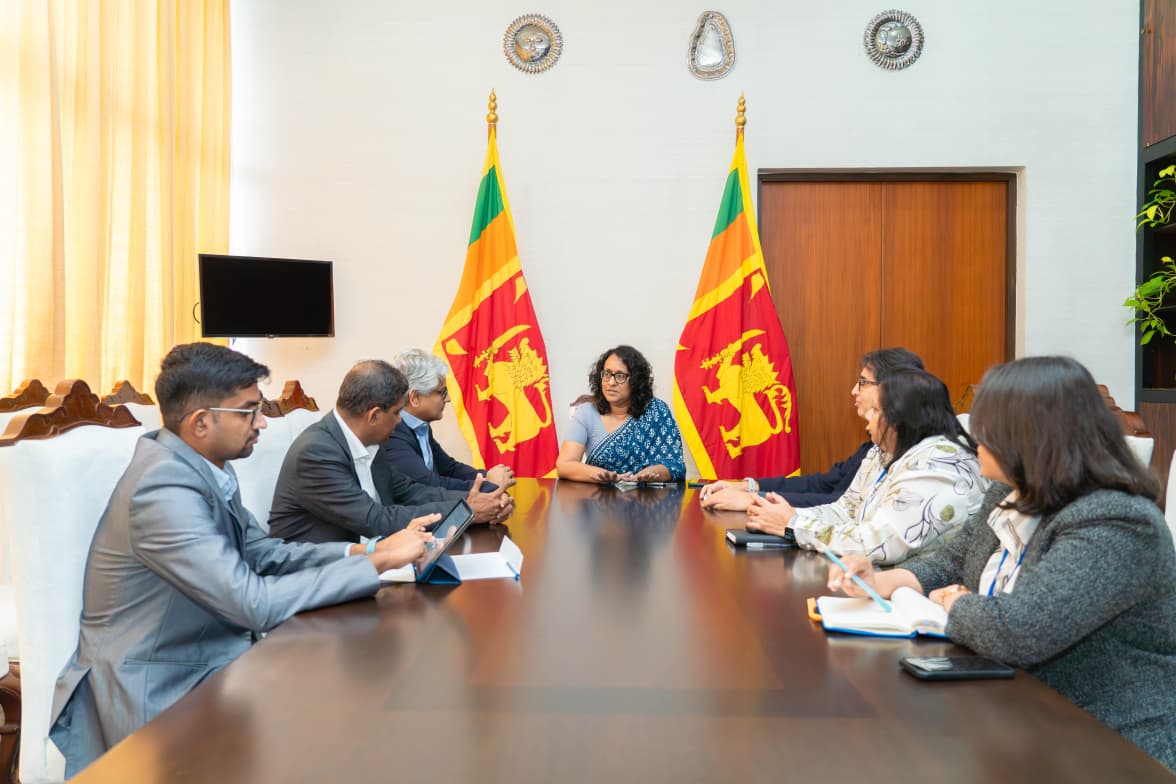
Representatives from the ’The Ceylon Chamber of Commerce’ met with Prime Minister Dr. Harini Amarasuriya on Wednesday [24th of June] at the Parliament premises.
During the meeting, discussions focused on the Sri Lanka Economic and Investment Summit 2026 (SLEIS 2026), which is scheduled to be held on 12 and 13 October 2026. Attention was also given to digitalization initiatives, the introduction of digital technologies in schools under new education reforms, and the transformative role of Artificial Intelligence (AI) in Sri Lanka’s education sector.
Representatives of the Chamber noted that the summit would serve as an important platform for encouraging both local and foreign investment, while also contributing to the shaping of the country’s future economic policies.
The meeting was attended by Krishan Balendra, Chairman of The Ceylon Chamber of Commerce; Vinod Hirdaramani, Deputy Vice Chairman; Shiran Fernando, Secretary General and Chief Executive Officer; Aliki Perera, Deputy Secretary General and Chief Operating Officer; and Anagi Rodrigo-Weerasekera, Chief Economist and Head of Economic Intelligence, along with several other representatives.
[Prime Minister’s Media Division]
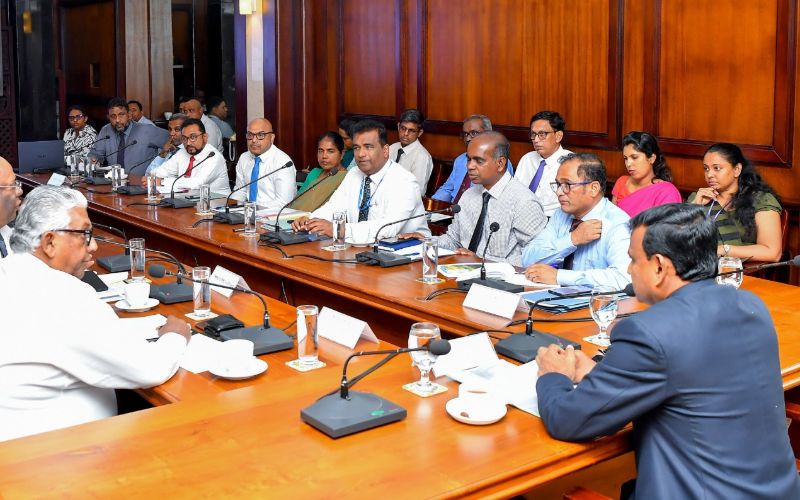
A discussion to review the progress of the housing project under which 4,700 houses are being constructed for the Malayagam community with Indian assistance was held this afternoon (24) at the Presidential Secretariat under the chairmanship of the Chief of Staff to the President, Prabath Chandrakeerthi.
Under this housing programme, 2,026 houses are to be provided to families identified by the National Building Research Institute (NBRI) as being at disaster risk. The remaining houses are expected to be allocated to eligible workers residing in the plantation sector.
Accordingly, the houses will be provided to Malayagam community families living on estates belonging to 22 Regional Plantation Companies, as well as estates under the State Plantations Corporation, Janawasama and Elkaduwa Plantations.
For the construction of each house, the Government of India has allocated Rs. 2.8 million, while the Government of Sri Lanka has contributed Rs. 400,000.
During the discussion, Chandrakeerthi instructed officials to ensure that the housing project is completed before the end of this year. He further directed that land identified for the construction of houses be released without delay and that the National Building Research Institute provide the necessary reports to identify suitable land for the project.
The housing project is being implemented jointly by the Ministry of Plantation and Community Infrastructure, the National Housing Development Authority, the State Engineering Corporation and the Plantation Human Development Trust.
Among those present were Additional Secretary (Development) of the Ministry of Plantation and Community Infrastructure, K. S. Wijayakeerthi; Director General (Engineering), N. D. N. Pushpakumara; Director General (Planning), W. A. K. S. Damayanthi; the Secretary General of the Planters’ Association; and officials from the National Housing Development Authority, the State Engineering Corporation, relevant institutions and plantation companies.
(PMD)

It has been reported that Attorney at Law Rakitha Rajapakshe, the son of former Minister of Justice Wijeyadasa Rajapakshe, has been arrested by the Commission to Investigate Allegations of Bribery or Corruption (CIABOC) over alleged links with the underworld.

Representatives from the Ceylon Chamber of Commerce meet PM

Progress of Housing Project for Malayagam Community families funded by India reviewed

South Africa stun South Korea to reach World Cup knockouts for the first time

Tremors of 7.5, 7.2 kill 32, injure hundreds in Venezuela

Former Minister Wijeyadasa Rajapakshe’s son arrested by CIABOC

Morocco come back after historic Haiti goals to reach World Cup last 32

‘Dates have the highest sugar content to fight Coronavirus’

Sunday Island 27 December – Headlines

#SundayIsland 17th December – Headlines

Sunday Island – 28th March

Sunday Island Headlines – 21 March

Sunday Island – 21st February – Headlines
-

 News6 days ago
Creditor receives USD 2.5 mn as Lankan public bears loss from theft of Treasury funds
-

 News5 days ago
Creditor not yet paid
-
 News5 days ago
Consumers bearing 22% tax burden despite 18% VAT claim: Dr. Harsha de Silva
-

 Features4 days ago
Nanda Pethiyagoda Wanasundara as three generations of family saw her
-

 Features3 days ago
Sri Lanka developing independent hydrographic capabilities
-

 Opinion6 days ago
SriLankan Airbus struck by lightning
-

 Editorial4 days ago
Fuel crisis: Beyond price debate
-

 Latest News4 days ago
Sooryavanshi thumps fastest List A fifty as India A win tri-series