
News
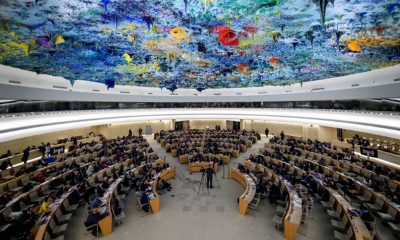
Geneva sessions: ‘Rejection of resolutions not sufficient, tangible measures needed to counter threat’


… several countries undertaking criminal investigations against Lankans
By Shamindra Ferdinando
Sri Lanka had failed again to counter unsubstantiated accusations pertaining to the Eelam conflict, at the ongoing 55th session of the Human Rights Council, authoritative military sources said.
Western powers had taken specific punitive actions against selected Sri Lankan military officers as well as political leaders on the basis of unsubstantiated allegations.
Canada, two years ago, declared that Sri Lanka had committed genocide during the war against the LTTE, sources said, alleging the government of Sri Lankan had not countered such serious accusations. Canada refused to accept former Air Force Commander Air Marshal Sumangala Dias as Sri Lanka’s High Commissioner to Ottawa on the basis that he had been a member of Sri Lankan armed forces.
The 55th sessions that commenced on 26 February will go on until 05 April 2024.
Repeated rejection of HRC resolutions 46/1 and 51/1, as well as the external evidence gathering mechanism set up in terms of these resolutions, would not help counter the relentless Geneva campaign against Sri Lanka effectively, diplomatic sources said.The government should set the record straight in Geneva, a senior diplomat told The Island.
Foreign Minister Ali Sabry, PC, addressed the high-level segment of the session on 27 Feb., while Sri Lanka’s Permanent Representative in Geneva, Himali Arunatilleke, addressed the session on 01 March following oral update on Sri Lanka.
Serving and retired military officers complained that even 15 years after the successful conclusion of the war the government was yet to deal with the basis of the Geneva investigation. The unsubstantiated allegation that as many as 40,000 civilians perished in the final assault remained the primary UN allegation (March 31, 2011 Darusman report paragraph 137), they said, questioning the inordinate delay in addressing the issue.
Declaring his office continued to advance accountability in Sri Lanka, Volker Türk, UN High Commissioner for Human Rights, said that he was providing support to several jurisdictions undertaking criminal justice investigations in respect of Sri Lankans. His office was in the process of deepening its information and evidence, base on specific incidents of human rights violation. The UN official said that his office was carrying out research on what he called, enforced disappearance and conducting consultations with victims.
Sources said that the UN declaration was a serious warning particularly to those against whom action had been already taken. In 2016, Australia refused a visa to veteran ground commander Maj. Gen. Chagie Gallage. In Feb 2020, the US designated Gen. Shavendra Silva in terms of Section 7031(c) of the Department of State, Foreign Operations, and Related Programs Appropriations Act. His wife and two daughters were also designated.
Gen. Silva’s case remained the only instance where family members of senior officers had been designated. In January 2023, Canada imposed sanctions on former Presidents Mahinda Rajapaksa and Gotabaya Rajapaksa, Staff Sergeant Sunil Ratnayake and Lieutenant Commander Chandana Prasad Hettiarachchi. In April 2023, the US blacklisted Admiral of the Fleet Wasantha Karannagoda, who responded swiftly that since his last visit there in 2007, as Commander of the Navy, and he hadn’t since sought a US visa.
There were several other cases, including US refusal to issue visa to the then General Sarath Fonseka during the yahapalana administration and preventing Maj. Gen. Udaya Perera from leaving for the US from the Bandaranaike International Airport (BIA) last year although he had a valid visa.
Sources pointed out that the UN official disclosed that several countries had conducted criminal justice investigations targeting Sri Lankans. In the absence of a cohesive plan to address accusations, foreign investigations, with the backing of Geneva seemed to have proceeded unhindered.







Latest News
Flood warning issued to the Divisional Secretariat Divisions of Ganga Ihala Korale, Udapalatha, Doluwa, Udunuwara, Yatinuwara, Gangawata Korale, Harispattuwa, and Pathadumbara


Due to heavy rainfall received in the upper catchment areas of the Mahaweli River over the past few hours, there is a risk of minor flooding in the low-lying areas surrounding the Mahaweli River within the Divisional Secretariat Divisions of Ganga Ihala Korale, Udapalatha, Doluwa, Udunuwara, Yatinuwara, Gangawata Korale, Harispattuwa, and Pathadumbara.Residents living in the above mentioned areas and motorists using roads passing through these areas are urged to exercise extreme caution and remain highly vigilant regarding the prevailing situation.
Furthermore, residents living in close proximity to the Mahaweli River in these areas are advised to remain highly alert to the situation and take all necessary precautions to protect themselves from any potential flooding.The relevant disaster management authorities are requested to take all necessary measures in response to this situation.

The National Building Research Organisation [NBRO] has issued landslide Red Alerts to the districts of Kandy, Kegalle and Nuwara Eliya effective from 14:00 hrs on 20.09.2026 To 14:00 hrs on 21.09.2026
Accordingly,
LEVEL III [RED] Land Slide early warnings have been issued to the Divisional Secretaries Divisions and surrounding areas of Pasbage Korale in the Kandy district, Dehiowita, Aranayake, Deraniyagala, Mawanella and Yatiyanthota in the Kegalle district and Kothmale West, Kotmale East, Ambagamuwa and Norwood in the Nuwara Eliya district
LEVEL II [AMBER] Land Slide early warnings have been issued to the Divisional Secretaries Divisions and surrounding areas of Padukka in the Colombo district, Nagoda, Thawalama and Neluwa in the Galle district, Bulathsinhala, Palindanuwara, Walallawita and Agalawatta in the Kalutara district, Ganga Ihala Korale in the Kandy district, Bulathkohupitiya and Kegalle in the Kegalle district, Akuressa and Pitabeddara in the Matara district, Thalawakele in the Nuwara Eliya district and Pelmadulla, Ratnapura, Ayagama, Kuruwita and Ratnapura in the Ratnapura district.
LEVEL I [YELLOW] Land Slide early warnings have been issued to the Divisional Secretaries Divisions and surrounding areas of Seethawaka in the Colombo district, Niyagama and Baddegama in the Galle district, Mirigama in the Gampaha district, Ingiriya in the Kalutara district, Udapalatha and Yatinuwara in the Kandy district, Galigamuwa, Warakapola and Ruwanwella in the Kegalle district, Kotapola, Pasgoda and Athuraliya in the Matara district, and Eheliyagoda, Kalawana and Elapatha in the Ratnapura district.
News
Development projects can deliver results to the people more quickly when the political authority and the public service work together towards a common goal – PM
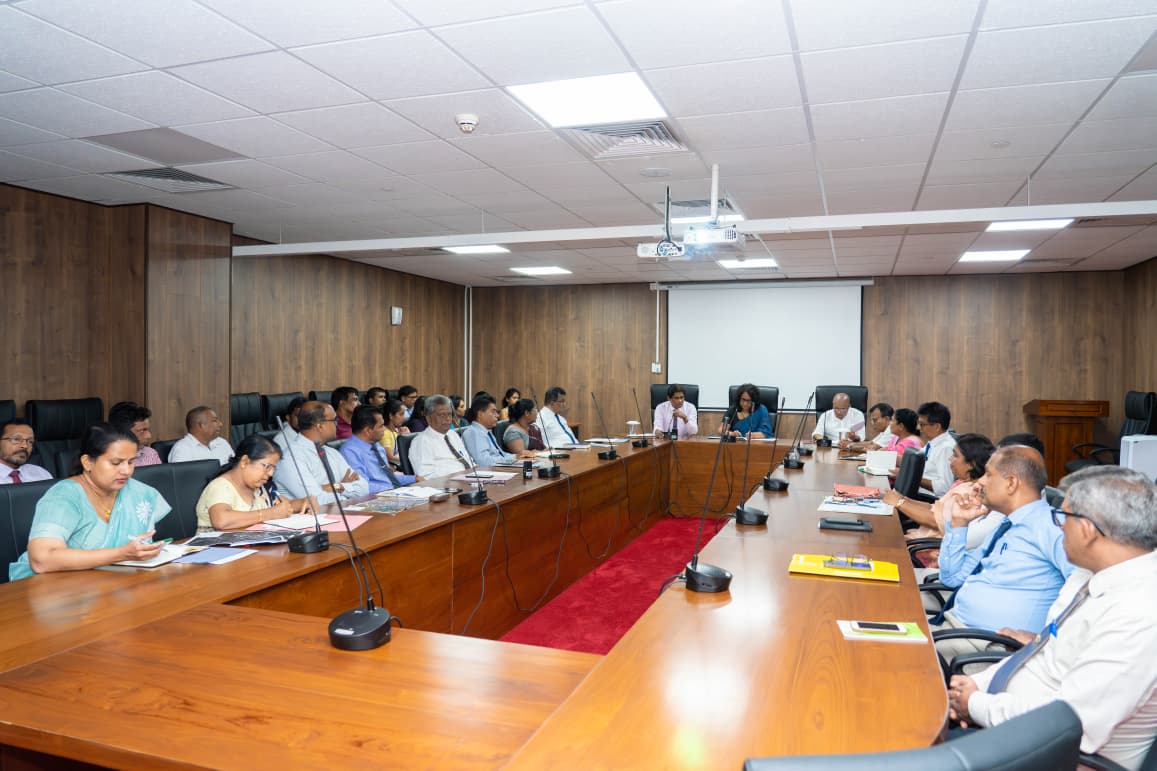
Prime Minister Dr. Harini Amarasuriya stated that development projects can deliver results to the people more quickly when the political authority and the public service work together towards a common, people-oriented objective.
The Prime Minister made these remarks while participating in a discussion held on Friday [September 18] at the Western Province Council Auditorium to review the progress of the development project to rehabilitate Rathmalana Kandawala Road and the drainage system on either side of the road, within the Dehiwala–Mount Lavinia Municipal Council limits in the Colombo District.
The project, which commenced on September 10, 2026, is scheduled to be completed before June 30, 2027. Implemented by the Provincial Road Development Authority (PRDA), the project includes the construction of a bridge at a cost of Rs. 64 million, the rehabilitation of the drainage system at a cost of Rs. 930 million, and the rehabilitation of the road at a cost of Rs. 115 million.
The Prime Minister also paid special attention to the progress of the responsibilities assigned to the Western Province Council, the Irrigation Department and the Ratmalana Divisional Secretariat in accordance with decisions taken at the previous committee meeting. Attention was also given to the current status of the plans being carried out by the Sri Lanka Land Development Corporation (SLLRDC), as well as the construction and maintenance activities being undertaken by the Provincial Road Development Authority (PRDA).
Commending the expedite and commendable progress of the project, the Prime Minister particularly appreciated the commitment demonstrated by officials of the relevant government institutions to work in close coordination with one another and in collaboration with the political authority.
The Prime Minister also emphasised the importance of taking measures well in advance to control flooding and minimise its impact on Colombo and several other districts in view of the rainy weather that may affect the Western Province during the latter part of this year.
The meeting was attended by the Chairman of the Colombo District Coordinating Committee and Member of Parliament Lakshman Nipuna Arachchi, Chairperson of the Ratmalana Divisional Coordinating Committee and Member of Parliament Samanmalee Gunasinghe, Chairman of the Roads Sub-Committee of the Colombo District Coordinating Committee Dewananda Suraweera, Mayor of the Dehiwala–Mount Lavinia Municipal Council Parakum Shantha, Chief Secretary of the Western Province K.G. Pradeep Pushpakumara, along with a number of government officials.
[Prime Minister’s Media Division]

Flood warning issued to the Divisional Secretariat Divisions of Ganga Ihala Korale, Udapalatha, Doluwa, Udunuwara, Yatinuwara, Gangawata Korale, Harispattuwa, and Pathadumbara

Landslide Red Alerts issued to the districts of Kandy, Kegalle and Nuwara Eliya

Shafali dazzles with 49-ball unbeaten 100 and India march into Asian Games final

Development projects can deliver results to the people more quickly when the political authority and the public service work together towards a common goal – PM

Landslide Early Warnings issued to the Districts of Colombo, Galle, Kalutara, Kandy, Kegalle, Matara, Nuwara Eliya and Ratnapura

Chamari Athapaththu’s unbeaten 83 leads Sri Lanka into final

‘Dates have the highest sugar content to fight Coronavirus’

Sunday Island 27 December – Headlines

#SundayIsland 17th December – Headlines

Sunday Island – 28th March

Sunday Island Headlines – 21 March

Sunday Island – 21st February – Headlines
-

 Opinion7 days ago
From Galkissa (Mount Lavinia) to Tambuttegama
-

 News4 days ago
US embassy won’t comment on IGP’s probe into joint drug raid
-

 Features6 days ago
The emptying university: why are academics leaving?
-

 Features7 days ago
Sri Lanka’s university crisis: Brain drain and union action demand urgent reform
-

 News3 days ago
Bid for Basil’s extradition nears final stage: Police
-

 Opinion7 days ago
Ashraff: From the SLMC towards the National Unity Alliance
-

 Business4 days ago
All-new Bolero MaXX unveiled in Sri Lanka
-

 Editorial7 days ago
Muscle flexing, astroturfing and dog-and-pony shows