
Latest News
Green puts Australia on top on a green-top

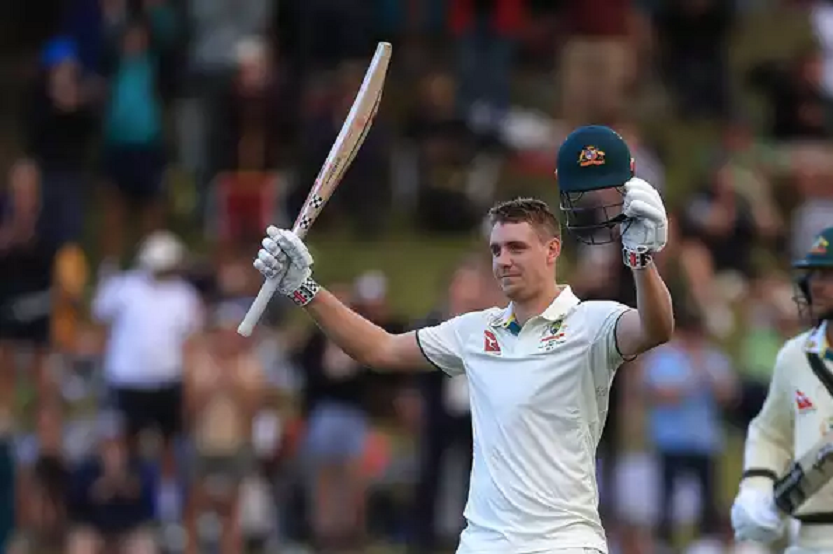
Cameron Green scored his second Test match ton as Australia overcame a mid-innings wobble on a green-top in Wellington to claim early control of the first Test against New Zealand. At stumps on the opening day at Basin Reserve, Green’s unbeaten 103 helped Australia overcome a fine Matt Henry bowling performance (4 for 43) to post 279/9.
Asked to bat on a green top, Australia’s top-order had the unenviable task of contending with a four-prong seam attack in (overcast) conditions conducive to their craft. To that effect, the hosts will feel aggrieved that they managed only a solitary wicket in what was a cagey opening session to the Test match. They were, perhaps, guilty of not bowling full enough in that first hour and despite beating Steve Smith and Usman Khawaja’s bats on a couple of occasions, there were no real chances created.
After each of the four quicks – Tim Southee, Henry, Scott Kuggeleijn and Will O’Rourke – had made their opening statements, it was Henry in his second spell of trying that brought New Zealand their first breakthrough. With the first ball of the 25th over, he drew an outside edge off Smith’s bat with a scrambled seam delivery that was sharply snaffled from ‘keeper Tom Blundell diving in front of first slip.
After a 67-run opening session, the play in the post-lunch period offered a better reflection of the conditions on offer. Kuggeleijn accounted for a highly defensive Marnus Labuschagne, who made 1 run off 27 deliveries, before finding himself rooted to the crease while attempting to play a full ball. Daryl Mitchell took the catch at first slip to end Labuschagne’s misery. Another full ball from Henry then brought the end of Khawaja’s dogged resistance as he failed to account for the inward curl on a delivery from around the stumps and lost his stumps.
When Travis Head fell in the following over, to O’Rourke, Australia were down to 89/4 and facing the prospect of a sub-par score. Green and Mitchell Marsh led a brisk counter-offensive to lift the visitors out of the rut. There were clear tactics employed by Green, in particular, who routinely walked down the pitch to the fast bowlers to cut the movement. Marsh, at the other end, found an alternative route to success by throwing his bat at any ball bowled on a wider line. Inside 14 balls of the pair getting together, there were four boundaries struck.
Marsh raced away to 26 off 19 following a six and a four off the top and outside edges respectively but the approach of the two Australian all-rounders had the effect of dispersing New Zealand bowlers off their control areas. The 67-run fifth-wicket stand ended straight after Tea when Marsh, looking to stay true to his counter-attacking disposition, top-edged a Henry short ball and was caught by the ‘keeper.
Green, however, continued to grow in confidence and hit Kuggeleijn for three boundaries in four balls as he pushed Australia closer to the crucial 200-run mark. The pitch proved harder to bat on in the period after the Tea interval with multiple deliveries rearing off a length and striking batters on the gloves and the arm. That meant batters were always eager to put away any balls on a driving length and one such attempt brought the end of Alex Carey’s stay in the middle as he drove a full Kuggeleijn delivery straight to cover.
Green got to his half-century with a boundary after drinks in the final session after an aerial drive evaded Southee on his follow-through. He upped his scoring rate thereafter as New Zealand turned to spin in a bid to get to the second new-ball as quickly as possible. He added 35 with Mitchell Starc and another 33 with Pat Cummins to take Australia past 250. He was in the 90s when Nathan Lyon fell to the second new ball. Batting with No.11, Green hit three boundaries in the last over of the day’s play to get to his milestone, displaying his deeper gears by going from 50 to 100 in just 46 balls and thereby helping his side grab the initiative from their hosts for good.
Brief scores:
Australia 279/9 in 85 overs (Steven Smith 31, Usman Khawaja 33, Cameron Green 103*, Mitchell Marsh 40; Matt Henry 4-33, William ORourke 2-59, Scott Kuggeleijn 2-56) vs New Zealand




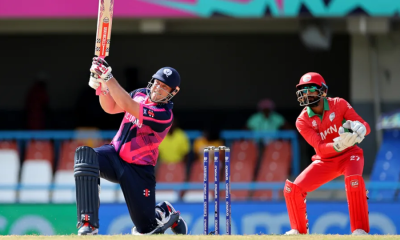

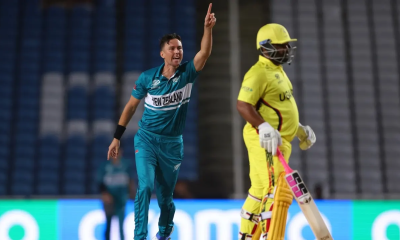

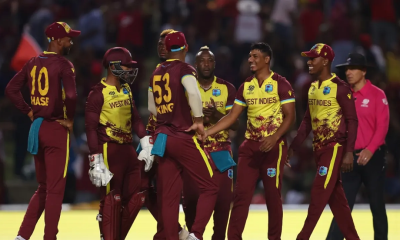


Summer has come early to the southern hemisphere and not just because of climate change. In Australia, where they have never played Tests in August before, a two-match series has already been completed, and it’s not even the end of the month. In South Africa, the international season officially starts next door – in Namibia, where a T20I tri-series kicks off a packed season.
Zimbabwe are the other participants, having long abandoned the idea of a conventional home season so they can host teams during their mild winters. It also gives next year’s men’s ODI World Cup co-hosts an opportunity to get cosy ahead of the main event.
The tri-series is a precursor to a mooted Africa T20 Cup, a continental tournament in the mould of the Asia Cup, aimed at growing the game in this region. The likes of Uganda, who played at the 2024 T20 World Cup, and recent men’s Under-19 World Cup participants Tanzania (2026) and Nigeria (2020) are likely to be involved in future editions. For now, the organisers have kept it to the continent’s heavyweights, to raise awareness and, crucially, funds. All proceeds from this tournament will go to the Africa Cricket Association.
How much the total earnings will be remains to be seen. The new Namibia Cricket Ground has world-class high-performance facilities and a seating capacity of 7,500. Ticket prices are reasonable enough to attract full houses, but that does not mean there are millions to be made. General seating has gone on sale for between 50 and 100 Namibian dollars (US$3.12 and 6.25) while premier seating is 200 Namibian dollars (12.50 USD). There is no major broadcast deal in place and on the eve of the tri-series, a television partner was yet to be announced. Cricinfo understands the games may be available on the streaming service of the continent’s biggest sports broadcaster, SuperSport , but not on their regular bouquet of channels. The series may consequently fly slightly under the radar, but it will still serve as an exercise in relationship-building for the three boards and self-discovery for their teams.
Namibia: Desperate to level up
Hosts Namibia have not progressed as they’d have liked after making the Super 12s of the 2021 T20 World Cup. They played in the next three events but had their worst outing earlier this year when they lost all four matches in their group. More game time against Full Members is what many Associates ask for and over the next three weeks Namibia will get that, in both white-ball formats as South Africa will stay on for three ODIs.
It’s exactly the kind of challenge they want as they enter the latter stages of Cricket World Cup League 2 (the progression pathway to 2027 World Cup qualification) and with the 2028 T20 World Cup qualification process not far away. “It’s sort of a question that we always get in the associate world. How do you bridge the gap to the next level? You only bridge it by winning against teams at the next level,”Gerhard Erasmus, Namibia’s captain said at the pre-tournament press conference. “The Associate teams over the years have made that happen more frequently. Lots of the Associate nations have gone away from the tag of just competing and games are actually started on very equal footing these days, especially the T20 format. It gives you that ability to impact the game or use a bit of momentum on your side. If you have two star performers on the day, it could swing the result your way.”
Erasmus is Namibia’s stand-out, as their leading run-scorer and third-highest wicket-taker in the format but it is important that they unearth others. For this series, Namibia have two 18-year-olds, Waldo Smith and Max Heingo, in the squad and three 21-year-olds. Alexander Busing-Volschenk, Junior Taanyanda and Jack Brassell are all being seen as players for the future and the last of those has impressed Erasmus most.
“A guy that comes to mind for me is Jack Brassell. Not only has his skillset gone up by the amount of overs that he’s bowled and the loads that he’s got behind him but he’s made a conscious decision to get stronger and bowl faster,” Erasmus said. “He’s now the fastest member of our side, which is something that he wants to do. They take their careers very personally and professionally. That’s what we as management or leadership also have to always do.”
South Africa: Mining their depth
Namibia will open the tri-series against South Africa, who they have bragging rights over after beating them at their only T20I meeting last year. The naysayers will point out that the South Africa XI was experimental, but so is this one and Lhuan-dre Pretoripus, Rubin Hermann and Bjorn Fortuin, as stand-in captain, are back to try and set the record straight. “It wasn’t a fun experience,” Fortuin said. “We got beaten by the better team on the day. If you take things for granted, you will definitely feel it.”
The current South African squad, which welcomes Quinton de Kock back into the fold, will be wary of making the same mistake. It is made up largely of players on the fringes of the first-choice side who will be hoping to strengthen their cases for future selection.
Fortuin occupies a slightly different position. Though capped 43 times in white-ball formats for South Africa, his entire career has run parallel to frontline left-arm spinner Keshav Maharaj and it’s difficult to see how Fortuin will get a sustained run but that gives him a different role. “Kesh has obviously been exceptional for quite a few years and he’s taken those talents all across the world. I’ve tried to emulate that as much as I can,” Fortuin said. “My opportunities have been limited, but as a player, all I can do is try and make the best of it. With regards to the squad that we’ve got here, it’s a fairly inexperienced squad, but really talented. And they’ve all done some special things around the world. Hopefully I can just impart some knowledge to them and let their natural game flow.”
In line for debuts are Duan Jansen and Ethan Bosch, but everyone from Lhuan-dre to Dewald Brevis to Kwena Maphaka is worth keeping an eye on, especially in a season with eight Tests, nine ODIs, three T20Is and the SA20.
Zimbabwe: Chasing consistency
The middle of the sandwich are Zimbabwe, who stunned the cricket world by reaching the Super Eight of this year’s T20 World Cup and are finally on an upward trajectory. Three chastening T20Is against India aside, Zimbabwe’s progress has been steady but now it’s about how long they can make it last.
They’ve kept some of their senior core in captain Sikandar Raza and soon-to-be-40 Graeme Cremer to “handle all the youth,” in Raza’s words. But they are starting to transition too.
Briam Benett, Brad Evans and Blessing Muzarabani are the names that will dominate their future but they need the likes of Newman Nyamhuri, Dion Myers and Tadiwanashe Marumani to show they can do a job more often than not in order to build the core of a future side. That’s something on Raza’s mind and this series could go some way to showing him, and Zimbabwe, what they have to work with.
“For Zimbabwe to go forward and for us to be competing and winning at the top level, we need to have a big pool of players. I’ve been very vocal about that,” he said. “I’m very hopeful that the guys we have picked will grab this opportunity because one, will grow our pool of players and two, that means Zimbabwe has more depth in different fields of play and that could only mean that Zimbabwe is going up. That’s what I want to see. My personal ambition, one of them is that before I call time, I want to make sure this country is still going on the upward trajectory and that can only happen if we have a big pool of players to choose from.”
Is Raza’s time coming to an end soon? Even at 40, it doesn’t sound like it. “Unfortunately, to handle all this youth that we have in the team, I don’t think one old guy was enough. So to get another old guy is certainly helpful,” he joked, referring to himself and Cremer. “These Gen Zs are a bit difficult to handle at times.”
Ultimately, it is the Gen Zers for whom a series like this has been created. The tournament should be fast-moving and, ideally, high-octane. Seven matches will be played in 10 days before the winner will walk away with a trophy, which incidentally is a cross-section of a tree trunk.
The rings that reveal the tree’s age, and the environment it grew in, are all clearly visible in a living record of its history. The symbolism is fitting as African cricket takes another step towards a future in which the sport can grow across the continent and establish itself as a stronger force on the global stage.
[Cricinfo]

World-leading javelin thrower Rumesh Tharanga underlined his status as the man to beat in world athletics with another sensational performance, winning the men’s javelin at the prestigious Weltklasse meeting in Zurich with a massive 92.07 metres.
Tharanga’s best effort came in the final round and left him just 21 centimetres short of the meeting record of 92.28m, which has stood for three decades.
The 23-year-old first overcome first round challenge from two-time world champion Anderson Peters of Grenada. Peters took the early lead with a first-round throw of 86.93m, but Tharanga responded in the second round with 88.23m to move ahead.
He then increased his advantage in the third round before producing his best effort of the night in the final round, sending the javelin soaring to 92.07m.
Peters had to settle for second with 86.93m, while Poland’s Dawid Wegner was third with 85.16m. Trinidad and Tobago’s Keshorn Walcott finished fourth with 83.02m, followed by Kenya’s Julius Yego (81.66m) and American Marc Anthony Minichello (80.38m).
The Zurich victory further strengthens Tharanga’s position at the top of the world javelin hierarchy at a crucial stage of the season. With the Wanda Diamond League Final in Brussels just a week away and the World Athletics Ultimate Championship looming, he has emerged as the athlete everyone will be watching.
Tharanga’s latest 92-metre-plus throw also provides a timely reminder of his extraordinary consistency at the highest level, as he continues his remarkable rise among the world’s elite javelin throwers. (RF)
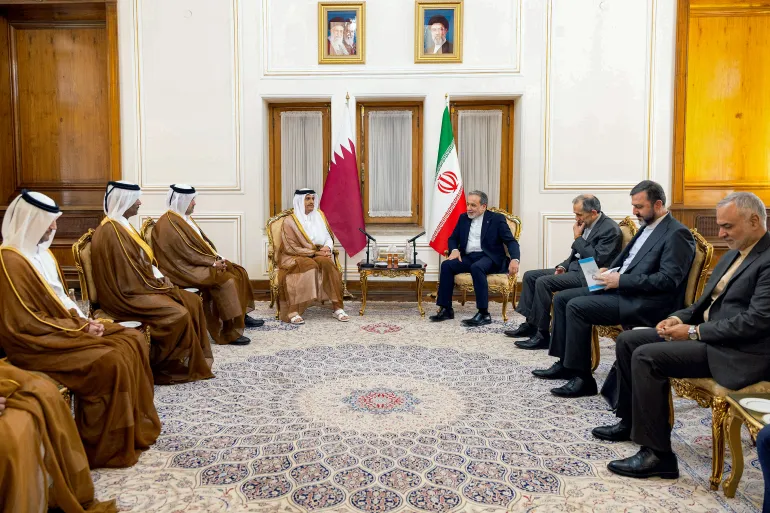
Qatar’s prime minister has held meetings in the Iranian capital, discussing key issues including the future of the Strait of Hormuz, amid international hopes that dialogue between the United States and Iran on ending the war will resume.
Iran’s Foreign Minister Abbas Araghchi and Qatar’s Sheikh Mohammed bin Abdulrahman bin Jassim Al Thani on Thursday discussed a proposed framework that includes the creation of a temporary shipping corridor through the Strait of Hormuz, as well as a possible “joint project” to clear the strait of mines, the Qatari Ministry of Foreign Affairs said in a statement. Iran says the mines were laid during the war.
The two officials also reviewed “the latest developments in the regional situation … along with the efforts being made to reduce escalation and create appropriate conditions for dialogue, contributing to the enhancement of regional security and stability”, the statement added.
Sheikh Mohammed, who is both prime minister and foreign minister of Qatar, later met separately with Iranian President Masoud Pezeshkian and parliament speaker and top negotiator, Mohammad Bagher Ghalibaf.
Ghalibaf emphasised the need to de-escalate regional tensions, according to Iran’s Tasnim news agency. He and Sheikh Mohammed also exchanged views on the current developments in the region and efforts to create suitable conditions for resuming dialogue, the report added.
“Qatar believes that dialogue and diplomatic solutions remain the optimal path for addressing disputes and overcoming crises,” Sheikh Mohammed said in a post on X, adding that his discussions in Tehran serve as “confirmation of our continued efforts to de-escalate tensions … while opening the door to peaceful solutions – including underscoring the importance of respecting freedom of navigation in the Strait of Hormuz in accordance with international law.”
Sheikh Mohammed also met with Iran’s security chief, Mohsen Rezai.
Rezai told him the “US must first take practical steps to fulfil Iran’s conditions and then Iran will proceed to open the Strait of Hormuz”, the Islamic Republic News Agency (IRNA) reported.
Rezai also reiterated previous pledges by Tehran that if Washington “starts any evil”, Iran would “bring disaster to its military and economic interests”.
Sheikh Mohamed’s visit follows a week of intense diplomacy in Iran involving separate meetings with Oman’s Foreign Minister Badr Albusaidi and senior Pakistani officials seeking ways to end the US-Israel war on Iran and reopen the strategic waterway through which about 20 percent of the world’s oil passes in peacetime.
[Aljazeera]

It’s still a queendom, but Sri Lanka are more than just Athapaththu now

Namibia T20I tri-series: Youth, depth and a continental dream take centre stage

Tharanga storms past 92m in Zurich

Iran, Qatar hold Hormuz talks amid int’l hopes dialogue with US will resume

Russell breaks world 100m hurdles record in Zurich

Sun directly overhead Kokkuvil, Nallur, Kodikamam and Nagar Kovil at about 12.11 noon today (28)

‘Dates have the highest sugar content to fight Coronavirus’

Sunday Island 27 December – Headlines

#SundayIsland 17th December – Headlines

Sunday Island – 28th March

Sunday Island Headlines – 21 March

Sunday Island – 21st February – Headlines
-

 Business7 days ago
SriLankan Airlines makes ShakthiSAT Mission possible for talented Sri Lankan student
-

 Features6 days ago
My secondary schooling after Royal Primary
-

 Features6 days ago
From the First to the 22nd: A short history of Amendment Politics and Reform Frustrations
-

 Latest News6 days ago
Tharanga edges out Chopra in 88m javelin battle
-

 News4 days ago
Missing doctor’s body found in Mahiyanganaya
-

 Features6 days ago
How Shelton Kodikara became first Professor of International Relations
-

 Features6 days ago
How St. John’s College Shaped Panadura for 150 Years
-

 News4 days ago
Australia declines to release Finance Secy Suriyapperuma’s citizenship details