

Connect with us

News

U.S. Deputy Secretary of State Verma emphasizes vital role of protecting sea lanes for economic growth in Indo-Pacific 

Published

on

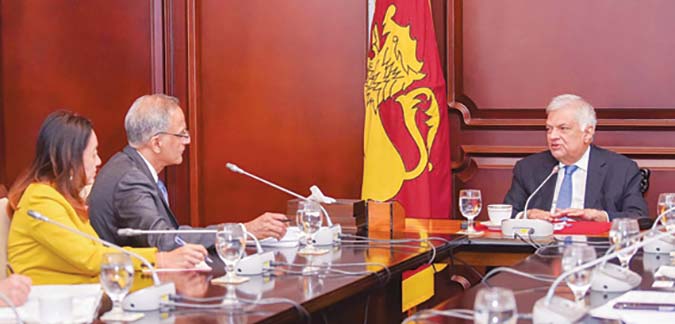
Deputy Secretary Richard Verma and Ambassador Julie Chung call on President Ranil Wickremesinghe at the Presidential Secretariat

The United States remains committed to the economic growth and prosperity of Sri Lanka, Deputy Secretary of State for Management and Resources Richard Verma told government, civil society and economic leaders during his February 23-24 visit to Sri Lanka. Verma on Friday met with President Ranil Wickremesinghe and Foreign Minister Ali Sabry to discuss progress on Sri Lanka’s IMF program, including inclusive economic and governance reforms aimed at keeping Sri Lanka on the path to sustainable economic growth.

Deputy Secretary Verma stressed the vital need to protect human rights and fundamental freedoms, including freedom of expression. They also explored opportunities to deepen defense and maritime cooperation between the United States and Sri Lanka, including strengthening the Sri Lanka Navy’s capabilities to safeguard national security and promote a more stable Indo-Pacific region.

On February 23, aboard the SLNS Vijayabahu, one of three former U.S. Coast Guard cutters transferred by the United States to Sri Lanka, Deputy Secretary Verma said, “I am pleased to announce that the Department of State has notified Congress of our intent to transfer a fourth medium endurance cutter to Sri Lanka.  The Department obligated $9 million in Foreign Military Financing to support this effort.  We look forward to offering the cutter, pending the completion of Congress’ notification period.

If completed, this transfer would further strengthen defense cooperation between the United States and Sri Lanka.  The ship would increase Sri Lanka’s ability to patrol its Exclusive Economic Zone, monitor its search and rescue area, and provide additional security for ships from all nations that transit the busy sea lanes of the Indian Ocean.”

 Participating in the announcement at Colombo Port were Sri Lanka State Minister of Defense Premitha Bandara Tennakoon, Commander of the Sri Lanka Navy Vice Admiral Priyantha Perera, and U.S. Ambassador to Sri Lanka Julie Chung, who remarked, “The United States has previously transferred three cutters to the Sri Lankan Navy, which deploys these ships for maritime operations and law enforcement missions, countering human trafficking and drug trafficking, while supporting humanitarian assistance and disaster response efforts. The eventual transfer of a fourth vessel would be just one more point in a long history of cooperation between Sri Lanka and the United States in preserving a free and open Indo-Pacific region.”

 Deputy Secretary Verma also visited the site of the West Container Terminal (WCT), a deepwater shipping container terminal in the Port of Colombo. The WCT, currently being constructed by Colombo West International Terminal (CWIT) Private Limited with $553 million in financing from the U.S. International Development Finance Corporation, will provide critical infrastructure for the South Asian region.

Operating near capacity since 2021, the Port of Colombo’s new addition will be the port’s deepest terminal and aims to boost Colombo’s shipping capacity, expanding its role as a premiere logistics hub connecting major routes and markets, boosting prosperity for Sri Lanka without adding to its sovereign debt.


News

GMOA warns of trade union action unless govt. urgently resolves critical issues in health sector

Published

on

Influx of substandard drugs is of particular concern

The Government Medical Officers’ Association (GMOA) has warned of renewed and intensified trade union action if the government fails to fulfil its promise to resolve the ongoing crisis in the health sector within the next few days.

GMOA Executive Committee member Dr. Prasad Colombage said his association was hopeful that commitments made by the government, including those formally stated by the Minister of Health in Parliament and recorded in the Hansard, would be implemented.

He called for urgent remedial action in view of the influx of substandard medicines into the country, patient deaths linked to such drugs, difficulties faced by doctors in prescribing medicines, and disruptions to patient care services caused by the continued migration of medical professionals. These factors, he warned, had placed patients’ lives at serious risk.

Dr. Colombage said discussions had already been held with all relevant authorities, including the President and the Minister of Health. He expressed hope that swift solutions would be forthcoming based on agreements reached at discussions. However, he cautioned that the GMOA would not hesitate to resort to strong trade union action if tangible progress was not seen in the coming days.

Meanwhile, the Federation of Medical and Civil Rights Professional Associations yesterday (01) handed over a special memorandum to President Anura Kumara Dissanayake, calling for immediate action to resolve the deepening crisis in the health sector.

Federation President, Consultant Dr. Chamal Sanjeewa, said Sri Lanka’s health system was currently facing a severe crisis and had sought an opportunity to hold discussions with the President on the matter.

The memorandum calls for the President’s direct and immediate intervention on several key issues, including the Indo–Sri Lanka health agreement, shortages of essential medicines including cancer drugs, continued allegations surrounding the administration of the Ministry of Health, reported irregularities at the National Hospital, Colombo, and the absence of an internationally accredited quality control laboratory for the National Medicines Regulatory Authority to test medicines. The Federation has also requested a meeting with the President to discuss these concerns in detail.

By Sujeewa Thathsara ✍️

Continue Reading

News

Elephant census urged as death toll nears 400

Published

on

Sri Lanka’s latest elephant census must result in immediate policy action, not remain a paper exercise, Centre for Environmental Justice (CEJ) Managing Director Dilena Pathragoda warned, as nearly 400 wild elephants have already died in 2025 alone amid escalating human–elephant conflict.

With the national elephant population estimated at around 5,879, Pathragoda said the figures would be meaningless unless they shape land-use planning, habitat protection and enforcement.

“As of mid-December, close to 397 elephants have died in 2025, mostly due to shootings, electrocution, train collisions and other human-related causes,” he told The Island. “When deaths continue at this scale, census numbers alone offer little reassurance.”

Official data show that 388 elephants died in 2024, while 2023 recorded a staggering 488 deaths, one of the highest annual tolls on record. Conservationists warn that the trend reflects systemic failure to secure habitats and elephant corridors, despite repeated warnings.

“An elephant census should not end with a headline figure,” Pathragoda said. “If these statistics do not influence development approvals, infrastructure planning and land-use decisions, they fail both elephants and rural communities.”

Elephant populations remain unevenly distributed, with higher densities in the Mahaweli, Eastern and North Western regions, while other areas face sharp declines driven by habitat fragmentation and unplanned development.

Pathragoda said recurring fatalities from gunshots, illegal electric fences, improvised explosive devices along with poisonings  and rail collisions expose the limits of short-term mitigation measures, including ad hoc fencing projects.

“The crisis is not a lack of data, but a lack of political will,” he said, calling for binding conservation policy, transparent environmental assessments and accountability at the highest level.

He urged authorities to treat elephant conservation as a national governance issue, warning that failure to act would only see future censuses record further decline of these majestic animals.

“Elephants are part of Sri Lanka’s natural heritage and economy,” Pathragoda said. “Ignoring these warning signs will come at an irreversible cost.”

By Ifham Nizam ✍️

Continue Reading

News

CTU raises questions about education reforms

Published

on

The Ministry of Education has yet to clarify whether school hours will be extended by 30 minutes from next Monday (05) under the proposed new education reforms, Ceylon Teachers’ Union (CTU) General Secretary Joseph Stalin has said.

Stalin told The Island that the Ministry should reconsider the planned reforms, warning that decisions taken without adequate study and consultation could have serious repercussions for nearly four million schoolchildren.

He said the Education Ministry had announced that education reforms would be implemented in Grades from 1 to Grade 6, but it had not said anything about the Grades above 6. This lack of clarity, he said, had created confusion among teachers, parents and students.

Stalin also noted that although learning modules had been issued, students are required to obtain photocopies based on the codes introduced in these modules. However, the Ministry had not revealed who would bear the additional financial burden arising from those costs, raising further concerns over the practical implementation of the reforms.

by Chaminda Silva ✍️

Continue Reading

Trending