
Latest News
Chinese ship, Xiang Yang Hong 3’s port call flares India tension

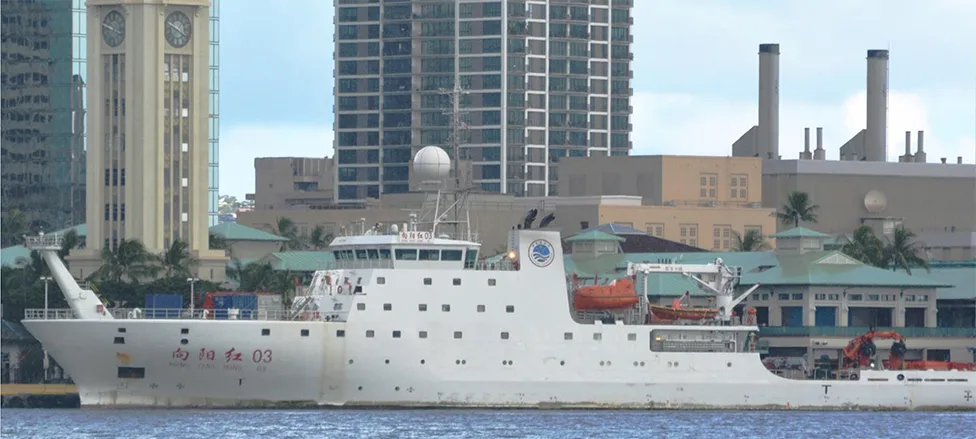
The expected arrival of a Chinese research ship in the Maldives this week has escalated tensions between Beijing, Delhi and Male.
Officially, the vessel Xiang Yang Hong 3 is there to “make a port call, for rotation of personnel and replenishment”. In short, an entirely innocuous stop.
But that is not how it is being seen in Delhi. Instead, the ship’s presence is at the very least a diplomatic snub. At worst, some fear, it could be a mission to collect data which could – at a later date – be used by the Chinese military in submarine operations.
China experts, however, have shrugged off their concerns. “The Chinese ships carry out scientific research work in the Indian ocean. Its activities on the high sea are entirely legitimate,” Zhou Bo, a former People’s Liberation Army Senior Colonel, told the BBC. “Sometimes the ships need replenishment – like fuel, food and water. So, they berth in a third country port, which is normal. So, the Indian government shouldn’t make any fuss about it. Indian Ocean is not India’s Ocean,” asserted Mr Zhou, who is now with the Tsinghua university in Beijing.
But this is not the first time that China – which competes for for influence with Delhi in the Indian Ocean amid a long-standing dispute over their Himalayan border – has sent one of its ships sailing close to Indian waters.

Two Chinese naval submarines made a port call to Colombo in 2014 and two Chinese research vessels visited Sri Lanka, close to the tip of southern India, in the past two years, much to the displeasure of India. The arrivals came as China, which has loaned billions of dollars to Colombo, made significant inroads into Sri Lanka.
The research ship, Xiang Yang Hong 3, had in fact originally planned to visit Colombo for replenishment before proceeding to the Maldives. But that has been shelved for now, according to Tharaka Balasuriya, the junior foreign minister of Sri Lanka.
“During this one year we want to develop our technology and expertise so that we can join in these research activities on an equal basis,” he told the BBC.
However, Colombo’s decision to stop the research vessels is being seen as a response to India’s strong objections to such visits by Chinese vessels.
India’s objections however, have made little difference in the Maldives.
The Maldives, which consists of about 1,200 coral islands and atolls in the middle of the Indian Ocean, has long been under India’s sphere of influence. But Mohamed Muizzu, who took over as president in November and is regarded as pro-China, wants to change that.
He campaigned on an ‘India Out’ platform, asking Delhi to withdraw about 80 Indian military personnel based on the island. India says the troops are in the island nation to maintain and operate three reconnaissance and rescue aircraft, donated by Delhi years ago.
The Maldivian government has set an ultimatum to Delhi to withdraw its troops by 15 March, two days before the country’s parliamentary polls. Following talks in Delhi last week, the Maldivian foreign ministry said India had agreed “to replace the military personnel” and that the first batch will leave by 10 March and the rest by the second week of May.
Following talks in Delhi last week, the Maldivian foreign ministry said India had agreed “to replace the military personnel” and that the first batch will leave by 10 March and the rest by the second week of May.


In December, Mr Muizzu’s administration also announced that it would not renew a hydrographic survey agreement with India that was signed by the previous government to map the seabed in the Maldivian territorial waters.
Relations have in fact deteriorated so much that none of the senior leaders of the Maldivian government attended a recent event organised by the Indian High Commission in Male to mark India’s 75th Republic Day.
China, meanwhile, rolled out the red carpet to Mr Muizzu when he went on a five-day state visit to Beijing last month. Since that trip, high-level Chinese officials have visited the Maldives. Mr Muizzu has also announced several Chinese-funded infrastructure projects.
The sudden shift in Male’s position towards China has raised concerns in Delhi, which attaches strategic significance to the island nation.
China, with its rapidly expanding naval forces, would likely also want access to such a strategically important location – something India wants to prevent.
“Of course, the Maldives is very important; it is the southern Oceanic flank of India,” Shyam Saran, a former Indian foreign secretary, told the BBC. “Just like we had serious reservations about what was happening in Sri Lanka, we will have serious reservations about that may happen in the Maldives,” Mr Saran said.

But it is not just Delhi worried about the relationship with Male.
The opposition Maldivian Democratic Party (MDP) and others have been urging Mr Muizzu’s government for a course correction, saying it’s not in the country’s interests to antagonise a giant neighbour like India. Last week the MDP said it was even contemplating moving impeachment proceedings against Mr Muizzu.
As a small island nation, the Maldives depends on India for most of its food, infrastructure building, and technological advancement. Many Maldivians go to India for medical treatment.
“Most people here think that government has taken the hostility against India a bit too far and that it is totally unnecessary,” Aik Ahmed Easa, a lawyer in Male affiliated with the opposition MDP, told the BBC. “The Maldives is a small country. But this is going into a dangerous phase where we are getting into the middle of the Asian superpower rivalry,” he said.
The Maldivian President’s office and the foreign minister did not respond to requests for comment.
China has greater strategic ambitions and it’s likely to send more ships to the Indian Ocean region for oceanographic research or to protect its commercial interests, experts say. For India, the challenge will be how to counter Beijing’s growing assertive influence in an area that Delhi perceives as its backyard.
Mr Zhou says Chinese aircraft carriers and their support vessels will eventually reach the Indian Ocean. If India disrupts restocking supplies for these ships in a third country – like Sri Lanka – then Beijing will be “furious”, he says.
(BBC)








A ferry carrying around 260 people has capsized off the coast of northern Cyprus with a search underway for survivors, according to local media.
The catamaran-style boat was travelling from the port of Kyrenia, also known as Girne, and started sinking a few kilometres off the coast of the island state on Sunday.
There were no immediate reports of casualties.
[Aljazeera]

Imam ul Haq is unlikely to play the rest of Pakistan’s Lord’s Test against England after being diagnosed with a grade-1 tear in his left calf. He has been advised ten days of rest. Cricinfo has learned that Imam was taken for scans at stumps on day one of the ongoing Test, after which the severity of the injury became clear.
Imam remained off the field after tea on the first day and has not been in action in this Test since with Salman Agha coming in as his substitute. Imam did not come out to bat in the first innings on day two, which folded inside 38 overs as Pakistan scored only 110 in reply to England’s 290.
Before the start of the second day’s play at Lord’s, the team management had said that Imam’s participation in the match depended on his treatment from a “strain to his left calf muscle”, and fast bowler Mohammad Ali sidestepped the question after stumps on day three. “I wouldn’t be able to tell you anything about it,” he told reporters. “I am aware of his status, but the team’s medical panel is better placed to answer you better.”
Imam did come out before the start of the fourth day’s play and faced a few gentle throw-downs, with his left calf heavily strapped. He looked limited in his movements while batting and limped back after a short while with members of the support staff around him.
Imam picked up the injury while batting in the Headingley Test, which Pakistan lost by an innings and 103 runs. He needed on-field attention from the team medical panel during the first innings and had his left calf strapped over the course of his 42-run innings in which he struck a partnership worth 91 runs with Abdullah Shafique for the third wicket after which Pakistan crumbled for 171.
Imam’s likely unavailability for the second innings will be a further blow for Pakistan who are staring at a steep target to level the series with England boasting a 357-run lead after the third day. A defeat at Lord’s will give England their first Test series win since December 2024, and Pakistan’s ninth defeat in their last ten away Tests. It would also mark Pakistan’s second consecutive Test series defeat in England after the lost 1-0 on the Covid-era tour in 2020.
The third and last Test of the series begins on September 9 in Birmingham, providing enough time to Imam to recuperate from the injury.
[Cricinfo]
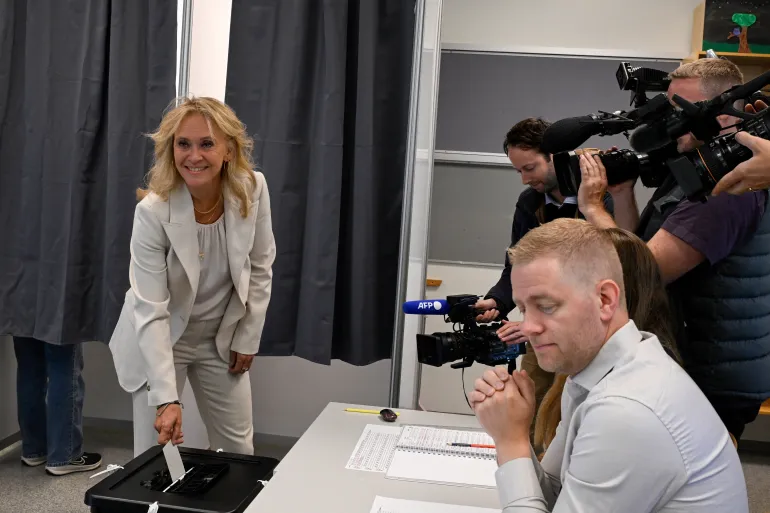
Voting has closed in Iceland’s referendum on resuming membership negotiations with the European Union.
Voting stations closed on Saturday, but it could take several hours for a clear victory for either the “yes” or “no” camp to emerge.
The referendum does not have exit polls, and ballot counting only began once voting stations closed.
Polling suggests the vote is on a knife wdge, with different surveys putting either side narrowly ahead, but none straying more than a few points from an even 50/50 split.
The vote comes 13 years after Iceland, then led by a Eurosceptic government, paused EU accession talks.
The country is currently governed by the pro-EU Social Democratic Alliance, which called the vote and promised to honour whatever the Icelandic public decides.
If Icelanders vote “yes”, the country would likely start years of negotiations with Brussels to hammer out membership terms. It would then hold a second referendum on whether to formally become part of the EU.
Security, the relatively sluggish Icelandic economy, and the future of the Icelandic currency, the krona, have all been significant themes in the run-up to the vote
(Aljazeera)

Ferry carrying 260 people capsizes off northern Cyprus coast

Imam unlikely to play rest of Lord’s Test after picking up left calf tear

Vimukthi, Ayodhya hand Sri Lanka winning start to Asia Cup title defence

Voting closes in Iceland’s knife-edge EU referendum

Showers in the Sabaragamuwa, Western and North-western provinces and in Galle, Matara, Kandy and Nuwara-Eliya districts

Sun directly overhead Mannar, Periyamadu, Puliyankulam, Welioya and Pulmoddai about 12.11 noon today (30)

‘Dates have the highest sugar content to fight Coronavirus’

Sunday Island 27 December – Headlines

#SundayIsland 17th December – Headlines

Sunday Island – 28th March

Sunday Island Headlines – 21 March

Sunday Island – 21st February – Headlines
-

 News6 days ago
Missing doctor’s body found in Mahiyanganaya
-
 News6 days ago
Australia declines to release Finance Secy Suriyapperuma’s citizenship details
-

 News6 days ago
22A: BASL suggests CJ recuse himself from hearing petitions
-

 News3 days ago
Eight politicians in drug kingpin probe
-

 Editorial7 days ago
Govts. drag feet as undergrads age
-
 Features5 days ago
Insights from Chieftains of Uva: Genealogy of two Kandyan Families – Part II
-

 Features5 days ago
Export diversification: Missing the wood for the trees – Part I
-

 Business3 days ago
Sri Lanka opens up: A new season of direct connectivity