
Latest News
Bumrah and Ashwin beat England’s bazballers as India draw level

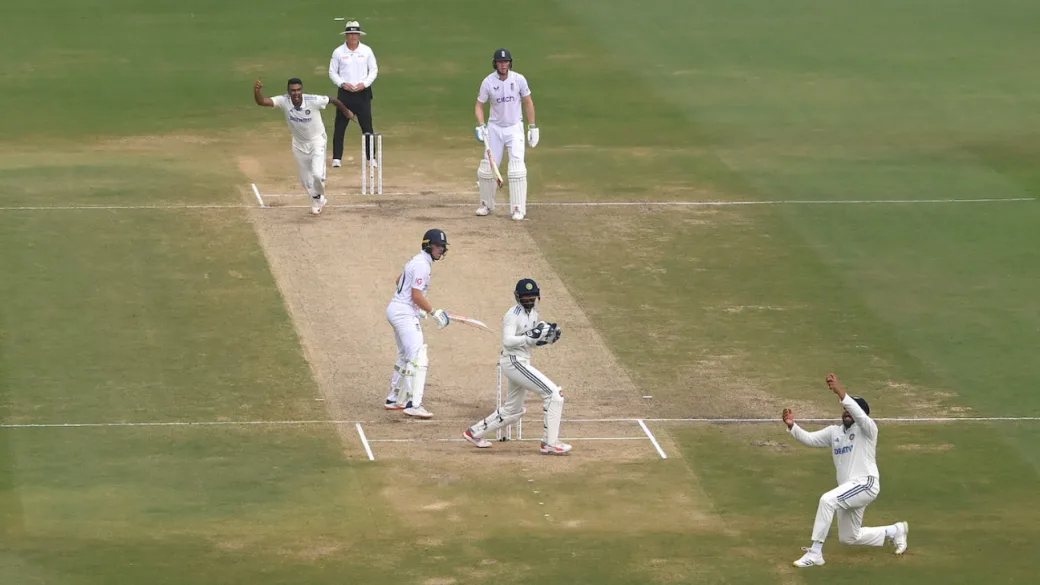
Bumrah’s figures of 3 for 46 in 17.2 overs were less spectacular than his first-innings six-for, but the timing of his breakthroughs was everything on a fraught fourth day – in particular, his priceless extraction of Jonny Bairstow on the stroke of lunch, a dismissal that capped a five-wicket session for India and left England’s chase with too far to run, having bursted out of the blocks with now typical gusto.
The loss was only England’s third in 11 fourth innings chases since the start of the Bazball era, and if a target of 399 had always seemed outlandish, their all-out total of 292 was still higher than the previous successful chase by a visiting team in India – West Indie’s 276 for 5 in Delhi in 1987-88.
For all of their endeavour, England will rue a handful of key moments that derailed their hopes – most particularly a lbw verdict against their most composed chaser, Zak Crawley, moments before the Bairstow extraction, and an atypically lax piece of running from the captain, Ben Stokes, that sawed off his ominously poised innings before it could cut loose. Joe Root, nursing a damaged finger, played a wild knock of 16 from 10 balls that begged several questions too, particularly given how composed England’s tail proved to be in adversity, most notably Tom Hartley, who was last man out for 36 from 47 balls.
The tone of England’s chase was established in the opening moments of the day. At one end, there was Crawley, all poise and calculation as he lined up India’s dangerman Bumrah and committed only to the balls that his 6’5″ frame could drive with impunity. At the other, there was Rehan Ahmed, a blur of ambitious strokeplay as he resolved to live dangerously and burgle his runs before India could get settled, as he did with a brace of boundaries in Axar Patel’s second over.
Rehan was there for a good time, not a long time, and Axar duly had the final word with a plumb lbw from round the wicket, but not before Rehan’s 23 from 31 balls had helped to add 45 runs in 11 overs for the second wicket. Out came Ollie Pope, the second-innings hero in Hyderabad, and as he too launched onto the offensive with a lasered drive for four first-ball, it was clear England weren’t about to go into their shells.
Crawley strode onto the front foot once more to dump Axar through long-off to reach a supremely measured 83-ball half-century, but while he sought to provide a very Bazball definition of an anchor, Pope was business personified in the course of a fleet-footed cameo. His faith in the sweep was a clear indication that the bounce had gone out of the surface, at least while Axar was in his sights, from whom he picked off all five of his boundaries in a 21-ball stay.
Brief scores:
India 396 (Yashaswi Jaiswal 209, James Anderson 3-47, Rehan Ahmed 3-65, Shoaib Bashir 3-138) and 225 (Shubman Gill 104, Tom Hartley 4-77) beat England 253 (Zak Crawley 76, Jasprit Bumrah 6-45, Kuldeep Singh 3-71) and 292 (Zack Crawley 73, Jasprit Bumrah 3-46, Ravichandran Ashwin 3-72) by 106 runs
(Cricinfo)









The Asian Youth Games gold medallist who has run sub four minutes previously returned a time of 3:55.97 seconds to become the first athlete in his age category at these championships to run the distance under four minutes.
Achintha who has a personal best of 3:53.05 from last year was representing Prince College Ratnapura today.
In another impressive 1,500 m feat Tharushi Abhisheka of Lyceum International School, Wattala established a new meet record in the Under-20 Girls’ 1,500m as she returned a time of 4:34.59 seconds to win.
By the end of the second day of the meet seven new meet records had been established.
D. V. C. de Soysa (of Galewela Central College) Under-16 Boys’ Discus Throw – 55.83m.
D. G. Lahiru Achintha (of Ratnapura Kumara Vidyalaya) Under-18 Boys’ 1,500m – 3:55.97 secs.
W. P. Nethula Induwara (Rahula College, Matara) Under-14 Boys’ 100m – 11.70 seconds
K. V. R. Gayesha (Ira Handa Kotuwa Wewa Maha Vidyalaya, Polonnaruwa) Under-16 Girls’ High Jump – 1.70m
H. M. D. S. Herath (Maris Stella College, Thimbirigaskatuwa) Under-20 Boys’ Long Jump – 7.65m
P. M. Amaya Semindi (Vijitha Central College, Dikwella) Under-14 Girls’ High Jump – 1.58m
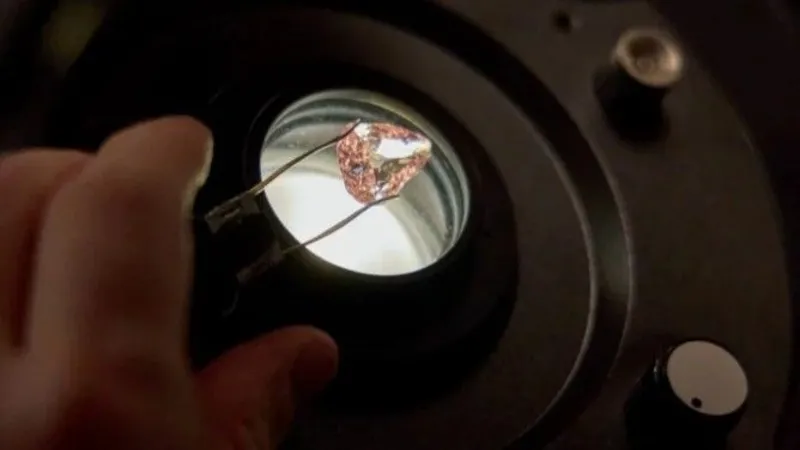
A rare pink diamond is going on display in France for the first time since it was stolen almost 100 years ago to the day – the last time it was shown to the public.
The nine-carat, pear-shaped gemstone known as the “Grand Condé” was pilfered in an overnight raid on the Château de Chantilly in October 1926 and concealed in a hollowed-out apple.
The diamond – one of few royal jewels to survive the French Revolution – was recovered a few weeks later when a hungry maid at the hotel in which the thieves were staying took a bite of the apple.
It will once again be on display in the Condé Museum at the Château de Chantilly until 3 January.
The museum’s director Mathieu Deldicque said that while the apple story may sounds far-fetched, it was widely covered by newspapers at the time.
Deldicque has faced questions about whether the exhibition may be tempting fate, especially given the string of heists on European cultural institutions in the past 12 months, including the daring daylight robbery of jewellery from the Louvre museum in Paris.
While he declined to reveal to CNN how much the diamond was insured for, he noted that extensive academic study into the properties of the diamond had taken place to make it uniquely identifiable.
The results of this analysis, as well as previously unseen archive material about the gem’s history and theft, form part of the exhibition, according to the museum.
Naturally occurring pink diamonds are exceptionally rare and often sell for tens of millions of dollars. The highest price ever fetched for one at auction was $71.2m (£53.6m) in 2017, according to Sotheby’s.
The exact origins of the Grand Condé remain a mystery.
It was first mentioned in 1740 in an inventory of Louis Henri de Bourbon, Prince of Condé, drawn up following his death, the Château de Chantilly said.
It then became part of the collection of Queen Marie-Amélie of Bourbon-Sicily, the wife of French King Louis Philippe I, and then her son, Prince Henri of Orléans, the Duke of Aumale.
He bequeathed it to the Institut de France, which now owns the Château de Chantilly, 50km (31 miles) north of Paris, along with thousands of artworks and manuscripts which became the Musée Condé collection.
(BBC)
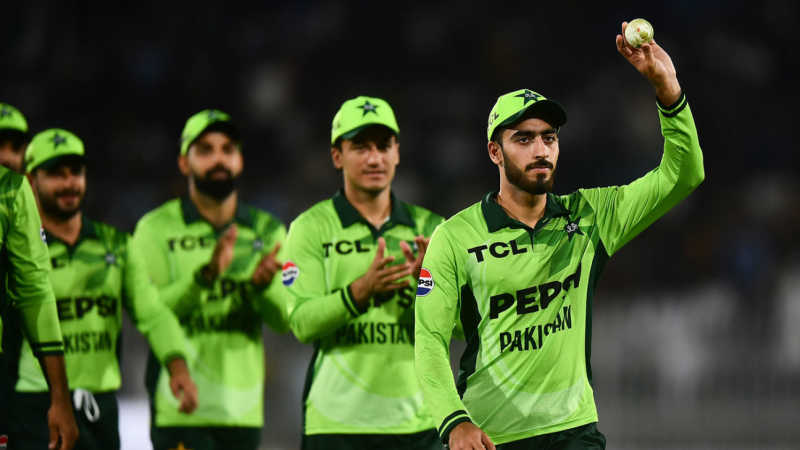
Sri Lanka’s men begin this match having won an international in the past week. This is more significant than it sounds. Their 2026 has been abysmal, with the team losing 22 matches to the 10 they have won. New captain Kusal Mendis had carried his team to that victory with his 87 not out off 48 balls, after Sri Lanka’s seamers had also had an encouraging outing.
But the game was only a dead rubber, Pakistan having sewn up the T20I series already. Pakistan have hardly been lighting up 2026 either, but they have had substantially more success than Sri Lanka. They had won their most recent ODI series, against Australia, 2-1. In that series, Pakistan may even have discovered a bright young all-round talent, left-arm spinner and lower-order batter Arafat Minhas, who claimed the Player of the Series award for his seven wickets at an average of 12.28. He has been in penetrative form in the past 10 days as well, having claimed five wickets across the three T20Is against Sri Lanka. Against Australia, Pakistan had also had excellent performances from Shaheen Afridi and legspinner Abrar Ahmed. It had, in fact, been Pakistan’s bowlers who dominated in a low-scoring series.
The tri-series is important for all three sides because there is now officially less than 12 months before the World Cup, which is set to begin on October 2 next year. Sri Lanka still have plenty to figure out – their white-ball squads having been in serious flux this year, as a new set of selectors searches (often fruitlessly) for a winning combination. Pakistan have players and stratetgies to trial as well.
In the series against Australia, Babar Azam had top-scored for Pakistan, hitting 40, 16, and 69 to average 41.66 across the matches. No one will call it a return to his heyday, but it was an encouraging sign following a modest run in 2025, in which he averaged 34 across 17 innings. Sri Lanka has been one of his favoured opponents over the years, Babar having struck four of his 20 centuries against them, averaging 58.33. The tracks in Rawalpindi at least are expected to be good for batting. Can he build up some form in the one format he now plays?
Lahiru Udara has reason to feel miffed at the selectors, many think. Having hit 188 against West Indies three Tests ago, he was left out of the squad entirely for the forthcoming Test series. But with Pathum Nissanka having been ruled out of the ODIs through an ongoing hamstring problem, Udara has surged into ODI contention on the back of a good T20I innings last week. At age 32, he knows his chances at this level are numbered. With the World Cup on the horizon, there is perhaps no better format to impress in right now than ODIs.
With neither Sahibzada Farhan nor Maaz Sadaqat in the ODI squad, Saim Ayub and Fakhar Zaman may open.
Pakistan (possible): Saim Ayub, Fakhar Zaman, Hasan Nawaz, Babar Azam, Salman Ali Agha, Shadab Khan, Ghazi Ghouri (wk), Minhas Arafat, Shaheen Afridi (capt.), Haris Rauf, Naseem Shah
Sri Lanka may bring Avishka Fernando straight into the XI, with Kamil Mishara having had a run of modest scores. Sri Lanka also have some decisions to make on the spin-bowling front, although they are likely to favour Maheesh Theekshana over legspinner Sachindu Colombage.
Sri Lanka (possible): Lahiru Udara, Avishka Fernando, Kusal Mendis (capt, wk), Kamindu Mendis, Sahan Arachchige/Pavan Rathnayake, Janith Liyanage, Dasun Shanaka, Dunith Wellalage, Dushmantha Chameera, Eshan Malinga, Maheesh Theekshana, Asitha Fernando
(Cricinfo)

Namal, Janaki further remanded

Achintha smashes 1,500 metres record at All Island Schools Games

Rare pink diamond goes on display in France 100 years after amateur heist

Nursery owner in China jailed for life after hundreds of children poisoned

Pakistan, Sri Lanka look to find the right mix as World Cup countdown begins

Mumbai Indians and head coach Mahela Jayawardene part ways

‘Dates have the highest sugar content to fight Coronavirus’

Sunday Island 27 December – Headlines

#SundayIsland 17th December – Headlines

Sunday Island – 28th March

Sunday Island Headlines – 21 March

Sunday Island – 21st February – Headlines
-

 News7 days ago
Sri Lanka escalates anti-graft drive with Shiranthi’s jailing
-

 News7 days ago
Iranian ships stranded, Lanka fears US sanctions
-

 Latest News6 days ago
Farhan and Sadaqat help Pakistan seal series in style
-

 Latest News5 days ago
Nissanka’s return headlines Sri Lanka’s Test squad against Pakistan
-
 Features6 days ago
Intake 16: 45 years of duty and honour
-

 News6 days ago
Malwathu Chapter issues statement on talks with President over Gnanasara Thera’s robes
-

 News7 days ago
Navi Pillay’s Lankan affairs in focus as she wins 2026 Nobel Peace Prize
-

 News6 days ago
CP alleges NPP has taken the blame for illegal US sanctions on Iranian vessels