
News
President emphasizes need of immediate reforms in global financial structure


President Ranil Wickremesinghe addressing the 3rd South Summit of the Group of 77 and China on Sunday (21) in Kampala, Uganda, highlighted the numerous challenges the world faces, such as conflicts, pandemic repercussions, climate disasters and financial market uncertainties. The President also emphasized the disproportionate impact on vulnerable G77 economies.
He stressed the urgency of reforming the global financial structure because the contemporary international debt resolution structure is more suited for a world where the Paris Club and London Club dominated global debt resolution. Currently the global debt and particularly debt in the developing world is dominated by international bond markets, and non-Paris Club lenders.
The President lamented the diversion of financial resources to debt service, hindering spending on essential public services and human development, impacting Sustainable Development Goal (SDG) targets. He criticized the Common Framework for its inability to provide speedy debt resolution, causing delays in addressing recent sovereign debt distress in many G77 countries.
Addressing climate finance, President Wickremesinghe highlighted the failure of the global financial system to meet the Global South’s needs for mitigating and adapting to climate change. Despite commitments made in global forums, he pointed out the lack of real contributions. He introduced Sri Lanka’s Tropical Belt Initiative, aiming to catalyse private investments for global public goods, including biodiversity, oceans, and forest resources.
Expressing concern about rising protectionist tendencies in global trade, the President urged decisions to be made in multilateral forums rather than unilaterally. He emphasized the need for coordination between the G77 and BRICS to ensure the smooth efficiency of global trade and investment.
While advocating for global financial reforms, the President called on the G77 + China to formulate strategies for member countries to prepare for energy transition, digital transformation, the green economy, and a skilled workforce for the new global economy.
As the largest alliance of developing countries within the United Nations, the G77 provided a platform for the Global South countries to express and advance their collective economic interests. It also served as a forum for joint discussions on international economic issues, fostering mutual cooperation among its member countries. The 3rd Southern Summit was convened under the theme of “Leaving No One Behind,” aiming to enhance collaboration among its 134 member nations in areas such as trade, investment, sustainable development, climate change, poverty alleviation, and the digital economy.
(PMD)







Business
Focus on developing the Coconut and Food & Beverage export industries into a USD 3 billion economy within the next two years
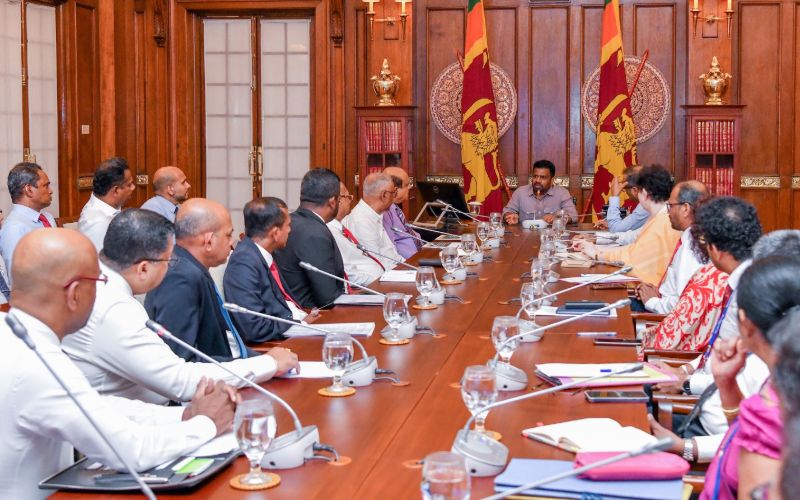
A discussion was held on Friday (26) afternoon at the Presidential Secretariat between President Anura Kumara Dissanayake and industrialists in the coconut and food and beverage manufacturing sectors on developing the coconut and food and beverage export industries into a USD 3 billion economy within the next two years.
Accordingly, the objective is to expand the coconut-based export industry into a USD 2 billion sector and the food and beverage export industry into a USD 1 billion sector, and extensive discussions were held on the plans required to achieve these targets.
The President stated that the Government is prepared to provide every possible form of incentive necessary to promote export diversification and encourage value-added products.
Proposals and suggestions aimed at developing these industries were also presented during the meeting, and the President further noted that future plans would be formulated after taking all such proposals and recommendations into consideration.
The President also expressed agreement to provide incentives for establishing industries in the Northern Province and assured that the Government would extend its fullest support for setting up coconut-based manufacturing industries in the region.
Attention was also focused on plans to streamline the importation of raw materials required for export production while safeguarding domestic producers. President Anura Kumara Dissanayake further stated that his Government’s objective is to build the country’s economy into an export-oriented production economy by strengthening domestic supply chains.
Minister of Labour and Deputy Minister of Finance and Planning Anil Jayantha Fernando; Secretary to the Ministry of Finance, Planning and Economic Development, Dr Harshana Suriyapperuma; Secretary to the Ministry of Industry and Entrepreneurship Development, Thilaka Jayasundara; and Chairman of the Export Development Board, Mangala Wijesinghe, were among those present.
The President of the Sri Lanka Food Processors Association, Aruna Senanayake; Vice President Rasika Seneviratne; Managing Director of CBL Group, Shyamali Wickramasinghe; Chief Executive Officer of SriLankan Catering Ltd, Mangala Wijesekera; Managing Director of Ma’s Tropical Food Processing (Pvt) Ltd, Mario D. Alwis; Chairman of the Consumer Foods Sector of John Keells Food Holdings PLC, Daminda Gamlath; together with a number of leading business leaders from the food production sector were also present.
President’s Media Division (PMD)
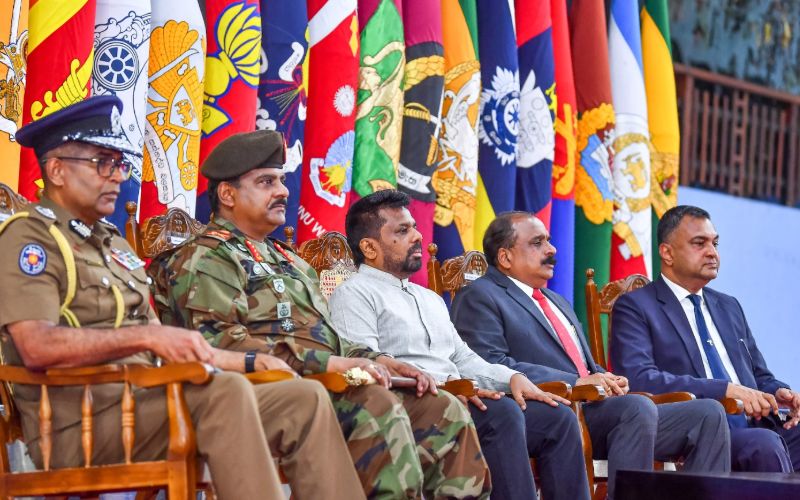
President Anura Kumara Dissanayake joined the ceremony held on Friday (26) morning at the Sri Lanka Infantry Regimental Centre in Panagoda to extend his best wishes to members of the Sri Lanka Army and the Sri Lanka Police Special Task Force who are set to depart on United Nations peacekeeping missions.
This marks the largest contingent of personnel ever to depart from Sri Lanka at a single time for United Nations peacekeeping operations. It is also significant as the first occasion on which a President has attended in person to extend his good wishes to the departing contingent.
Addressing the gathering, the President stated that this demonstrates to the world that Sri Lanka possesses forces prepared to stand for the protection, democracy and human rights of oppressed people wherever they may be. The President noted that this is a tremendous source of pride and honour for the nation. The President further pointed out that, although it may be difficult for Sri Lanka to become the wealthiest country in the world, it can nevertheless become one of the world’s most respected and dignified nations.
The President also emphasised that all those departing on peacekeeping missions carry the pride of the nation upon their shoulders and that it is the responsibility of every individual to safeguard the country’s honour and dignity by performing their duties with dedication and professionalism.
In order to help ease the current crisis in Haiti and support efforts to establish peace and stability in that country, the Government of Sri Lanka is scheduled to deploy this Gang Suppression Force (GSF) to Haiti in August.
The contingent comprises 900 Army personnel drawn from various regiments, 189 officers of the Police Special Task Force, and, for the first time in Sri Lanka’s military history, 43 female Army personnel specially trained in demining and explosive ordnance disposal operations. In addition, the battalion has been equipped with armoured vehicles, locally manufactured Uni Buffel vehicles, as well as two specialised bulletproof vehicles provided by the Presidential Security Division.
Following is the speech delivered by the President;
“We know that all of you gathered here today are preparing to undertake an extremely important mission in the service of world peace, carrying with you the reputation and pride of our nation. What is it that you take with you as you leave our country? First and foremost, we believe that you depart bearing the honour and dignity of Sri Lanka upon your shoulders. Each of you carries a profound responsibility to safeguard our motherland, its esteem and its pride in the course of your duties. This is because we must transform our country into one that enjoys great international respect and prestige. We all understand one thing: we may not become the richest nation in the world. However, we can become one of the world’s most dignified and honourable nations.
To achieve that, there are many tasks that we must undertake and fulfill. In doing so, we know that we must build a state whose economy does not collapse in the manner we have experienced before. When a country suffers economic collapse, its pride, reputation and dignity are also diminished in the eyes of the international community. If we are a nation unable to repay its debts, if we are a nation that has gone bankrupt, then we become a state that has lost its self-respect. Therefore, one of our greatest challenges is determining how to transform Sri Lanka into a strong and resilient economy.
In that regard, I believe we have already achieved several significant successes. One of them is that our economy has developed the capacity to withstand internal shocks, including floods, cyclones and other disasters. You are aware that cyclone Ditwah that struck during the November–December period last year became one of the most economically devastating cyclones in Sri Lanka’s recent history. That was an internal challenge. Yet we possessed the capability to build an economy strong enough to confront such an internal crisis. As a result, we were able to allocate Rs. 500 billion for recovery without printing new money or obtaining fresh loans. Consequently, by January, February and March, our economy remained stable and continued to record growth. Had that not been the case, we would not have achieved an economic growth rate of 5.1 per cent. Our ability to respond swiftly was made possible by the economic strength we had built.
Similarly, with the recent conflict in the Middle East, many people began to speculate that our country would once again come to a standstill. There were discussions about possible fuel shortages, power cuts, import restrictions and the suspension of vehicle imports, among many other concerns. Yet, in response to the impact of that conflict, we allocated Rs. 100 billion, to provide relief to the people. What does this demonstrate? It shows that we have strengthened an economy capable of withstanding internal shocks.
I believe our principal challenge now lies in how we respond to external shocks. How do we mitigate the effects on our economy arising from wars and conflicts elsewhere in the world? To address this, I believe we require a strategic plan.
We have engaged in extensive discussions on this matter and have already taken a number of important steps towards preparing ourselves for such external disruptions.
Your service, as you depart today, is in the interest of both our nation and global peace.
Next, if a nation is to attain true dignity and honour, the rule of law and the supremacy of law must be firmly established. Every citizen must respect the law and submit to it. However, our country long maintained a culture in which certain groups neither feared the law nor obeyed it. They possessed the means to evade justice through their wealth and influence. How can a nation achieve international respect, honour and prestige under such circumstances? A country cannot progress when one law applies to the wealthy and powerful and another to the poor and vulnerable.
Therefore, I firmly believe that one of the most important foundations of national dignity and honour is breathing life into the principle that all are equal before the law. Society must have confidence that the law will be applied equally to everyone whenever wrongdoing occurs. Internationally, Sri Lanka must be recognised as a country that respects the rule of law.
I believe that we have already taken considerable strides in this regard. We are building a state in which everyone is subject to the law. This is not easy, because old habits and entrenched influences continue to exert pressure. Nevertheless, we remain determined to establish the principle that every person must be accountable under the law.
In that endeavour, our armed forces and our Special Task Force have a vital role to play. We have every confidence that you will fulfill the unique responsibility entrusted to you in upholding the rule of law and the authority of the state in our country.
At the same time, we must safeguard the freedom of our citizens. No citizen of this nation should have to live in fear of those who govern them.
Yet, for a long period, the citizens of our country did live in fear of their rulers. A nation cannot move forward under such circumstances. A state cannot progress when its people live in fear of, and in subservience to, those in power. What, then, must we do? Citizens must have the right to criticise those who govern them. They must have the right to organise themselves in defence of their rights in opposition to the governing authorities. If the people have entrusted us with the office of President, then the people have the right to question me. We must build a state that safeguards such freedoms and human rights. That is an essential foundation for a nation’s progress and for earning an honourable reputation in the world.
In this regard, we know that our armed forces and our distinguished officers have rendered immense service to our country over many years. However, there have at times been reports, both domestically and internationally, raising certain doubts concerning some aspects of that service.
Nevertheless, I wish to state clearly that, from the ordinary soldier at the lowest rank to the Commander of the Army and from the police constable on the ground to the Inspector General of Police, if any action has been taken in defence of this country, its people and the security of the state, then we, as a government, are duty-bound to protect and uphold every such action. If anyone, anywhere, has carried out duties in the interests of national security, the freedom of our people and the protection of the state, then we have a responsibility to protect all those who stood in support of those efforts.
At the same time, we also have a responsibility to investigate any actions that may have harmed the reputation of our armed forces or undermined their responsibilities in pursuit of the ambitions of a small group. If, in furtherance of the interests of a very small faction, things inappropriate for the armed forces have been done, or acts have been committed that fall outside what is expected of them, then, for the sake of the reputation of the military, the protection of victims and the dignity of our nation, we are prepared to act and indeed we must act. None of this constitutes personal vengeance or political persecution. We must rebuild a strong and respected reputation for our armed forces.
If a small group, in pursuit of narrow interests, has abandoned the honour, values and commitment that the military owes to the people and to the state, then I believe that, for the sake of the dignity and reputation of the armed forces themselves, such matters must be investigated, examined and made known to society. Our honour does not rest upon burying crimes in the sand; it rests solely upon conducting proper investigations and bringing the truth to light. That is the conviction we hold. Therefore, I believe that the mission upon which you are about to embark today is one of immense responsibility. It will bring honour and prestige to our country.
The people of Haiti are facing an internal crisis that requires the easing of conflict, the safeguarding of their fundamental rights and the creation of an opportunity for them to choose a strong government through democratic elections. What has happened there is that the state itself has found it difficult to protect its own democracy, freedom and the lives of its citizens. Consequently, the United Nations has had to intervene. For what purpose? To uphold the freedom, democracy and human rights of the people of that country.
So, for what purpose are you departing today? You are leaving Sri Lanka to help safeguard the freedoms, democracy and rights of the citizens of another nation. What a source of pride and honour this is for us as a country. You are setting out from Sri Lanka to uphold the freedom of the people of another land. You are departing to strengthen democracy in another country. You are leaving to protect the rights of another people. You are going to safeguard the lives of citizens in another nation. I believe this is among the highest honours and greatest sources of pride that we can attain as a country.
You are demonstrating to the world that we possess an armed force and a Special Task Force that are prepared to stand for the protection, democracy and human rights of oppressed people wherever they may be in the world. That is of great importance. Moreover, Sri Lanka has, for many years, served alongside United Nations peacekeeping forces and on every occasion has earned distinction and respect. Today, you depart bearing the honour of a nation that has long performed its duties within UN peacekeeping missions with exemplary discipline and professionalism.
Your predecessors and the contingents that served before you protected that honour in those lands. I believe that, as you prepare to depart for Haiti, you carry with you not only the honour of the nation but also the reputation of your senior officers. Therefore, you are setting out to safeguard both the dignity of the country and the esteem of those who served before you.
Your parents, too, must feel immense pride. If there is a profession in this country that exemplifies discipline, it is the military and the police service. Generally speaking, a tendency has emerged among the younger generation to shy away from disciplined professions. Many are more attracted to unstructured lifestyles and less inclined towards orderly and regulated forms of work. Consequently, many young people today show a preference for informal employment rather than careers founded upon discipline and structure.
It is in such circumstances that you chose to join the armed forces and the Special Task Force of Sri Lanka, embracing a life of discipline. Your uniform, your appearance, your grooming, the time at which you rise and your daily duties are all governed by a structured code of conduct. Your parents have entrusted their children to a profession founded upon discipline and they must undoubtedly take great pride in that. The uniform you wear represents the honour and dignity of our nation and the fact that their child wears it is a source of great distinction for the country.
Moreover, your role becomes especially significant in times of war or disaster. Whenever a disaster occurs, the first person I contact is the Secretary to the Ministry of Defence. Whether it was the recent fire at an elderly care home in Horana, a building fire, or the emergence of instability or conflict, it is to the Defence Secretary that we turn. Not only during natural disasters such as landslides and floods, but even in times of conflict, is it upon you that we first rely. We have great confidence that you will respond swiftly and take the necessary action.
Your parents have raised and guided you to become the professionals we need whenever disaster strikes this country. We need young people who are prepared to work to help the nation recover from any calamity. That, too, is a source of immense pride for parents. Today, you are not only protecting the freedom, democracy, and human rights of your own motherland, but are also departing to stand for the security and liberty of the people of another country. Reflect for a moment on how proud your parents must be that their child is travelling far from home to serve in defence of the safety and well-being of another people. It is a tremendous honour and source of pride for parents and equally a matter of national pride.
Therefore, this moment of your departure is an occasion on which all of us feel renewed respect and admiration for you. My final appeal to you is this: remember that you carry our national flag upon your shoulders. In every duty you perform and in every step you take, this motherland and your parents are watching you. Consequently, I believe that all of us bear a responsibility to act with the utmost seriousness, dedication and sense of duty. I look forward to meeting you again in Sri Lanka after you have fulfilled that responsibility. I sincerely wish you every success in this important mission. Thank you very much, everyone”.
President’s Media Division (PMD)

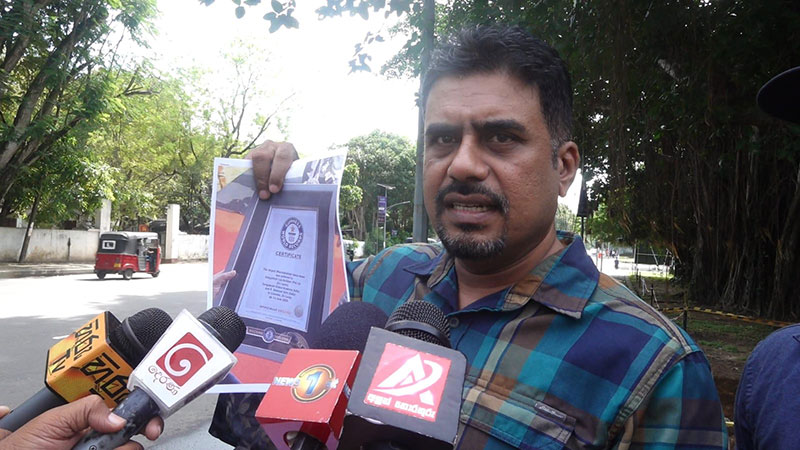
The Jana Aragala Sandhanaya yesterday lodged a complaint with the Commission to Investigate Allegations of Bribery or Corruption (CIABOC), calling for an investigation into Deputy Minister Sundaralingam Pradeep over alleged irregularities related to a Guinness World Record event held in Sri Lanka.
The organisation alleged that state patronage had been extended to a private company for the event and that large sums of money had been collected from around 5,000 families of participating students.
Speaking to the media, after submitting the complaint, Jana Aragala Sandhanaya National Executive Council member and Frontline Socialist Party (FSP) Secretary, Duminda Nagamuwa, alleged that the government had promoted the Bharatanatyam workshop, held on June 14, as an event that secured a Guinness World Record for the participation of the largest number of students.
He said a government politician had taken the lead in organising the event, attended by Deputy Minister Mahinda Jayasinghe.
Nagamuwa questioned the decision to provide state support for an event organised by a private entity, claiming that the Guinness certificate issued for the achievement had been awarded not to Sri Lanka or a state institution, but to a company.
“Why did the government provide state patronage to a private institution’s programme?” he asked.
He alleged that each of the approximately 5,000 participating students had paid Rs. 5,000, resulting in the collection of a substantial amount of money. He claimed that parents were also asked to pay additional amounts of Rs. 3,450 for logos and Rs. 2,350 for certificates.
Nagamuwa alleged that many families, from economically disadvantaged backgrounds, had incurred heavy expenses travelling to Colombo and staying there for several days for the event, with some families spending around Rs. 30,000 each.

Cape Verde break record as smallest nation to reach World Cup knockouts

India A stretch lead to 170 after Sai Sudharsan retires hurt

T20 World Cup: Scotland miss out as eight teams secure automatic spots for 2028

Maliban Biscuits and Peoples Leasing PLC qualify for CDB-MCA T10 Tier B final

Focus on developing the Coconut and Food & Beverage export industries into a USD 3 billion economy within the next two years

Another 1,132 Sri Lankan Personnel to be deployed for United Nations Peacekeeping Missions

‘Dates have the highest sugar content to fight Coronavirus’

Sunday Island 27 December – Headlines

#SundayIsland 17th December – Headlines

Sunday Island – 28th March

Sunday Island Headlines – 21 March

Sunday Island – 21st February – Headlines
-

 Features7 days ago
Nanda Pethiyagoda Wanasundara as three generations of family saw her
-

 Features6 days ago
Sri Lanka developing independent hydrographic capabilities
-
 Opinion5 days ago
Ranasinghe Premadasa: The man who would not take ‘No’ for an answer
-

 Editorial7 days ago
Fuel crisis: Beyond price debate
-

 Latest News6 days ago
Sooryavanshi thumps fastest List A fifty as India A win tri-series
-

 News4 days ago
US Assistant Secretary of State for South and Central Asian Affairs meets President
-

 Opinion4 days ago
Sri Lanka’s national security: Justice, reconciliation, and forward-looking vigilance
-

 Features7 days ago
The Sirisena – Ranil conflict and events leading to MR’s return as PM