
Editorial
From heyday to ‘hay day’


Monday 18th December, 2023
The SLPP’s second national convention on Friday (15) was a soft launch of its next election campaign, presidential or parliament, to all intents and purposes. The presidential election will have to be held next year, and there is no way the government can postpone it. President Ranil Wickremesinghe himself told Parliament the other day that the next presidential and parliamentary elections would be conducted in 2024, followed by the Provincial Council and local government polls in 2025. All political parties have therefore gone into overdrive to mobilise popular support with an eye to next year’s national elections. The SLPP must have expected to shore up its image, or what remains thereof, with the help of Friday’s show, which however fell short of the target.
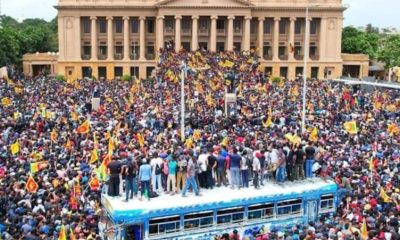
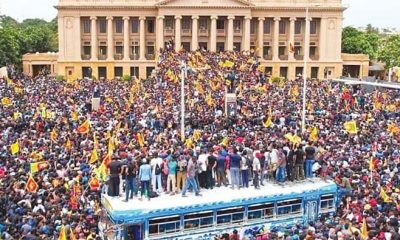
Founded in 2016 as an alternative to the SLFP, which joined the Yahapalana government, the SLPP had a meteoric rise. In May 2017, it together with the Joint Opposition led by former President Mahinda Rajapaksa, held a mammoth May Day rally at the Galle Face Green, which it turned into a sea of heads. It trounced the Yahapalana government at the local government polls held the following year, and went on to win the presidential and parliamentary elections in 2019 and 2020, respectively.
It mustered a two-thirds majority in Parliament in its heyday, and nobody expected the people to turn against it, the way they did last year. Ironically, the cradle of anti-government protesters’ struggle or Aragalaya was the Galle Face Green itself. Today, it’s the SLPP’s ‘hay day’, so to speak; its leaders and rank and file had bundles of hay (as well as grass) greeting them on the way to their party’s second national convention, on Friday, courtesy the anti-government activists. The people who turned violent last year and attacked the properties of the SLPP politicians have opted to ridicule the government members and their backers in a non-violent manner.
The Rajapaksas and their acolytes seem to think they will be able to take the people for a ride again. On Friday, they sought to arouse nationalism and lionise themselves; they said they had saved the country from terrorism and were capable of winning future elections and forming a stable government. Basil Rajapaksa went to the extent of issuing a veiled threat to the political rivals of the Rajapaksas.
He said those who hurled stones at lions had to be mindful of the consequences of their action, implying that the Rajapaksas and their backers were lions, and they would get even with their political enemies. (He seems to have forgotten that he and his brothers headed for the hills last year, fearing the irate public.) Curiously, having made boastful claims at Friday’s convention, Basil resigned as the National Organiser of the SLPP. Is it that he himself does not believe in his own rhetoric?
Grass and hay metonymically represent cattle, and those who hung them in public places on Friday did so to liken the SLPP politicians and their supporters to bovines. The organisers of that grass-hay protest may consider themselves very smart, and they are reportedly on cloud nine because the bundles of fodders became a social media sensation, but in our book, theirs was a reprehensible act, to say the least, and they must be ashamed of causing such affronts to innocents. Why should the cattle be insulted by being compared to the SLPP politicians and their backers?
Bovines are very useful to humans, as is public knowledge; they pull heavy loads, help plough fields and give milk without expecting anything in return. They are an invaluable asset to the farming community, unlike the ruling party politicians who have ruined the agricultural sector and inflicted immense suffering on farmers as well as others.
So, it is nothing but unfair to compare a bunch of corrupt, greedy, parasitic politicians to them. Similarly, the lions would be offended if they were aware of attempts being made in some quarters to liken a pack of rejected crooked politicians to them.Let the government and the Opposition be urged to stop insulting poor animals.








Thursday 17th September, 2026
The police have been grappling with a chronic manpower shortage, but they have not allowed it to stand in the way of investigating Opposition politicians. They are going to probe an NGO activist’s complaint that the LTTE, a banned organisation, was ‘promoted’ at a recent SLPP rally in Anuradhapura, according to media reports. Presumably, the complaint is about Jaffna District MP Ramanathan Archchuna’s admission during his speech at the SLPP rally on 12 Sept., that he was a Tiger (LTTE member).
If the police launch an investigation into MP Archchuna’s statement at issue, they should also probe some serious allegations he made against the incumbent government, especially his claim that pro-LTTE groups residing overseas backed the JVP-led NPP’s election campaigns.
The JVP-NPP government is all out to paint a black picture of the SLPP as a party of rogues and pseudo-patriots in a bid to prevent nationalistic forces from rallying behind the Rajapaksas again. So, all signs are that the police will go the whole nine yards and probe MP Archchuna’s declaration that he is a ‘Tiger’, though this is not the first time he has said so. It is doubtful whether the JVP/NPP leaders will be able to portray themselves as patriots by causing legal action to be taken against Archchuna and the SLPP over his Anuradhapura speech.
All self-proclaimed patriots in Sri Lankan politics have demonstrated that they do not scruple to subjugate their ‘patriotism’ to political expediency. Real patriots do not abuse power, resort to violence or terrorism, suppress democracy, destroy state assets, steal public funds or indulge in bribery and corruption, do they?
A probe is currently underway into an allegation that the SLPP engineered the 2019 regime change with the help of the National Thowheed Jamaath (NTJ), which carried out the Easter Sunday carnage. On Tuesday (15) Additional Solicitor General Dileepa Peiris informed the Colombo Fort Magistrate’s Court that investigations had uncovered that a person named Alawdeen, the father-in-law of one of the Easter Sunday suicide bombers, had provided speedboats to Zahran and his associates to travel to India before the Easter Sunday terror attacks. Alawdeen’s daughter, who was married to the bomber, had been released from detention during the presidency of Gotabaya Rajapaksa, and Alawdeen had supported Rajapaksa’s election campaign, Peiris claimed. His allegation reminds us of Yusuf Mohamed Ibrahim, the father of two Easter Sunday suicide bombers, Inshaf and Ilham. Ibrahim has been a key suspect in the Easter Sunday bombing investigation, and his company was under investigation for its alleged role in supplying materials used in the Easter Sunday attacks. Investigators have revealed that one of the two Ibrahim brothers who carried out the terror attacks spent about Rs. 45 million on NTJ terror operations. Ibrahim was a JVP National List nominee in 2015.
The Rajapaksa family has been accused of securing the help of both northern terrorists and eastern terrorists to capture power. One may recall that it enlisted the support of former southern terrorists as well. The UNP accused Mahinda Rajapaksa of having won the presidency in 2005 by bribing the LTTE to call for a boycott of the 2005 presidential election, thereby preventing many Tamil voters, who were thought to be supportive of UNP candidate Ranil Wickremesinghe, from voting. Mahinda contested from the SLFP, which was backed by a collective of left parties, with the JVP leading his presidential election campaign from the front and making his victory possible. President Rajapaksa subsequently provided political leadership for defeating the LTTE.
The UNP cut secret deals with the LTTE. President Ranasinghe Premadasa donated arms, ammunition, building materials and money to the LTTE while it was fighting the Indian Peace Keeping Force. The TNA, created by the LTTE, announced the 2005 presidential election boycott in the LTTE-held areas, and acted as the LTTE’s mouthpiece in Parliament. In the 2010 presidential election, the TNA backed former Army Commander Gen. Sarath Fonseka, who contested from the New Democratic Front, supported by the JVP, the UNP, the SLMC, etc. The same UNP-led opposition alliance, backed by the TNA and the JVP, among others, supported Maithripala Sirisena’s successful presidential bid in 2015. The JVP is now facing allegations that it is shielding an Easter Sunday terror suspect (Ibrahim) and has secured the support of pro-LTTE groups to win elections.
Politicians are not alone in having double standards on terrorism. Some prominent religious leaders who publicly express their abhorrence of terrorism had no qualms about meeting LTTE leaders, including Prabhakaran, and posing for photographs with them.
Nothing gives greater succour to terrorism than the hypocrisy of political and religious leaders.
Wednesday 16th September, 2026
Opposition propagandists are in overdrive trying to portray the JVP-NPP government as an inefficient regime or a kakistocracy. But there are certain tasks it carries out very efficiently, and they include increasing taxes, tariff, and fuel prices. Speculation is rife that another fuel price hike is in the pipeline. Filling stations, operated by some foreign companies, have stopped dispensing diesel, claiming losses, according to media reports.
Opposition-aligned trade unionists and consumer rights groups have claimed that the government is trying to jack up diesel prices on the pretext of preventing losses to foreign petroleum companies so that the cost of running oil-fired power plants to meet Norochcholai’s generation shortfall caused by low-grade coal imports could be passed on to the public. The government stands accused of recovering losses due to procurement rackets by increasing electricity tariffs and petroleum prices.
Norochcholai’s coal quality issues translate directly into lost megawatt-hours, which must be replaced by expensive diesel power generation to avert power cuts. Experts have pointed out that even short durations of this replacement can consume hundreds of thousands of litres of diesel, depleting national stocks and costing billions of rupees.
Maintaining adequate fuel reserves and preventing coal supply shortfalls are critical for the country’s energy security. Delays in coal shipments and quality issues have compounded problems besetting the Norochcholai power complex. When coal power generation dropped due to substandard coal imports, the government should have planned for diesel demand surges while fixing the coal procurement process to minimise recurring shortfalls. Its failure to do so has driven the Ceylon Petroleum Corporation (CPC) to buy diesel at very high prices, as revealed by HSBC Group CEO Georges Elhedery, who told the media that Sri Lanka had once paid as much as USD 286 for (refined) diesel per barrel. The CPC subsequently admitted that it had purchased diesel at the extraordinarily high prices mentioned by the HSBC CEO. CPC Chairman D. J. Rajakaruna claimed that his institution had been left with no alternative but to pay the exceptionally high prices for diesel, as refusing to do so would have resulted in a fuel shortage. What was left unsaid however was that the demand for diesel had surged as oil-fired power plants were being pushed into service to make up for the shortfall in Norochcholai’s generation and avert power cuts.
Now that the government has indicated its willingness to consider increasing fuel prices, in two weeks, filling stations are bound to place bigger orders in the coming days and hoard fuel.
The government’s efforts to conceal the fact that the public has had to bear the losses caused by the coal scam have been in vain. There is no way the coal procurement rackets can be covered up. One may recall the UNP-led Yahapalana government’s attempts to obscure the Treasury bond scams in 2015 by means of aggressive denials and obfuscation failed. In a bid to muddy the water, it used a forensic examination of earlier Treasury bond transactions dating back to 2008 in keeping with a presidential commission of inquiry recommendation. The incumbent government is apparently trying to do something similar to confuse the public. When the coal procurement racket under its watch was exposed, it appointed a presidential commission of inquiry to probe all coal transactions dating back to 2009, when the coal procurement process reportedly began. A wag says that if a JVP-NPP politician happens to be caught with a gun and venison, the government may appoint a commission to investigate deer hunting since the time of King Devanampiyatissa, who encountered Arahant Mahinda while out on a deer hunt.
It is imperative that the government ensure transparency in fuel pricing. The public should be shown the complete cost reflective pricing formula together with the exact international benchmark, exchange rate, landed cost, taxes, levies, CPC costs, any loss-recovery component, etc., every time pump prices are revised. Consumers have a right to know how fuel prices are calculated.
Sadly, the Opposition does not seem keen to address issues concerning lack of transparency in fuel pricing, and the allegation that the government resorts to cost padding to justify price hikes. It is all hat and no cattle, critics say.
Tuesday 15th September, 2026
Printing is becoming increasingly challenging in Sri Lanka. This is more so about printing newspapers and books owing to the ever-rising cost of paper, ink and high taxes, which even threaten the very survival of the printing and publishing industries. Printers and publishers are struggling to keep their heads above water. Today’s comment however is not a tale of woe about the predicament of printers and publishers. Instead, it is about the fact that under Sri Lankan law, printing has been historically among the forms of labour assigned to prisoners sentenced to rigorous imprisonment, and allied issues, such as preferential treatment given to politicians serving jail terms.
It has been reported that former Aviation Minister Priyankara Jayaratne, sentenced to seven years of rigorous imprisonment for corruption, has been attached to the prison printing section. The Commission to Investigate Allegations of Bribery or Corruption filed a case against Jayaratne, alleging that he caused a loss to the state by unlawfully making SriLankan Catering release Rs. 320,000 for providing lunch to his supporters participating in the May Day parade of 2014, when he was the Minister of Aviation. Questions have been raised in some quarters about the proportionality of punishment, and they no doubt deserve serious discussion.
The general view among jurists is that proportionality is fundamental to justice: punishment should be commensurate with the gravity of the offence, neither unduly lenient nor excessively severe; when proportionality is disregarded, punishment can cease to be justice and become retribution, undermining public confidence in the law while imposing unnecessary human and financial costs on society. However, it defies comprehension why influential politicians sentenced to rigorous imprisonment for corruption, etc., are attached to prison printing sections. Former ministers Mahindananda Aluthgamage and Nalin Fernando, both serving lengthy terms of rigorous imprisonment, for causing losses to the state through corrupt deals while in power, have also been assigned work in the prison printing section, according to media reports.
Has the prison printing section become a convenient refuge for influential inmates?
We are not arguing that the former ministers in prison should be made to perform backbreaking tasks involving heavy manual labour, such as road-making and maintenance, carrying or moving heavy materials. Although rigorous imprisonment is still legally defined as imprisonment with hard labour, today, the labour imposed on prisoners sentenced to RI can take various forms of prison employment, including skilled and semi-skilled work, such as printing, rather than the arduous manual labour traditionally associated with the term.
Given the categorisation of agricultural and plantation work, coir-making, and printing as hard labour in prison, a wag asks whether the arduous nature of these tasks should not also be taken into consideration in determining the remuneration of ordinary workers toiling in these sectors.
Farmers are arguably in a far worse predicament than prisoners, especially the politicians behind bars; instances are not rare where they suffer heavy losses due to crop failures, soaring production costs and disastrous agricultural experiments by politicians, such as the organic farming initiative during the last government, and many of them worry about the next meal. Prisoners have no such problems to contend with. They at least get free meals although there may be occasions when a dead cat is found in a cauldron of parippu curry, as former Deputy Minister Ranjan Ramanayake has revealed. The plight of plantation workers is even worse. They have been reduced to semi-slavery, with cunning politicians shedding copious tears for them and granting them some relief to garner their votes.
Meanwhile, if “rigorous imprisonment” has become an archaic expression for a sentence that legally entails hard labour, as argued in some quarters, while the work assigned to prisoners today technically ranges from manual labour to skilled prison employment, then serious thought should be given to changing the nomenclature to reflect the true nature of the punishment. Above all, tasks categorised as hard labour should be fairly allocated to prisoners serving terms of RI in the interests of equality of treatment.

DIMO KNIGHTS 2026 Reinforces a Culture of Recognition and Growth

Isle of Man teenage all-rounder Lucy Barnett ICC Women’s Player of the Month for August 2026

Sonal Dinusha named the ICC Men’s Player of the Month for August 2026.

USA midfielder sues doctors after on-pitch cardiac arrest

River home to 500 crocodiles chosen as Olympic rowing venue

Steps will be taken to implement a new National Youth Policy in Sri Lanka in the first quarter of 2027 – PM

‘Dates have the highest sugar content to fight Coronavirus’

Sunday Island 27 December – Headlines

#SundayIsland 17th December – Headlines

Sunday Island – 28th March

Sunday Island Headlines – 21 March

Sunday Island – 21st February – Headlines
-

 Sports7 days ago
DDS set to lose Test captaincy
-

 News7 days ago
Sri Lanka faces new grid challenge as rooftop solar surges: former CEB GM
-

 Latest News6 days ago
Shafali, Deepti power India into sixth T20 Asia Cup final
-

 Latest News6 days ago
Sri Lanka thwart Fatima Sana challenge to secure Asia Cup final spot
-

 News5 days ago
Gnanasara Thero absconding after SC ruling
-

 News6 days ago
Ammunition cache found in old Kandy bungalow
-

 Editorial7 days ago
A flight of fancy
-

 News5 days ago
Green Climate Fund (GCF) Regional Dialogue for East and South Asia will be held from 14 to 17 September 2026 at Cinnamon Life at City of Dreams Hotel, Colombo