
News
ADB to fund water supply sector reform program in Sri Lanka


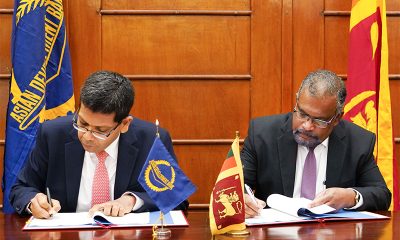
The Asian Development Bank (ADB) is to fund the upcoming water supply sector reform program in Sri Lanka and a discussion in this regard took place at the Presidential Secretariat between between a delegation headed by Asian Development Bank’s Country Director for Sri Lanka Takafumi Kadono and Senior Advisor to the President on National Security and Chief of Presidential Staff Sagala Ratnayaka, Minister Jeevan Thondaman, President’s Senior Adviser on Economic Affairs Dr. R.H. S. Samaratunga, the Secretary of the Ministry of Water Supply R.M.W.S. Samaradivakara and other officials
The key objectives of these reforms revolve around enhancing the management of a climate-resilient, safe and environmentally sustainable water supply systems.
(PMD)












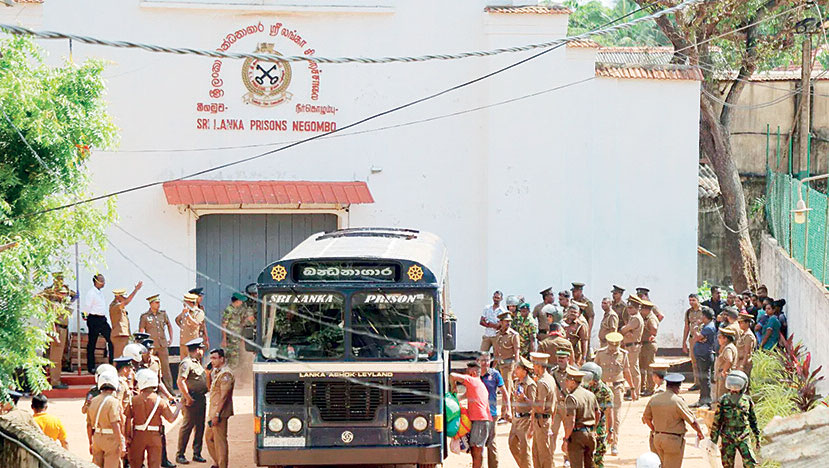
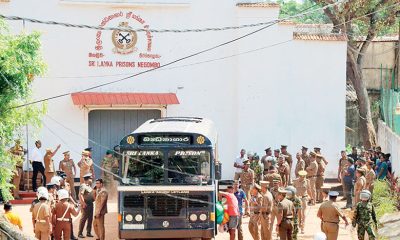
The Joint Opposition has demanded a thorough investigation into the recent Negombo Prison riots. The following is the text of the statement issued by it yesterday:
“The riot which took place in the Negombo Prison on 5 and 6 July is among the worst incidents of its kind in the history of prisons in our country. 31 fatalities include 23 inmates and 8 prison officials, as at present.
The facts, in terms of sequence and gravity, are so appalling as to shock the conscience of the nation.
An absolutely impartial and thorough investigation of the course of events is essential. We welcome the appointment, for this purpose, of a committee of inquiry presided over by a recently retired judge of the Supreme Court.
There are several circumstances which seem to us to call for candid, truthful and complete explanation. We set them out seriatim.
(1)The violence began on 5 July and culminated in two deaths. The situation, however, appeared to have been brought under reasonable control by evening, and there was relative calm.
An obvious precaution, to prevent escalation, was to separate the warring groups – the inmates and the prison officers. Incredibly, this was not done and, to the best of our knowledge, there was dismal failure to prevent deterioration of the situation throughout the night.
(2) Contrary to all reason, a group of prison officials were sent among the inmates early on 6 July, when the latter were having their morning meal. In the highly charged atmosphere which prevailed, this provocative act was an open invitation to retaliation. The inevitable then happened, and the most bestial carnage occurred. This was the high point of the atrocities.
The action of the prison authorities, placing at grave risk the lives of the officers, defies logic and common sense to the point of raising legitimate questions as to the motive underlying the extraordinary action by the authority that directed this initiative.
(3) At the height of the pitched battle, a prison security official used an automatic weapon to open fire, through an aperture in a door, maiming or killing a number of inmates. There is a critical need to ascertain whether this indiscriminate firing was justified or whether lesser measures, in the context of prudent management of the situation, would have sufficed.
(4) A Deputy Inspector-General of Police has made a public statement that, although the police were on standby since the evening of 5 July, they received no instructions to bring the situation under control. He explained that police would move in only when requested to do so by the prison authorities; and they stood by passively in the absence of instructions to intervene.
We therefore have the bizarre situation that the police, including the Special Task Force, were mere spectators and were deprived of the opportunity during a critical stage of the events, to use their discretion and expertise in a situation which continued to be handled with less than total finesse and capability.
How did this become possible?
(5) There was, at the very least, inexcusable recklessness in respect of the arrangements which were made to transfer inmates from Negombo to Welikada, Angunukolapelessa and Boossa prisons.
a) According to the Committee for Protecting the Rights of Prisoners, about 8.30 p.m. on 7 July, inmates transferred to Angunukolapelessa prison were savagely beaten and sustained broken limbs and extensive lacerations.
b) About 8.30 p.m., a bus transporting 21 inmates from Negombo prison arrived at the Welikada Prison Hospital premises. While trapped inside the vehicle, the inmates had been violently assaulted, with the injured left profusely bleeding, and a gunshot victim trapped among them. One of the 21 inmates, assaulted while in the bus, succumbed to his injuries.
c) A very grave issue relating to a custodial death surfaced when, at 8 a.m. on 8 July, it was confirmed that an inmate transferred from Negombo Prison to the high-security Boossa Prison had died. At 10.40 a.m. on 8 July, a second death was confirmed at the Angunukolapelassa Prison.
In relation to these developments, a critical question arises as to responsibility for the arrangements regarding conveyance of inmates from Negombo to Angunukolapelessa, Welikada, and Boossa.
(6) Deaths of prison inmates while in the custody of the State is a very serious situation in terms of Article 11 of the Constitution of Sri Lanka, as well as under international law. Sri Lanka has to act in compliance with several international instruments, including Articles 6, 7 and 10(1) of the International Covenant on Civil and Political Rights, the International Convention on Torture, and the Universal Declaration of Human Rights. The most useful document is that dealing with minimum standards of treatment of prisoners, referred to as the Nelson Mandela Rules.
Since state responsibility is involved, extreme vigilance is mandated. It is, therefore, a matter of the utmost surprise and regret that the Minister of Justice appears to have been incommunicado while heinous events involving loss of human life were occurring with impunity on Sunday, 5 July and throughout Monday, 6 July. The Minister did not visit the Negombo Prison until approximately 3 p.m. on 6 July. When, at 12.30 p.m. on 8 July, in response to an urgent request by the Committee for the Protection of the Rights of Prisoners, a special emergency meeting was held at the Ministry of Justice, unfortunately, the Minister did not think it fit to attend, but was content to be represented by the Director of Prisons.
(7) On 7 July, about 8.30 p.m., a team of officers from the Rapid Response Unit of the Human Rights Commission of Sri Lanka visited the Welikada Prison. Most surprisingly, the chief jailer of the Welikada Prison denied them access to the facility.
This is a blatant contravention of Sections 11(d) and 28(2) of the Human Rights Commission of Sri Lanka Act, No. 21 of 1996, and gives rise to reasonable suspicion that a coordinated effort was being made to conceal acts of murder and torture. This rightly elicited a vehement protest from Justice L.T.B. Dehideniya, Chairman of the Human Rights Commission of Sri Lanka.
(8) There is no doubt that the situation of anarchy in the Negombo Prison was directly attributable to the absence of a proper system of authority and control. For more than a year, the Negombo Prison had been without a permanent Commissioner-General. On 9 June 2025, Mr. Tushara Upuldeniya, who held that post, was interdicted. In subsequent proceedings, the Human Rights Commission ordered his reinstatement, but the Secretary to the Ministry of Justice, Ms. Ayesha Jinasena, contemptuously defied this order. Her sustained, arrogant refusal to give effect to a binding direction of the Commission is a significant contributing cause of the loss of life in this tragic situation. She must be held accountable for the dire consequences of her intransigence.
This calamity gives rise to issues of criminal and civil responsibility, and heightens the need to provide clear-cut answers to some highly pertinent questions.
Within the framework of the country’s constitutional scheme, the Special Task Force comes within the control not of the Minister of Justice, but of the Minister in charge of the Police. Operational deployment of the STF in the relevant circumstances requires the concurrence of the Minister of Defence.
There must be clarity as to whether appropriate consultation took place in this regard.
The practical reality needs to be borne in mind that prison officials are subjected to intolerable strain because of the acute overcrowding of prisons. Approximately four times the number of inmates for which these facilities were intended, are currently being held. Significant numbers are held in our prisons despite the absence of any conviction by a court of competent jurisdiction. This accounts for about three-fourths of the total number of inmates. The result is that the presumption of innocence, which is accorded constitutional recognition, is often honoured in the breach. A practical appraisal of the situation warrants recognition that the legitimate interest of prison officials, understaffed and ill equipped, should not lack focus.
Total transparency and honesty is required in respect of this unmitigated tragedy. We will stand steadfastly against obfuscation or concealment.”
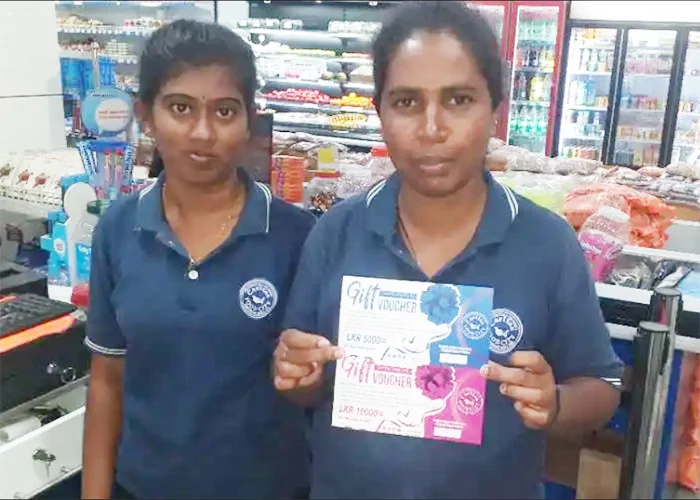
(UCAN) On a hot summer day in late June, Mary Amalautpavam was busy preparing products for delivery to a supermarket in the popular resort town of Nilaveli, on Sri Lanka’s northeastern coast.
The 28-year-old Catholic widow paused occasionally to watch her four-year-old son playing nearby.
Each week, she earns about 10,000 Sri Lankan rupees (US$30) by producing a range of food items, including rice, flour, and chili — an income she could hardly have imagined just two years ago.
For years, Amalautpavam used to work for middlemen and businesses who offered paltry amounts because her village had no reliable market where she could sell them directly.
“Food City is giving us a better opportunity to reach customers and earn more,” she told UCA News with a smile.
She is among 42 local entrepreneurs who received training in food safety, packaging, labelling, supermarket management and business development, as well as technical skills, such as using QR code systems.
“Middlemen bought our products for very low prices, and sometimes we worked for almost nothing. Now I feel proud because my work has value,” Amalautpavam said.
Such initiatives are considered vital in helping lift people out of poverty in Sri Lanka, where about one-quarter of the population lived below the poverty line in 2024, according to the World Bank.
The island nation of about 22 million people suffered its worst economic crisis in 2022, triggering mass protests that forced President Gotabaya Rajapaksa from office.
A bailout agreement with the International Monetary Fund helped stabilise the collapsed economy and support its recovery.
Food City in Trincomalee, about 267 kilometers (166 miles) northeast of the capital, Colombo, is operated by the Eastern Human Economic Development (EHED) Centre, the social development arm of Caritas in the Diocese of Trincomalee.
According to official figures, Muslims make up about 42% of the diocesan population, while Buddhists and Hindus each account for about 26%. Christians comprise about 6%.
Many of the suppliers, including Amalautpavam, are single mothers, widows and women from remote rural communities who previously had little access to formal markets.
She said informal traders often paid her less than half the market value of her products, trapping her in a cycle of debt and poverty.
Since joining the Food City project, she has overcome many of those financial hardships and obtained government registration, enabling her to enter the formal business sector for the first time.
The registration also allows small entrepreneurs, like her, to supply products to other supermarkets, expanding their markets and increasing their income.
Food City sells local and imported groceries, fresh produce, dairy products, meat, stationery and household essentials. It manages more than 10,000 products through a computerised inventory system while maintaining close partnerships with farming communities.
With regular orders arriving every two weeks, Amalautpavam can now cover household expenses consistently and plan for her son’s future.
The supermarket attracts hundreds of customers each day, particularly in the evenings when families gather along Nilaveli’s popular beachfront.
Acting on a tip-off, the Talatuoya Police successfully raided an illicit liquor distillery, operating in a forest area, in the Bawlana village, on the night of July 12.
The raid was conducted by the Criminal Investigation Division of the Talatuoya Police, led by Sub Inspector Rathnayake, under the instructions of Officer in Charge (OIC) Inspector Hemal Liyanage.
During the operation, police seized a large quantity of ‘Goda’ (fermented mash used for illegal liquor production), totaling 96,375 litres, alongside various distilling equipment. One suspect was also taken into custody during the raid.
Preliminary investigations revealed that the illicit liquor produced at this distillery had been distributed to several areas, including Hanguranketha, Rikillagaskada, Marassana, and Talatuoya. The suspect is expected to be produced before the Kandy Magistrate’s Court.
By S.K. Samaranayake

Joint Opp. demands thorough probe into Negombo Prison riot

Lanka Aluminium collaborates with SLIA to organize factory visit for architects

Catholic project helps Lankan women rebuild livelihoods

Talatuoya Police raid major illicit distillery

Sun Siyam Pasikudah hosts Miss Polski 2026 finalists for exclusive photoshoot on Sri Lanka’s East Coast

Allergy awareness walk and run to be held in Colombo on Sunday

‘Dates have the highest sugar content to fight Coronavirus’

Sunday Island 27 December – Headlines

#SundayIsland 17th December – Headlines

Sunday Island – 28th March

Sunday Island Headlines – 21 March

Sunday Island – 21st February – Headlines
-
 News5 days ago
Herath warns prospective migrant workers not to get fleeced by racketeers
-

 Midweek Review7 days ago
Unexpected focus on ‘pieces of tin’ worn by military men
-
 Features3 days ago
Prison riots and politics: NPP’s biggest challenge and Sri Lanka’s biggest opportunity
-

 Editorial4 days ago
What’s the world coming to?
-
 Foreign News5 days ago
Tensions erupt in Indian state after 11-year-old raped and murdered
-
 Features5 days ago
Devanesan Annan – in Memoriam
-

 News6 days ago
Negombo Prison riot: Ensuring protection of prisoners fundamental responsibility of the state – UN
-

 Editorial7 days ago
Prison riots and political battles