
Business
Between homefront policies and global developments: Sri Lanka’s external sector outlook


By Nilupulee Rathnayake
 Having weathered a challenging period marked by a deep economic crisis, Sri Lanka is now demonstrating positive signs of an economic upturn. Still, amidst limited homefront policy alternatives against an unfavourable global backdrop, a critical question arises: how will Sri Lanka’s external sector cope in the face of these challenges?
Notably, import controls, initially imposed in response to the dearth of foreign exchange liquidity in the domestic market, are being largely eased. The government is actively seeking to forge partnerships with regional giants, aiming to strengthen trade relations through Free Trade Agreements (FTAs). Nevertheless, in the broader global context, the rise of geopolitical rivalries, slow growth and contracting demand in key markets create multiple uncertainties for Sri Lanka’s external sector recovery.
Global Economic Developments: A Complex Web of Uncertainties
Globally, there are promising signs of economic progress in the near term. Supply chain disruptions, which significantly impacted various industries, have largely returned to pre-pandemic levels. Energy and food prices, having peaked during conflict-induced periods, have substantially subsided, alleviating global inflationary pressures faster than anticipated.
However, the global economic landscape remains overshadowed by a complex web of uncertainties. Political dysfunction in key economies and ongoing geopolitical rivalries present challenges. The United States’ imposition of bans on certain exports to Chinese firms exemplifies the extant geopolitical tensions. This growing inclination towards trade interventions through industrial policies, subsidies, and import restrictions, driven by national security and environmental considerations, has the potential to impact the trajectory of globalisation. These developments carry substantial implications for emerging and developing economies, particularly those deeply reliant on a globally integrated economy, foreign direct investment (FDI), and technology transfers. Economies contending with burgeoning sovereign debt overhangs in particular, are expected to face heightened vulnerabilities. Having defaulted in early 2022, Sri Lanka is among the countries particularly affected by these global economic shifts.
Sri Lanka’s Vulnerable Export Sector
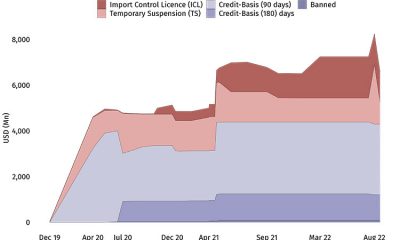
In 2022, Sri Lanka recorded its lowest merchandise trade deficit since 2011, primarily due to reduced imports and an uptick in exports. Merchandise exports expanded by 4.9% in 2022 compared to the previous year, while import expenditure decreased by 11.4% in 2022 relative to 2021. The decrease in import expenditure stems from a combination of import restrictions and foreign exchange liquidity constraints.
However, as import controls ease and the economy gradually improves, a marginal increase in import expenditure is observed from June 2023 onwards. While improving consumer welfare and food security, this move may negatively impact the trade deficit this year, especially as global demand for Sri Lanka’s primary exports, like tea and garments face a downturn – the former triggered by high production costs and the latter by contracting foreign demand.
Sri Lanka’s key export markets for garments, particularly in the US and Europe, are experiencing low growth and weakened demand since the fourth quarter of 2022. Consequently, monthly earnings from garment exports in August 2023 indicates a 26% decline compared to August 2022. Notable decreases in the import of Ceylon tea by prominent Sri Lankan tea importers in 2022 relative to 2021, including Russia (by 9.6%), the UAE (by 2.5%), and Turkey (by 47%), also highlight the vulnerability of Sri Lanka’s export sector to external shocks. The tea market’s condition has seen a modest improvement in 2023, though it has not been entirely resolved.
The concentration of Sri Lanka’s exports in terms of products and markets has long been a source of concern, rendering the economy exceedingly susceptible to sector-specific shocks.
Tourism and Worker Remittances: A Silver Lining
In a positive trajectory, 2023 has witnessed a notable increase in monthly tourist arrivals compared to the previous year, signalling a discernible recovery trend. Cumulative tourist arrivals from January to August 2023 amounted to 904,318, compared to 496,430 arrivals recorded during the corresponding period in 2022. Overcoming the challenges within this sector necessitates a coordinated effort from various stakeholders, including the government and the private sector, as Sri Lanka endeavours to reconstruct its brand identity as a secure and preferred destination.
Worker remittances, representing another crucial source of foreign exchange earnings, have exhibited promise. In the first half of 2023, worker remittances grew to USD 2.8 billion, however it remains below the pre-pandemic level of USD 3.6 billion recorded in the first half of 2018. While the Middle East remains a vital destination for Sri Lankan workers, alternative destinations offering employment across various job categories have emerged, including South Korea, Singapore, Japan, and several European countries. Notably though, the large-scale migration of workers, including white-collar employees, raises concerns regarding long-term economic repercussions due to brain drain.
Challenges in Attracting Foreign Investment
In a fiercely competitive global FDI landscape, political stability and a robust macroeconomic framework are paramount considerations for investors, especially given the numerous countries competing for their attention.
In the post-war period, Sri Lanka experienced its peak FDI inflows in 2018, attracting USD 1.6 billion. However, in 2022, this figure dwindled to USD 898 million, reflecting the adverse impact of the pandemic and economic challenges. Sri Lanka’s economic crisis – and the country’s sovereign default status together with public protests, strikes, and violence – reshaped the country’s perception as a not particularly attractive destination for foreign investors.
As Sri Lanka anticipates modest growth in the coming years, it becomes imperative not only to retain existing investors but also to proactively seek new investments within the current unfavourable climate. The Board of Investment (BOI) has targeted to attract USD 2 billion in FDI in 2023, with a particular focus on the tourism sector. An incentive package, potentially incorporating tax incentives, is being contemplated as a viable policy intervention, aligning with practices observed in peer countries aimed at attracting FDI.
Building Resilience and Diversification
Sri Lanka’s external sector has been susceptible to policy missteps that exposed it heavily to external global shocks. Building the economy’s resilience against external pressures must necessarily be a crucial part of the adjustment and recovery process. As import controls are also eased, to bridge the widening trade deficit, Sri Lanka needs to implement concrete policy measures to diversify its export basket and connect to global value chains.
Several initiatives have already been undertaken, for instance, to pursue fresh trade relationships with neighbouring giants. These trade agreements should be deep trade agreements that target not only merchandise trade but also services, FDI promotion, value addition, trade facilitation, and digitisation. In the near term, negotiations are ongoing on various stalled trade agreements with India, China, and Thailand, amongst others, while expressing interest in joining the RCEP trade bloc in the medium term.
However, notably, Sri Lanka can no longer approach efforts to expand and diversify exports in a piecemeal fashion and FTAs on their own will fail to deliver. High energy costs, labour shortages, and scaling back on infrastructure spending, amongst others, impact the operating environment for businesses. Sri Lanka’s longstanding structural bottlenecks must be overcome by implementing the necessary reforms to raise productivity for sustained growth if the country is to regain lost confidence in its economic prospects.
*This blog is based on the comprehensive chapter on the external environment in IPS’ ‘Sri-Lanka: State of the Economy 2023’ report.
Link to original blog: https://www.ips.lk/talkingeconomics/2023/10/24/between-homefront-policies-and-global-developments-sri-lankas-external-sector-outlook/





by SK Samaranayake
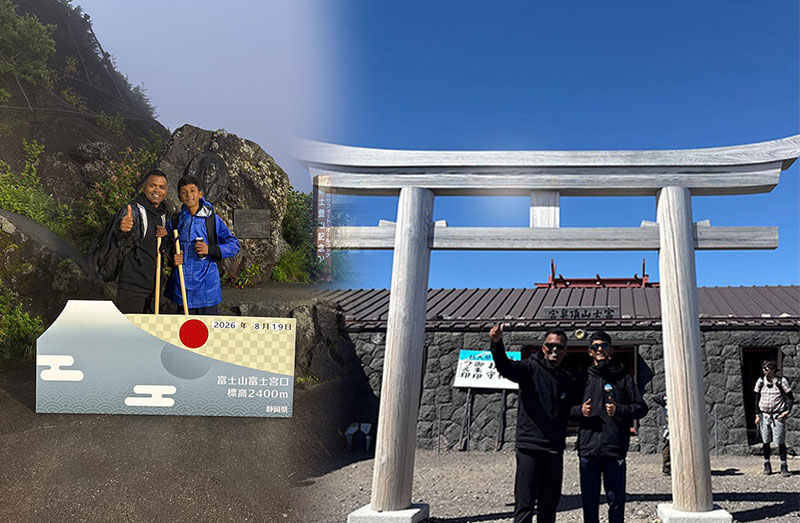
For Daham Gunasena, reaching the summit of Mt. Fuji with his 12-year-old son was not the end of the journey but the beginning of a different kind of lesson.
Gunasena, Director – Commercial at SPAR Sri Lanka and a senior business leader, academic and Chartered Accountant, spent nearly 12 hours on August 19 climbing Japan’s highest mountain with his son, Methum. After eight hours of climbing, the pair reached the 3,776-metre summit before beginning a demanding four-hour descent to Fujinomiya 5th Station.
“The summit was only halfway,” Gunasena reflected, describing the experience as a lesson in preparation, perseverance and responsibility.
Their journey began two days earlier with a trial excursion to the 6th Station and the volcanic landscape around Mt. Hoei. The experience allowed Gunasena to assess the altitude, terrain, weather and equipment before deciding whether his son was ready for the summit attempt.
The climb itself reinforced the value of taking one step at a time. Rather than focusing on the distant summit, father and son concentrated on the next marker, the next few steps and short periods of rest.
Reaching the summit brought another lesson. After taking photographs and celebrating, they still had four hours of descent ahead of them over loose volcanic terrain.
“Reaching the top was an achievement. Returning safely was success,” Gunasena said.
The experience also prompted him to reflect on how Japan manages Mt. Fuji, including visitor education, digital information, sanitation, transport, safety and environmental protection.
Having climbed Sri Pada 12 times last year and five times so far this year, Gunasena sees opportunities to apply some of these principles in Sri Lanka without compromising the mountain’s unique pilgrimage traditions.
He suggested a comprehensive digital platform for Sri Pada providing information on weather, congestion, transport, sanitation, first aid and emergencies, while educating foreign visitors about its religious significance.
For Gunasena, however, the most enduring lesson was personal: a mountain can teach what lectures cannot—through preparation, perseverance, respect for nature and the shared experience of taking each step together.

Sri Lankan industries are being encouraged to adopt advanced condition monitoring technologies to detect equipment problems before they develop into costly failures, as global technology company FLIR and its local partner Marlbo Trading Company strengthen their collaboration.
The companies brought together industry professionals at a technical seminar held on August 20 at Taj Samudra, Colombo, focusing on the use of thermography and acoustic imaging to reduce unplanned downtime, improve energy efficiency and lower maintenance costs.
Organised by Marlbo under the theme “Condition Monitoring Using Thermography and Acoustic Imaging for Measurable ROI,” the seminar highlighted the growing importance of proactive and predictive maintenance in improving equipment reliability and operational efficiency.
FLIR Sales Director – Instrumentation, India, Bhaskar Lala, and APAC Condition Monitoring Specialist David Gambarte shared their expertise on the latest diagnostic technologies and their practical industrial applications.
Thermal imaging can identify abnormal heat patterns linked to electrical and mechanical faults, while acoustic imaging can detect problems that may go unnoticed during routine inspections.
The technology is particularly useful in identifying compressed-air leaks, which can cause significant energy losses and increase operating costs.
Shevon Liyanage, Engineer – Measuring Instruments at Marlbo, also shared insights into applying condition monitoring technologies in the Sri Lankan industrial environment.
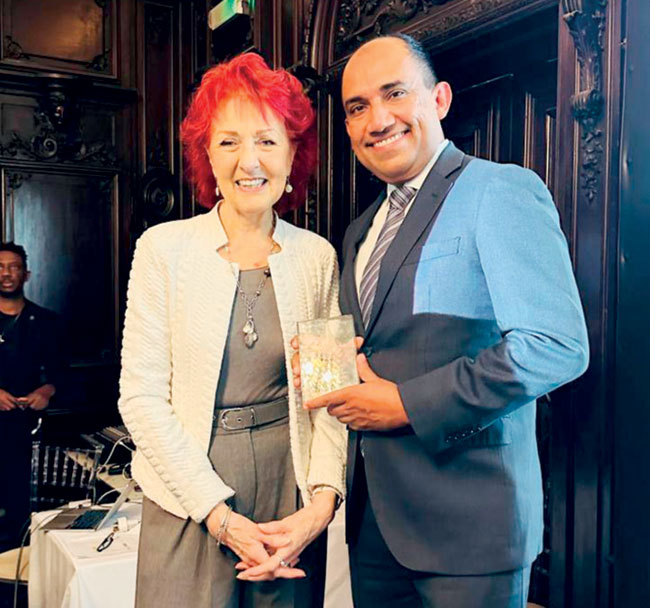
Lumbini Tea Valley Ceylon won an award for its Singharaja Wirytips at The Leafies: International Tea Awards held in London in 2024, marking another international recognition for the Sri Lankan tea producer.
The award comes as the company marks two decades of direct exports, with its premium and organic Ceylon teas now reaching 35 countries across six continents.
Established in 1984, Lumbini Tea Valley began its direct export drive after Chaminda Jayawardana joined the family business in 2000 alongside his father, Dayapala Jayawardana. The initiative materialised in 2006 with the company’s first direct shipment—a 15-kilogram consignment of Flowery Broken Orange Pekoe (FBOP) tea to the United States.
Since then, the company has expanded its direct-export operations, which now account for around 20% of its total manufacturing output. Following its transition to organic production, approximately half of its organic tea output is exported directly by the company.
Its key export markets include Japan, the United States, France, the Netherlands, Switzerland and Australia, with direct shipments now reaching 35 countries.
The company said its direct-export model would continue to expand amid growing international demand for traceable, single-origin Ceylon tea, with premium and organic grades at the centre of its export strategy.

Petrol to cost less from midnight today (30)

Head teacher evacuated 900 children minutes before school washed away by Nepal floods

UPDATE: Seven killed and 23 missing after boat capsizes off northern Cyprus, says Turkish Cypriot PM

Iceland votes against restarting talks on joining EU

“Rathuwewi Mihimadala” Book Launched with the Participation of the Prime Minister

Turkiye, Somalia forces free cargo vessel hijacked by pirates

‘Dates have the highest sugar content to fight Coronavirus’

Sunday Island 27 December – Headlines

#SundayIsland 17th December – Headlines

Sunday Island – 28th March

Sunday Island Headlines – 21 March

Sunday Island – 21st February – Headlines
-

 News6 days ago
Missing doctor’s body found in Mahiyanganaya
-

 News6 days ago
Australia declines to release Finance Secy Suriyapperuma’s citizenship details
-
 News6 days ago
22A: BASL suggests CJ recuse himself from hearing petitions
-

 News3 days ago
Eight politicians in drug kingpin probe
-

 Editorial7 days ago
Govts. drag feet as undergrads age
-

 Business3 days ago
Sri Lanka opens up: A new season of direct connectivity
-
 Features5 days ago
Insights from Chieftains of Uva: Genealogy of two Kandyan Families – Part II
-

 Features3 days ago
Redefining ageing in Sri Lanka