
Features
Lessons from Lockdown – Keeping COVID-19 in Perspective

by Anila Dias Bandaranaike
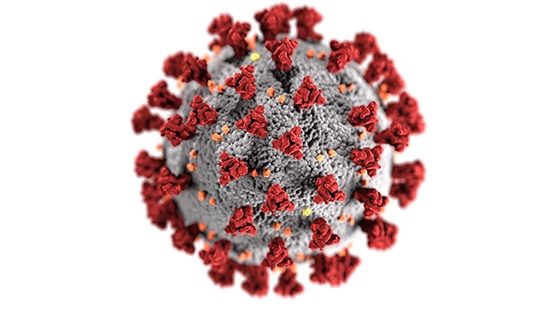
COVID-19 has caused a calamitous global crisis. While tens of millions have tested positive for this virus, over a million people have suffered and died from it. The first COVID-19 case was detected in Wuhan City, China, in December 2019. By November 15 2020, two sources of global statistics recorded about 54 million cases and 1.3 million deaths in 220 countries and territories (World Health Organisation (WHO), Worldometer). Today, medical research is being funded to find a vaccine to protect us humans against it. At the same time, countries are desperately trying to find ways to balance the fight against the spread of COVID-19 with keeping economic activities alive, so that people can have incomes, food, medicines and other basic needs to survive.
Lockdowns in many parts of the world and instructions to avoid crowds, ensure social distancing, wear masks and wash hands, have helped reduce further spread. However, many people, especially poor daily wage earners, have lost access to incomes, nutrition and medicines. Hence, the authorities have to balance these lockdowns, which minimise human interactions, with their economic consequences.
Meanwhile, the print and electronic media have gone more viral than the virus itself. COVID-19 takes priority over most news globally and locally. In Sri Lanka, posts early in this second wave reflected our penchant for playing the blame game. Unsourced video clips, WhatsApp forwards, articles and interviews, blamed, in turn and according to inherent prejudices, different players. These included the company which discovered the first case testing positive, all garment workers and manufacturers, the president, the government, Indians, etc. Rational, factual explanations on the subject were to no avail, such as procedures followed for quarantine of returnees from India and the difficulty in identifying positive but asymptomatic cases.
Perception and prejudice the Sri Lankan way conquered reality. A president, who was hailed a few months ago as being decisive and having everything “under control” the military way, is now blamed for being lax and allowing the virus to spread. Bogey-men of the past, Tamil “terrorists, Muslim “extremists” and Christian “convertors”, each irrationally equated with travel to India, gathering in mosques and churches, were blamed for the first wave. They have been completely overshadowed by “virus-spreading” garment workers of today. These workers have been ostracised in their neighbourhoods, their significant contribution to the economy forgotten, just because the first case identified in the second wave was a garment factory employee.
In the midst of this avalanche of information and misinformation, we need to get our own situation in perspective. In light of the rising number of positive cases in Sri Lanka since October 5, what exactly about COVID-19 is relevant for our future health and safety?
First, let us examine available statistics. We will need to rely on these statistics, despite some concerns about their accuracy. By November 15, Worldometer reported that in 39 million closed cases, 97% had recovered and 3% had died. Available medical evidence highlighted serious respiratory problems among severe or critical COVID-19 cases. Deaths related to those respiratory problems were usually complicated by other underlying health problems, often age-related. This implied that the elderly and those with certain health problems were more vulnerable.
We already experienced in Sri Lanka a few months ago, the outcome of the young, fit and healthy Navy cohort, who had tested positive for COVID-19. They showed few symptoms, were minimally ill and recovered within a few weeks. By October 5, Sri Lanka’s Health Authority had reported a total of 3,400 cases, with 3,260 recoveries and 13 deaths, leaving about 130 active cases. These statistics indicated over 99.6% recoveries and less than 0.4% deaths in 3,273 closed cases. Hence, Sri Lanka’s fatality rate was much lower than the current 3% global rate.
On November 15, with 16,583 total cases, recoveries at 11,495 and deaths at 53, active cases were 5,305 (hpb.health.gov.lk). The fatality rate was still relatively very low, at 0.5%. Against this background, we need to know:
1) How likely are Sri Lanka’s COVID-19 cases to become serious?
2) How likely is death from COVID-19 in Sri Lanka?
3) Can our health services handle the number of serious cases?
4) Who in our population are vulnerable to becoming serious COVID-19 cases and need protection
We also need to remember that our entire knowledge of this virus is from global experiences of less than one year. Theories abound, on its long-term health impact, on possible tests, on preventive means and possible medication. It is too early for any ongoing research to be conclusive. Humanity is still groping in semi-darkness. According to one reputed source in the literature, there have been more 200 tests (around 170 different molecular (PCR) tests, 37 antibody tests and 2 antigen tests) made available. The available scientific literature does not provide certainty about the accuracy (false positives and false negatives) of these tests. As more tests are being performed under varying conditions across the globe, the level of accuracy could also be compromised. Hence, while the reported number of positive cases has been rising fast, we really do not know the true extent of the spread anywhere. So, let us try to find answers to our questions with the available evidence.
How likely are Sri Lanka’s COVID-19 cases to become serious?
Regional comparison of available global statistics shows that fatality rates have, thus far, been much lower in Africa and Asia, than in the West. The Americas and Europe, holding 23% of world population, accounted for 76% of COVID-19 deaths. Asia and Africa, with 77% of world population, accounted for 24% of deaths. (Source:
Worldometer). Current global research is testing theories that in “developing” countries of Africa and Asia 1) greater previous exposure to viruses or 2) compulsory childhood inoculations against viruses, such as the BCG vaccine, had provided a higher resistance to COVID-19. Others theorise higher resistance in those regions due to diet or climate or a milder strain of the virus. Whatever the conclusions, evidenc points to a relatively lower severity of the disease in Sri Lanka, thus far.
How likely is death from COVID-19 in Sri Lanka?
Hard evidence up to November 15 indicated that the fatality rate was very low, at less than 0.5% of closed cases. Sri Lanka’s death rate from COVID-19, at 2 per million population, was also very low, ranking 185 among 220 countries and territories.
Can our health services handle the number of serious cases?
The Health Authority previously conveyed that hospitals had adequate capacity to handle 2,000 cases. Early in the second wave, it was conveyed that this would be increased. By November 15, Sri Lanka had over 5,000 active cases, significantly higher than hospitalisation capacity. Thus far, mild cases have not needed hospitalisation.
However, we do not know how many cases were serious and needed hospitalisation. From 8 months experience, we can expect the number of serious cases to be low. To date, the Health Authority has revised its strategies over time to meet changing needs in the country. It has not yet indicated inability to handle the changing hospitalisation load.
Who in our population are vulnerable to becoming serious COVID-19 cases and need protection? Global experience over the past 10 months has shown that the elderly and those with certain health-related pre-conditions (cancer, diabetes, heart disease, etc.) are at higher risk of severe respiratory complications from COVID-19. We need to ensure that those who are vulnerable in our homes and communities are protected from exposure to COVID-19. We can do so by following the precautionary instructions given by the Health Authority – wearing masks, washing hands, minimising exposure from and to others, avoiding crowds, social distancing, etc.
While positive cases rise, Sri Lanka’s experience of the past 8 months points to most cases recovering from a mild bout of the virus, unless they belong to an identified vulnerable group. Hence, it is not the spread of the virus per se, but to whom it is spreading, where and how, that should be our focus to bring it under control. We need to stop wasting time playing the blame game. We should refrain from all unauthenticated, unhelpful or sensationalised “forwards” or “news” in social or mainstream media. This only adds to panic and irrationality. If we act calmly and responsibly and abide by the instructions given by the Health Authority, we can bring COVID-19 under control. We need to do so urgently, before it spreads among the vulnerable in our population or exhausts our hospitalisation capacity.
(The author is a former Assistant Governor and Director of Statistics of
the Central Bank of Sri Lanka)


 The International Labour Organisation (ILO) now defines a living wage as the wage level necessary for workers and their families to afford a decent standard of living, given national circumstances, for normal hours of work. This standard of living is operationalised through the cost of essential goods and services, typically including food, housing, healthcare, education, transport, and a modest allowance for contingencies and social participation.
In contrast, “cost of living” in economics is a broader price index concept that tracks the overall prices of a representative consumption basket but is not inherently normative about what constitutes decency or dignity.
Living wage methodologies effectively translate a cost-of-living basket, specified for a given family size and living standard, into a monthly income requirement for workers, thereby linking real wages to human development objectives rather than only to market productivity.
Methodologies for computing a living wage
Most contemporary living wage estimates follow a structured “cost of a basic but decent life” approach built around three steps: defining a reference family, costing a normative consumption basket, and converting that cost into a wage per worker.
The Anker methodology, widely used in global supply chains and in Sri Lanka, is a leading example: it defines a model family (e.g., 2 adults and approximately 2–3 children), estimates the cost of a low-cost nutritious diet, adequate housing, and non-food essentials, and then allocates that cost over expected number of full-time workers per family.
Within the Anker framework, the food component is based on locally appropriate diets meeting caloric and nutritional norms, priced using local market surveys and adjusted for waste and home preparation.
Housing costs are derived from standards for minimally acceptable housing (e.g., durable materials, sufficient space, basic services), using rents or imputed rental values from empirical fieldwork. Other essential expenditures, health, education, transport, clothing, and a small margin for unexpected events, are typically estimated as a percentage mark-up over food and housing costs, derived from national household survey data.
Finally, the methodology sets a reference number of workers per family, divides total family living costs by this number to get a net living wage, and then adjusts to a gross living wage by adding payroll taxes and mandatory deductions. Periodic updates are made using consumer price indices (CPIs) to reflect inflation or deflation and, where necessary, new field surveys to capture structural shifts in prices and consumption patterns.
Sri Lanka’s living wage estimates and their link to cost of living (Anker Methodology)
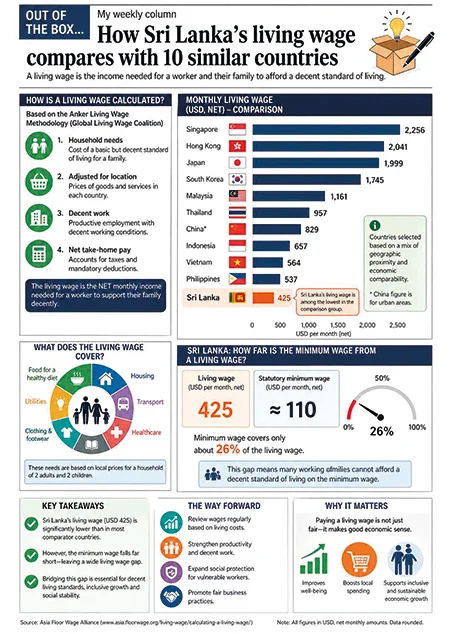 Sri Lanka has been the subject of several living wage studies, notably for the tea estate sector and for urban and rural areas, using the Anker methodology.
In the tea estate sector, an updated 2024 Anker report estimates the cost of a “basic but decent” standard of living for a typical family at about LKR 78,067 per month (approximately USD 260), implying a gross living wage of LKR 48,584 per month (USD 160) and a net, take-home living wage of LKR 44,357.
For urban Sri Lanka, the Anker Living Wage Reference Value was originally set at LKR 84,231 per month in April 2022, corresponding to a net living wage of LKR 77,492 plus social security contributions. After cumulative inflation of about 36.9 percent between April 2022 and June 2025, the updated gross urban living wage is estimated at approximately LKR 115,291 per month (around USD 385), consisting of a net living wage of LKR 106,068 and social security contributions of LKR 9,223
These Sri Lankan figures are explicitly derived from cost-of-living calculations: they incorporate the cost of food, housing, utilities, health, education, and other essentials at local prices and then convert these into wages per adult worker, assuming roughly 1.7–1.8 full-time earners per family. Because living wage estimates are indexed to actual price dynamics, periods of high inflation, as Sri Lanka experienced in 2022–2023, translate almost mechanically into sharp upward revisions in living wages, underlining the tight coupling between living wage levels and the evolving cost of living.
Comparative living wages: Sri Lanka and other countries
Cross-country comparisons require careful normalisation because living wages reflect local prices, family structures, and social norms, but several datasets provide a structured basis for comparison. [asia.floorwage](https://asia.floorwage.org/living-wage/calculating-a-living-wage/)
The Asia Floor Wage Alliance, for example, publishes a regional living wage benchmark expressed in purchasing power parity (PPP) terms, with a 2024 benchmark of 1,750.54 PPP dollars per month converted into local currencies using country-specific PPP exchange rates.
Using this PPP-based approach, the 2024 living wage equivalent for Sri Lanka is estimated at around LKR 158,353 per month, assuming a PPP exchange rate of about 90.5 Sri Lankan rupees per PPP dollar.
This PPP-normalised figure is substantially higher than the Anker 2024–2025 estate-sector and urban living wage estimates in nominal rupees, partly because the Asia Floor Wage benchmark is set to ensure a more harmonised standard across Asian garment-producing economies and uses a single PPP wage target.
These figures indicate that, within this PPP-based framework, Sri Lanka’s living wage in local currency is relatively high compared to countries such as India and Bangladesh, but the comparison reflects both different PPP exchange rates and domestic price structures.
From a cost-of-living perspective, this pattern is consistent with Sri Lanka being a lower-middle-income country with relatively higher prices for some essentials compared with low-income South Asian economies, especially after recent macroeconomic and inflationary shocks.
Global patterns and high-income economies
Global datasets covering more than 200 countries show that typical-family living wage levels, whether calculated in PPP or nominal terms, tend to correlate positively with national income levels, with North America, Western Europe, and Australia displaying the highest living wage values.
In this global distribution, living wages in middle- and low-income regions of Asia, Africa, and Latin America are lower in absolute terms, though the ratio of living wage to median wages or statutory minimum wages can be high, underscoring the gap between decent-work standards and prevailing labour market outcomes.
Interestingly, some studies note that rural living wage estimates can be relatively high in poorer countries because limited infrastructure and service availability raise the cost of accessing a given standard of living, such as safe water, transport, and education.
For Sri Lanka, rural Anker living wage benchmarks similarly reveal the importance of non-food costs, such as transportation to schools, health facilities, and workplaces, in shaping the total family budget, despite lower nominal rents in many rural areas.
Living wage, social policy, and Sri Lanka’s development trajectory
The emerging international consensus around a living wage is rooted in the human rights-based notion of a “decent life” rather than a subsistence minimum or an arbitrarily set statutory floor.
From a social science perspective, incorporating living wage benchmarks into wage-setting institutions, collective bargaining, and social dialogue reorients labour markets toward social reproduction, intergenerational mobility, and social cohesion, rather than merely cost competitiveness.
For Sri Lanka, where recent crises have eroded real wages and increased household vulnerability, living wage estimates such as the Anker urban and estate-sector benchmarks provide an analytically rigorous yardstick for evaluating whether current wage policies and social transfers are adequate relative to the actual cost of a basic but decent life.
Comparisons with regional PPP-based benchmarks like the Asia Floor Wage suggest that, while Sri Lanka’s living wage requirement in local currency is relatively high, the country also faces significant affordability challenges, especially for low-paid workers in export sectors and informal employment, whose earnings often fall short of these normative thresholds.
In policy terms, the living wage framework highlights the need for coordinated approaches that combine wage-setting reforms, inflation-sensitive social protection, and productivity-enhancing investments, so that rising living-cost-consistent wages do not simply translate into inflationary spirals or employment losses.
For empirical research in Sri Lanka, these benchmarks open avenues for micro-level analysis of wage gaps, household coping strategies, gendered labour outcomes, and the distributional effects of macroeconomic adjustment, all anchored to a transparent and internationally recognised living wage methodology.
(The writer, a senior Chartered Accountant and professional banker, is Professor at SLIIT, Malabe. The views and opinions expressed in this article are personal.)
Echoes of ‘The Walk for Peace’
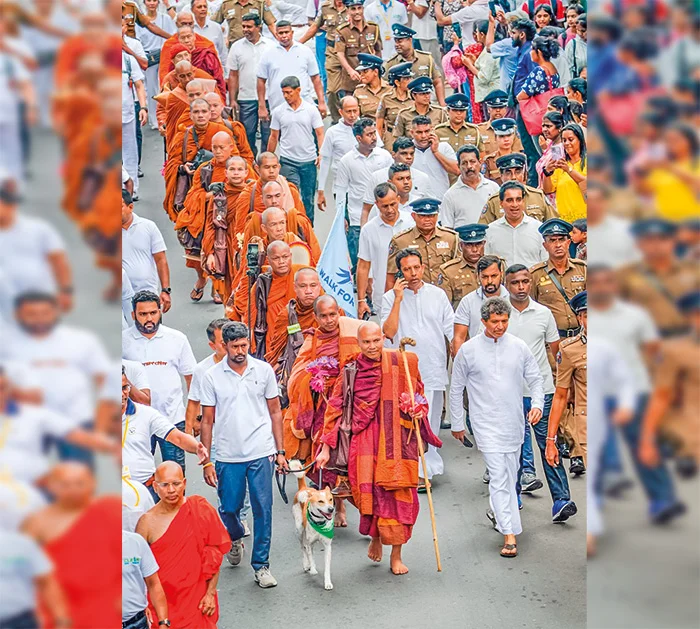
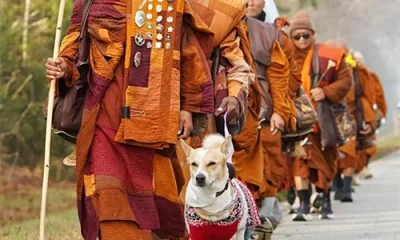
The international Walk for Peace’ reaching Colombo, joined by a large number of monks and devotees, led by spiritual leader Ven Bhikku Pannakara, with the peace dog ‘Aloka,’ completing the 161 km journey.The walk commenced in Dambulla on April 22 following the main ceremony at the Jaya Sri Maha Bodhi in Anuradhapura.Pic by Nishan S.Priyantha
by Ven. Dr. Kirinde Assaji Nayaka Thero
Chief Incumbent, Gangaramaya Temple, Hunupitiya, Colombo
Throughout human history, one of the greatest and most complex challenges has been the establishment of lasting peace and the maintenance of harmonious coexistence. While peace is often understood simply as the absence of war or armed conflict, a deeper, spiritual perspective reveals it as a profound state of social and mental harmony. It is an ideal that must be cultivated within individuals as well as across societies.
Buddhism offers one of the most practical and timeless philosophies of peace. The teachings of the Buddha are rooted in non-violence and the four sublime virtues—loving-kindness, compassion, sympathetic joy, and equanimity. Central to this philosophy is the idea that true peace in the world begins with inner peace within the individual. Conflict, the Buddha taught, arises not on battlefields but within the human mind, driven by greed, hatred, and delusion. Without overcoming these negative forces, lasting peace in the external world remains unattainable.
In today’s world, marked by geopolitical tensions, economic competition, and social unrest—this inward approach to peace is more relevant than ever. Despite technological advancement, humanity continues to grapple with violence and division. The Buddha’s teaching points instead to an internal struggle: a battle against anger, jealousy, and ignorance. Rather than weapons of destruction, Buddhism promotes wisdom, compassion, patience, and discipline as the tools to overcome conflict.
The path to peace begins with understanding its causes. Just as muddy water becomes clear when left undisturbed, the human mind achieves clarity and calm when negative emotions are subdued. This principle is reflected in the Buddha’s intervention during a historic dispute between the Sakya and Koliya clans over water, where he reminded them of the greater value of human life, thereby preventing bloodshed.
In a world increasingly threatened by conflict over limited resources and political power, such lessons remain highly relevant. The Buddha also emphasised the principle of moral causation—actions have consequences.
Yadisaṃ vapate bijaṃ tadisaṃ harate phalaṃ
Kalyaāṇakariī kalyaṃ papakariī ca papakaṃ
Pavutthaṃ tata te bijaṃ phalaṃ paccanubhossasiti
“As one sows the seed, so does one reap the fruit.
The doer of good receives good results, and the doer of evil receives evil results.
Dear one, whatever seed you have planted, you will experience the corresponding fruit of it.”
At the heart of Buddhist ethics is respect for life. All beings fear harm and seek happiness, and therefore, violence against others cannot lead to true well-being. This message is particularly significant in an era where the race for power and advanced weaponry continues to overshadow compassion and humanity.
The fundamental moral discipline in Buddhism is respect for life and opposition to harming living beings. The Buddha taught that all beings desire happiness, and fear suffering, and that harming others will not lead to happiness.
Sabbe tasanti dandassa
sabbe bhayanti maccuno
attanam upamam katva
na haneyya na ghataye.
“All tremble at violence; all fear death. Comparing others with oneself, one should neither kill nor cause others to kill.”
Despite technological advancement, the world appears to be moving backwards in terms of compassion and peace. Power-driven politics and the race for advanced weaponry cannot provide lasting solutions. Global leaders, diplomats, and policymakers must urgently recognise the importance of the tolerant, balanced, and non-violent approach taught in Buddhism. Protecting the right to life of all beings, and acting with compassion beyond divisions of race, religion, or politics, is the only true foundation for world peace.
Sri Lanka, as a nation nourished by the essence of Buddhism, has long upheld this principle. The Sri Lankan tradition, rooted in boundless loving-kindness and compassion, strives to uphold human values even amidst the harsh realities of global politics. From the respect shown by King Dutugemunu towards King Elara, to Sri Lanka’s stance at the 1951 San Francisco Peace Conference invoking the words “Hatred is never appeased by hatred,” to recent humanitarian acts in rescuing sailors in distress—these all reflect a single philosophy: valuing human life above all divisions.
The presentation of a “Joint Declaration for Peace” by the Mahanayake Theros at Gangaramaya Temple recently reaffirmed Sri Lanka’s commitment to global peace. Despite global power struggles, Sri Lanka continues to stand as a symbol of compassion and peace, reminding the world that human kindness is more powerful than weapons.
Institutions such as the Gangaramaya Temple have played a vital role in fostering social harmony. Through charitable, educational, and cultural programmes, the temple has encouraged unity across religious and ethnic lines, while also promoting interfaith dialogue and cooperation.
The annual Navam Maha Perahera, organised by the temple, stands as a powerful symbol of national unity, bringing together people from diverse backgrounds in a shared celebration. Similarly, vocational training and educational initiatives have helped empower young people from all communities, strengthening social cohesion.
A recent “Walk for Peace,” led by Venerable Pannakara Thero and supported by the monastic community, further underscored this commitment. More than a physical journey, it represented a spiritual effort to cultivate peace within the human heart and spread a message of compassion to the wider world.
One of the most touching aspects of the event was the participation of a dog named “Aloka,” which accompanied the monks throughout the journey. This simple yet powerful image reflected the Buddhist teaching that all living beings value life and deserve compassion, highlighting the universal nature of peace.
Ultimately, the Buddha’s message remains clear: peace cannot be achieved through hatred or violence. True peace arises from self-discipline, moral conduct, and the cultivation of a pure mind. As the teaching states, avoiding evil, doing good, and purifying one’s mind is the path laid down by the Buddha.
Let us plant the seeds of peace within our hearts and nurture them with loving-kindness. (“Sabba papassa akarananṃ – kusalassa upasampadā – sacitta pariyodapanaṃ – etaṃ Buddhana sasanaṃ”)
In a time when global tensions continue to rise, this timeless message serves as a powerful reminder that lasting peace begins within each individual—and that compassion remains humanity’s greatest strength.
“Devo vassatu kalena – sassa sampatti hetu ca
Pito bhavatu loko ca – rajaā bhavatu dhammiko”
(“May the rains fall at the right time, bringing about abundant harvests.
May the world be joyful and prosperous.
May the ruler be righteous and just.”)
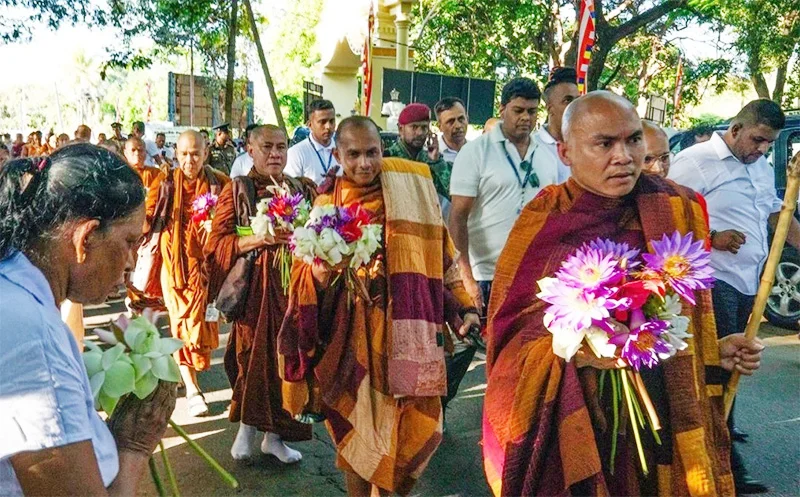
The ongoing peace march by a group of international Buddhist monks has captured the sentiment of Sri Lankans in a manner that few public events have done in recent times. It is led by the Vietnamese monk Venerable Thich Pannakara who is associated with a mindfulness movement that has roots in Vietnamese Buddhist practice and actively promoted among diaspora communities in the United States. The peace march by the monks, accompanied by their mascot, the dog Aloka, has generated affection and goodwill within the Buddhist and larger community. It follows earlier peace walks in the United States where monks carried a similar message of mindfulness and compassion across communities but without any government or even media patronage as in Sri Lanka.
This initiative has the potential to unfold into an effort to nurture a culture of peace in Sri Lanka. Such a culture is necessary if the country as the country prepares to move beyond its history of conflict towards a more longlasting reconciliation and a political solution to its ethnic and religious divisions. The government’s support for the peace march can be seen as part of a broader attempt to shape such a culture. The Clean Sri Lanka programme, promoted by the government as a civic responsibility campaign focused on environmental cleanliness, ethical conduct and social discipline, provides a useful framework within which such initiatives can be situated. Its emphasis on collective responsibility and shared public space makes it sit well with the values that peacebuilding requires.
government’s previous plan to promote a culture of peace was on the occasion of “Sri Lanka Day” celebrations which were scheduled to take place on December 12-14 last year but was disrupted by Cyclone Ditwah. The Sri Lanka Day celebrations were to include those talented individuals from each and every community at the district level who had excelled in some field or the other, such as science, business or arts and culture and selected by the District Secretariats in each of the 25 districts. They were to gather in Colombo to engage in cultural performances and community-focused exhibitions. The government’s intention was to build up a discourse around the ideas of unity in diversity as a precursor to addressing the more contentious topics of human rights violations during the war period, and issues of accountability and reparations for wrongs suffered during that dark period.
Positive Response
The invitation to the international monks appears to have emerged from within Buddhist religious networks in Sri Lanka that have long maintained links with the larger international Buddhist community. The strong support extended by leading temples and clergy within the country, including the Buddhists Mahanayakes indicates that this was not an isolated effort but one that resonated with the mainstream Buddhist establishment. Indeed, the involvement of senior Buddhist leaders has been particularly noteworthy. A Joint Declaration for Peace in the world, drawing on Sri Lanka’s own experience, and by the Mahanayakes of all Buddhist Chapters took place in the context of the ongoing peace march at the Gangaramaya Temple in Colombo, with participation from the diplomatic community. The declaration, calling for compassion, dialogue and sustainable peace, reflects an effort by religious leadership to assert a moral voice in favour of coexistence.
The popular response to the peace march has also been striking. Large numbers of people have been gathering along the route, offering flowers, water and support to the monks. Schoolchildren have been lining the roads, and communities from different religious backgrounds extend hospitality. On the way, the monks were hosted by both a Hindu temple and a mosque, where food and refreshments were provided. These acts, though simple, carry a message about the possibility of harmony among Sri Lanka’s diverse communities. It helps to counter the perception that the Buddhist community in Sri Lanka is inherently nationalist and resistant to minority concerns that was shaped during the decades of war and reinforced by political mobilisation that too often exploited ethnic identity.
By way of contrast, the peace march offers a different image. It shows a readiness among ordinary people to embrace values of compassion and coexistence that are deeply embedded in Buddhist teaching. The Metta Sutta, one of the most well-known discourses in Buddhism, calls for boundless goodwill towards all beings. It states that one should cultivate a mind that is “boundless towards all beings, free from hatred and ill will.” This emphasis on universal compassion provides a moral foundation for peace that extends beyond national or ethnic boundaries. The monks themselves emphasised this point repeatedly during the walk. Venerable Thich Pannakara reminded those who gathered that while acts of generosity are commendable, mindfulness in everyday life is even more important. He warned that as people become unmindful, they are more prone to react with anger and hatred, thereby contributing to conflict.
More Initiatives
The presence of political leaders at key moments of the march has emphasised the significance that the government attaches to the event. Prime Minister Harini Amarasuriya paid her respects to the peace march monks in Kandy, while President Anura Kumara Dissanayake is expected to do so at the conclusion of the march in Colombo. Such gestures signal an alignment between political authority and moral aspiration, even if the translation of that aspiration into policy remains a work in progress. At the same time, the peace march has not been without its shortcomings. The walk did not engage with the Northern and Eastern parts of the country, regions that were most affected by the war and where the need for reconciliation is most acute. A more inclusive geographic reach would have strengthened the symbolic impact of the initiative.
In addition, the positive impact of the peace march could have been increased if more effort had been taken to coordinate better with other civic and religious groups and include them in the event. Many civil society and religious harmony groups who would have liked to participate in the peace march found themselves unable to do so. There was no place in the programme for them to join. Even government institutions tasked with promoting social cohesion and reconciliation found themselves outside the loop. The Clean Sri Lanka Task Force that organised the peace march may have felt that involving other groups would have made it more complicated to organise the events which have proceeded without problems.
The hope is that the positive energy and goodwill generated by this peace march will not dissipate but will instead inspire further initiatives with the requisite coordination and leadership. The march has generated public discussion, drawn attention to the values of mindfulness and compassion, and created a space in which people can imagine a different future. It has been a special initiative among the many that are needed to build a culture of peace. A culture of peace cannot be imposed from above nor can it emerge overnight. It needs to be nurtured through multiple efforts across society, including education, religious engagement, civic initiatives and political reform. It is within such a culture that the more difficult questions of power sharing, justice and reconciliation can be addressed in a constructive manner.
by Jehan Perera

Eran Wickeamaratne named new Sri Lanka Cricket chief

President and Exco of Sri Lanka Cricket step down

Ferreira, Shubham, Rajasthan Royals openers hand Punjab Kings their first defeat

Dulani and Samarawickrama set up Sri Lanka’s victory in T20I series opener

Heat Index at Caution Level in the Northern, North-central and North-western provinces and in Kegalle, Trincomalee and Batticaloa districts during the day time

Showers or thundershowers will occur in most parts of the island after 1.00 pm

‘Dates have the highest sugar content to fight Coronavirus’

Sunday Island 27 December – Headlines

#SundayIsland 17th December – Headlines

Sunday Island – 28th March

Sunday Island Headlines – 21 March

Sunday Island – 21st February – Headlines
-
 News7 days ago
Lanka faces crisis of conscience over fate of animals: Call for compassion, law reform, and ethical responsibility
-
 News6 days ago
Whistleblowers ask Treasury Chief to resign over theft of USD 2.5 mn
-

 News6 days ago
No cyber hack: Fintech expert exposes shocking legacy flaws that led to $2.5 million theft
-

 News3 days ago
BIA drug bust: 25 monks including three masterminds arrested
-

 Business4 days ago
Nestlé Lanka Announces Change in Leadership
-

 News3 days ago
Banks alert customers to phishing attacks
-
 News4 days ago
Hackers steal $3.2 Mn from Finance Ministry
-
 Business6 days ago
Dialog Enterprise partners Star Garments: Pioneering 5G innovation in Sri Lanka’s apparel industry