
Latest News
Top-order batters, five-star Santner make it two in two for New Zealand


New Zealand’s innings started with three maidens in a row but ended with them bashing 50 off the last three overs, courtesy Tom Latham, Mitchell Santner and Matt Henry, which propelled them to 322. Netherlands started the chase slowly and never shifted gears as they folded for 223, as New Zealand further consolidated their position at the top of the points table after making it two in two.
Player-of-the-Match Santner, who clubbed an unbeaten 36 from 17 balls with the bat, then grabbed 5 for 59 with the ball, and in the process became the first New Zealand spinner to claim a five-for in a men’s ODI World Cup. He varied his pace consistently on a spin-friendly pitch – exactly the trait which makes him threatening – as the highlight of all his wickets was that of Scott Edwards’.
Santner slowed it down considerably and went with a wide line outside off to tempt Edwards off the fifth ball of the 35th over. The Netherlands captain had cracked 12 off the three previous deliveries – it included a six and a four – and with the required rate mounting, went slogging across the line, only for the ball to balloon back towards Santner. Thus, at 174 for 6, all of Netherlands’ little-remaining hopes of causing an upset vanished.
However, they had New Zealand in a tricky position with the ball at one stage. New Zealand lost 3 for 16 in the death overs – 238 for 3 in the 41st became 254 for 6 in the 45th – but Latham kept defying the Netherlands bowlers at one end. From being 1 off 5 balls after 34 overs, he smashed 53 from 46 despite the slow and gripping nature of the pitch, which proved challenging for all incoming batters barring Latham.
Brief scores:
New Zealand 322 for 7 in 50 overs (Will Young 70, Tom Latham 53, Devon Conway 32, Rachin Ravindra 51, Daryl Mitchell 48, Mitchell Santner 36; Aryan Dutt 2-62, Paul van Meekeren 2-59, Roelof van der Merwe 2-56) beat Netherlands 223 in 46.3 overs (Colin Ackermann 69, Teja Nidamanuru 21, Sybrand Engelbrecht 29, Scott Edwards 30; Mitchell Santner 5-59, Matt Henry 3-40) by 99 runs
(Cricinfo)











Latest News
Sun directly overhead Madampe, Thorayaya, Thotagamuwa, Rattota and Kalavanchikudy about 12.09 noon today (03)

The sun is going to be directly over the latitudes of Sri Lanka from 28th of August to 07th of September due to its apparent southward relative motion.
The nearest places of Sri Lanka over which the sun is overhead today (03) are Madampe, Thorayaya, Thotagamuwa, Rattota and
Kalavanchikudy about 12.09 noon.
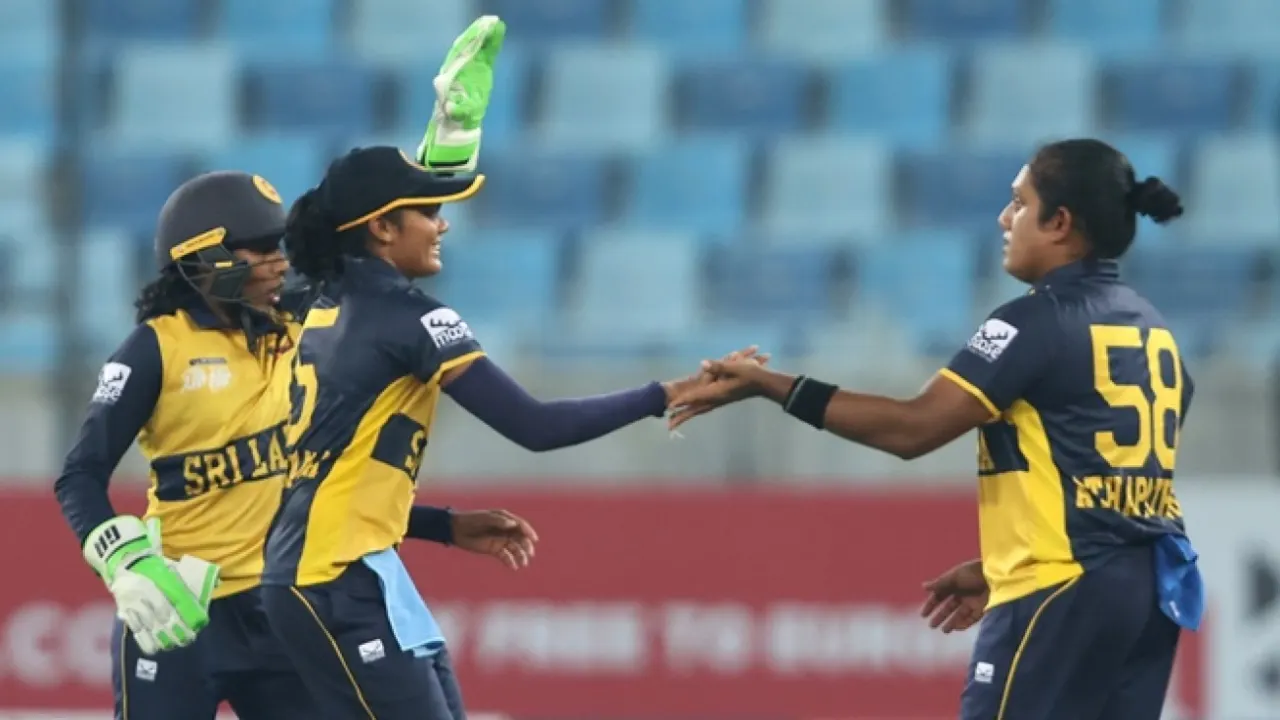
A Chamari Athapaththu seven-wicket haul and Nilakshika Silva’s 50 off 35 saw defending champions Sri Lanka withstand a valiant Indonesian side to register a resounding 75-run victory in their Asia Cup match in Dubai.
Athapaththu was undoubtedly the pick of the bowlers, as she started and finished Indonesia’s slide with career best figures of 7 for 05, inclusive of a hat-trick – nearly two in fact. Chasing a target of 125, the opening pair of Maria Corazon and Rahmawati Pangestuti struck 16 runs in the first two overs, but once spin came into play scoring slowed down to a trickle and Indonesia were eventually bowled out for 49 in the 19th over.
Sri Lanka, too, had found it tough to combat Indonesia’s mix of spin and slow-medium seamers as they stumbled to 62 for 6 in the 13th over, but their innings received a timely boost as Nilakshika countered with a trademark back-against-the-wall effort to drag her side to a total that seemed about par on a pretty sluggish surface. In the end it proved to be plenty.
Sri Lanka struggle early on
Having been put in to bat on a fresh surface, Sri Lanka were perhaps guilty of a little complacency against their less-fancied opponents. Time and again the top order sought to find the boundary, and time and again they failed to find their timing.
On a wicket where the ball was hardly coming on, the Sri Lankan batters’ tunnel vision focused squarely on boundary hitting and eschewed strike rotation; there were 19 dot balls in a powerplay that had fetched 31 runs for the loss of two wickets.
By the halfway point of the innings, the dot count had risen to 28. The scorecard, meanwhile, read 47 for 5. Indonesia, to their credit, did well to bowl to their fields and frustrate the Lankan batters.
Sanjana Kavindi got to double-digits with a pair of nicely struck boundaries, but she was the only one of Sri Lanka’s top five to do so – and she was eventually done in on 15 missing an attempted cut on a straight one.
Nilakshika brings the Silva-lining
With recognised batting fast running out, Sri Lanka needed someone to take control of the innings, and as she has done so often over recent years it was Nilakshika that stood up to be counted.
She first strung together 17 off 18 with Kaushini Nuthyangana, but when Nuthyangana fell Nilakshika produced a masterclass in batting with the tail. She cajoled Kawya Kavindi to keep rotating the strike, and when the opportunity arose she was unerring in finding the boundaries – including Sri Lanka’s first and only six of the innings in the penultimate over.
Their seventh-wicket partnership eventually ended on 50 off 36, reached simultaneously alongside side Nilakshika’s fifty – her third in T20Is – but by then she had already ushered her side to safety.
Athapaththu steals the show
In Chethana Vimukthi, Sri Lanka might have their first ever genuine fast bowler but on a wicket where the ball was not quite coming on, pace never seemed like the answer. For the first two overs of the chase, Indonesia’s openers did well to find boundaries against Vimukthi and and fellow seamer Kawya, but then Sri Lanka introduced their spinners.
Athapaththu promptly castled Pangestuti before removing Corazon and Rada Rani off consecutive deliveries in her next over. Here she missed her hat-trick by a whisker, a yorker narrowly missing Desi Wulandari’s off stump.
She brought herself back into the attack in the 14th and removed Nanda Sakarini, and she capped things off by achieving her hat-trick at the second time of asking, taking three wickets off what proved to be the final three deliveries of the innings.
Scores:
Sri Lanka Women 124 for 7 in 20 overs (Sanjana Kavindi 15, Nilakshika Silva 50, Kawya Kavindi 15*; Ni Ariani 1-23, Sang Maypriani 2-15, Ni Luh Dewi 3-32, Sofia Velic 1-21) beat Indonesia Women 49 all out in 18.3 overs (Rahmawati Pangestudi 10, Ni Made Putri Suwandevi 12; Kavya Kavindi 1-14, Sugandika Kumari 1-03, Chamari Athapaththu 7-05, Kavisha Dilhari 1-02) by 75 runs
[Cricinfo]

The Memorandum of Understanding (MoU) relating to the project to provide technological solutions to prevent wild elephants from being hit by trains was signed yesterday (01) afternoon at the President’s Media Centre, under the patronage of Secretary to the President Dr Nandika Sanath Kumanayake.
Coordinated through the “Clean Sri Lanka” programme, the project is being implemented as a public-private partnership, with the Railway Department, the Department of Wildlife Conservation and the Forest Conservation Department working together, with full financial support from People’s Bank.
The system consists of three-beam detection, passive infrared (PIR) sensors, automatic temperature sensors and a tamper alarm system to detect animals weighing more than 20 kilogrammes and unauthorised interference. Signal lights (red/yellow/green) installed on either side of the railway tracks, together with a special screen installed inside the locomotive cab, will alert the driver in advance to the exact location of an elephant.
A demonstration test of the system was successfully conducted at the Pinnawala Elephant Orphanage premises in the presence of the relevant officials, following which a report on the system was prepared.
The system will be implemented as a pilot project from next month at 13 locations where wild elephant accidents are frequent. A newly developed website is also scheduled to be launched to enable the progress of the project to be viewed live.
Additional General Manager of Railways P.D.S.B. Chandrasena, Director General of Wildlife Conservation M.S.L.R.P. Marasinghe, Conservator General of Forests S.C. Palamakuumbura and Chairman of People’s Bank Chandana Guniyangoda signed the relevant MoU. Officials from the Clean Sri Lanka Secretariat, including Presidential Additional Secretary (Clean Sri Lanka) Engineer S.P.C. Sugeeshwara, as well as senior officials from the Railway Department, Department of Wildlife Conservation, Forest Conservation Department and People’s Bank, were also present.
[President’s Media Division]

Sun directly overhead Madampe, Thorayaya, Thotagamuwa, Rattota and Kalavanchikudy about 12.09 noon today (03)

Afternoon thundershowers in the Northern, North-central, Eastern and Uva provinces in next few days, starting from today (03).

22A: SC urged to suspend hearing, appoint full bench

Govt. seeks NATO assistance

Recent ‘Ice’ detection at the Colombo Port made on US intelligence – Embassy

Sri Lanka launches National Food Safety Policy with support from FAO and EU

‘Dates have the highest sugar content to fight Coronavirus’

Sunday Island 27 December – Headlines

#SundayIsland 17th December – Headlines

Sunday Island – 28th March

Sunday Island Headlines – 21 March

Sunday Island – 21st February – Headlines
-

 News6 days ago
Eight politicians in drug kingpin probe
-

 Features4 days ago
“Wrap Me Up in My Blazer”— A Gentlemanly Bradby Reminiscence
-

 Business6 days ago
Sri Lanka opens up: A new season of direct connectivity
-

 Features3 days ago
When Sri Lankan stories find their own voice
-
 Latest News7 days ago
Nepal-Tibet floods: What happened, what caused them and who is missing?
-

 Features6 days ago
Redefining ageing in Sri Lanka
-

 Editorial6 days ago
The toxic legacy of two lakes
-

 Business6 days ago
Jaffna Teaching Hospital secures lifeline water supply via ADB-funded Thalaiyadi sea water desalination plant