
Features
Trade with the Middle East – Libya, Syria, Egypt and Iraq

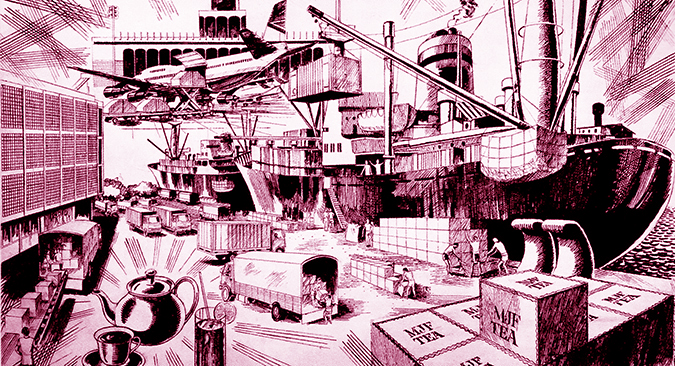
(Excerpted from the Merrill, J, Fernando autobiography)
Libya: In my bulk trading days, I did considerable business with the Middle East. AF Jones and another company dominated the supply volumes to Libya. In retrospect, I deeply regret the environmental damage caused by this trade, as many tea shipments were in five and 10 kg packs, in sapu and albizzia boxes. These were shipped out regularly in container loads. Our distributor in Libya was a wealthy Maltese family, M. Albernozo and his two sons, John and Marcel.
Libya is a beautiful country and was administered as a colony of Italy from 1912 till well in to World War II. After the defeat of the Italian and German forces in Africa, Libya was under Allied occupation from around 1943 to 1951. The Italian influence is very evident in their food, drink, and clothing. Food, in fact, was also as cheap as drink. A good bottle of wine cost no more than a shilling.
Until the overthrow of King Idris, who ruled the country from 1951 to 1963, when he was ousted in a coup by Colonel Muammar Gaddafi, it was a comfortable country to trade in. I visited Libya regularly from 1958 till about 1985. In the early days I used to stay at the Grand Hotel, Tripoli, an old but well-maintained hotel overlooking the harbour. Both the service and food were very good when it was being managed by an Italian group.
Gaddafi introduced an iron-fisted rule and his style of governance soon impacted on my business in the country as well. Procedures for foreigners at the airport became difficult and humiliating, with arrogant young immigration officials being equally discourteous and unhelpful. Once, I was rudely told to fill my disembarkation card in Arabic! Customs inspectors treated all incoming visitors as if they were potential smugglers, checking travel bags by simply throwing the contents out.
The best hotel in Tripoli at that time was the Al Waddan, referred to as the “Waldorf Astoria of Tripoli,” built in 1935 and designed in collaboration by two famous Italian architects. Accommodation, service, and food were excellent, until Gaddafi issued an edict suddenly that all foreigners employed in the country should leave within 24 hours. My distributor, Albernozo’s Finance Director, a Greek, was told that whilst he could stay on, his Italian wife would have to leave the country immediately. The quality of facilities and services declined but business continued to be good, though the import trade was also nationalized.
Albernozo returned to Malta soon afterwards and we continued our business with Nasco, a large Libyan tea importing company. I established a good relationship with its Chairman, Mohammed Zigallai, who gave me some decent orders. Conditions within the country, however, became both restrictive and oppressive under the Gaddafi regime. At the request of my friends in the country, on my visits to Libya I used to carry with me many items which had become unavailable in the country. However, more often than not, those had to be left behind at the Customs.
The discovery of oil in Libya enriched it and the country prospered during Gaddafi’s rule, despite its authoritarianism. However, his military interventions in other countries in the region and internal opposition to his rule created instability within. The civil strife, compounded by NATO-led military action led against Gaddafi, culminated in his death in 2011. Since then, that once-peaceful country has been in a constant state of turmoil.
Syria
My experience with Syria too mirrors those of Libya. I found it to be a very sophisticated society, a composite of an ancient classical culture reaching back many centuries and influenced subsequently by French colonization. Its tea trade had been in private hands for many years and I used to visit the country at least twice a year. Syrians, by nature, were very friendly and I formed warm relationships with my business contacts, who frequently invited me to their homes for meals.
Once the importation was taken over by the State organization, TAFCO, the nature of my interactions in the trade changed dramatically. The new barons of the import/export trade were blatantly dishonest and attempted to entice me into various fraudulent schemes, the main purpose being personal enrichment through deliberate downgrading of the quality of deliveries, against agreed shipment standards. The shipment broker came to meet me several times seeking commissions as well. I refused to compromise on quality and, as a result, lost the business.
Egypt
Egypt was another lucrative market for Ceylon Tea until its nationalization of the import trade. My first agent, who is my friend to this day, was Ibrahim Soudan and his family. My business with Egypt went very well, during a period when Egypt was buying about 40 million kg of Ceylon Tea annually. However, the Egyptian Government signed a trade pact with Kenya and the Egyptian off take of Ceylon Tea diminished rapidly as a result.
Today, the Egyptian market is dominated by cheaper East African teas and the Ceylon Tea presence is not significant. However, with the development of the tea bag market, Dilmah is regaining a foothold in Egypt. Regrettably, with the commencement of my food service and restaurant supply business, by mutual agreement, we severed our business connection with the Soudan family. They were importing their own brand in Ceylon packs, supplied by my friend Gamini Fernando’s company, Ceylon Tea Marketing.
Our agent in the restaurant tea supply business is my very good friend, Hassan Al Shahin, one of the biggest merchants in Egypt. It is a great privilege to deal with people like Hassan and Ibrahim, warm and family-oriented businessmen, with whom I have established trade connections spanning generations. Before long, between those family companies and Dilmah, there will be respective third generations trading with each other.
That is the charming connectivity of the world of tea, especially when the business is controlled not by multinationals but by families with a philosophy of delivering genuine quality to the customer. That was also the attractive and genuine face of much of the international trade many decades ago, before being rolled over by the multinational juggernaut.
Iraq
In Iraq, a country which is still an important destination for Ceylon Tea, my distributor was Dhanoon Ahmed Khootachi. He provided me with very good business, taking care of me personally on my visits to the country. I used to stay in the Baghdad Hotel, where food and service were both excellent. However, hotel accommodation used to be both limited and expensive and, in view of the stringent exchange controls in Ceylon, one had to be frugal as well.
It was not uncommon for delegates from Ceylon to overseas trade fairs to share hotel rooms, especially when the more affluent delegates from other countries, or from the richer companies from Ceylon itself, commandeered available accommodation. I recall one occasion in Iraq when I shared a room, I think with my friend Kumar Paul. I slept the night on a sheet I spread on the floor.
Once the trade was nationalized in Iraq, the importation of tea passed from private hands to the State-controlled Iraqi Government Tea Purchasing Board. Its representative in Sri Lanka would purchase the country’s requirements, generally around 30 million kg per year, through appointed agents in the country. The first such representative was Farouk Murad, who was accompanied to the country by his wife and his two children. I was a regular supplier for many years.
The decline of Iraq in the last decade is not dissimilar to the fate of Libya; engineered largely by the US and UK, through the transparently-false ploy of a search for weapons of mass destruction, when the real motive was the destabilization of the Saddam Hussein regime and the seizure of control of oil production.
In essence, the Middle East was a common market for tea, with a general similarity of consumer preferences across most countries. When Egypt, Iraq, Iran, Syria, and Libya were free markets, with several importers purchasing tea in Colombo, there was a healthy market competition. Once the economies of those states came under central state control, with one corporation representing 20-30 buyers, countries like Egypt and Iraq established their own buying offices in Colombo.
Purchasing arrangements impacted on prices. When a delegation came out to make large-scale purchases, exporters competed with each other to sell at unrealistic prices, which spelled disaster to the Low-Grown producers. The system of large-volume forward contracts, not an uncommon feature then, contributed to price depressions which prevailed for months.
The Syrian tender procedure also paved the way for various irregularities. Another factor is that when centrally-controlled economies are represented by a single buyer to the country, they also have the power to determine the sources of supply, invariably gravitating to the cheapest buying centre, to the obvious detriment of Ceylon Tea, which has always been the highest priced.





 The West Asian peace effort continues waveringly amid uncertainties. The world could be considered as having ‘some breathing space’ currently in this tangled situation on account of a dip in oil prices but whether such relief would be of a long term nature is left to be seen.
Meanwhile, some vital ‘details’ in the peace process are continuing to hobble it. One such factor is the nuclear issue. While US President Donald Trump is on record that Iran’s purported nuclear programme from now on will be monitored by the International Atomic Energy Agency (IAEA), this assertion is being denied by the Iranian authorities who indicate that Iran will be coming under no such regime. That is, Iran will be answerable to no one with regard to its legitimate right to defend itself.
Accordingly, an early closure to the nuclear question could not be expected and the furthering of peace in the region hinges on the principal sides being of one mind on the issue. Moreover, toll-free shipping through the Strait of Hormuz is proving to be a bone of contention between the warring sides.
However, perhaps going largely unnoticed in the Middle East region are identity questions of considerable magnitude that have stood in the way of the region making some headway towards a peace settlement and which would continue to undermine such a process going forward. Identity, or a group’s self conception, is by far the most intractable of the factors in the conflict and the main sides would do well to manage it effectively before long.
US Vice President J.D. Vance, as pointed out in this column last week, fired one of the first salvos in this regard in the current peace effort. He reportedly said: ‘Regional peace and stability includes stopping the funding of “terrorist organizations” .’ He probably had in mind the Hezbollah organization which is funded and armed by Iran but, needless to say, the latter would reject this statement out of hand because it does not see the Hezbollah as terroristic in orientation.
Accordingly, the tangled issue of ‘who is a terrorist?’ would recur to hamper the West Asian peace bid. An important corollary to this matter is that Middle Eastern militants would be branding US administrations as terroristic considering the humanly costly military interventions undertaken by the latter over the decades in the world’s war zones.
It is difficult to see the main sides taking up the issue of terror and arriving at a common understanding on the problem over the next couple of months in their peace deliberations but the unresolved question could be expected to be the proverbial ‘elephant in the room’ that could even wear the sides down. Accordingly, ‘quick fixes’ to the Middle East imbroglio would need to be ruled out.
However, paring down terror to its essentials, it needs to be found that in contemporary times it is identity and issues growing out of it that keep the question alive and render it intractable. In fact the problem should be seen as igniting and sustaining a multiplicity of conflicts world wide.
So pervasive are identity questions that they are seen by some as having played a role in leading to the recent resignation of Keir Starmer as UK Prime Minister. Among other things, the latter is seen as having been incapable of managing migration related issues besides falling short in strengthening domestic social cohesion.
Identity issues came to a head in the UK in the form of the recent anti-immigrant riots in Northern Ireland. Clearly, some immigrants continue to be seen as aliens and parasitic in nature in some parts of the UK by jingoistic elements. Thus is ignited anti-foreigner violence.
That said, some of the most laudable measures for the promotion of peaceful race relations are found in the UK today. The latter’s race relations legislation could be seen as constituting a model for the rest of the world and needs to be studied and adopted by particularly the global South where identity conflicts are rampant.
Unfortunately, racial amity is not being considered a priority by the Trump administration. Under the latter immigrants are being seen by supremacist whites as the archetypal ‘Other’ who should be violently shunned. Accordingly, social cohesion in the US too is being steadily undermined and stepped-up race hate in the country shouldn’t come as a surprise.
In the West Asian region, archetypal ‘Othering’ could prove particularly pernicious and destructive. It could lead to the unraveling of the current peace talks between the adversaries and needs to be addressed by them if the negotiations are to prove productive.
For far too long the West and Israel have been viewed as archetypal enemies by Iran and its supporters. On the other hand, Palestinian militants have been habitually seen by the Far Right in the US and by hard line Israelis as sworn enemies who are best eliminated. These seemingly unresolvable divides in the Middle East could bring down the present negotiatory process.
Even if the present round of mediated negotiations between the US and Iran lead to a substantive cessation of hostilities in West Asia, the divisive mindsets of the prime antagonists, that is, the US and its ally Israel on the one side and Iran and its supportive militant groups on the other, would need to be changed for the better if enduring peace is to be given a chance. That is, mindsets would need to be transformed on both sides of the divide from mutual hostility to mutual amicability. No doubt, a long-gestation process.
It cannot be stressed enough that those mediating in this long-running conflict, themselves need to approach peace-making with unbiased minds. It needs to be realized, for example, that Israel too has been ‘hurting’ badly in this conflict over the decades to the degree to which the Palestinian side has been victimized cruelly, dispossessed and divested of dignity.
Any negotiated peaceful settlement should seek to address this persistent mindset malaise as well and turn enmity into amicability. An equitable solution that addresses the lingering grievances of both sides could lay the basis for this process of ‘Turning Spears into Ploughshares.’
‘Land and Bread’ have been at the heart of the Middle East conflict over the decades or even centuries. An equitable solution should provide these assets in equal measure for both sides. There is no getting away from the ‘Two State Solution’.

Long End Street is not a summation of Short End Streets. Eighteen short-term crises and no long-term growth in sight!
For quite some time, there has been no agency of government dealing with long-term economic and social policy questions. Nor have universities been of any help. There has been a National Planning Department in the Ministry of Finance but we have not seen any worthwhile reports from them. M. D. H. Jayawardena, in 1956, presented in Parliament the Six-Year Programme of Investment. Soloman Bandaranaike established a National Planning Council and a Planning Department, with Princy Siriwardena as its Director. They wrote the Ten-Year Plan, better known for its readability than its depth of analysis or policy content. Ten years or so later Dudley Senanayake established a Ministry of Planning and Employment with Gamani Corea (later of high international repute) as its Permanent Secretary. The Ministry was responsible for some useful analytical work and the development of a bureaucracy responsible for plan implementation. The latter was the work of a brilliant member of the Ceylon Civil Service, Godfrey Gunatilleke, who also worked in the Ministry. The major pre-occupation of the Ministry turned out to be the annual government budget and the management of direly scarce foreign exchange, all short term considerations. They set up a bureaucratic mechanism to evaluate capital expenditure in the government budget. The Ministry won plaudits for its Foreign Exchange Budget, some analytical wok on the economy, including population projections as well as education, in both schools and universities. As the 1970s wore on, planning earned a bad press and the new government of 1971 disbanded most of that and created a Department of National Planning in the Ministry of Finance, which survives to date.
A part of the purpose of this narrative has been to bring out that, all along, government has had no outfit of economists and sociologists whose job was to study long term changes in our society and the economy and in the rest of the world and propose solutions for consideration by governments. (A brilliant exception was the work on education, that was directed by Jinapala Alles, who had graduated in chemistry and was a fast learner and was at great ease with numbers. He was also an effortless leader of a small team of self-selected competent and enthusiastic public servants.) The government depended on the Central Bank for advice on long term development of the economy. Princy Siriwardena was seconded for service in the Planning Secretariat; similarly, Gamani Corea was from the Bank. Later, he was replaced with H.A.de S. Gunasekera, likely the most brilliant economics teacher in the University of Ceylon. He taught monetary economics, essentially short term. (His favourite economist Keynes famously wrote, “In the long run we are all dead”.)
When the Ministry of Planning and Employment was established in 1965, government plundered the Central Bank to staff it: Gamani Corea, R. M. Seneviratne, N. Ramachandran, Nihal Kappagoda and G. Usvatte-aratchi. Later, W. M. Tillekeratne and A. S. Jayawardena both long term employees of the Central Bank, were appointed as the chief economist of government. Jayawardena still later became the Governor of the Bank. Several other employees of the Bank, including J. B. Kelegama, P. B. Karandawela, P. B. Jayasundera worked at high levels in successive governments and that practice continued when Mahinda Siriwardena became the Secretary to the Ministry of Finance when Anura Dissanayake became the Minister of Finance. It is mysterious that the government saw no need for specialist advisers who would identify long term economic and social problems and solutions therefor, look out for markets and technology and warn of impending pitfalls, in contrast to our mighty neighbour which had a Planning Commission that handled long term problems and a Central Bank which had learnt to handle masterly, monetary problems.
Pitambar Pant, Montek Singh Ahluwalia, Manmohan Singh, I. G. Patel and Raghu Ram Rajan were most distinguished economics policymakers and central bankers. Japan benefited greatly from the work of MITI. So did Korea from its counterpart. This is not to argue that had there been an outfit of that sort, Sri Lanka would now be rich but to warn that the Central Bank is neither equipped nor fit to fight those battles. If you scan the Central Bank Act of 2023, you will find stabilisation the most frequently recurring theme. Clause 6 reads ‘The primary object (objective?) of the Central Bank shall be to achieve and maintain domestic price stability.’ The most generous reading that the Bank may have anything to do with economic development is in Clause 6 (4) ‘In pursuing the primary object (objective?), the Central Bank shall take into account, inter alia, the stabilisation of output towards its potential level.’ Lawyers may have a field day with that and economists may beg for its meaning.
Amarananda Jayawardena was the last Governor of the Central Bank who had understood that the central bank was equipped to handle short term problems and that not always valiantly, and that it had neither the tools nor the resources to plan and engineer long term development. As Governor, he did not speak for the government on long term economic and social problems, although prior to assuming duties as Governor of the Bank, he had been the chief economist of the government. Jayawardena knew all too well the nature of the tools and the resources he had and how far he could confidently aim and shoot. It was simply silly to produce a Five-year Road Map (no matter how colourful the accompanying graphics), when a central bank mainly used transactions in the short-term financial assets market to move interest rates and the demand for money. The Bank of England, for most of the 20th century, used Commercial Paper with two ‘good names’ at its Discount Window. Short-term and long-term rates of interest, normally, behave in a predictable relationship, although occasionally, and in volatile times, that relationship may become inverted. (I am not well read on recent Fed and the Riks Bank market operations.)
The economists at the Central Bank are experts in monetary policy and are rarely knowledgeable about economic growth. An exception was S. B. D. de Silva and he found writing a half page note to the Centra Bank Bulletin (monthly) stultifying. He left the Bank quite young and continued studying economics until the very end of his life. As undergraduates they may have read on economic growth and development but as professionals in the central bank, it is unlikely that they kept working on problems in that area. They may also have learned, some time, that there has been no central bank credited with spearheading economic development in any country. Therefore, to pretend that they can advise the government on economic planning, is a hobby which they would be wise to desist from.
We did a splendid job of saving our new born children and their mothers as indicated in low infant mortality and maternal mortality rates. We scored an even more resounding victory in educating all our children. If we have any claim to any civilizing missions in the 20th century, these two stand out. Beside them, we have been mostly failures. The economy has advanced only laggardly. It has miserably failed to exploit excellent opportunities to sell in burgeoning markets, output employing a healthy and educated labour force. Japan, South Korea, China, Vietnam, south India, Ethiopia, Rwanda and several other countries, all (except Japan) late comers to the game compared to Sri Lanka, succeeded in doing just that. It is wrong to blame governments alone for poor economic growth, as many do. Most economic activity in this country is run by the private sector and leaders there have made poor use of opportunities.
When ministers of government and its employers collect bribes, private sector persons pay bribes. The markedly rapid economic growth in Andhra Pradesh, Telangana, Karnataka, Tamil Nadu and Keralam and poor growth in Madhya Pradesh, Uttar Pradesh, Bihar and many others in the north east are under the same central government dispensation, sharply pointing to differences in the quality of business leadership in the two groups. ‘Big business’ here run betting shops, supermarkets, hospitals, import and market household equipment, banks and insurance companies and, most ambitiously maintain construction companies. (In the widely watched IPL cricket matches 2026, Sri Lanka advertised regularly a Betting Centre!) Tourism in this country is the business of small-scale enterprises with low productivity. The ubiquitous kade with a stock-in-trade of less than one hundred thousand rupees, borrowed from a relative or a friend, is a sign of rampant unemployment and not of budding entrepreneurship. When you go to consult a doctor in a private hospital in Colombo and wait endless hours, count the number of men and women employees idling, supervised by a proportionately large number of idling supervisors. Where are the large-scale manufacturing and service companies, selling the world over, where economies of scale abound in the 21st century? So far as I recall, there has been no Initial Public Offering (IPO) of shares in the Colombo Stock Market during the last 7 years. Nor have multinational companies established here any large factories or offices.
Is the air we breathe deathly to enterprise?
by Usvatte-aratchi

By the time Sir Keir Rodney Starmer resigned, polls showed that he had become the least popular Labour Prime Minister in living memory. His fall was all the more striking because his political beginnings had once suggested a very different trajectory. As a teenager in the Labour Party Young Socialists, and later as editor of the Marxist journal Socialist Alternatives, he had stood firmly on the radical left. As a human rights lawyer he opposed the illegal invasion of Iraq, earning a reputation for principle and moral clarity.
It was this early radicalism that his supporters later weaponised, presenting him as a unifying leftwing figure in the aftermath of the coup against the Labour Party leader Jeremy Corbyn. The right-wing of Labour, having spent years undermining Corbyn (including through a coordinated campaign that framed him, falsely, as anti-Semitic) found in Starmer a vessel through which they could reclaim the party while reassuring the membership that continuity with the Corbyn surge remained intact.
In his resignation speech, Starmer claimed to have inherited a politically, morally and financially bankrupt Labour Party. Yet the record shows that Corbyn had revived the party’s grassroots, drawing tens of thousands of new members back to a party embodying the tradition of Keir Hardie. The oligarchy closed ranks against this leftist heavyweight, using Starmer and the Labour right wing as their weapon. Starmer’s “Changed Labour” was not a renewal but a repudiation, embracing the very Thatcherite revisionism that had hollowed Labour out in the first place.
A Britain battered by decades of neoliberal restructuring formed the backdrop to Starmer’s rise. The cumulative effects of Maggie “milk-snatcher” Thatcher’s programme, deepened by Blair, Cameron, May, and Johnson, combined with the convulsions of Brexit to produce a profound economic, social, and political crisis. The Conservative Party imploded under the weight of its own contradictions. Starmer, offering managerial calm, an a Corbyn-lite manifesto, rode the wave of Tory collapse to a landslide victory.
But once in office, he revealed himself as a Blairite in sombre tones: a Thatcherite in Labour clothing. Within weeks he slashed winter fuel payments for pensioners, inaugurating a harsh antiworkingclass agenda. He embraced the Israeli government even as it carried out genocide in Gaza. The former human rights lawyer now used antiterror legislation to suppress dissent, particularly protests against the genocide. His immigration rhetoric, invoking an “island of strangers,” echoed the poisonous cadences of Enoch Powell.
Throughout his premiership he remained pofaced, showing little emotion even when forced into humiliating Uturns by public outrage. He displayed no visible sorrow at the mass killing of children in Gaza. Only at the prospect of losing office did he appear moved. He was, in the words of Saki, a man with “the soul of a meringue,” a mediocrity whose obedience to the oligarchic class and to Zionist backers embodied what Hannah Arendt called the banality of evil. His legacy – and that of the Tories who preceded him – is a nation distrustful of politicians of whatever hue, open to the pseudo-anti-elite, deception of the billionaire-backed racist far-right
His resignation leaves Britain at a crossroads – will it follow the fascistic path of Nigel Farage’s Reform Party, or will it go down the green-red road of Zach Polanski and Corbyn? Even replacing Starmer with the newly-elected Andy Burnham will only provide more-of-the-same Tory policies – Burnham went on record saying his first foreign visit as Prime Minister would be to Israel. These are the same policies that created a visceral hatred of Starmer and opened the gates for Reform’s surge.
When news of his resignation broke, a friend told this writer that the one who had engineered the exit of Jeremy Corbyn had been unable to complete two years in office. He added, ‘Rajakam kalath kalakam palade”-– even if you reign, your deeds will bear consequences.
And, so ends the Starmer era, not with the dignity of a statesman, but with the hollow thud of a project built on betrayal, opportunism, and the abandonment of the very principles he once claimed to uphold.
by Vinod Moonesinghe

Showers will occur in the Western, Sabaragamuwa and North-western provinces and in Galle, Matara, Kandy and Nuwara-Eliya districts

Proposed EPF-ETF merger harmful to private sector workers – FSP

Opposition argues that National Environment Amendment Bill is unconstitutional

ITAK makes representations to BJP TN President

USD 6.9 mn belonging to SL workers, others, held up in Israeli legal tangle

When Chamari fires, Sri Lanka win big

‘Dates have the highest sugar content to fight Coronavirus’

Sunday Island 27 December – Headlines

#SundayIsland 17th December – Headlines

Sunday Island – 28th March

Sunday Island Headlines – 21 March

Sunday Island – 21st February – Headlines
-

 News6 days ago
Creditor receives USD 2.5 mn as Lankan public bears loss from theft of Treasury funds
-

 News5 days ago
Creditor not yet paid
-
 News5 days ago
Consumers bearing 22% tax burden despite 18% VAT claim: Dr. Harsha de Silva
-

 Features4 days ago
Nanda Pethiyagoda Wanasundara as three generations of family saw her
-

 Features3 days ago
Sri Lanka developing independent hydrographic capabilities
-

 Opinion6 days ago
SriLankan Airbus struck by lightning
-

 Latest News3 days ago
Sooryavanshi thumps fastest List A fifty as India A win tri-series
-

 Editorial4 days ago
Fuel crisis: Beyond price debate