
Sports
Petes’ presence in rugby was overwhelming this season!

By A Special Sports Correspondent
The schoolboy rugby players of St. Peter’s College proved beyond any doubt that they can handle pressure in the sport of rugby. This they did for the last time this season when they got the better of Isipatana in the Dialog sponsored inter-school under 19 rugby final played at Sugathadasa Stadium on September 10.
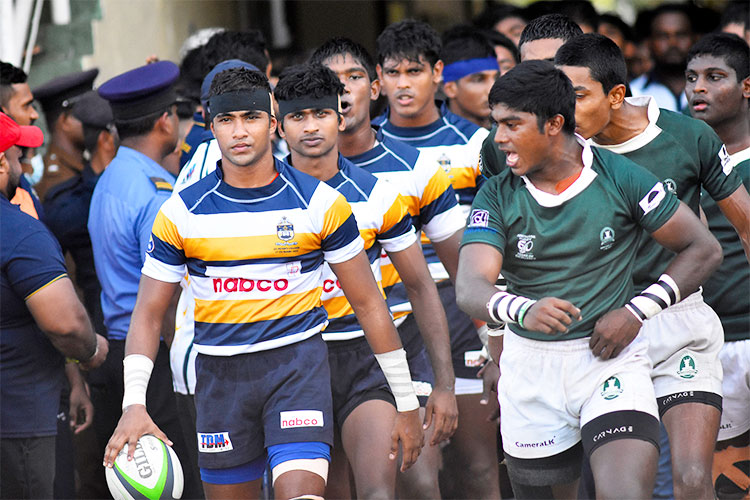
The Peterites were never rattled by the rough house tactics adopted by the Green Shirts from the time the two lined up in the ‘tunnel’ and then when the game began on the pitch minutes later. The lads from Bambalapitiya showed that when you are focused on the game you don’t have time or the necessity to indulge in activities that challenge the spirit of the game.
When the two teams met at Bambalapitiya in the league decider, hosted by St. Peter’s, the host team employed a riot squad apart from the services obtained by the police as measures taken for crowd control. The decision to strengthen security at the match in the league was done for obvious reasons. The knockout final was organised by the Sri Lanka Schools Rugby Football Association and there were concerns about security at the match. But all that depends on what happens in the middle of the pitch and referee Raveen Alexander must be given pat on the back for a job well done. The Greens Shirts were warned for unwanted play in the early minutes of the game following a complaint by the Peterite players for biting by the opposition and then the witnessing of feet up in a maul situation; another offense by Isipatana.
St. Peter’s responded to Isipatana’s aggression with three smashing tries with the first one scored by Sudesh Jayawickreme standing out. Jayawickreme’s try under the posts deflated the spirit in the Isipaana camp mainly because it was scored with the message given that ‘more high octane stuff’ was to come.
Hooker and utility player Dulaj Nawodya quickly exposed a defence that was cracking 18 minutes into the game and scored the second try in clinical fashion. The third try in the first half came through the efforts of Dineth Ranasinghe and by the 21st minute of the game St. Peter’s, leading 19-3, were giving the ‘Green Shirts’ lessons on how to play in a rugby final.
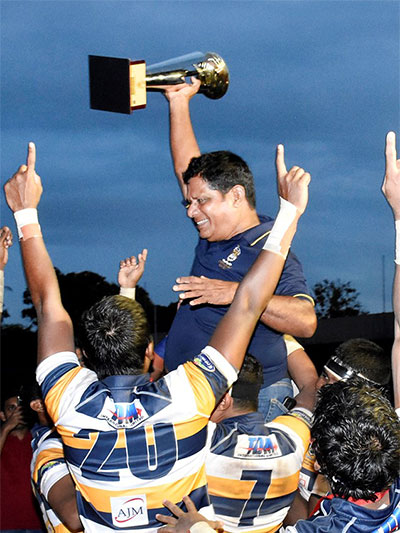
St. Peter’s head coach Sanath Martis is seen celebrating the team’s victory with his chargers at the President’s Trophy rugby final against Isipatana on September 10 at the Sugathadasa Stadium.
Isipatana must be given the credit for being a side that doesn’t surrender that easily. They knew they were up against an opposition mightier than them and when they settled in towards the tail end of the first half, they managed to breach the Peterite defence and score their first try in the game. Skipper Navin Kanishka scored that all important try and made the scoreboard look respectable from an Isipatana point of view.
The second half was evenly contested and Isipatana came back strongly with a try by their forwards. The rains threatened to slow the game and there was no help from the soggy pitch conditions for both teams. But the will to run the ball by both teams prevailed over the odds that threatened to spoil a much looked forward to schools rugby final.
Place kicker Yumeth Shihara was decently accurate with his spot kicks and booted through two penalties to swell the Peterite score in the second half. The only little hitch up that the Peterites had was the two yellow cards that were given away in the second half; one by the team’s skipper Ashain Madugasge. The Peterites playing twice in the second half with 14 men and not losing the game rubbed salt into Isipatana’s wounds. The only consolation Isipatana had this season was bagging the Sevens title. They were forced to finish as runners-up in the knockout and took third place in the league tournament.
St. Peter’s have much to owe coach Martis. The winning ways he has instilled in the St. Peter’s rugby set-up cannot be priced. To study the facial features of this coach, come to a decision and announce to the rugby world that behind his face lies a vicious and dangerous man would be a grave mistake. Few have observed a tender heart, the warmth of a
father to all and the rugby professionalism that runs in his blood to the very core. This man knows his rugby and when he gets players who are willing and able that combination can be dangerous on the field as shown this season by St. Peter’s.
Mention must be made of the Christian institution that St. Peter’s is and the way the authorities here mold the students and instill good values that can be shown when they represent their alma mater on the sporting field. Prayers said before the game starts and done on the field have sometimes posed the question from outsiders whether the authorities at this institute are making a show of religion in public. Prayers have done good for the boys and sparing a thought for the ‘All Mighty’ before a challenge in the sporting field has not only calmed the player’s nerves, but also driven the thought into them of fearing doing wrong and not the opposite team.


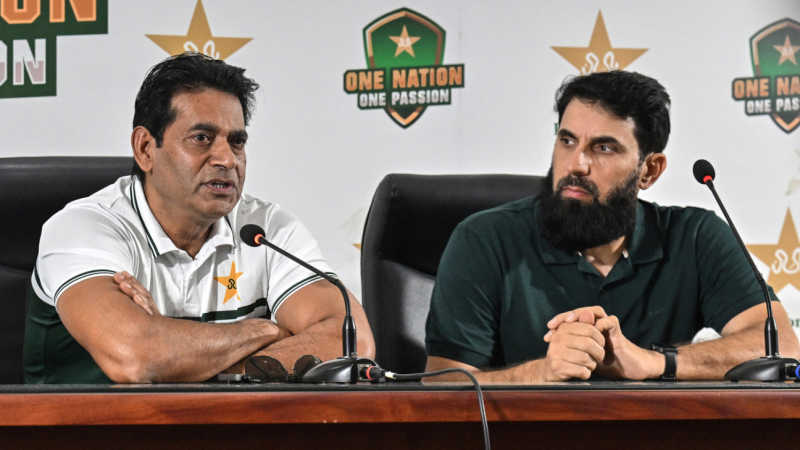
Misbah ul Haq has offered his resignation from the Pak7stan men’s national selection committee the day after the PCB made wholesalw changes to the Teat squad and team management midway through the ongoing tour of England. Misbah has also decided to step down from his role as a batting consultant at the National Cricket Academy in Lahore.
After going 2-0 down in the three-match series by losing at Lord’s by 194 runs, the PCB removed seven players from the Test squad and also released Sarfaraz Ahmed and Umar Gul as head coach and bowling coach ahead of the third Test at Edgbaston from September 9.
Mohammad Rizwan, Imam-ul-Haq, Salman Agha, Ali Usman, Aamer Jamal, Awais Zafar, and Khurram Shahzad were the seven players released. Five uncapped players – Arafat Minhas, Mohammad Imran Jnr, Saad Baig, Mohammad Imran Randhawa, and Razaullah – will join the Test squad along with Saim Ayub and Abdullah Fazal. Mike Hesson and Ashley Noffke – the head coach and bowling coach of the white-ball set-up – have joined the Test coaching staff.
Cricinfo understands the PCB served a notice to members of the selection committee following the Lord’s defeat seeking a written explanation regarding the selections of Rizwan and Imam in the squads for the tours of West Indies and England.
The notice was sent on Monday, the same day the board announced its decision to send home the seven players and two coaches, ahead of the third Test at Edgbaston from September 9. The notice asked for a written explanation outlining the reasons for their selections and the process through which it was arrived at, within 24 hours of the receipt of notice. From the start of 2024 until the West Indies tour, Rizwan was Pakistan’s top Test run-scorer with the highest average. Imam had only played two Tests in that period but was a heavy domestic run-scorer.
Since retiring as Pakistan’s most successful Test captain in 2017, Misbah has served in various capacities in the PCB. He was appointed in the dual role of head coach and chief selector in 2019. He served in both roles until October 2020, when he resigned as the chief selector to focus entirely on the head coaching responsibilities, from which he ultimately resigned the next year.
Two years later, he was brought in as an advisor by the then chief of ad-hoc management committee Zaka Ashraf and had since remained involved with the PCB. He was announced as one of five mentors for the now-defunct men’s Champions Cup after the current management took over in 2024, and he also mentored women’s teams in domestic competitions. He was the coach of the Pakistan Gold side which won the 50-over National Champions Cup in Multan last month under Shaheen Afridi’s captaincy.
Misbah was made part of the four-member selection committee which includes Aaqib Javed, Sarfaraz Ahmed, and Asad Shafiq in March this year and had also been on a 180-days-a-year contract with the PCB as a batting consultant.
(Cricinfo)
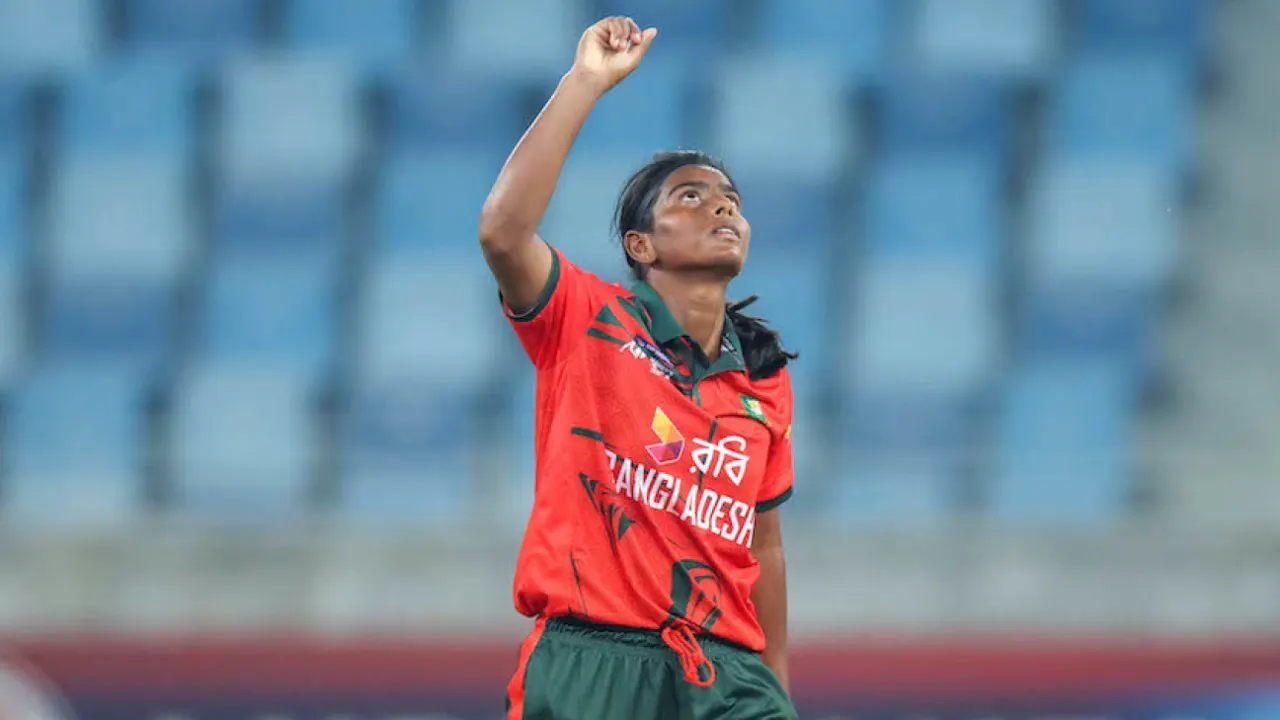
A superb bowling performance led by Marufa Akter and the spin attack helped Bangladesh overcome Indonesia in their Asia Cup opener in Dubai.
Indonesia, on their Asia Cup debut, put up a spirited performance especially with the ball to restrict Bangladesh to 129 for 8. Sobhana Mostary , playing her 100th international match, top-scored with 40, while Shorna Akter injected late momentum with 31 off 18 balls. Indonesia in return were bowled out for 58, with left-arm spinner Nahida Akter finishing with figures of 3 for 15.
Indonesia make early inroads
Indonesia’s Ni Made Putri Suwandewi found swing almost immediately but Bangladesh’s openers handled the movement well to make a positive start, scoring four boundaries in the first two overs. But that did not last long as Suwandewi struck in her second over, having Juairiya Ferdous mistime an inswinging delivery towards cover point, where Ni Ariani came forward and held a sharp low catch to give Indonesia their first wicket in Asia Cup.
Mostary and Dilara Akter then found run-scoring increasingly difficult. Bangladesh managed only one boundary between the third over and the end of the powerplay, reaching 30 for 1.
Indonesia’s spinners maintained the pressure thereafter, conceding only a few boundaries and repeatedly forcing Bangladesh’s batters to manufacture their shots. The partnership between Mostary andDilara struggled to gather momentum and was eventually broken when Ariani had Dilara caught for 27 off 31 balls. Bangladesh reached 58 for 2 at the halfway stage.
Shorna shines, Indonesia sparkle
Bangladesh’s first six came only in the 13th over thanks to Mostary. But her attempt to accelerate was checked soon after as 16-year old legspinner Sofia Velic, on her international debut, dismissed captain Nigar Sultana. Mostary was then left with the responsibility of guiding Bangladesh towards a competitive total, but Indonesia continued to restrict the scoring. Ni Luh Dewi struck twice in the 17th over to remove Mostary for 40 and Ritu Moni, leaving Bangladesh in further trouble.
Shorna briefly changed the momentum, hitting a six and a four, but Indonesia’s bowling ensured Bangladesh could not fully capitalise. Indonesia too dropped as many as three catches but the reprieves did not make much of an impact.
Ariani produced a dramatic finish to the innings, picking up two wickets as Bangladesh slipped from 105 for 3 to 129 for 8. They lost five wickets for 21 runs in just 17 balls, with Shorna, who had looked Bangladesh’s most fluent batter late in the innings, stranded at the non-striker’s end for much of the final over.
Bangladesh bowlers rule
Marufa began with a probing over, getting the ball to swing both ways and keeping Indonesia’s openers cautious. She broke through in her second over, having Rahmawati Pangestuti edge a full delivery to mid-on. she struck again in her next over, trapping Maria Corazon lbw with a full ball that swung sharply into her pads and beat her attempted flick. Indonesia had lost both openers early but they had made a slightly better start than Bangladesh managed during their own powerplay.
But the game shifted after the powerplay as Bangladesh’s spinners tightened the screws. Senior legspinner Fahima Khatun ended Ni Putu Ayu Nanda Sakarini’s difficult stay at the crease in the ninth over, trapping the Indonesia captain in front for just 2 off 15 balls. Sanjida Akter Meghla followed up with another wicket in the next over, trapping Dewi lbw after she missed a length ball that came into her pads.
Nahida struck in the 12th over but it was in the 14th over that Indonesia’s innings completely fell apart. Nahida first dismissed Suwandewi for 3 after a mistimed pull. Sofia Velic was then run out for 1 following a quick throw from deep fine leg, before Nahida finished the over by bowling Ariani for 2. Indonesia had slipped to eight down, and two more run-outs completed their innings as Bangladesh sealed a convincing 71-run victory.
Scores:
Bangladesh Women 129 for 8 in 20 overs (Dilara Akter 27, Sobhana Mostary 40, Nigar Sultana 10, Shorna Akter 31*; Ni Made Putri Suwandevi 1-13, Ni Ariani 3-28, Ni Luh Dewi 2-21) beat Indonesia Women 58 in 17.3 overs (Maria Corazon 12; Marufa Akter 2-06, Sanjida Akter Meghia 1-11, Nahida nahida 3-15, Fahima Khatun 1-09) by 71 runs
[Cricinfo]

by Rex Clementine
The Cricket Transformation Committee met the press yesterday and offered a firm assurance that the new constitution for Sri Lanka Cricket will be in place before November, with all democratic avenues available for concerned parties to challenge it in court.
According to committee head Eran Wickramaratne, the draft constitution has already been forwarded to the Ministry of Sports and subsequently to the relevant legal authorities to iron out any flaws.
Once the draft reaches Cabinet, it will be gazetted, with provisions allowing interested parties to challenge the legality of the new constitution in court.
SLC elections have been bitterly contested over the years and, at times, have resembled a political battlefield rather than a process to elect cricket administrators. There have been instances where members of prominent clubs were suspended for voting against the wishes of their clubs, while armed gunmen have even entered the Board premises at Maitland Place to intimidate voters. Such incidents eventually forced authorities to shift cricket elections to a neutral venue.
The influence wielded by paper clubs and certain district cricket associations during elections has also come under the microscope. The new constitution is expected to address many of these long-standing concerns and Wickramaratne gave a categorical assurance that ballot rigging will not be tolerated this time around.
“There will be no room for rigged elections. That’s for sure. There is a democratic process and people will be allowed to challenge the new constitution within those frameworks,” Wickramaratne said.
Another major talking point at the media briefing was the inaugural Champions Trophy. It was revealed that although the International Cricket Council has indicated that the tournament could be taken away from Sri Lanka as an elected body is not currently running the administration, officials remain hopeful that the country will retain the hosting rights.
There have been suggestions that India could host the tournament should Sri Lanka lose it. Even in such an eventuality, Sri Lanka would not miss out on participation, with the top six teams qualifying for the event and Sri Lanka currently placed sixth in the ODI rankings.
“I am made to understand that the decision will be taken at the next ICC meeting, which will be held in November. By then, we should have cleared many hurdles and the new constitution would have been passed by Parliament and dates should be fixed for the election,” Wickramaratne told the press.
“We have kept the ICC informed about what has been happening on a regular basis and we are hopeful that we will be able to host the Champions Trophy,” he added.
Former captain Kumar Sangakkara, who is also a member of the committee, was present at the briefing and was asked about creating more opportunities for budding Test cricketers.
Sangakkara stressed that Test cricket needed to be protected in the years ahead, but pointed out that supporters too had a role to play by demonstrating their appetite for the game’s traditional format.
He added that concerns over the future of Test cricket had been raised even at ICC level and that measures were being explored to safeguard the longer format of the game.

Cabinet aporives recruitment of Nursing Instructors for Nursing Schools under the Ministry of Health and Mass Media on Contract Basis
Signing agreement for the establishment of BIMSTEC Technology Transfer Facility in Sri Lanka
The cabinet approves agreement on mutual legal cooperation in criminal matters between the Republic of Sri Lanka and the Republic of Korea

Misbah-ul-Haq resigns as Pakistan selector after Test squad upheaval
Amendment of the Quarantine and Prevention of Diseases Ordinance No. 3 of 1897
Cabinet approves donation of USD One Million to the Government of Nepal

‘Dates have the highest sugar content to fight Coronavirus’

Sunday Island 27 December – Headlines

#SundayIsland 17th December – Headlines

Sunday Island – 28th March

Sunday Island Headlines – 21 March

Sunday Island – 21st February – Headlines
-

 News5 days ago
Eight politicians in drug kingpin probe
-

 Features3 days ago
“Wrap Me Up in My Blazer”— A Gentlemanly Bradby Reminiscence
-

 Business5 days ago
Sri Lanka opens up: A new season of direct connectivity
-
 Features7 days ago
Insights from Chieftains of Uva: Genealogy of two Kandyan Families – Part II
-

 Features5 days ago
Redefining ageing in Sri Lanka
-

 Latest News5 days ago
Nepal-Tibet floods: What happened, what caused them and who is missing?
-

 Editorial7 days ago
Warning of power cuts: El Niño and corruption
-

 Features7 days ago
Export diversification: Missing the wood for the trees – Part I