
Sports
Sri Lanka set aside their worst fears


by Rex Clementine
at Pallekele
There’s a fair bit to be done for Sri Lanka to get back to their glory days in cricket, but you can safely say that the team has a taken huge strides to achieve that target. Yes, the drubbing by Pakistan at SSC and in Galle are still fresh in memories but Test cricket is one format where they have done reasonably well.
It is the white ball formats the team has struggled, playing multiple qualifying tournaments in the last three years across T-20s and ODIs. T-20 cricket has reached a safety zone, no doubt about it and the automatic qualification for next year’s tournament in the US and West Indies is proof for that.
ODI format is still a work in progress, but there are impressive signs. The team’s bowling is pretty formidable with both the quicks and spin departments bowling sides out with some impressive performances. If they make a genuine effort to fix the injury woes, that will be a massive relief. This Asia Cup, they are literally depending on their seconds string attack.
There were doubts how Matheesha Pathirana will go. He has pace sure, but accuracy was a question mark and there were doubts whether he will be as good as in the 50 over format as he was in the 20 overs game.
Was it the right decision to pick him over Pramod Madushan and Binura Fernando, some of us wondered? What an inspired decision it proved to be.
In his first spell, Matheesha accounted for the big wicket of Shakib-al-Hasan and then in the second spell claimed the wicket of Mushfiqur Rahim, the other experienced batter in the opposition line-up. Then the tail couldn’t handle his pace and his four-wicket haul gave Sri Lanka a much-needed win and fears of the team might not being able to make it to the second round were set aside.
Maheesh Theekshana was sensational as well making early inroads bowling with the new ball. His variations are confusing, and batters aren’t able to play him with confidence. Of course, there will be bigger challenges when they play India and Pakistan.
Then there’s Dhananjaya de Silva, a very underrated cricketer. You can always be assured of his ten overs for not many and he gives you the much-needed cover at number six. Why the selectors picked Kusal Mendis ahead of Dhananjaya as vice-captain is confusing indeed.
Mendis of course is on borrowed time. He’s been on borrowed time for quite some time now, but they seem to create roles for him to fit into the side. How much we can go on saying that he has got talent and that he is the future of the team needs to rest and other deserving players need to be looked at.
If Sadeera Samarawickrama had got half the chances that Mendis had got, he would have won us many more games. It remains to be seen if Kusal Perera is fit, whether the selectors will have the courage to axe Mendis. Of course, that will make the selectors look dumb. Not often do you drop your vice-captain from the side. However, they have done dumber things than this.
Sadeera first came into the scene in 2017 and should have gone onto become a permanent fixture. But once Graham Labrooy, who picked him finished his term, he was thrown in the cold store and successive selection panels didn’t even bother to try him out.
If a player’s work ethic and attitude doesn’t impress selectors or the team management, there is certainly something wrong in the system. That’s one reason why we have struggled so much.
How well Sadeera batted against Bangladesh after the top order had collapsed. His only blemish is that he plays too many attacking shots too early in the innings. Even on Thursday, he had an opportunity to prove his mettle by finishing off the game, but he threw away his wicket. He will learn.
However, Mendis, whether he will learn is a big question mark. So is Niroshan Dickwella. The opportunities these two have got, had we invested on some others, we would have made rapid progress. Better later than never.
Young batters putting up their hands and making it count has helped Sri Lanka to move forward in the right direction. Pathum Nissanka has already established himself and then there’s Charith Asalanka, who has played some match winning knocks under pressure. He didn’t carry a lot of form into the Asia Cup but the unbeaten 62 at Pallekele would have given him lot of confidence.
The unsung hero of Sri Lanka’s recent success is Kasun Rajitha. It’s a pity that even in these pages, we discuss him last. Often Rajitha ends up without taking a wicket but what the scorecard doesn’t say is that how many catches were dropped off him. Captain Dasun Shanaka put down one against Bangladesh and poor Rajitha continues to suffer.








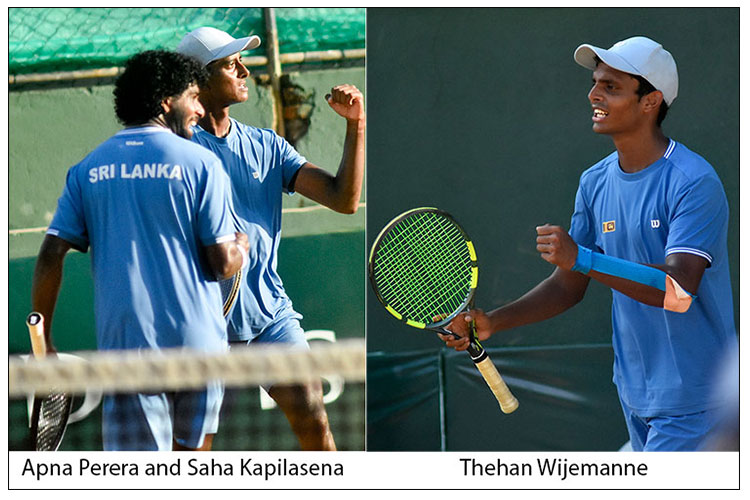
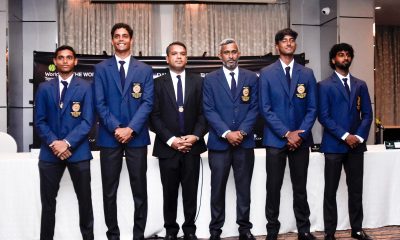
Hosts Sri Lanka made a winning start to their Davis Cup Asia/Oceania Group IV campaign, edging out Qatar 2-1 in a closely contested opening-day tie at the Sri Lanka Tennis Association courts in Colombo on Wednesday.
The visitors struck first when Mubarak Alharrasi defeated Sri Lanka’s Apna Perera 6-3, 4-6, 6-2 in a hard-fought opening singles encounter, giving Qatar an early 1-0 lead.
Sri Lanka bounced back in the second singles as Thehan Wijemanne produced a spirited comeback to overcome Mossa Alharrasi 3-6, 6-4, 6-4. After dropping the opening set, Wijemanne showed great composure to win the next two sets and level the tie at 1-1.
The decisive doubles match proved to be a tense affair, with Apna Perera returning to partner Saha Kapilasena. The Sri Lankan duo held their nerve in two tie-breaks to defeat Jabar Al Mutawan and Mossa Alharrasi 7-6, 7-6, sealing the tie 2-1 for the hosts.
Sri Lanka’s ability to recover from the opening singles defeat highlighted the team’s resilience as Wijemanne’s comeback victory and the doubles pair’s clutch performance ensured a successful start to their campaign. The hosts will now look to build on the opening-day victory as they continue their quest for promotion in the Asia/Oceania Group IV competition.
MCA PREMIER LEAGUE 2026
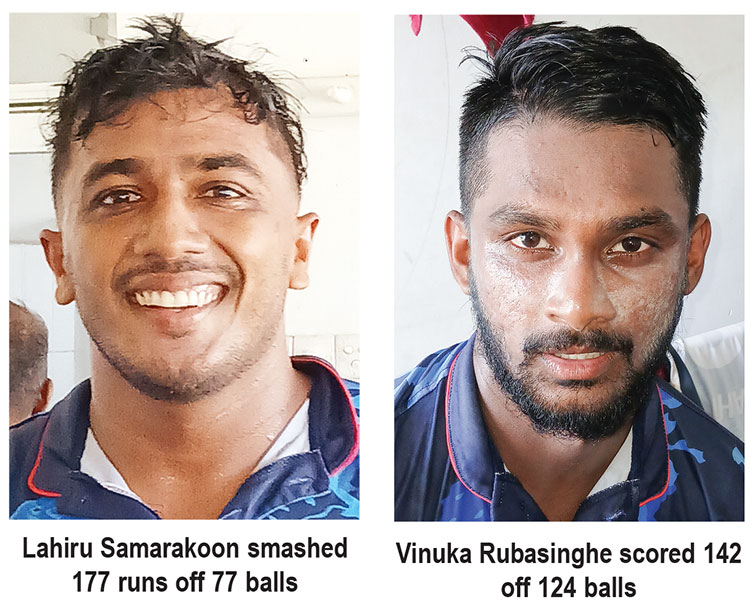
A 253 run sixth wicket partnership between Vinuka Rubasinghe [142 runs off 124 balls] and Lahiru Samarakoon [177 runs off 77 balls] set the foundation for David Pieris Group of Companies to amass 411/7 against DFCC Bank in the opening match of the Mercantile Cricket Association’s Premier League Cricket tournament played at the Thurstan Ground on Thursday [23]
Lahiru smashed 18 fours and 13 sixes in his 177 while Vinuka smashed 16 fours and 3 sixes in his 124 ball 142. Nipun Premarathne, Sandaru Wickremarathne and Raveen de Silva captured two wickets each.
In the chase Mihiranga Nimsara and Tharindu Nirmal captured three wickets each to restrict DFCC Bank to 257/8 in their 50 overs. Raveen de Silva top scored with 79 off 103 balls while Pavan Pathirajah chipped in with 65 runs.
SCORES:
David Pieris Group of Companies
411/7in 50 overs [Vinuka Rubasinghe 142, Lahiru Samarakoon 177; Nipun Premarathne 2-67, Sandaru Wickremarathne 2-65, Raveen de Silva 2-79]
DFCC Bank
252/8 in 50 overs [Raveen de Silva 79, Pavan Pathiraja 56 ; Mihiranga Nimsara 3-57 , Tharindu Nirmal 3-35]
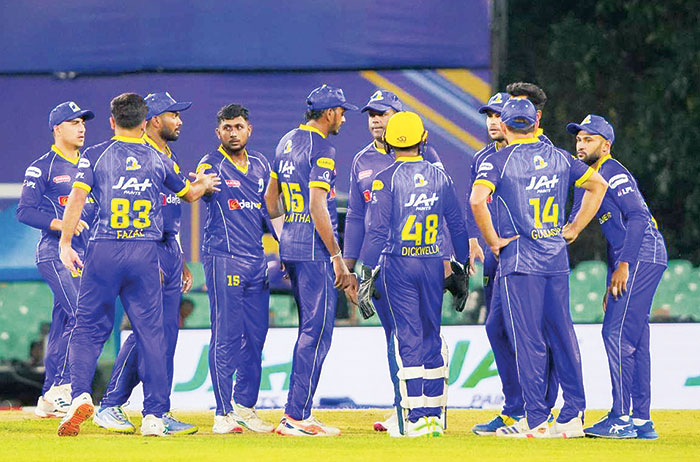
Reeza Hendricks scored his second fifty of the tournament and took his team over the line without getting dismissed for the second time as Dambulla Sixers defeated Galle Gallants at their home, Rangiri Dambulla International Stadium, in the eighth match of the Lanka Premier League.
Hendricks came into bat at number three in the third over after Niroshan Dickwella departed and soon saw the back of Sahibzada Farhan as well. He then stitched a quickfire 36-run stand with Pavan Rathnayake and then took the game away in a 69-run stand with Marques Ackerman.
Rathnayake took the attack to the impact sub Eshan Malinga in the last over of the powerplay. Before that, he had a single six in his LPL career in 7 innings; then he deposited three maximums in a single over against Malinga, ending the powerplay at 70/3, as he departed for a 11-ball 29 on the last ball.
Hendricks, joined by his countryman, Ackerman, took the team’s total to 102/3 inside 10 overs, as the latter hit a massive six against Akif Javed in the 10th over to cross the 100-run mark.
The flow of boundaries continued as Hendricks and Ackerman continued with massive sixes from both batters in back-to-back overs against Malinga and Mehidy Hasan Miraz, leaving the equation required to 54 runs off 48 balls.
Ackerman was finally dismissed as Karunaratne showed up with the ball in hand as well, breaking the 69-run partnership for the fourth wicket. Hendricks still did not stop as he reached his second half-century of the season off just 30 deliveries.
The new batter Gulbadin Naib hit a couple of straight maximums against Mohammad Nawaz, ending the expensive over which had already seen Hendricks start with back-to-back boundaries, leaving just 16 runs off the last five overs, which also kickstarted Dambulla Sixers’ power blast as well.
Gulbadin hit 3 maximums in his six-ball cameo to finish the game in style with 23 balls remaining, chasing down the target set by Galle Gallants with ease.
At the start of the match, Galle Gallants’ Sam Harper (40 off 22 balls including 3 sixes and 3 fours) and Charith Asalanka (25 off 19 balls; 2 fours, 1 six) started well after losing Lasith Croospulle in the third over to Vishwa Lahiru. The duo gathered 64 runs off 37 balls for the second-wicket.
Chamika Karunaratne rescued the innings after Harper was bowled by Gulbadin Naib in the ninth over and Asalanka was caught and bowled by Ackerman.
While wickets fell on the other end, skipper Dasun Shanaka came and arrested the collapse with a cameo. Later he made full use of the power blast’s first over, scoring 15 runs before Farooqi came back with a double-wicket over, dismissing Karunaratne for 45 runs off 30 deliveries and Mohammad Nawaz for two.
Shanaka chipped in with 20 runs off 10 balls, while Mehidy Hasan Miraz’s 16 runs off 13 balls took Gallants’ total to 178/8 in 20 overs.
Brief Scores
Dambulla Sixers
won by 6 wickets with 23 balls to spare
Galle Gallants:
178/8 in 20 overs [Chamika Karunaratne: 45 (30), Sam Harper: 40 (22), Fazalhaq Farooqi: 3/39 (4) Marques Ackerman: 2/27 (3)]
Dambulla Sixers:
180/4 in 16.1 overs [Reeza Hendricks: 64* (37), Marques Ackerman: 35 (25)
Pavan Rathnayake:
29 (11), Chamika Karunaratne: 1/7 (1), Dasun Shanaka: 1/18 (2)]

Child abuse crisis: 108,000 complaints reported in 10 years

CA dismisses writ petition seeking postponement of A/L exam

Bimal’s remarks on MP’s conduct spark heated exchange in Parliament

SC rules fundamental rights of Aragalaya activist were violated

TRINEX-26 naval exercise begins off Trincomalee coast

Court defers hearing of GR’s Easter Sunday petition

‘Dates have the highest sugar content to fight Coronavirus’

Sunday Island 27 December – Headlines

#SundayIsland 17th December – Headlines

Sunday Island – 28th March

Sunday Island Headlines – 21 March

Sunday Island – 21st February – Headlines
-

 Features5 days ago
Two memorable excerpts from a former SLAF commander’s memoir
-

 Business5 days ago
‘Giving up was never an option’: The fisherman who fought back after losing millions in SL
-
 Latest News6 days ago
Davis cup Asia/Oceania Group IV 2026 to be held in Colombo from 20th to 25th July
-

 Features5 days ago
Erdoğan’s New Republic
-

 Life style5 days ago
Taste of the Swiss Alps comes to Colombo
-

 News6 days ago
Evidence recorded in money laundering case against Yoshitha Rajapaksa
-
 Midweek Review2 days ago
Three high-profile alleged suicides shaping key investigations
-

 News6 days ago
Dengue outbreak gallops ahead: Infections surpasses 73,455, leaving 50 dead