
Business
The National Action Plan on UNSCR1325 and the impact of armed conflicts on children


The Universities Network for Children in Armed Conflict and the Institute of Political Studies “S. Pio V”, supported by the Italian Ministry of Foreign Affairs and International Cooperation have organised a conference within the framework of the project ‘The National Action Plans (NAP) on UNSCR1325 and the impact of armed conflicts on children: a study and analysis of the International Universities Network”. The project aims to carry out qualitative and quantitative research and produce an insightful report, by geographical area, of the serious violations against children by armed conflict situations. The research also makes a valuable analysis of post-conflict reform, rehabilitation and reintegration of children affected by armed conflict and this is the critical path where UNSCR1325 can and should play a pivotal role.
Speaking about the objectives of this conference Laura Guercio, Professor of Sociology of Human Rights & International Cooperation to Development at the University of Perugia and a Professor of International Relations at the University Cusano Rome. A member of the Council of the European Law Institute in Vienna said, ” The NAP is to create a narrative and collate ideas on how Resolution 1325 can impact and support the global movement to reduce the direct and indirect impacts of armed conflict on children. To achieve this, we must expand the understanding and impact of Resolution 1325 from its gender perspective to reach children affected by armed conflict as well as create a wider umbrella of sustainable peacebuilding via the four pillars of Resolution 1325 – Participation, Protection, Prevention, and Relief and Recovery. The impact of armed conflict on children needs to deep dive into the areas.”
Participation – how can we create a dialogue from a gender perspective to mutually include the protection of children under Resolution 1325 and how should the National Action Plans reflect this?
Protection – how does the jurisdiction of the national and international communities work together to create a system of sustainable protection of children from armed conflict under the umbrella of Resolution 1325? (Considering that internal civil wars create a jurisdictional question for international community intervention)
Prevention – what specific areas of direct and indirect impacts of armed conflict on children can Resolution 1325 address?
Relief and Recovery – can Resolution 1325 play a larger role in the relief and recovery of children affected by armed conflict (as this is a critical impact point that tends to see a lot of children fall through the cracks)?
Accountability – how do we improve accountability measures to support children and women affected by armed conflict?
Armed conflict causes severe direct and indirect consequences for children and most often the indirect consequences are not addressed due to the grave nature of the direct consequences, which are broadly defined as death, injury, recruited as child soldiers and violence against children. The dire consequences of the indirect harm caused to children during the armed conflict have a lasting impact on these children due to the double-barrelled trauma such as gross violations of being abducted, forced removal from their families, illegal detention and recruitment as child soldiers. In addition, these children are also deprived of their fundamental rights to education, shelter, and the right to build a fruitful and holistic life.

Laura Guercio
The project will also include videos and a photo exhibition by two Italian photo reporters, Marzia Ferrone and Vittorio Alonzo, on the condition of children living in armed conflict and post-conflict.
This conference provides the opportunity to build a comparative analysis of NAP’s of selected Asian countries vis a vis the IV Italian Action Plan in accordance with Resolution 1325.
Background to Conference and Research Topic
The charter of the United Nations Security Council (UNSC) is the maintenance of international peace and security. Security must be present, and its presence must be realised – this is a critical indicator of peace. As the popular saying goes, “The absence of war doesn’t necessarily mean the presence of peace”.
In 2000, The UNSC Resolution 1325 recalled 1261 (1999), 1265 (1999), 1296 (2000) and 1314 (2000) and;
expressed concern about the fact that the majority of people affected by armed conflict are women and children,
reaffirmed the role of women as “agents of lasting peace”: their equal participation in peacebuilding, maintaining and promoting peace and security and the increase in decision-making for conflict prevention are crucial for peace and security,
reaffirmed the need for humanitarian and human rights laws that protect the rights of women and children during and after conflicts.
The Beijing Declaration (1995) states the hard reality of women and children being most vulnerable during conflict and further states that women and girl-children are even more at risk due to their social status and sex.
In the presence of conflict, it is observed time and time again that women assume the key role of ensuring family livelihood amid armed conflict and destruction. Women are also seen as being active in cultivating peace and collaboration in their communities at a grass root level. A strong example of this is; during the armed conflict and post-conflict in Sri Lanka, we saw the transformation of battle-hardened women into successful entrepreneurs. What started as a desperate shift for survival has now mainstreamed and evolved into a community of businesswomen that challenged the patriarchal gender norms and changed the socio-cultural landscape. Therefore, the narrative must begin to reflect the strong agency women are competent, capable and willing to carry forward with the global community looking beyond the umbrella of protection of women per se. This is the narrative that will make UNSCR 1325 stronger and able to reach further to the protection of children.



Timing aligns with national policy discussions
By Sanath Nanayakkare
The USA–Sri Lanka Chamber of Commerce is exploring an innovative promotional initiative to showcase Sri Lanka’s tourism, cultural heritage, and commercial opportunities in the heart of New York City during the upcoming Christmas and holiday season.
The proposed campaign aims to bring Sri Lanka’s unique identity to one of the world’s most internationally recognized cities through a mobile digital billboard featuring high-quality photographs and videos highlighting the island’s natural beauty, rich heritage, and diverse commercial offerings. Designed to capitalize on New York City’s significant holiday-season foot traffic, the initiative will reach American consumers, international tourists, and potential business partners.
The digital showcase will feature pristine beaches, scenic mountains, waterfalls, tea plantations, wildlife, ancient cities, Buddhist heritage, traditional arts, authentic cuisine, and modern attractions, positioning the country as a premier international travel destination. An interactive QR code linking to comprehensive tourism information will also be incorporated, allowing viewers to directly explore travel opportunities.
Beyond destination promotion, the initiative provides Sri Lankan businesses with a vital platform to introduce their products and services to the American market. Enterprises representing Ceylon tea, spices, food products, gems and jewellery, apparel, handicrafts, wellness, hospitality, and tourism will have the opportunity to showcase their brands alongside the broader national campaign.
The Chamber notes that this effort will be particularly beneficial for small and medium-sized enterprises (SMEs) seeking greater international exposure, brand recognition, and commercial partnerships in the United States. By integrating tourism promotion with commercial visibility, the project aims to strengthen Sri Lanka’s international image while supporting trade, investment, and business development.
Operating under the central message of “Discover Sri Lanka. Experience Sri Lanka. Visit Sri Lanka,” the campaign presents the island as a destination defined by natural beauty, cultural richness, distinctive products, and entrepreneurial potential. More information on the initiative is accessible at www.usaslcc.org.
Tourism sector stakeholders have welcomed the move, noting that private-sector-led initiatives of this nature bypass cumbersome bureaucratic procurement procedures and complex tender processes typically associated with state-run promotional campaigns abroad.
The timing aligns with recent national policy discussions regarding tourism promotion. Participating in a Fireside Chat at the inauguration of the Sri Lanka Economic and Investment Summit 2026, organized by the Ceylon Chamber of Commerce, President Anura Kumara Dissanayake emphasized that a proper procurement mechanism needs to be established before acquiring tourism promotional concepts, recommending a performance-based system where agencies are compensated according to verified growth in tourist arrivals.

For 10th consecutive year
Seylan Bank PLC, the Bank with a Heart, has reaffirmed its commitment to supporting Sri Lanka’s automotive industry by partnering with the 20th edition of the Colombo Motor Show 2026 as the Official Banking & Leasing Partner for the 10th consecutive year. This makes Seylan Bank the longest-standing partner of the Colombo Motor Show, further reflecting its longstanding association with one of Sri Lanka’s most prominent automotive exhibitions. The four-day exhibition is scheduled to take place from 20th to 23rd November 2026 at the Bandaranaike Memorial International Conference Hall (BMICH), marking the first time the Colombo Motor Show will be held as a four-day event.
As one of Sri Lanka’s leading international motor and motor accessories exhibitions, the Colombo Motor Show will bring together vehicle enthusiasts, prospective buyers, industry professionals and automotive service providers. The 2026 edition is expected to feature over 200 trade stalls covering motor vehicles, accessories, spare parts, lubricants, tyres, batteries, leasing facilities and other motor-related services.
Through its continued partnership, Seylan Bank will showcase a comprehensive range of financial solutions designed to support customers in meeting their personal and business needs, with a particular focus on Seylan Leasing facilities. Visitors to the exhibition will have the opportunity to receive on-the-spot leasing evaluations and expert guidance from Seylan Leasing Specialists, helping them explore vehicle financing options conveniently during the event.
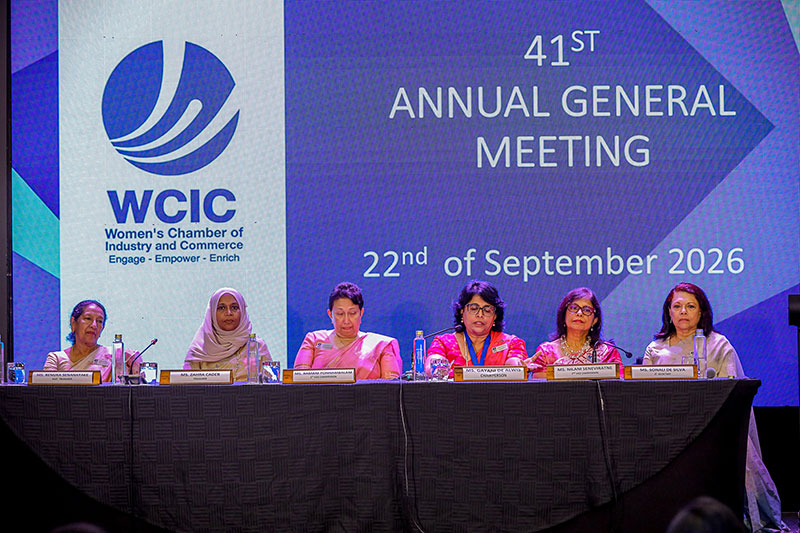
The Women’s Chamber of Industry and Commerce (WCIC) is sharpening its focus on helping women entrepreneurs move beyond business creation towards sustainable growth, as it expands its membership, partnerships and advocacy footprint.
WCIC Chairperson Gayani de Alwis, concluding her second tenure, highlighted the Chamber’s efforts had increasingly centered on creating pathways for women to translate entrepreneurial ambition into viable enterprises and, importantly, build those businesses for the longer term.
“Ultimately, our impact is not measured by the number of programmes we conducted, but by the women whose businesses grew, whose voices became stronger, whose horizons expanded and whose contribution to the economy became greater,” she said addressing the WCIC 41st Annual General Meeting (AGM) held on 22 September for which the Chief Guest was Canadian High Commissioner to Sri Lanka and the Maldives Isabelle Martin.
The focus has included a special initiative for female university students with an entrepreneurial mindset, regional chapter initiatives in the Northern Province, capacity-building programmes and the inaugural ‘Beyond Ramp Up’ workshop.
The Chairperson said these initiatives were designed to move women “from aspiration to enterprise, and from enterprise to sustainable growth”, signaling a broader focus on strengthening the progression of women entrepreneurs beyond the initial stages of business formation.
WCIC recorded a 20 percent increase in membership during the period with membership crossing 460 and expanded its ecosystem through a series of strategic partnerships.
Internally, WCIC moved to strengthen its governance framework, revising its Articles of Association to ensure regulatory compliance and introducing a Code of Conduct and Board self-assessment. Clearer organisational roles, job descriptions and performance targets were also introduced as part of efforts to strengthen accountability and professionalise its operations.
Reflecting on her tenure, the Chairperson said the period had been about building a stronger, more connected and professionally governed organisation, while converting its wider ambitions into tangible opportunities for women in business.

CTU: Teacher shortage casts doubt on govt.’s education reforms

Norochcholai to remain offline for several days after blackout

President links businessman held with arms to politicians

CID probe sought into tusker’s death amid fears of elephant-killing syndicate

Bill to allow remote witness testimony in courts

Sajith condemns alleged assault on monks, calls for their safety

‘Dates have the highest sugar content to fight Coronavirus’

Sunday Island 27 December – Headlines

#SundayIsland 17th December – Headlines

Sunday Island – 28th March

Sunday Island Headlines – 21 March

Sunday Island – 21st February – Headlines
-

 Latest News6 days ago
Nissanka’s return headlines Sri Lanka’s Test squad against Pakistan
-

 News5 days ago
Sri Lanka, India caught in US-Iran ship crisis
-

 Latest News6 days ago
Imran Khan’s PTI braces to fight federal takeover of Khyber Pakhtunkhwa
-

 Latest News5 days ago
Kusal Mendis’ unbeaten 87 hands Sri Lanka consolation win
-

 Latest News5 days ago
Missiles intercepted near Riyadh after Saudi coalition hits Yemen fuel depot
-

 News6 days ago
Mahinda and Shiranthi hospitalised
-

 News6 days ago
Presidential pardons: Govt. studying Justice Thurairaja’s recommendations – Minister
-

 Latest News6 days ago
Former Zimbabwe player and umpire Sarah Dambanevana dies aged 36