
Features
‘Will you walk into my parlour?’ said the Spider to the Fly


‘Will you all join my government?’ President asked entire Parliament The second is deadly to more than one fly
by Usvatte-aratchi
There (were) are forms of government in which the legislature (Parliament), those who make laws, are the same as those who execute them. There are other forms of government in which disputes between the two, as well as between citizen parties, are settled by the executive. The epitome of such concentration of authority and power is an absolute monarchy/a tyranny, where a king in 18th century France could say ‘I am the state’ or a dictatorship as we saw in Germany, in the 20th century where legislative, executive and judicial powers were all vested in one Fuehrer. The form of government in present China, seems unique in that the Chinese Communist Party, with its countrywide presence, exerts a strong integrating force over all decisions of government.
There are still other forms of government, where the central feature is that there is a separation of powers: lawmakers (legislature), those that put those laws into practice and propose new legislation (the executive) and those that adjudicate disputes (the judiciary). Each of those parts is autonomous within spheres determined by law. It is a modern form of government. Neither the Roman nor feudal forms of government, nor ancient Chinese, Indian, nor the magnificent governments in Africa exhibited this feature, had anything like it. It is also a sophisticated form of government, because at some point, close to the top, it is necessary to unify the exercise of supreme power.
The organ at the top, which exercises such massive power, needs to be checked on the one hand and the powers exercised by one branch must be balanced with those exercised by other organs, on the other. Otherwise, one branch will exercise power over others and the regime may become tyrannical. As Alexis de Tocqueville so sharply observed in the 18th century, the clearest functioning of the separation of powers then, was in the government of the several states in America that went ‘to form a more perfect union’ and remains so to date. The powers of the President (the executive) to appoint judges of federal courts are subject to approval by the Senate (a part of the legislature). Most recently, the Senate rejected the nomination of Justice Robert Bork, a brilliant jurist, to a seat in the United States Supreme Court.
Whenever the Appeal Court of Sri Lanka grants a plea by a defendant to release him/her from police custody, the judicial branch is checking the activities of the executive branch of government. Whenever the Supreme Court rejects or limits the provisions in a Bill before Parliament, the judicial branch is checking the activities of the legislative branch. When the executive branch stands in the way of the legislative branch of government exercising the latter’s principal lawful functions, the Constitution is in jeopardy.
The question becomes immediately urgent because the President, the head of the executive branch, who also happens to be the Minister of Finance, has refused (has failed) to ‘issue a warrant under his authority to withdraw from the Consolidated Fund a sum …’to defray the costs of holding elections’ to Provincial Councils in March 2023 or thereafter. Parliament, the legislature, in November 2022, specifically had voted to incur that expenditure in an Appropriation Bill (Budget proposal) presented by the then Minister of Finance. The reason given to the public was that the government had no funds. (As a matter of fact, governments almost never have funds.
You have to tax the public to find money!) There is no provision in the Constitution for the Minister of Finance to exercise any discretion in the matter of disbursing funds in the Budget approved by Parliament. In such circumstances as when a vote of expenditure had been approved by Parliament, it is necessary that Parliament, in a supplementary Bill, disapprove and eliminate that expenditure from the Budget for the year 2023. It is not provided for in the Constitution for the Minister of Finance (or for that matter, any functionary) to delete any expenditure at his discretion. To do so would be to vitiate completely the provision in Section 148 that ‘Parliament shall have full control over public finance’. The Minister, who is not a member of the legislature, has made completely nugatory the will of the legislature. It is the function of the judiciary to restore the constitutionally valid position.
In most countries, where there is a separation of powers, the executive branch has immediate control over irresistible lethal power. Other branches can intervene but by the time they do so, the foul deed may have been done. The executive branch of government can impose its will on the other branches, were it to so make up its mind. That it does not do so rests on a desire on the part of all parties that a liberal form of government is desirable even at the cost of some degree of efficiency.
There has been no deep respect for the principle of the separation of powers in our country. When the Chief Justice of the country was forcefully evicted from her post effectively, the legislative branch failed to stand up to respect the autonomy of the judicial branch. The lackadaisical conduct of the executive branch in investigating grievous crimes, committed by the executive branch, has made it impossible for the courts to perform their lawful functions. To tolerate the conduct of the Minister of Finance, who is not a member of Parliament, to interfere in matters of control over public finance to deny funds for legislative activities, is to give the executive branch of government power to veto decisions of the legislature.
Under these chaotic governance practices, the legislative and judicial branches must keep sharp vigil lest their powers are grabbed by a corrupt and incompetent executive branch, which has shown a pronounced proclivity to plunder and waste. Hearings at the meetings of the Committee on Public Accounts and the Committee on Public Enterprises reveal daily and weekly, shocking gross incompetence and wholly unacceptable shortcomings on the part of senior members of the executive branch.
In a way, we should expect that turnout because the Cabinet of Ministers, who sit atop the executive branch, are calumniated to have plundered government funds so much so that the crisis in public finances we suffer through are the direct result of those crimes. That no member of a previous and present Cabinet has been convicted of any crime relating to such plunder is convincing evidence of both widespread and deep corruption in the entire machinery of government.
The Opposition in Parliament and media will serve this society best, if it, in so far as it can, were to guard the community against a repetition of the plunder of public funds that threw this society into a position of a mendicant nation. Custodians cannot protect their charges by changing the coats they wear into those of criminals.
The advice of some elders in this society for Parliament to unite with the executive to build this nation arises from a failure to understand how deeply this nation has been wounded by its political leaders, since 2005, and how the structure of government we have adopted requires a separation of powers and the exercise of checks and balances by one branch of government on the activities of another. The spider invites you to his parlour to fatten itself at cost to your very existence.







Features
Winged guardians of Sri Lanka’s natural heritage: Featured birds highlight biodiversity richness ahead of World Biodiversity Day

As the world prepares to observe the International Day for Biological Diversity, commonly known as World Biodiversity Day, on May 22, Sri Lanka stands as a vivid example of how a relatively small island can hold an extraordinary concentration of life.
The annual observance serves as a global reminder of the importance of protecting ecosystems and the rich variety of life forms that sustain the planet.
This year’s observance comes amid increasing international concern over biodiversity loss driven by habitat destruction, climate change, pollution, invasive species and unsustainable development. Scientists warn that the disappearance of species affects not only wildlife but also food security, water resources, livelihoods and ecological stability.
For Sri Lanka, World Biodiversity Day carries particular significance.
Despite occupying less than 0.03 percent of the Earth’s land surface, Sri Lanka possesses remarkable ecological richness and has earned global recognition as one of the world’s biodiversity hotspots.
The island’s forests, wetlands, rivers, mountains and coastal ecosystems support an extraordinary range of species, many of which are found nowhere else on Earth.
Among the most visible and fascinating representatives of this natural wealth are birds — creatures that fill forests and gardens with colour and song while performing critical ecological functions. Birds pollinate flowers, disperse seeds, regulate insect populations and serve as important indicators of environmental health.
Conservation Biologist Rajika Gamage of the Tea Research Institute says birds often provide the earliest signals of environmental changes taking place within ecosystems.
“Birds are among the most important indicators of habitat quality. Changes in bird populations can reveal ecological disturbances long before they become visible to people,” Gamage said.
Black bird
As Sri Lanka reflects on biodiversity conservation, five remarkable bird species — the Yellow-fronted Barbet, Crimson-fronted Barbet, Sri Lanka Hanging Parrot, Tawny-bellied Babbler and Blackbird — illustrate not only the beauty of the country’s avian diversity but also the interconnected nature of ecosystems.
Sri Lanka’s biological richness is exceptional by global standards. The island contains a high percentage of endemic species among amphibians, reptiles, freshwater fish, mammals and birds. The country’s geographical isolation, varied elevations and diverse climatic conditions have shaped unique evolutionary pathways over millions of years.
Its wet zone rainforests, dry zone forests, montane cloud forests, grasslands and agricultural landscapes collectively create a mosaic of habitats capable of supporting diverse life forms.
Gamage notes that biodiversity conservation extends far beyond protected areas.
“People often think biodiversity exists only inside national parks and forests. But biodiversity is supported through connected landscapes that include home gardens, agricultural lands, tea plantations, wetlands and village ecosystems,” he explained.
Research in plantation landscapes has demonstrated that tea-growing regions with habitat diversity and natural vegetation can support substantial bird populations, including endemic and ecologically important species.
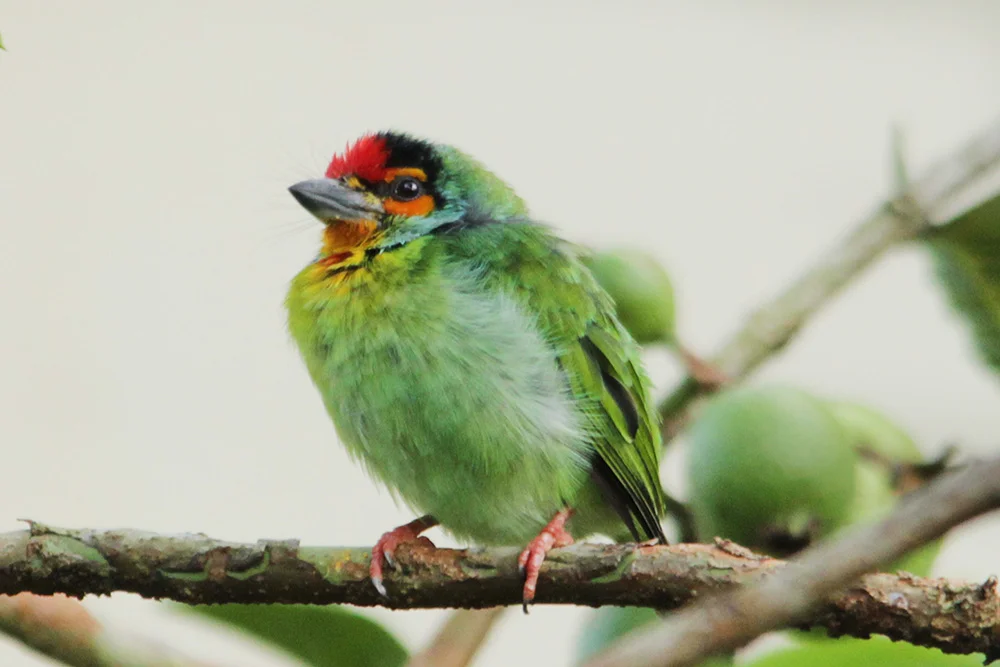
Among the featured birds, the Yellow-fronted Barbet stands as one of Sri Lanka’s most recognisable endemic species.
The bird, with its bright green plumage, yellow forehead and blue facial markings, often remains hidden among dense foliage despite its loud repetitive calls echoing through gardens and forests.
Sri Lanka Hanging Parakeet
While many people hear its calls every day, few realise its importance within ecosystems.
The species feeds heavily on fruits and berries, becoming an important seed disperser. Seeds consumed by the bird are transported and deposited elsewhere, helping natural forest regeneration.
“Many birds function as ecological engineers without people realising it,” Gamage said. “Seed-dispersing species contribute directly to maintaining forest diversity.”
Equally colourful is the Crimson-fronted Barbet.
Distinguished by its vivid crimson forehead against green plumage, this endemic bird inhabits forests and tree-rich landscapes within wetter parts of Sri Lanka.
Like the Yellow-fronted Barbet, it performs a critical ecological function through seed dispersal.
The species often serves as an indicator of healthy vegetation and suitable habitat structure. Its ability to survive in modified landscapes with sufficient tree cover also demonstrates the importance of preserving green corridors beyond forests.
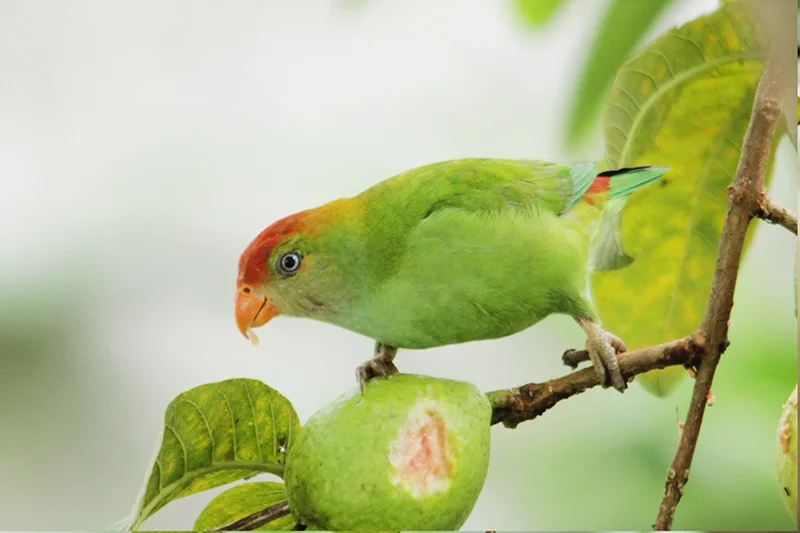
Another unique representative of Sri Lanka’s avian heritage is the Sri Lanka Hanging Parrot.

Tawny Bellied Babbler
Small, energetic and brightly coloured, the bird is famous for its unusual habit of sleeping upside down while hanging from branches.
Its striking appearance makes it popular among birdwatchers, but its ecological significance extends beyond aesthetics.
Feeding on fruits, flowers and nectar, the Hanging Parrot acts both as a pollinator and seed disperser.
As it travels among plants and trees, it assists natural reproductive processes essential for maintaining healthy ecosystems.
“Pollination and seed dispersal are among the foundations upon which ecosystems function,” Gamage explained.
Less conspicuous but equally valuable is the Tawny-bellied Babbler.
Often moving quietly through shrubs and undergrowth in pairs or small groups, the species spends much of its time searching for insects and other small invertebrates.
Unlike fruit-eating birds, the Tawny-bellied Babbler contributes to ecological balance through natural pest control.
Its feeding behaviour helps regulate insect populations, particularly within agricultural landscapes.
Birds that naturally reduce insect numbers provide ecological services that may reduce reliance on chemical pest-control methods.
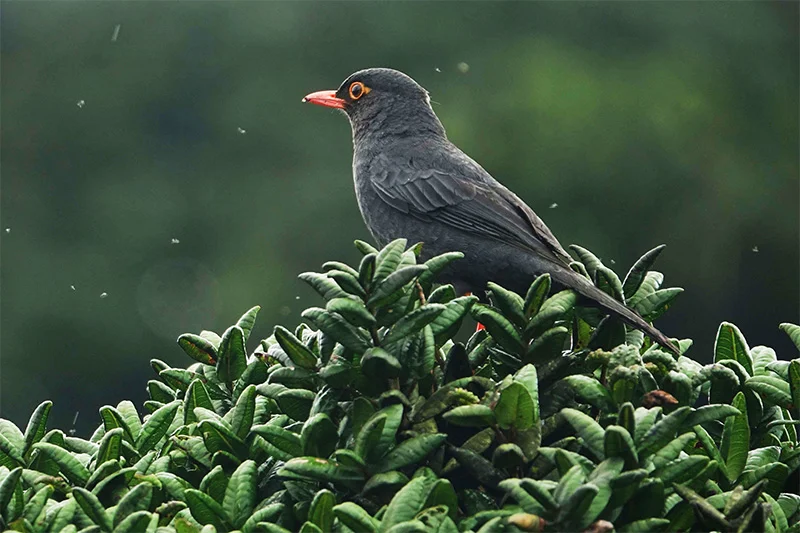
The Sri Lanka Blackbird occupies yet another important ecological niche.
Found mainly in montane forests and cooler highland environments, the species reflects environmental conditions within sensitive mountain ecosystems.
Scientists often monitor highland bird populations because changes in their distribution or numbers can indicate broader environmental changes, including habitat degradation and climate impacts.
As World Biodiversity Day approaches, experts stress that conservation challenges continue to grow.
Habitat fragmentation, pollution, deforestation and climate-related pressures increasingly threaten ecosystems around the world, including Sri Lanka.
Yet conservationists emphasise that solutions frequently begin at local levels.
Protecting trees in home gardens, restoring degraded habitats, conserving wetlands and promoting biodiversity-friendly agricultural practices can all contribute significantly to preserving ecological balance.
Gamage believes that public understanding remains central to future conservation efforts.
“People should understand that biodiversity is not separate from human life. Clean water, fertile soils, pollination, climate regulation and ecological stability all depend upon biodiversity,” he said.
The songs of Sri Lanka’s birds may appear ordinary to casual listeners, but behind those sounds lies a story millions of years in the making.
The call of a Yellow-fronted Barbet from a village garden, the bright flash of a Hanging Parrot moving across a forest edge, the quiet movements of a Tawny-bellied Babbler beneath dense vegetation, or the presence of a Blackbird in cool mountain forests are all reminders of the extraordinary natural heritage the island possesses.
As Sri Lanka marks World Biodiversity Day alongside the global community, these winged ambassadors become more than beautiful wildlife species.
They represent the fragile yet complex web of life that sustains ecosystems — and ultimately sustains humanity itself.
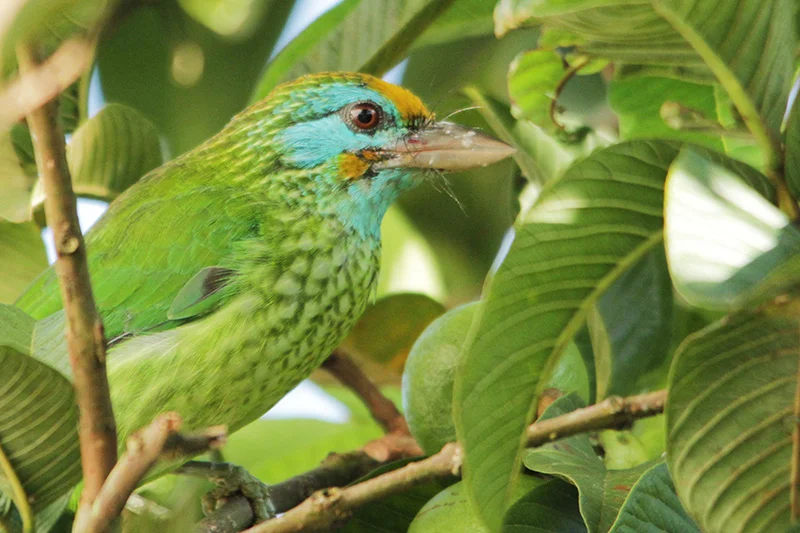
Yellow Fronted Barbet
By Ifham Nizam

Time, it is said, is the great healer. But there are some wounds that will not heal with time. They need specific and focused treatment. The dates May 18 and 19, the two final days of Sri Lanka’s three decade long war, are less in the consciousness of the people than before. But the continuation of the untreated and unhealed wounds of the war continues to be seen in the many groups of people who gather to remember their loved ones on these days. In Colombo, a group of victim families and committed activists from different communities gathered at Wellawatte beach and lit lamps. These gatherings are also a political statement that the wounds of the war remain untreated and unhealed.
One of the key features of May 18 and 19 has been the polarised positions taken by Tamil and Sinhalese groups. Tamil groups mourn those who perished in the war, especially in the last battles, on May 18 while many Sinhalese commemorate the military victory on May 19. Since 2015 there has been a diminishing of tensions due to the more nuanced way successive governments have marked the end of the war. This was especially the case during the governments led by Ranil Wickremesinghe and is now also true of the government headed by President Anura Kumara Dissanayake.
The present government has done much to mitigate the sense of polarisation between the state and the ethnic and religious minorities. The government’s insistence that it will treat all citizens equally and not support extremism in any form is appreciated by minorities who have often felt marginalised and viewed with suspicion in the past. But the government cannot afford to rest on its laurels merely because it is better than previous governments. It needs to take specific and focused action to heal the wounds of the past. Symbolic gestures and inclusive rhetoric are important, but they are not enough in themselves to deal with the consequences of a protracted ethnic conflict.
The unresolved issues are well known. They surface repeatedly in the resolutions on Sri Lanka passed at the UN Human Rights Council in Geneva. In 2015 Sri Lanka co-sponsored UN Human Rights Council Resolution 30/1 which called for reconciliation, accountability and constitutional reform including power sharing arrangements. This resolution and the ones that preceded it emerged from the demands of war affected communities and found resonance within the international human rights community. They include the issues of missing persons, disappeared persons, political prisoners, military occupation of civilian lands and accountability for alleged wartime abuses.
Most Capable
Under the NPP government, Tamil people have felt they can attend events commemorating those who died in the war in large numbers. This is evidence that the country is changing in the direction of reconciliation. State institutions too have cooperated in this process in creating a conducive climate for memorialisation. But despite the passage of 17 years since the end of the war, the emblematic issues remain unresolved although the government appears sincere in its desire to resolve them. Indeed, the government has deployed some of its most capable leaders to deal with these challenges.
President Dissanayake himself has taken on the task of reshaping public consciousness through speeches that emphasise unity rather than division. Minister of Justice and National Integration Harshana Nanayakkara has responsibility for institutions dealing with missing persons, reparations and reconciliation. Leader of the House Bimal Rathnayake has been entrusted with accelerating economic development in the north. Economic development is essential. The north and east require investment, jobs, infrastructure and opportunities for young people. Poverty and unemployment affect all communities and development can reduce feelings of exclusion. But economic development alone cannot resolve the deeper roots of ethnic conflict.
Protracted ethnic conflicts are rarely caused only by economic grievances. They are also about identity, dignity, historical memory and political power. This is where many governments in Sri Lanka have failed. They have believed that rapid development, highways, buildings and investment would be sufficient to overcome decades of mistrust. But communities that feel politically marginalized do not simply abandon their aspirations because roads are built or markets expand. Human beings seek recognition of who they are and a meaningful share in the decisions that govern their lives. Language is particularly important. In Tamil majority districts, the government secretariats continue to be staffed by those who are only Sinhala-speaking. This is a constant reminder to Tamil speakers that they are not equal to Sinhalese in their dealings with the state.
Academic research on divided societies has shown that constitutional arrangements can either exacerbate conflict or reduce it. Countries such as Belgium and Northern Ireland provide examples where systems of power sharing have enabled communities with different identities to coexist peacefully within a common state. In Northern Ireland, peace became sustainable only when political institutions ensured that both communities had a guaranteed role in governance rather than leaving one side permanently subordinate to the other. Sri Lanka’s own efforts at political reform have focused largely on territorial power sharing through the 13th Amendment to the Constitution and the provincial council system.
More Belonging
The fact that the government leadership is now saying that provincial council elections will be held this year is therefore a positive development. It would restore democratic participation at the provincial level after years of delay and neglect. However, reforms need to go further. Provincial councils have remained weak institutions with inadequate powers and finances. Successive governments have hesitated to fully implement the provisions of the 13th Amendment, especially regarding land and police powers. These laws, including the language law, need to be fully implemented. The reluctance or incapacity of successive governments to do so, including the present one, has reinforced minority perceptions that promises of devolution are made but never sincerely implemented.
A new national narrative for Sri Lanka must therefore go beyond non racism and economic development. True reconciliation requires accepting diversity not as a threat but as the foundation of a united and peaceful country. Power sharing should not be viewed as a concession extracted under pressure. It should be understood as a democratic necessity in a plural society. The purpose of power sharing and giving equal rights to Tamil language speakers is not division but inclusion. It gives all communities a stake in the state and reduces the fear that political power will permanently remain in the hands of one community alone.
Sri Lanka has had leaders in the past who understood this reality. Prime Minister S W R D Bandaranaike attempted to reach a political settlement through the Bandaranaike Chelvanayakam Pact of 1957. Today the political context offers another opportunity. The nationalist forces that dominated politics for many years have lost credibility due to their association with corruption, economic collapse and political mismanagement. But where they did the right thing they are remembered positively as the late State Minister of Plantation Industries and Mahaweli Development in Sri Lanka Lohan Ratwatte still is in Batticaloa for having heeded the Tamil cattle farmers and appointing a Tamil officer to deal with their problems. The government has a two thirds majority in Parliament and enjoys significant public goodwill. This creates space for courageous leadership.
The time has therefore come for the government, opposition and minority political parties to put aside their bitter political feuds and engage with each other sincerely to arrive at a consensual political solution embedded within the Constitution. Sri Lanka has tried military victory, centralized rule and development centred approaches. None by themselves have resolved the ethnic conflict. The lesson of the past is that non racism and economic development are necessary, but they are not sufficient. Lasting peace in Sri Lanka requires power sharing, trust building and a political settlement that gives every community a sense of belonging to a country they all feel is home.
by Jehan Perera
Reform of the Anti-Corruption Act – Part II
When Sri Lanka gained Independence, the only anti-corruption legislation in force consisted of Sections 158, 159 and 160 of Chapter IX of the Penal Code, which dealt with public servants accepting or soliciting gratification for doing or forbearing to do any official act, or showing favour to any person, etc. Since these provisions were considered inadequate, the Bribery Act was promulgated in 1954. An amendment to the Bribery Act (No. 40) of 1958 created the office of the Bribery Commissioner.
The accumulation of unexplained wealth was also brought within the ambit of the Bribery Act. Where a person holding public office acquired property or money which could not have been part of his known income or receipts, the presumption was that such money and property had been acquired through the proceeds of bribery. Until 1994, once the Bribery Commissioner’s Department investigated an allegation of bribery against any person and was satisfied that there was a prima facie case, the matter would have to be referred to the Attorney General for prosecution.
1994: the pivotal year
In 1994, the new government that came into power introduced the Commission to Investigate Allegations of Bribery or Corruption Act No. 19, of 1994, which created a Commission that could investigate allegations of bribery or corruption and also institute prosecutions without having to refer the matter to the Attorney General’s Department. The government of 1994 also brought an amendment (Act, No. 20 of 1994), which introduced a new Section 70 to the Bribery Act which made ‘causing a loss to the government’ an offence amounting to corruption, even if there is no evidence of bribe taking or unlawful enrichment by the person concerned.
From the time this Section 70 was enacted in 1994, it attracted the attention of legal experts even before any prosecutions had been instituted under its provisions. In 1999, President’s Counsel (later Justice) Saleem Marsoof writing to the journal of Financial Crime raised questions about the impact Section 70 of the Bribery Act would have on the exercise of the discretionary power held by public servants. Taking the example of the power granted to the Collector of Customs under the Customs Ordinance to reduce the duty imposed on an excisable article if he was of the opinion that the duty was excessive, Justice Marsoof asked whether the exercise of that discretionary power could lead to prosecution under Section 70.
Indeed, the wording of Section 70 left public servants seriously exposed. Section 70 referred to a ‘wrongful’ or ‘unlawful’ loss to the government which implied that some losses to the government could be lawful and correct. However, there was no way proposed to distinguish one from the other. The problem with Section 70 was that it sought to place in a straitjacket an aspect of public administration and governance which could not be dealt with in that manner.
It was after the Yahapalana government came into power, in 2015, that Section 70 of the Bribery Act really came into its own. In January 2018, the Yahapalana cabinet decided to amend Section 70 so as to empower the Commission to Investigate Allegations of Bribery or Corruption to institute prosecutions under Section 70 not only in the Magistrate’s Courts but in the High Courts as well. An amendment to the Bribery Act (No. 22 of 2018) was passed by the Yahapalana government for this purpose.
At the height of this Section 70 prosecutions blitz under the Yahapalana government, another legal heavyweight President’s Counsel M. M. Zuhair wrote to The Island about a case, where Section 70 had been applied to a former Attorney General (no less!). He wrote:
“…Opinions and decisions are required to be taken regularly by the Executive, headed by the President, by Ministers, by the Cabinet and by the Courts. These decisions are often taken both with and without reference to any person benefiting from such decisions.
“To interpret or allege such decisions as wrongful or unlawful particularly after the holders of such office had ceased to hold the office… could become a common occurrence that could lead to abuse of section 70 for personal or political purposes. Public servants would be unwilling to take decisions and governance could ground to a virtual halt, adversely affecting the people …”
Under Section 70, government officials, whether it be the Director General of the Customs Department, the Attorney General or arguably even members of the judiciary, were exposed to the possibility of prosecution. The Bribery Act of 1954 was repealed by the Anti-Corruption Act, No. 9 of 2023, but the old Section 70 continues to exist in the Anti-Corruption Act of 2023 in the form of Section 111. Hence this issue is still very much alive. What makes things worse is that Section 161 of the Anti-Corruption Act of 2023 says that “Where the provisions of this Act are in conflict or are inconsistent with any other written law, the provisions of this Act shall prevail.”
The Indian solution
Undoubtedly, public servants have infinite opportunities to accept bribes or to show favour to selected parties. However, this discretionary power has been granted to public servants to facilitate the smooth functioning of the government. Without such discretionary power, governance will become impossible. Obviously, some middle ground will have to be found or we may see the entire country grinding to a halt. Bribery and corruption are issues that afflict all of mankind. Our neighbour India appears to have a workable system in place to deal with such issues without paralysing the entire system of governance.
According to the Indian Prevention of Corruption Act of 1988, the authority that investigates allegations of bribery or corruption is the police. Only police officers, above a certain rank, can investigate any offence related to bribery and corruption without the order of a Magistrate or make arrests without a warrant. Under Section 19 of the Indian Prevention of Corruption Act, no bribery or corruption prosecution can be instituted in a court of law against a public servant without the sanction of the Indian central government or a state government as the case may be.
According to Section 17A of the Indian Prevention of Corruption Act when it comes to the investigation of offences relating to recommendations made or decisions taken by public servants in the discharge of their official functions or duties, no police officer can even conduct an inquiry into such matters without the prior approval of the Indian central government, or a state government as the case may be.
The Indian Central Vigilance Commission Act was passed in 2003 to establish a Central Vigilance Commission (CVC) to inquire into offences under the Prevention of Corruption Act of 1988 committed by certain categories of public servants of the Central Government.
In conducting such inquiries, the Indian Central Vigilance Commission can among other things, issue summons, examine any person under oath; require the production of any document; requisition any public record from any court or office etc.
However, under Section 8(1)(c) of the Act of 2003 the Central Vigilance Commission cannot even begin such an inquiry unless a reference has been made by the Central Government requesting the Commission to do so. Under Section 26 of the Central Vigilance Commission Act of 2003 the police cannot conduct any inquiry into any offence under the Prevention of Corruption Act of 1988 alleged to have been committed by certain categories of employees without the prior approval of the Central Government.
The Indian anti-corruption laws have provisions to prosecute wrongdoers for actually taking bribes or for possessing unexplained wealth. The above -mentioned safeguards have been put in place to shield public servants who make bona fide decisions in the discharge of their duties. India has an institutionally strong public service which will not necessarily get swept off their feet by temporary political waves. There is a much stronger institutional consciousness within the Indian public service than in the public service in Sri Lanka.
Indeed, even the Indian political establishment behaves very differently to that of Sri Lanka when it comes to safeguarding the sovereignty and the national interest of that country. In 2010, when a Congress Party government moved to toughen the Indian Foreign Contributions Regulatory Act, the Parliamentary Committee that examined the reforms was headed by the BJP Leader of the Opposition Sushma Swaraj. Due to such conditions that prevail in India, the safeguards for public servants provided for in the Indian Prevention of Corruption Act of 1988 and the Central Vigilance Commission Act of 2003 would suffice to shield public servants from unfair inquisitions, arrest and prosecution and to keep the business of government running smoothly.
(To be continued tomorrow)
by A Special Correspondent
(Continued from yesterday)

At least 100 dead in Ebola outbreak in DR Congo, official says

Trump says he called off new Iran attack at request of Gulf states

Lanka Premier League returns after two years, opener set for July 17

Cummins, Kishan, Klaasen power Sunrisers Hyderabad into playoffs; Chennai Super Kings not out yet

Mushfiqur ton, Litton and Joy fifties set Pakistan 437

Showers will occur at times in the Western, Sabaragamuwa, Central, North-western, Northern and Southern provinces and in Anuradhapura district

‘Dates have the highest sugar content to fight Coronavirus’

Sunday Island 27 December – Headlines

#SundayIsland 17th December – Headlines

Sunday Island – 28th March

Sunday Island Headlines – 21 March

Sunday Island – 21st February – Headlines
-
 News6 days ago
Ex-SriLankan CEO’s death: Controversy surrounds execution of bail bond
-

 Features2 days ago
Sri Lankan Airlines Airbus Scandal and the Death of Kapila Chandrasena and my Brother Rajeewa
-
 News3 days ago
Lanka’s eligibility to draw next IMF tranche of USD 700 mn hinges on ‘restoration of cost-recovery pricing for electricity and fuel’
-
 Midweek Review6 days ago
A victory that can never be forgotten
-

 News2 days ago
Kapila Chandrasena case: GN phone records under court scrutiny
-

 Opinion5 days ago
Electricity tariffs have skyrocketed: Can further increases be prevented?
-
 Features4 days ago
Mysterious Death of United Nations Secretary General Hammarskjöld
-

 News2 days ago
Rupee slide rekindles 2022 crisis fears as inflation risks mount