
Business
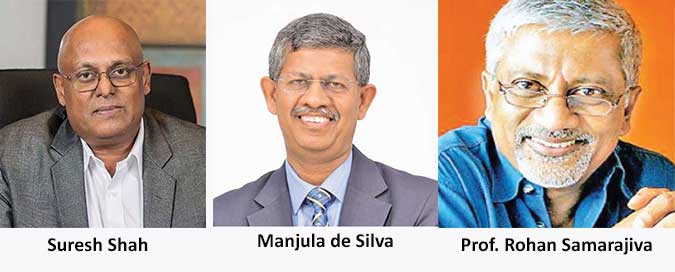
Human capital and natural resources are the real assets of Sri Lanka, not its SOEs: Suresh Shah

-
Dividends paid to government by SOEs including State Banks is a mere 0.5% of state revenue
-
Privatisation is a sensitive call undertaken in the interest of 22 million people
-
Restructuring crucial public entities more difficult than privatising SOEs
-
Finalising transaction advisors for entities identified for privatisation underway
-
Says government monopolies will not be converted into private sector monopolies
By Sanath Nanayakkare
Suresh Shah, Head of State Owned Enterprises (SOE) Restructuring Unit of the Ministry of Finance said last week that Sri Lanka’s true national assets are in its human capital and natural resources, so it needs to be correctly understood that state-owned enterprises are not the real national assets.
He made this remark while addressing a webinar on “Charting a New Course: Expert Perspectives on Restructuring State-Owned Enterprises” – which had been organised by the Centre for Banking Studies of the Central Bank of Sri Lanka.
His keynote speech also made the revelation that despite the fact some government entities are profitable, figures show that as an average over the past 10 years, the total dividend payout made to the government by all profitable SOEs including the State Banks had been a mere 0.5% of the total revenue of the government.
“None of these SOEs are national assets. National assets are elsewhere. Our true national assets are in our human capital, youth talent and natural capital such as rivers, forests and our ocean. We need to harness the potential of those national assets if we are to build the country we want,” he noted.
Further speaking he said:
“SOE restructuring goes much beyond privatising than many people would think. The real objective of the restructuring process is to provide improved products and services to the citizens of the country at the right price when and where they want them. SOE restructuring is all about enabling those elements within a competitive economic framework than at any given time. In other words, it is about providing the citizens with quality products and services at better prices with widespread availability. In this process, there will be some institutions that will be privatized and there will be some that will remain within government. The fundamental question in this context is how we are going to carry out this sensitive call.
The exercise will be about how the end-consumer would benefit as a result of it. Would the consumer be better served by privatizing a certain SOE or would it be better to leave it unchanged from government control? How does one make the decision? Many people talk about profit-making entities and loss-making entities but that’s not the way in which this decision should be made. The real decision should be made on whether there is a market failure or not. A market failure happens when goods and services are provided to consumers, but the provision of those goods and services don’t actually take place in a competitive environment favourable to the consumer.
It could be that there is a monopoly supplier at play or there are a few cohorts because of whom consumers don’t receive a fair and decent deal in terms of quality, price and availability. Ideally the government needs to look at the regulatory framework to ensure that citizens have unhindered access to essential services they need rather than non-essential goods and services. The government doesn’t necessarily have to be in business to deal with market failure because it can do so with regulatory mechanisms and thus ensure proper operation in the market and safeguard the consumer.”
“The opinion that is doing the round is; loss-making SOEs need to be privatised and profit-making SOEs need to remain unchanged in government control. This is a fallacy surrounded by misinformation. Something that a lot of people tend to forget is that the profit an SOE makes doesn’t belong to the shareholder, in this case the government. What come to the shareholder are the dividends and not the profits. The profits remain within that company. So if a 100% government-owned entity makes a profit of Rs. one billion and declares a dividend of Rs. 100 million, the Rs. 900 million will remain with that entity and the government would get only Rs. 100 million.
If you look at the past 10-years, the average of the dividends declared by all SOEs to the government, as a component of the government’s total revenue works out to about 0.5%. And this includes the dividends that have been declared by the State Banks as well. So what the government gets in cash flow terms from profit-making SOEs is a very, very small component of its total revenue.”
” If we divest a listed government entity at the market price (without a premium) and you invest the proceeds of that in fixed deposits, the chances are that fixed deposit interest you will earn from those proceeds would be about 4 to 5 times the dividends that entity would declare in any given year. So if you look at it from a purely cash flow terms, it makes sense to divest these entities”.
“Another point to remember is the government collects taxes from private and public entities; 15% of a company’s revenue as VAT, 2.5% as social security levy and 30% on its profit as income tax comes to the government. In addition, a public sector entity will provide the government with dividends. When you move these entities into the private sector, they will increase their productivity and efficiency. What you lose from the dividend component, you will be more than compensated through taxation. So from a purely cash flow point of view, this story about profit-making entities and loss-making entities simply doesn’t hold water. And the biggest danger in making the case for profit -making enterprises and loss-making enterprises is that we are pushing the government to focus on profit.
When that happens it tends to ignore its fundamental responsibility of providing services to the citizens. You can’t have a profitable police department or national education system or healthcare system. So, getting the government to focus on profit is extremely dangerous because it has it obligations to the general public. Profit should be the purview of the private sector. This is why we need to move certain SOEs to the private sector and retain critical public services in government control. When non-critical SOEs are privatised, the government will have the taxation system at its disposal to raise enough revenue to provide critical public services on its own account.”
“We need to have a proper system to manage those entities unchanged from the government control. This will be more difficult than privatizing other SOEs.”
“SOEs have failed mainly because we have parked the losses that came from politically-driven subsidies within these SOEs. Such subsidies must be taken on the government’s balance sheet rather than the balance sheet of the entity through which the subsidies are provided. Cases in point are the CEB and CPC where subsidies were given on electricity and fuel respectively. As a result of that, those entities had poor balance sheets and when it came to a crunch, we faced fuel shortages and power cuts. And very recently we had dramatic increases in energy prices.
So we need to have a system where we don’t park subsidies within these entities. SOEs have also failed because of poor management system. We need to appoint fit and proper people to their boards. And also we created jobs in SOEs that were not really there and made them overstaffed. Further, government management procedures are cumbersome, unproductive and take a long time whereas the private sector can make decisions more much more efficiently than the government. The restructuring process will carefully take all these into account in order to make SOEs commercially-oriented ventures.”
Suresh Shah emphasized that he is aware that his unit is dealing with the interests of 22 million people who are stakeholders of these entities and he and his team would do the job in a very responsible and transparent manner.
“At present we are shortlisting or trying to finalize transaction advisors for entities that have been identified for privatization. Once that is done, once the advisors are appointed then they will help us with the due diligence and with valuations. They will help us create data rooms for review of potential investors. And then we will open up the EOI and RFP process once again to invite bids from anyone who is interested in making a proposal for any one of these entities.”
He asserted that his unit would try its best to ensure that in the process of restructuring, government monopolies would not be turned into private sector monopolies.
Manjula de Silva, Former Secretary General and CEO of the Ceylon Chamber of Commerce said,” Privatization is not the only option. In some cases, you would want to keep the state entities going but open the market for other players by liberalizing it. I think that is what is happening in the petroleum distribution sector. What is important is creating a level playing field for everyone. For example, the Petroleum Ministry is setting policy for the petroleum industry while operating CPC. So we need to separate policy making, regulating and commercial operations to ensure that the market environment is fair for everyone.”
Prof. Rohan Samarajiva, Chairperson of LIRNEasia who has been a longtime proponent of SOE restructuring and privatization said,” I have been advocating this for many years on my own account for my own purposes. For one thing, I want a better country for my grandchildren to live in. So, getting the entire purpose of this privatization exercise effectively communicated to the general public is vital. We have got to let the people know that by doing this good things can happen for the benefit of every one. A case in point is Lanka Hospitals Plc. Who would have thought the government would get into the health sector as a private player? It just happened because Lanka Hospitals fell in the lap of the government accidentally. If we can spread the success story of that chance-happening and its positive results across the society, I think that would be a wonderful start in our communication journey.”
Dhananath Fernando, Chief Executive Officer of Advocata Institute moderated the webinar.








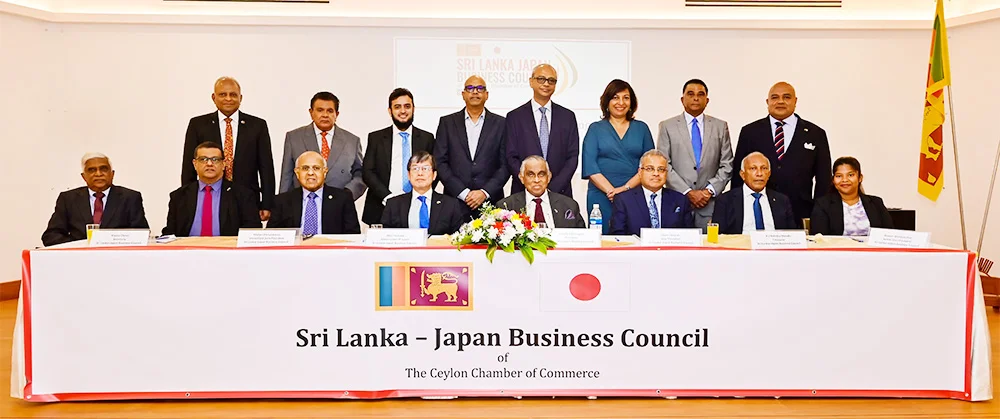
Japan Business Council (SLJBC) of The Ceylon Chamber of Commerce recently held its 47th AGM, with the Ambassador of Japan and the Patron of the Council, Akio ISOMATA, attending as the Chief Guest.
Addressing the gathering, Ambassador ISOMATA outlined three priorities for deepening bilateral economic relations: an effective and forward-looking trade and investment policy, the promotion of domestic industrial policy, and expanded investment in renewable energy. He noted that Sri Lanka’s ongoing review of its Free Trade Agreement policy would be important in shaping the country’s future negotiating landscape. He encouraged Sri Lanka to look Eastward toward Southeast Asia and Japan, proposing that the country adopt an export-oriented industrial model. The Ambassador welcomed the Government’s National Export Development Plan 2026 and National Mineral Policy 2026 as consistent with Japan’s vision of connecting Sri Lanka’s export-related manufacturing sectors with India’s high-growth manufacturing base.
In his address, President Athulla R F Edirisinghe reflected on nearly seven decades of humanitarian and development support extended by Japan to Sri Lanka, and paid tribute to the Chairman of the Sasakawa Peace Foundation Yohei Sasakawa, for his magnanimity in establishing the Foundation. Reflecting on the history of Japanese investment in the region from the 1970s onward, he observed that Sri Lanka had missed many opportunities to attract Japanese foreign direct investment. Highlighting the 2025 proposal for a Sri Lanka – Japan Economic Corridor by the Ministry of Economy, Trade, and Industry Japan, he called on Sri Lankan businesses, industry associations, and the wider community to come together in dialogue with the Government to ensure the country does not miss this opportunity as well.
2026/27 Committee: President: Athulla R F Edirisinghe – Director, Hirohama Ceylon (Pvt) Ltd, Senior Vice President – Ruwan Waidyaratne – Managing Director, Hayleys Advantis Ltd, Vice – President – Shamil Mendis – Managing Director, Spear International (Pvt) Ltd, Treasurer – Rohitha Mendis – Managing Director of Prudential Shipping Lines (Pte) Ltd, Immediate Past President – Mahen Kariyawasan – Managing Director, Andrew The Travel Company (Pvt) Ltd, representatives from Amano Lanka Engineering (Pvt) Ltd, BOV Capital (Pvt) Ltd, Brandix Apparel (Pvt) Ltd, Heritage Teas (Pvt) Ltd, Kalhari Enterprises (Pvt) Ltd, Lanka Harness (Pvt) Ltd, Dentsu Grant (Pvt) Ltd, MAC Holdings (Pvt) Ltd, and Vidullanka PLC. By invitation: HVA Foods PLC (subsidiary of George Steuart & Co), Spillburg Holdings (Pvt) Ltd, and Vaughan Chemicals (Pvt) Ltd.
The Sri Lanka – Japan Business Council plays an important role in promoting trade, tourism, and investments between Japan and Sri Lanka. For membership inquiries contact Kiyara at The Ceylon Chamber of Commerce via E-mail: businesscouncils1@chamber.lk or Tel.: 011 5588875/ 5588800.
By Ifham Nizam
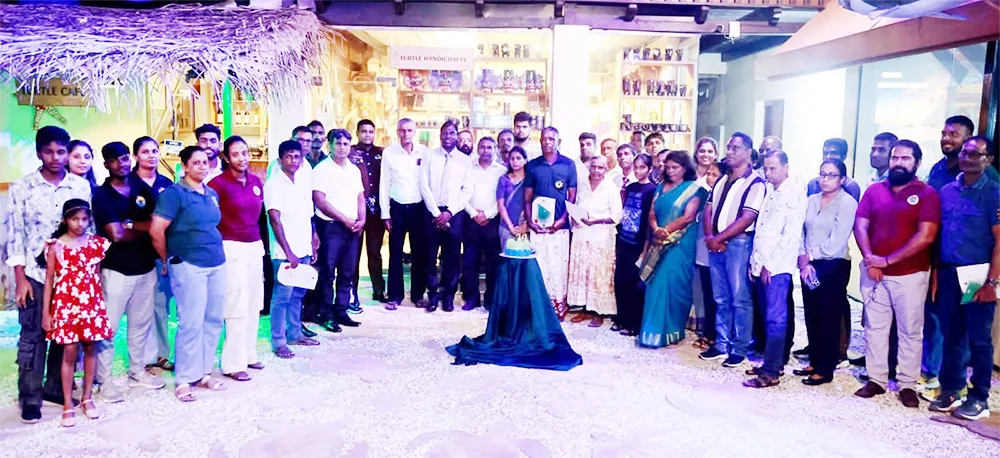
What started 30 years ago as an effort to protect sea turtles has evolved into a community-based economic model that has generated livelihoods, attracted tourists and transformed Rekawa into one of Sri Lanka’s best-known nature tourism destinations.
The Rekawa Turtle Conservation Project, launched on September 2, 1996, by the Turtle Conservation Project (TCP) in partnership with the Department of Wildlife Conservation and the Rekawa community, marked its 30th anniversary last week, demonstrating how biodiversity protection can become an economic opportunity for communities living alongside sensitive natural resources.
Speaking at the anniversary celebrations, TCP chairman Thushan Kapurusinghe said the project currently provides direct livelihoods for 28 people, but its economic impact extends considerably beyond those directly employed by the programme.
‘Today, 28 people directly earn their livelihood through this project. But its impact goes far beyond those 28 individuals, Kapurusinghe said.
He pointed to the transformation of the area over the past three decades, arguing that the growth of tourism in the community has been closely linked to the turtle conservation programme.
‘If you travel from Netolpitiya to this area, you can clearly see how much the village has transformed over the years. There is no doubt that the growth of tourism in this community has been driven by the Turtle Conservation Project, he said.
The economic significance of Rekawa lies in its ability to convert the protection of a natural asset into a source of recurring community income.
Tourists do not come to Rekawa merely to see a beach. They come to witness sea turtles emerging from the ocean and nesting in their natural habitat—a tourism experience that depends directly on the continued protection of the nesting beach.
Kapurusinghe said tour operators regularly bring visitors to Rekawa, with some tourists traveling there after visiting major attractions such as the Kandy Esala Perahera.
The model represents a fundamental shift from viewing conservation as an expense to recognising biodiversity as an economic asset that can generate sustainable livelihoods when properly managed.
The 30th anniversary celebration at the Rekawa Turtle Conservation Project Information Centre brought together Southern Wildlife Region Director of the Department of Wildlife Conservation Channa Suraweera, government officials, conservation organisations, community representatives and long-standing supporters of the initiative.
Individuals who had contributed to the project over the past three decades were also recognised with awards for their service to sea turtle and environmental conservation.
Rekawa’s experience has attracted international attention because of precisely this combination of conservation and community development. The project has received international recognition as well as the Green Employment Award from the Ministry of Environment and Natural Resources. Earlier international recognition included a highly commended ‘Tourism for Tomorrow’ award, while the project’s turtle-watch programme subsequently received further recognition in responsible tourism and conservation.
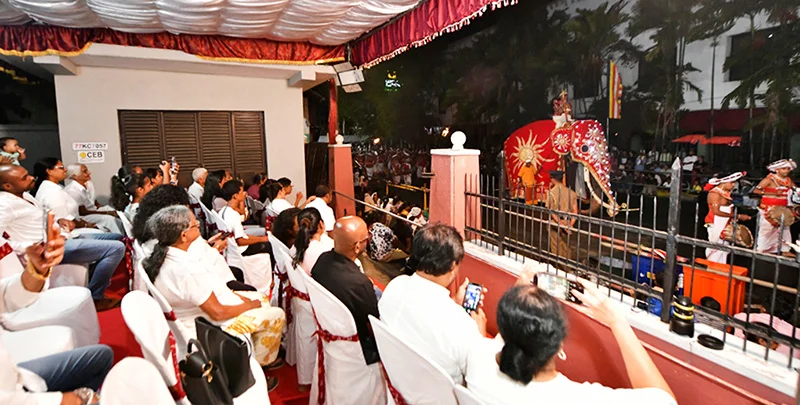
For an evening, the timeless spectacle of the Kandy Esala Perahera unfolded at especially close quarters for a select group of Ceylinco Life’s most valued policyholders and their families, who were hosted to an exclusive viewing experience by the Company’s Customer Relations Division.
Held at the Ceylinco Life Kandy Branch on Kings Street, the annual event coincided with the second Randoli Perahera, bringing guests into the heart of one of Sri Lanka’s most spectacular expressions of culture, tradition and pageantry.
As the procession made its majestic passage through the streets of Kandy, guests enjoyed VIP seating at a prime vantage point, allowing them to experience the colour, movement and grandeur of the Perahera up close. The evening offered a fitting setting for Ceylinco Life to celebrate its enduring relationships with its premium clientele.
The experience extended well beyond the spectacle outside. Guests were welcomed with evening refreshments and an exclusive dinner buffet presented by the prestigious Amaya Hills Resort, adding a fine-dining dimension to an already memorable evening.
Families, too, were at the centre of the occasion. A private movie theatre experience provided entertainment for children and adults alike, while each attending family received a beautifully framed family photograph as a personalised souvenir, a tangible reminder of an evening shared together against the backdrop of one of Sri Lanka’s most treasured cultural traditions.
Besides being a much sought-after opportunity to watch the Perahera, the occasion was an expression of appreciation. Through its continuing Customer Relationship Management activities, Ceylinco Life seeks to create experiences that recognise its most valued policyholders not simply as customers, but as relationships to be celebrated and nurtured. And on this particular August evening, the enduring splendour of the Kandy Perahera provided the perfect setting for doing just that.

Showers will occur in the Western and Sabaragamuwa provinces and in Galle and Matara districts

Justice Minister hits back at CLA

First visit by an Indian Defence Minister since IPKF deployment

“I’m not a war criminal, I fought for my country”: Shavendra Silva

Govt. tells UN 22nd Amendment meant to strengthen judicial independence

Legacy of enforced disappearances: Vital facts conveniently forgotten to whitewash LTTE and India

‘Dates have the highest sugar content to fight Coronavirus’

Sunday Island 27 December – Headlines

#SundayIsland 17th December – Headlines

Sunday Island – 28th March

Sunday Island Headlines – 21 March

Sunday Island – 21st February – Headlines
-

 News6 days ago
Denied of promotion to SC despite vacancies, justice Gurusinghe retires
-

 Latest News7 days ago
Grade 5 scholarship exam results released
-

 News6 days ago
22A: SC urged to suspend hearing, appoint full bench
-

 News4 days ago
Namal remanded until Sept. 18 over Airbus deal investigation
-

 Latest News3 days ago
Tharanga creates history with Diamond League crown in Brussels
-
 News6 days ago
Govt. seeks NATO assistance
-

 Editorial6 days ago
Strange arithmetic goes unchallenged
-

 News3 days ago
Dispute which triggered listed company director being detained at BIA resolved