
Business
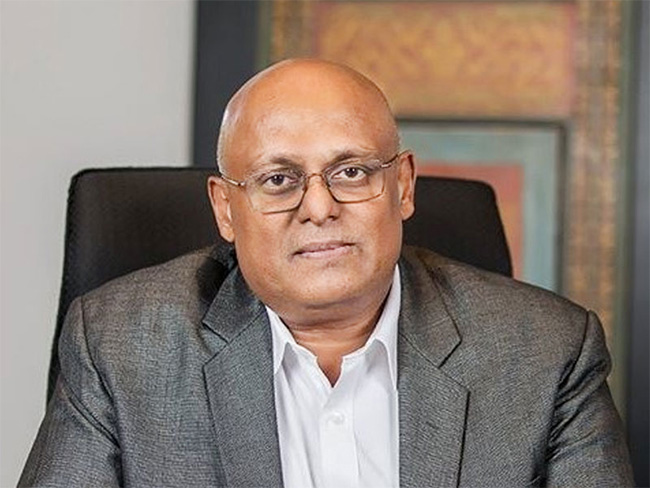
Restructured SOEs to be converted into limited liability companies – Suresh Shah

By Hiran H.Senewiratne
A new legislature would be in place by the middle of this year to restructure 130 State Owned Enterprises (SOE), which would not accommodate any political appointments to their Boards because they will be converted into limited liability companies, Head, State-Owned Enterprises Restructuring Unit (SOERU), Suresh Shah said.
‘At present, out of 130 SOEs in the country, 17 are non- operational but the Boards of directors are still functioning in them. In respect of 85 entities, state intervention is not necessary. These would need to be sold but with regard to the balance; government intervention is needed, Shah said.
Shah made these observations at a recent seminar titled, “Enhancing Efficiency of State Owned Enterprises”, organized by the Organization of Professional Associations of Sri Lanka (OPA). It was attended by a large number of professionals.
Shah said that enhancing efficiency of state owned enterprises is immensely important considering the country’s current economic situation and added that Sri Lanka Telecom, CPC and CEB should be definitely privatized for the betterment of the people of the country.
Shah added: ‘CPC, Sri Lanka Telecom and CEB get guarantees from the Treasury and raise loans from state banks. When those loans cannot be settled, the state banks’ balance sheets are at stake.
‘Therefore, Sri Lanka Telecom and some major parts of the CEB should be privatized to enhance the services being provided to the people of the country. Even CPC should be privatized for the sake of the people who need a better service.
‘SOE entities will be restructured based on nine principles. All appointments to Boards must be done through the Constitutional Council. Politicians should not get involved in appointments.
‘Approximately 85 institutions were identified as being suitable for divestment. Among the challenges that had been identified by the SOE Restructuring Unit were; subsidies, the appointment of unsuitable directors, overstaffing, and circular debt.
‘Consequently, the Unit had come up with a number of recommendations that included, divestment of loss-making or non-strategic SOEs, bringing all such enterprises under the Finance Ministry, while making them limited liability companies.
‘The importance of not “parking” subsidies with state banks should be emphasized. The government should create a better environment to attract investors to the country. Singapore is a fine example of this.
‘Divestiture guidelines would be crafted by the Unit with experts’ ideas and once divested, these entities would be holding companies and profits would be divided as dividends among the owners of the entity, as in listed companies.’
Secretary to the Treasury and the Ministry of Finance Mahinda Siriwardena highlighted that state owned enterprises have both positive and negative impacts on the economy. ‘The government was also implementing institutional reforms to improve the balance sheets of these enterprises. Another key reform was bringing all SOEs under the control of a holding company, he said.
Siriwardana also noted that strict regulations would be brought regarding the appointment of directors. He said reducing the losses in some SOEs is the priority of the government and strict regulations will be brought in future when appointing directors, chairmen etc.




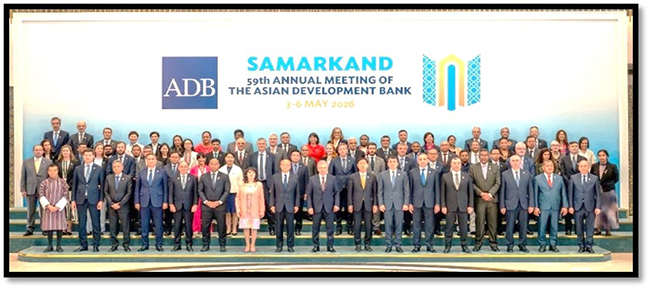
In the ancient Silk Road city of Samarkand, where merchants once connected civilisations through trade and ideas, a new conversation unfolded from 3–6 May at the 59th Annual Meetings of the Asian Development Bank.Political leaders, central bank governors, investors, innovators and development partners gathered under a compelling theme: “Crossroads of Progress: Advancing the Region’s Connected Future.”
The message resonating across the forum was unmistakable. Asia and the Pacific are entering a decisive decade in which connectivity, technology and regional cooperation will shape economic power and social resilience. Supply chains are being redesigned. Artificial intelligence is transforming productivity. Energy systems are becoming increasingly interconnected. Financing models are evolving to accommodate climate pressures and development needs. Countries that move quickly and cohesively are likely to benefit from this transformation. Those trapped in internal fragmentation risk falling behind.
The Annual Meetings demonstrated that the future envisioned by the ADB is no longer theoretical. Across the region, governments are already repositioning themselves to participate in a more integrated Asian economy. Discussions focused heavily on cross-border infrastructure, digital innovation, energy interconnection, sustainable finance and regional policy harmonisation.
One recurring theme was that “integration is power.” In an era marked by geopolitical uncertainty and economic disruption, regional cooperation is increasingly viewed as the foundation of resilience. From trade corridors and logistics systems to energy-sharing mechanisms such as the ASEAN Power Grid, policymakers emphasised that countries can no longer afford to operate in isolation.
The conversations in Samarkand also reflected how development itself is being redefined. Data, digital infrastructure and artificial intelligence are becoming as important as roads, ports and airports. Governments across Asia are already deploying AI-enabled public services, fintech systems, smart agriculture and real-time disaster response technologies to improve efficiency and social inclusion.
Equally important was the recognition that public financing alone will not be enough to meet the region’s ambitions. The ADB repeatedly stressed the need for innovative financing mechanisms capable of mobilising private capital while strengthening domestic fiscal systems. Climate adaptation, energy transition and infrastructure expansion will require development finance that is scalable, catalytic and capable of attracting long-term investor confidence.
For Sri Lanka, the discussions carried particular significance.
Having emerged from one of the gravest economic crises in its post-independence history, Sri Lanka today stands at a delicate juncture. The country possesses many of the advantages needed to participate meaningfully in Asia’s next growth phase: strategic geographic positioning, human capital, maritime access and longstanding relationships with multilateral institutions such as the ADB. Yet the gap between potential and preparedness remains considerable.
While many Asian economies appear to have moved toward greater institutional maturity and long-term policy coordination, Sri Lanka continues to wrestle with recurring political instability, governance concerns, debt restructuring pressures and inconsistencies in economic policymaking. Questions surrounding legal processes, public sector reforms and policy continuity continue to affect investor confidence and national coherence.
The challenge facing Sri Lanka is therefore not merely economic. It is fundamentally institutional and political.
The larger Asian story unfolding in Samarkand was one of countries aligning national purpose with regional opportunity. Whether through digital transformation, energy integration or climate financing, many nations appear increasingly focused on continuity, coordination and long-term execution. Sri Lanka, by contrast, still appears engaged in resolving foundational questions about governance, accountability and economic direction.
This does not diminish the country’s prospects. Rather, it highlights the urgency of reform and policy harmonisation if Sri Lanka is to become a meaningful participant in the region’s connected future.
The ADB’s vision for Asia is ultimately centered on resilience through cooperation. It is a vision in which countries strengthen themselves not in isolation, but through deeper engagement with regional systems of trade, finance, energy and technology. For Sri Lanka, this presents both an opportunity and a warning.
The opportunity lies in leveraging multilateral partnerships, embracing digital modernisation, strengthening institutional credibility and integrating more deeply into emerging regional networks. The warning is that Asia’s transformation is accelerating. Countries unable to build stable governance structures and coherent development strategies may struggle to capture its benefits.
Samarkand itself offered a symbolic reminder of this reality. Historically, it flourished because it connected worlds. Today, Asia is once again building new networks of connection – digital, financial, infrastructural and geopolitical.
The question confronting Sri Lanka is whether it can align its political will and economic resilience quickly enough to travel alongside the region’s next decade of growth rather than watch it from the margins.
By Sanath Nanayakkare
Business
CBSL and Australia’s S4IE programme partner to advance digital financial literacy for MSMEs


The Central Bank of Sri Lanka (CBSL) has entered into a Memorandum of Understanding (MoU) with Australia’s Skills for an Inclusive Economy (S4IE) programme to launch a pilot initiative aimed at enhancing digital financial literacy among micro, small, and medium enterprises (MSMEs). Recognised as a vital engine of Sri Lanka’s economic recovery and inclusive development, MSMEs stand to benefit from targeted interventions designed to improve access to finance, strengthen institutional coordination, and foster a more supportive enabling environment.
The pilot will test evidence-based approaches, the outcomes of which will inform future policy design and programming. CBSL intends to scale successful measures in collaboration with national and international partners.
Commenting on the partnership, Dr. P. Nandalal Weerasinghe, Governor of the Central Bank of Sri Lanka, stated: “This initiative reflects CBSL’s dedication to practical, evidence-based solutions. The pilot enables us to test and refine methodologies that can be expanded over time to deliver sustainable outcomes for MSMEs across the country.”
His Excellency Matthew Duckworth, Australian High Commissioner to Sri Lanka, emphasied the program’s long-term vision: “Australia is pleased to partner with the Central Bank of Sri Lanka on this initiative. From the outset, our focus has been on building systems and partnerships that are both sustainable and scalable, ensuring benefits extend well beyond the pilot phase.”
The initiative aligns with broader efforts to promote inclusive economic growth and strengthen institutional capacity. It reflects Australia’s ongoing partnership with Sri Lanka in support of reforms that advance economic stability, resilience, and shared prosperity.
Representing the Australian High Commission, Zoe Kidd, First Secretary (Development), and R. Sivasuthan, Senior Programme Officer, reaffirmed Australia’s commitment to close collaboration with CBSL. Their aim is to ensure the pilot yields actionable insights and sustainable outcomes, with a clear pathway toward future scaling.

Adding to the existing pressures, the Public Utilities Commission of Sri Lanka (PUCSL) has approved a revision of electricity tariffs for the second quarter of 2026, effective from today for users who consume over 180 electricity units. This increase arrives just as the Sri Lankan rupee faces renewed pressure, having recorded a 3.6% depreciation against the US dollar year-to-date. The convergence of a weaker currency and higher power costs creates renewed pressure on the cost of living.
For the average Sri Lankan household, this policy shift is not just a line item on a utility bill; it is a catalyst for a broader inflationary trend. Even before this revision, headline inflation had already shown signs of a sharp ascent, with the Colombo Consumer Price Index (CCPI) surging to 5.4% in April 2026, a stark jump from the 2.2% recorded only a month prior.
This statistical climb is most painfully visible at the local marketplace. At the Narahenpita Economic Centre, the cost of essentials has become highly volatile: beans have climbed to Rs. 700/kg, while carrots have reached Rs. 400/kg. The protein basket is equally strained, with Kelawalla fish priced at Rs. 2,980/kg. With the new electricity tariffs taking effect, the food manufacturing industry now faces fresh overheads for processing, refrigeration, and packaging. These increased costs will inevitably trickle down to the retail shelf, threatening to push these prices even higher.
While global energy markets offered a brief moment of relief with Brent crude prices dipping by over $6 per barrel last week, the domestic impact of a depreciating rupee means that the cost of imported fuel and raw materials remains high.
This invisible pressure, combined with the visible hike in electricity rates, leaves little room for families to breathe.
Despite these immediate challenges, the broader economic framework shows pockets of resilience, according to the Central Bank’s economic indicators. Industrial production in food and apparel grew steadily earlier this year, and the government recorded a notable budget surplus of Rs. 169.7 billion in the first two months of 2026.
However, as the nation moves into the second quarter, the strength of this fiscal discipline will be tested against the lived reality of its citizens. As the new rates come into effect from today, Sri Lankans are left to wait and see just how much further their kitchen budgets can be stretched.
By Sanath Nanayakkare

Landslide Early Warnings issued to the Districts of Badulla, Kalutara, Kandy, Kegalle, Kurunegala, Matale and Monaragala

Philippine VP Sara Duterte impeached for a second time

US and French nationals test positive for hantavirus after leaving ship

Thailand’s divisive ex-PM is out of jail, but is the Thaksin era over?

Andy Flower fined for ‘use of an audible obscenity’ during Mumbai Indians clash

Royal Challengers Bengaluru eliminate Mumbai Indians and go top after tense finish

‘Dates have the highest sugar content to fight Coronavirus’

Sunday Island 27 December – Headlines

#SundayIsland 17th December – Headlines

Sunday Island – 28th March

Sunday Island Headlines – 21 March

Sunday Island – 21st February – Headlines
-

 News5 days ago
MIT expert warns of catastrophic consequences of USD 2.5 mn Treasury heist
-
 News7 days ago
CJ urged to inquire into AKD’s remarks on May 25 court verdict
-

 News2 days ago
Lanka Port City officials to meet investors in Dubai
-

 Editorial5 days ago
Clean Sri Lanka and dirty politics
-
 Opinion7 days ago
Security, perception, and trust: Sri Lanka’s delicate balancing act
-

 Editorial4 days ago
The Vijay factor
-

 News3 days ago
SLPP expresses concern over death of former SriLankan CEO
-

 News6 days ago
Development Officer bids Rs. 48 mn for CPC’s V8 at auction