
News
Opp. alleges Prez intends to bring media under his thumb, roll back election map

‘Broadcasting Authority a political mechanism led by Media Secretary’
By Shamindra Ferdinando
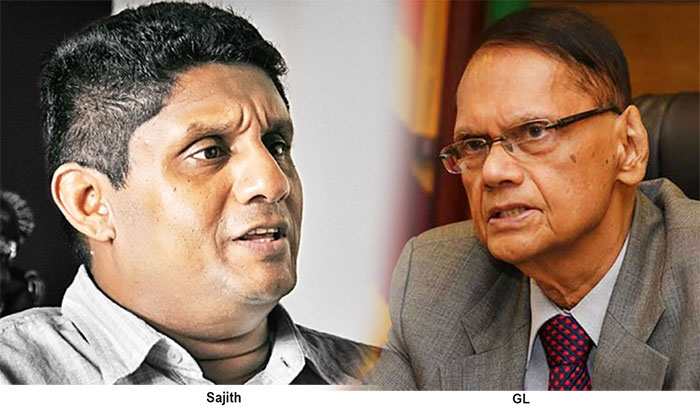
Top Opposition spokesman Prof. G. L. Peiris yesterday (05) alleged that President Ranil Wickremesinghe intended to silence television and radio stations through the proposed Broadcasting Authority Bill (BAB).
The former External Affairs Minister asserted that the BAB was part of a destructive political strategy meant to neutralise the media against the backdrop of the President’s bid to roll back the election map. He said so, referring to President Wickremesinghe’s recent declaration at the Bar Association event in Nuwara Eliya that the primary interest of the public was nothing but the revival of the economy. The UNP leader downplayed the importance of elections.
Addressing the media at the party office of Nidahasa Jathika Sabhawa, Prof. Peiris explained how the President planned to rein in free media through the five-member Broadcasting Authority Commission, and a three-member committee tasked with inquiring into complaints. The MP questioned the suitability of the President naming three persons to the Commission, in addition to appointing the Secretary to the Media Ministry who would be ex-officio head of the five-member Commission.
Urging the media to be vigilant of President Wickremesinghe’s game plan, rebel SLPP lawmaker said that the proposed committee would have the power to initiate inquiries on its own and conduct raids on ‘offending’ media institutions. The MP discussed the possibility of the committee taking hold of documents and other data in the hands of journalists while threatening them with imprisonment unless they revealed their sources.
Samagi Jana Balawegaya (SJB) and Opposition Leader Sajith Premadasa, in a separate statement, vowed to oppose the proposed Bill, both in Parliament and outside. MP Premadasa said that the decision-making body of the Opposition political parties, led by the SJB, resolved to campaign against the controversial Bill.
The first salvos against the Bill were fired by one-time Media Ministry Secretary Charitha Herath, and SJB stalwart Dr. Harsha de Silva last week. In response to their criticism, Justice Minister Dr. Wijeyadasa Rajapakse PC announced that they were still in the process of discussing proposals pertaining to the proposed Broadcasting Authority Bill.
Prof. Peiris emphasized that contrary to such claims the relevant Bill was in the public domain. The former minister said that there couldn’t be any doubt over whether the government would finalize the Bill and, if enacted, would automatically silence the media.
Describing the Bill as seriously flawed, Prof. Peiris questioned the competency of those who prepared it. It couldn’t have been done at the Legal Draftsman’s Department, the ex-minister said, alleging that responsibility had been outsourced.
Prof. Peiris said that the Supreme Court would be definitely moved against the proposed law. The academic said that the government was engaged in a desperate bid to consolidate its position. Comparing the Broadcasting Authority Bill with the Bill on the Central Bank of Sri Lanka, Prof. Peiris said that the former wouldn’t receive the go ahead from the Supreme Court. The proposed Bill as a whole was contrary to the Constitution, lawmaker Peiris said, asserting that democracy couldn’t survive the death of the media.
Referring to President Wickremesinghe’s speech to the National Law Conference at the Nuwara Eliya Grand Hotel, Prof. Peiris said that just because the UNP was in a pathetic state and couldn’t do well at elections, at any level, the UNP leader shouldn’t try to justify his bulldozing actions.
Prof. Peiris accused the President of putting off Local Government polls as he feared facing the electorate. The UNP is represented in Parliament by just one National List seat, earlier held by the President.





News
Cabinet aporives recruitment of Nursing Instructors for Nursing Schools under the Ministry of Health and Mass Media on Contract Basis

There are 17 nursing schools under the Ministry of Health and Mass Media including the postgraduate primary nursing school.
There are 142 vacancies in the posts of Grade I / Special Grade Nursing Officer (Education) as on 31.03.2026 in those schools while 24 officers are to be promoted to the special grade on 31.12.2025 owing to the vacancies existing in the post of Special
Grade Nursing Officer (Education). Therefore, the number of vacancies is to be 166.
In addition, there are 24 vacancies in the post of Special Grade Nursing Officer (Education).
Although at present action has been taken to upgrade the nursing schools to nursing colleges and upgrade the nursing diploma course to nursing degree course, no action has been taken so far to carry out recruitment for the training relevant to the appointment for the post of Grade I / Special Grade Nursing Officer (Education).
Accordingly, the Cabinet of Ministers granted approval to the resolution furnished by the Minister of Health and Mass Media to recruit retired nursing instructors and nursing instructors who served in the nursing schools belonging to the three armed forces and are retired or have resigned legitimately from service to the post of Grade I / Special Grade Nursing Officer (Education) on contract basis.
Latest News
Signing agreement for the establishment of BIMSTEC Technology Transfer Facility in Sri Lanka
It has been decided to establish a BIMSTEC technology transfer facility in Sri Lanka by entering into a Host Country Agreement at the second leaders’ summit of BIMSTEC (Bay of Bengal
Initiative for Multi-Sectoral Technical and Economic Cooperation) held in New Delhi, India, in 2008, with the objective of enhancing regional cooperation.
The relevant cooperation agreement was signed by the member countries at the 5th BIMSTEC summit on 30-03-2022 in Colombo.
The prime objective of this technology transfer facility is to provide technology, capacity building, and management of intellectual property for the micro, small, and medium-scale
enterprises of the BIMSTEC member countries.
According to the cooperation agreement, an agreement should be entered into between Sri Lanka, as the host country, and BIMSTEC Secretariat for formalizing the legal status, privileges, and immunities of the technology transfer facility.
The drafted agreement has received the relevant institutional approval and legal clearance.
Accordingly, the Cabinet of Ministers has approved the resolution furnished by the Minister of Science and Technology to sign the proposed agreement.
News
The cabinet approves agreement on mutual legal cooperation in criminal matters between the Republic of Sri Lanka and the Republic of Korea
Approval has been granted at the cabinet meeting held on 11-12-2023 to sign an agreement between the Republic of Korea and the Government of Sri Lanka regarding mutual cooperation
in criminal matters.
However, according to the aforementioned approval, the relevant agreement could not be signed between both parties.
Through this agreement, opportunities will be provided
for mutual assistance to other countries in handing over judicial documents and collecting evidence for the use of criminal case matters.
Accordingly, the Cabinet of Ministers has approved the resolution provided by the Minister of Justice and National Integration to sign an agreement between the Republic of Korea and the Government of Sri Lanka to cooperate in criminal matters.

Cabinet aporives recruitment of Nursing Instructors for Nursing Schools under the Ministry of Health and Mass Media on Contract Basis
Signing agreement for the establishment of BIMSTEC Technology Transfer Facility in Sri Lanka
The cabinet approves agreement on mutual legal cooperation in criminal matters between the Republic of Sri Lanka and the Republic of Korea

Misbah-ul-Haq resigns as Pakistan selector after Test squad upheaval
Amendment of the Quarantine and Prevention of Diseases Ordinance No. 3 of 1897
Cabinet approves donation of USD One Million to the Government of Nepal

‘Dates have the highest sugar content to fight Coronavirus’

Sunday Island 27 December – Headlines

#SundayIsland 17th December – Headlines

Sunday Island – 28th March

Sunday Island Headlines – 21 March

Sunday Island – 21st February – Headlines
-

 News5 days ago
Eight politicians in drug kingpin probe
-

 Features3 days ago
“Wrap Me Up in My Blazer”— A Gentlemanly Bradby Reminiscence
-

 Business5 days ago
Sri Lanka opens up: A new season of direct connectivity
-
 Features7 days ago
Insights from Chieftains of Uva: Genealogy of two Kandyan Families – Part II
-

 Features5 days ago
Redefining ageing in Sri Lanka
-
 Latest News5 days ago
Nepal-Tibet floods: What happened, what caused them and who is missing?
-

 Editorial7 days ago
Warning of power cuts: El Niño and corruption
-

 Features7 days ago
Export diversification: Missing the wood for the trees – Part I