
News
Lankans jump ship as a bankrupt nation struggles

By Amal JAYASINGHE
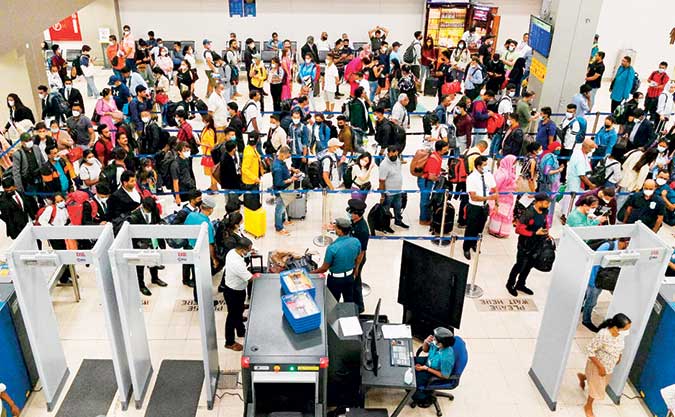
The snaking queues for food and fuel that crisscrossed Sri Lanka last year have given way to a different kind of line — people scrambling for travel documents to flee their bankrupt island.
“What we see as normalcy is a mirage,” customer care executive Gayan Jayewardena, 43, told AFP while queueing at a government office for a passport for his baby daughter.
“The situation is not getting better,” said Jayewardena, whose wife and two older daughters already have their papers.
“When we consider it from the point of our children, it is better to leave. We want to migrate to a country like New Zealand.”
The South Asian nation’s 22 million people suffered desperate shortages of essentials in 2022 after the government ran out of dollars to finance imports, including life-saving medicines.Months of protests led to the storming of then-president Gotabaya Rajapaksa’s palace on July 9 last year.
His successor Ranil Wickremesinghe doubled taxes and cut subsidies, two highly unpopular moves.The new government may have restored supplies, but at sometimes three times the previous price.
Wickremesinghe secured a $2.9 billion bailout from the International Monetary Fund in March and expects a recovery next year, but many in the country are not so optimistic.Software engineer Maduranga, 38, who uses one name, said the high living costs and taxes prompted him to consider migrating to Australia.
“The cost is going high, every day it is going higher, but the salary amount is the same”, Maduranga said. “Companies are not increasing the salaries, so that’s why we are trying to leave.”
At the foreign employment bureau, where Sri Lankans must register before taking up jobs abroad, numbers surged from 122,000 in 2021 to a record 311,000 last year.
For the first five months of this year, the bureau recorded around 122,000 people leaving — the same as in all of 2021 — but officials believe many others also left on tourist visas to seek work in the Middle East and elsewhere in Asia.
Last year, the number of people applying for passports more than doubled — from over 382,500 in 2021, when the economy grew by 3.3 percent, to a record 911,689 passports in 2022, when the economy contracted 7.8 percent.
The trend has continued.
This year through May, 433,000 overseas travel documents have been issued, according to the Immigration and Emigration Department.An online system was launched in June to cope with the swelling demand, but those urgently seeking passports must apply in person.
“My number was 976 and I think after me there would have been about 500 people,” said Damitha Hitihamu, 51, after handing in his papers to renew his passport in a day.
“I never expected to see such a crowd for the one-day service.”
Sri Lanka has been a labour exporter for decades, providing both skilled and unskilled workers, especially to Gulf states.
But the impact of the brain drain is increasingly being felt.Newspapers are awash with reports of shortages of doctors, nurses, engineers and other skilled workers because so many have left.Sri Lanka’s construction industry, one of the biggest employers, is reporting losing skilled workers and professionals at an alarming rate.
“There is large-scale migration of construction workers,” said Nissanka Wijeratne, secretary-general of the Chamber of Construction Industry.
Wijeratne said losses were “at all levels” but that it was “worse in the professional categories”.Around 200,000 jobs were cut in construction during the recession coupled with hyperinflation last year — and many of those still working are looking to leave.
“When I checked with one consultancy company, they used to have 70 professionals in that office,” Wijeratne said. “Now it has reduced to 15.”
Insurance professional Lalantha Perera, 43, said his salary was not enough to support his wife and two children.
“After the protest campaign last year, we got some relief,” he said. “But that is not enough and I am planning to go to a European country.”
The economic think tank Advocata Institute says middle-class workers are seeking employment abroad to escape poverty at home.
“Amongst the poorest people, they have cut down their meals,” said Advocata head Dhananath Fernando.
“The middle classes — those who can afford — are attempting to migrate.”












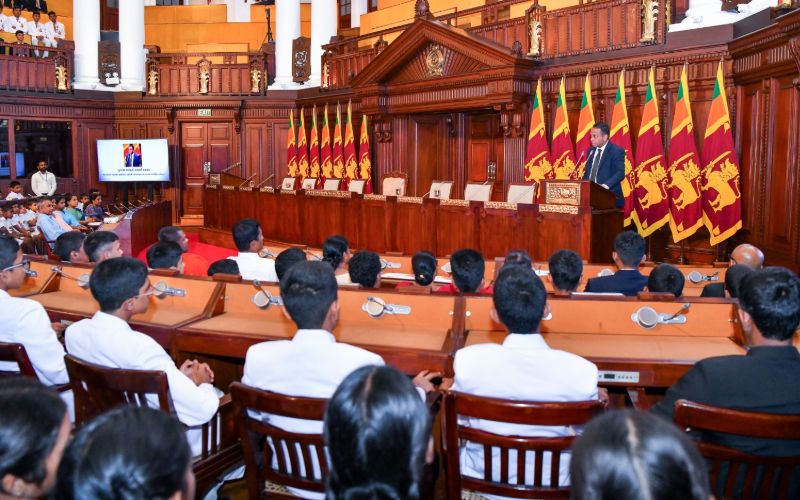
Marking the completion of two years of the ‘Vision’ Programme, students from Pinnawala Central College and Matale Siri Seevali College were given an opportunity on Thursday (24) to visit the Presidential Secretariat.
The ‘Vision’ Programme was launched for schoolchildren jointly by the Presidential Secretariat, the Ministry of Education and the Department of Communication of the Parliament of Sri Lanka.
Following a visit to the former Parliament building at the Presidential Secretariat, the students were also briefed on the history of Parliament.
The role of the President’s Fund and its importance to schoolchildren were explained by Senior Additional Secretary to the President Roshan Gamage.
The ‘Vision’ commemorative book, featuring the two-year journey of the ‘Vision’ Programme and its special activities, was also presented to the participating schools.
As part of the programme, valuable plants were also presented to the schools as a symbolic gesture underscoring the importance of environmental conservation.
Director General of Public Relations Dharmasiri Gamage, the Director and Assistant Director of the Tri-Services Security Coordination Unit, the principals and teaching staff of Pinnawala Central College and Matale Siri Seevali College, and students were among those present on the occasion.
President’s Media Division (PMD)
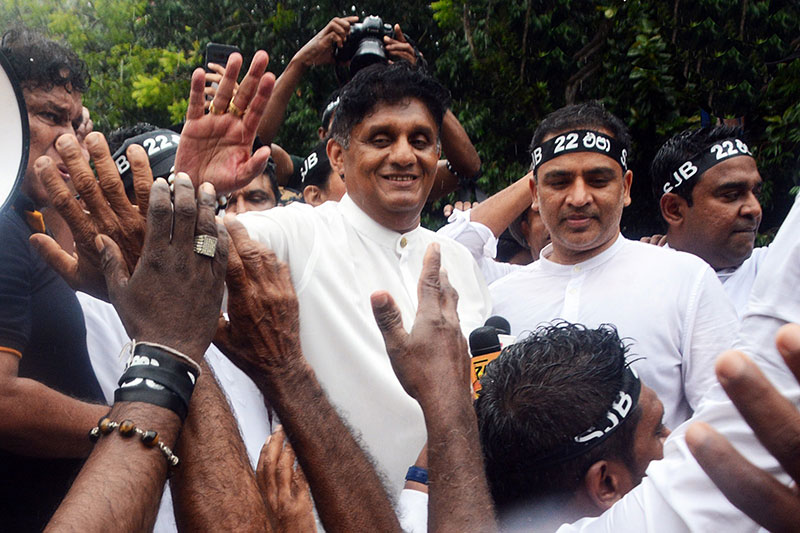
Opposition and SJB Leader Sajith Premadasa yesterday vowed that an SJB government would repeal the 22nd Amendment (22A) to the Constitution.Premadasa made the pledge while addressing thousands of SJB supporters who gathered near Parliament to protest against 22A.
Addressing the rally at Polduwa Junction, Battaramulla, Premadasa said the proposed constitutional amendment would undermine democracy and judicial independence and enable the concentration of political power in the Executive.
“Even if they pass it, under an SJB government we will scrap it,” Premadasa told the gathering, claiming that 22A was aimed at paving the way for a one-party state and placing the State under the control of a single political party.
Braving the rain, Premadasa said they had gathered there peacefully and had no intention of resorting to violence.
“We have gathered here to protect democracy,” he said, challenging the government to hold Provincial Council elections if it was confident of facing the people.
Premadasa said the SJB was prepared to work with any democratic and clean political force committed to the country’s progress and public welfare, amid ongoing discussions on cooperation among Opposition parties, including the United National Party.
Premadasa also accused groups aligned with the government of attempting to discourage people from attending the protest through statements and other measures.
SJB General Secretary Ranjith Madduma Bandara said the protest had been organised against the proposed amendment, which the party had opposed on the grounds that it could pave the way for authoritarianism.
The demonstration began around 9 a.m. at Polduwa Junction and coincided with Parliament taking up the proposed 22nd Amendment for debate. Proceedings on the Bill are scheduled to continue today (25).
The Supreme Court has determined that the proposed amendment does not require approval at a referendum and could be passed with a special majority in Parliament.
Meanwhile, traffic congestion was reported on roads surrounding Parliament and Polduwa Junction following the demonstration.
Security was also tightened in and around the Parliamentary complex, with a heavy police presence observed at Polduwa Junction and near the main entrance to Parliament.

Two retired female Navy petty officers were ordered to be remanded until October 5 over their alleged involvement in the abduction and disappearance of two women in Trincomalee during the war.
Trincomalee Chief Magistrate M.S.M. Samsudeen yesterday ordered that the two suspects be remanded and directed that they be produced for an identification parade on October 5.
The suspects, residents of Chilaw and Haputale, were arrested after appearing before the CID in connection with another court case. They were subsequently produced before the Trincomalee Magistrate’s Court.
The court was informed that the investigation concerned the alleged abduction of Sasikumar Thenmoli and Mary Delsia, residents of Paalaiyootru, Trincomalee, on or around May 13, 2008.
The CID told court that information uncovered during its investigations indicated that the two women had allegedly been detained at an underground location known as the “Gun Site” at the Trincomalee Naval Base while the two suspects were serving in the Navy. The women were subsequently reported missing.
Further investigations into the alleged abduction and disappearance of the two women are continuing.

‘Vision’ Programme Marks Two Years

Costa Rica minister fired for unapproved meeting with Trump in US

At least 41 die as boat capsizes in DRC’s Lake Tanganyika

Showers will occur at times in the Western, Sabaragamuwa, Southern, Central and North-western provinces

Sajith vows to scrap 22A under future govt.

Two retired female Navy officers remanded over disappearance of two women during war

‘Dates have the highest sugar content to fight Coronavirus’

Sunday Island 27 December – Headlines

#SundayIsland 17th December – Headlines

Sunday Island – 28th March

Sunday Island Headlines – 21 March

Sunday Island – 21st February – Headlines
-

 News6 days ago
Shanakiyan urges urgent action over reported death sentence for Lankan in Saudi Arabia
-

 News5 days ago
Namal Rajapaksa Buddhist gambit fails, bail denied
-

 Features5 days ago
Why the spelling Sri Lankan names in English vary
-

 Features5 days ago
Three bands, a new identity: Sri Lankan wolf snake recognised as distinct species
-

 Business5 days ago
SLIIT holds largest-ever convocation
-

 News5 days ago
Govt monitors reported Saudi death sentence – Foreign Ministry
-

 News5 days ago
Vehicle prices drop by up to Rs. 1 mn, says importers’ body
-

 Business5 days ago
All-new Bolero MaXX Pik-Up unveiled in Lanka