
News
Training is territorial policing in Kandy and learning from early bona fide mistake

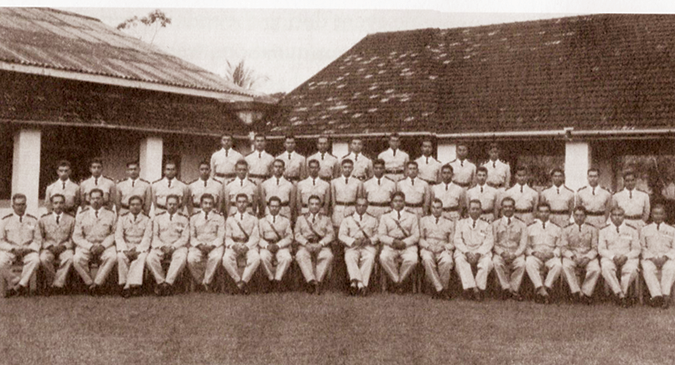
Excerpted from the memoirs of Rtd. Senior DIG Kingsley Wickramasuriya
G.A.D.E.A. Seneviratne (known to many as Ana) was the Superintendent in charge of the Kandy Police Division. When I reported to him his first task, after a pep talk as to how I should get about my work, was to find me suitable lodgings. ASP Leo Perera who I replaced was boarded close to the Police Station. That seemed to be a suitable place and he suggested that I try it. Soon I moved there and started my work, although I changed the lodging later.
Ana was a straight officer and a disciplinarian, a tough customer to deal with. He expected hard work from us young officers and saw to it that we carried out our duties according to the book – The Departmental Orders (DO). He would scrutinize our Weekly Diaries and pull us up on the diary itself if we slacked and failed to carry out our duties according to instructions in the DO. His remarks would draw the attention of our Range Deputy Inspector-General who in turn would give a few hard knocks. So, we had to be careful not to earn his wrath. He was hard to please.
He had a program drawn up for our training. Accordingly, I was attached to the Kandy HQ station for a couple of weeks. During this period, I had to do my Night Rounds at the Kandy HQ station going around to various points where men were deployed on duty and checking those points. One night when I visited the Supreme Court judge’s bungalow to check the sentry on duty around -11.00 pm, he was found fast asleep with his weapon unattended.
I removed the weapon and took it to my lodgings intending to return it to the police station the next morning and take the Sentry to task later. The next day early morning, HQ Inspector Kadigawa called over at my lodgings and informed me of the furor and the excitement that the missing weapon had caused and inquired whether I knew anything about the missing rifle. When I told him, what happened and produced the rifle, there was a sigh of relief. The Supreme Court Judge had complained angrily to the Superintendent about his security being compromised when he had learned about the missing rifle.
The Sentry Constable had cooked up a story to cover up his negligence and made entries in his Pocket Note Book. There was a lot of excitement at the Police Station as well over the incident. The Superintendent had ordered an immediate inquiry and asked the HQI to report what had happened. The HQI was aware from the entries I had made in the Officers’ Visiting Book (OVB) that I had been around on Night Rounds. So that is why he decided to check with me. They were almost on the verge of reporting the missing weapon to Police HQ when the HQI came to me.
I of course did it with the good intention of instilling discipline and that the sentries are kept alert, but realized the gravity of what I had done only later after the incident. I learned my lesson. So, did the Sentry Constable. He escaped with only a red entry in his recruit file.
Later the SP carved out a small district for me with two ‘C’ Grade police stations – Talatuoya and Hanguranketa. I gradually learned the routine of visits to and inspections of police stations while managing this district. At the beginning of each month, an inspection program was sent to the OIC of the Police Station giving notice of formal regular monthly inspections while I made surprise visits during the day as well as at night. That kept the police stations alert as they had no previous notice of my visits or night rounds. I attended the weekly parade at the Kandy HQ Station with the Superintendent taking the salute on horseback.
As part of the training, I had to accompany the SP on one of his half-yearly Inspections at Hasalaka Police Station. He proposed that we do a hike through the jungle from Hanguranketha to Hasalaka. He was fond of hiking and familiar with the route. Sc we went to Hanguranketha in his car and from there we proceeded, on foot through the jungle. We reached Hasalaka by the evening and lodged at the Rest House for the night. The next day we were at th police station by 6.30 am for the Inspection, starting with the parade.
I observed the entire procedure followed by him which I was to adopt at my inspections later for many years to come. At these inspection: he would keep the OIC on pins going into every detail in the book and satisfying himself that everything was in order. The OIC heaved a sigh o relief only at the end of the Inspection when the inspecting officer would make his remarks that the “Station is in Order”.
The style of inspection, the SP would later explain, came down long line of inspecting officers who had established a reputation for conducting tough inspection procedures. There were several schools of Inspection methodology that came to be named after those officer for instance, the Leembruggen School, L.I. De Silva School, and Sydney de Zoysa School. These were the legacies left behind by those officers who had picked it up from the British. There were many interesting legends built up around those inspection methods and their authors which I was to learn later.
Hanguranketha was an area where coconut toddy tapping was aplenty. There were toddy-collecting centers and toddy tope ( from where the main toddy tope in Ragala was fed. These were supposed to be under the supervision of the Excise Department/my inspections /visits to Hankuranketha Police Station, One thing noticed was the high incidence of crimes of violence caused by liquor. From the petitions I received much of this was attributed to the sale of illicit liquor. It was also obvious that coconut toddy was available from small retail points selling toddy illicitly.
Having studied the problem, I got the police station to concentrate on these illicit centers at first but soon found the effort futile as long as the retailers got their supp from the Toddy Tope at Hanguranketha. So, the problem persisted. Finally, I decided that the solution to the problem lay with the Toddy Tope at Hanguranketha and organized a raid through the Vice Branch of the Kandy Police.
The raiding party consisted of Sergeant 4464 Sakalasuriya in charge of the Vice Branch and several constables attached to the branch. On the appointed day the raiding party proceeded to the Toddy Tope in a hired van. I accompanied the party in my private car driven by the police driver assigned to me. On arrival, we divided ourselves into two groups. One party conducted the raid at the Toddy Tope and the other proceeded to the main premises of the Tope owner where some transactions were being conducted.
The owner was a person of Indian origin living on a temporary residence permit. With the wealth he had collected through the toddy business this TRP holder was a very influential person in the area. I confronted him personally and informed him of the raid that we were conducting at both places and went on to question those who had gathered there to buy toddy illicitly. For the Toddy Tope owner, this was a very embarrassing situation whereas he had been carrying on business unhindered and enjoyed a prominent social status.
After the raid, we collected all the productions and arrested those who were culpable under the provisions of the Excise Ordinance gathered at the Tope and were ready to leave when an Inspector of the Excise Department appeared and raised objections stating that he had come to measure the toddy that was to be sent to the Toddy Collection Center at Ragala.
When I informed him that was not possible as we have already conducted a raid for the illicit sale of liquor, he appeared to be angry and questioned my competency about what I was doing.
I returned with the party after the raid to Kandy Police and got about my business trusting that the Senior Sergeant from the Kandy Vice Branch would attend to the nitty-gritty of note writing and reporting to courts. Sometime in the afternoon when ASP Navaratnam of Kandy District (1) and HQI Kadigawa came to my lodgings raising the alarm that no notes have been written by the raiding party and as such no proper legal action could be taken against the culprits. That was when I started getting the jitters. The ASP and the HQI had been instructed by the Superintendent to go into the matter and take remedial action.
After going into the pros and cons of the case it was decided on the advice of ASP Navaratnam to present all the productions taken to custody during the raid including some cash collection on an ‘A Report’, and not to enter any prosecution against the Toddy Tope. This advice was to later save me and the raiding party from being questioned in the Kandy Magistrate’s Courts about the propriety of our actions.
With the matter at that stage, the next day the Toddy Tope owner came to the SP’s office to make a complaint against me. The SP who by then was aware of what had taken place and my bona fides asked the complainant to produce his TRP before entertaining the complaint. That was the end of that. But what was still worse was that he filed a case against me and the raiding party in Magistrate’s Court, Kandy alleging some serious criminal charges arising out of the raid.
He had retained an eminent criminal lawyer from Colombo for the case. Once again, my brother came to my aid and retained an equally eminent lawyer, Eardley Perera, from Colombo. But I had to do the preparation of the brief for the counsel and meet the legal expenses. The case went to trial and at the end of the prosecution, my counsel called me to the witness box for the defense. I faced the cross-examination confidently convincing Magistrate Udalagama of the bona fides of our action. He finally acquitted us of all charges and dismissed the case specially remarking at the end of the case that ‘he had no doubt whatsoever about the bona fides of the action of the young ASP.
The Tope owner was bent on revenge because he had lost face over this raid and his ego was hurt. The allegations were serious and an exaggeration of what took place. I realized that by trying to do my duty I had placed not only myself but several others in a very awkward position. I had not only to defend myself but others who too were doing their duty. I also learned that complaints entertained must be bona fide and investigations completed as soon as possible. This experience in my early professional life taught me how to protect myself and others, against acting on impulse and attendant pitfalls.
All these events and the routine were reported in the Weekly Diaries. They were forwarded to the Deputy Inspector-General of Police of the Range with the Superintendents remarks and came back with praise where praise was due to encouragement/guidance or with knocks at the blunders or shortcomings. The Weekly Diary was a good management tool — by remote control -one of the best practices the Britisher had invented.
On 1st February 1965, I suddenly got transfer orders to the Gampaha Division. I paid my courtesies to SP Kandy and departed with his blessings. He was very appreciative of the work I did during my tour of duty and predicted that I would do well in the Service.



Latest News
Sun directly overhead Mannar, Periyamadu, Puliyankulam, Welioya and Pulmoddai about 12.11 noon today (30)


The sun is going to be directly over the latitudes of Sri Lanka from 28th of August to 07th of September due to its apparent southward relative motion.
The nearest places of Sri Lanka over which the sun is overhead today (30) are Mannar, Periyamadu, Puliyankulam, Welioya and
Pulmoddai about 12.11 noon.
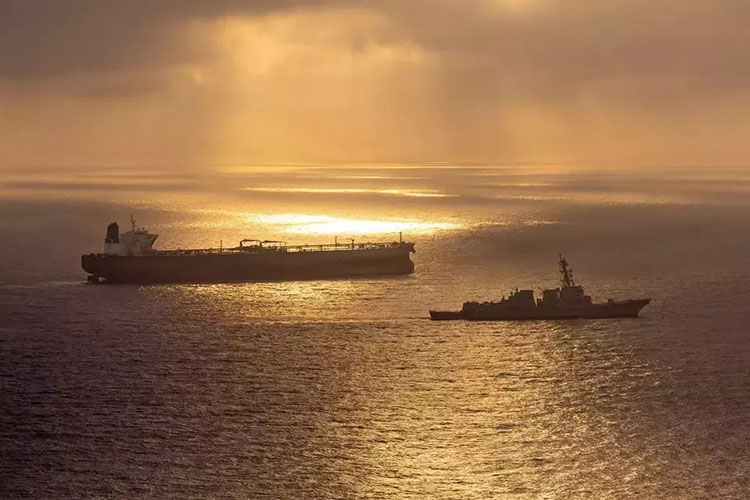
(AFP) Sri Lanka’s maritime authorities were monitoring a fleet of 11 US-sanctioned Iranian oil tankers just off the island’s southern coast, the foreign minister said Wednesday.
The tankers were spotted close to the Galle harbour where an Iranian frigate, IRIS Dena, was sunk by a US submarine in March, killing 104 sailors. Sri Lanka’s navy rescued 32 Iranian sailors from that frigate.
Iranian vessels have been in limbo, unable to return to their home port because of a US blockade.
Sri Lanka’s Foreign minister Vijitha Herath said the tankers were in international waters where they had freedom of navigation.
“These ships are away from our territorial waters… we have no hold on them, nor have we facilitated them,” Herath told AFP.
The military deployed reconnaissance aircraft and patrol boats to monitor the vessels outside Sri Lanka’s 12-nautical-mile territorial waters, a military official told AFP on condition of anonymity.
“There is no indication of any ship-to-ship transfer of oil or illegal discharge of pollutants, so there is no basis for Sri Lankan authorities to take action against them,” the official said.
Many Iranian merchant vessels moved east towards the Strait of Malacca and Singapore due to US sanctions, while several remained near Sri Lankan waters, authorities said.
Sri Lankan officials said Washington had not formally notified Colombo about sanctioned Iranian-flagged vessels
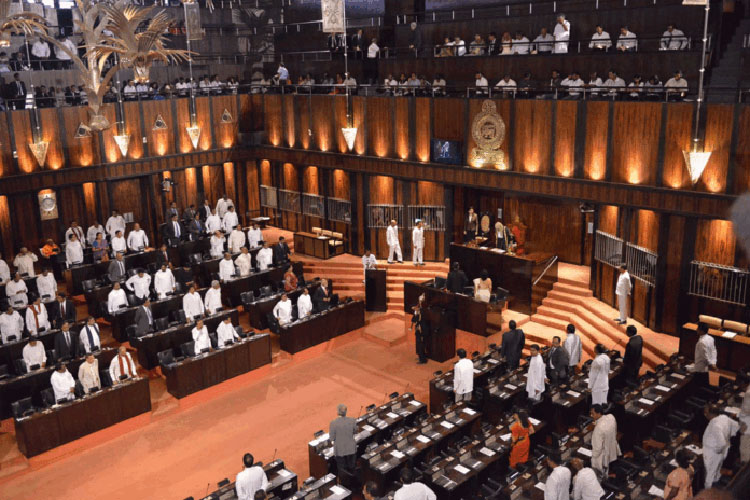
Parliament is to debate next Wednesday the Government’s proposal to abolish the post of Chief of Defence Staff (CDS), with the Second Reading of the Chief of Defence Staff (Repeal) Bill scheduled for September 9.
The Bill seeks to repeal the Chief of Defence Staff Act No. 35 of 2009, which was introduced shortly after the end of the armed conflict.
According to Secretary General of Parliament Kushani Rohanadeera, Parliament will meet from September 8 to 11, with the business for the week approved by the Committee on Parliamentary Business chaired by Speaker Dr. Jagath Wickramaratne.
The debate on the Chief of Defence Staff (Repeal) Bill is scheduled to take place from 11.30 a.m. to 5 p.m. on Wednesday, following questions to the Prime Minister and other parliamentary business.
The CDS post was established under the 2009 Act as part of the country’s higher defence command structure.
On Tuesday, September 8, the House will consider two Orders published in Extraordinary Gazettes under the Motor Traffic Act from 11.30 a.m. to 5 p.m., followed by an Opposition motion at the adjournment.
On Thursday, September 10, Parliament will debate a Resolution under the Women’s Empowerment Act.
The final sitting day of the week, Friday, September 11, has been allocated from 11.30 a.m. to 5.30 p.m. for several Private Members’ Motions.
The motions will cover issues including regulation of the petroleum, fuel and water industries, measures to increase the birth rate, protection of the Diyagama Forest, pension deductions affecting Pirivena teachers, food-crop cultivation in mountainous areas, development of the Kithul industry and the establishment of a Faculty of Medicine at South Eastern University.
Questions at the adjournment will be taken up at the end of each sitting day.

Voting closes in Iceland’s knife-edge EU referendum

Showers in the Sabaragamuwa, Western and North-western provinces and in Galle, Matara, Kandy and Nuwara-Eliya districts

Sun directly overhead Mannar, Periyamadu, Puliyankulam, Welioya and Pulmoddai about 12.11 noon today (30)

Lanka tracks 11 US-sanctioned Iranian tankers off coast

House to debate abolition of Chief of Defence Staff post

Mass graves tragic evidence of failed states – Rathnayake

‘Dates have the highest sugar content to fight Coronavirus’

Sunday Island 27 December – Headlines

#SundayIsland 17th December – Headlines

Sunday Island – 28th March

Sunday Island Headlines – 21 March

Sunday Island – 21st February – Headlines
-

 News5 days ago
Missing doctor’s body found in Mahiyanganaya
-
 News5 days ago
Australia declines to release Finance Secy Suriyapperuma’s citizenship details
-
 News5 days ago
22A: BASL suggests CJ recuse himself from hearing petitions
-

 News2 days ago
Eight politicians in drug kingpin probe
-

 Editorial6 days ago
Govts. drag feet as undergrads age
-
 Features4 days ago
Insights from Chieftains of Uva: Genealogy of two Kandyan Families – Part II
-

 Features4 days ago
Export diversification: Missing the wood for the trees – Part I
-
 Business2 days ago
Sri Lanka opens up: A new season of direct connectivity