
News
Domestic debt restructuring: Harsha insists money belonging to EPF members must be safeguarded


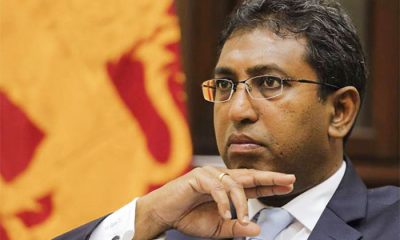
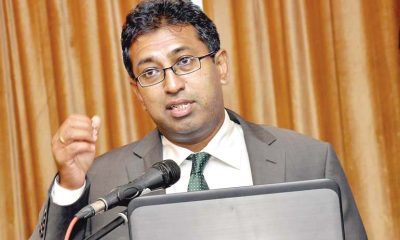
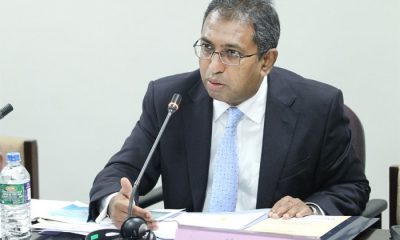
Opposition MP Dr. Harsha de Silva has highlighted the critical considerations surrounding Domestic Debt Optimisation and its impact on the members of the Employees Provident Fund (EPF). Speaking on behalf of the Opposition, recently, de Silva emphasised the need to prioritize the interests of EPF pension fund members in any decision-making process.
“Our foremost concern should be securing the retirement benefits of the hardworking people of Sri Lanka,” de Silva stated. “The EPF, as a pension fund, plays a crucial role in ensuring a financially secure future for its members upon retirement. We cannot allow the government’s pursuit of cheap money to jeopardize the interests of EPF pensioners.”
Referring to the EPF Act, de Silva underscored the obligation for a parliamentary resolution to ensure the EPF receives sufficient funds from the Treasury to meet minimum payment requirements if it is unable to do so. He further emphasized the importance of gradually settling any resulting loans over time. “We must protect the EPF pension fund from being subjugated to the government’s needs at the expense of pensioners. The negative 47 percent real return to EPF in 2022 has severely eroded the value of the fund, and we cannot disregard this significant loss,” de Silva added.
Discussing the risks associated with domestic debt optimization, de Silva highlighted the concept of opportunity cost. “Subjecting the EPF pension fund to this optimization may result in a loss of potential reinvestment opportunities,” he explained. “For instance, if the EPF currently holds bonds maturing within the next one or two years, they have the potential to be reinvested at higher rates, ensuring better returns for pensioners. However, if these bonds’ maturity dates are extended beyond 2027 at lower rates that will have a high opportunity cost to EPF members.”
Clarifying the EPF pension fund’s overall financial position, de Silva reassured the public that the EPF is not facing immediate trouble. “The EPF pension fund maintains a positive cash flow, with contributions consistently exceeding pension payouts by approximately 30 billion rupees in recent years,” he stated. “This ensures the EPF’s ability to meet its pension obligations. However, we must acknowledge that returns on investments may decrease.”
Concluding his remarks, de Silva firmly stated that “Considering the negative real interest rate the EPF pension fund has already experienced, it is unjust to overburden it further with large opportunity costs due to domestic debt optimization. We must prioritize the interests of EPF members and strike a balance between preserving reasonable returns to the members while providing debt relief to the government. The long-term financial security of Sri Lanka’s workforce cannot be jeopardized.”







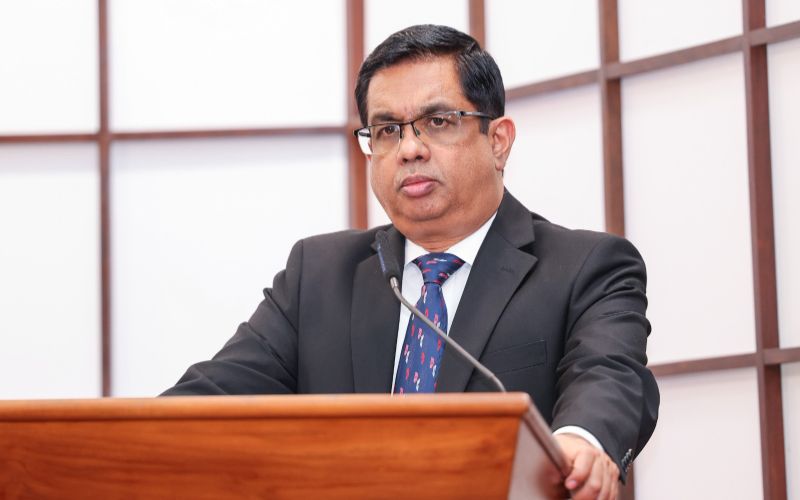
The Memorandum of Understanding (MoU) relating to the project to provide technological solutions to prevent wild elephants from being hit by trains was signed yesterday (01) afternoon at the President’s Media Centre, under the patronage of Secretary to the President Dr Nandika Sanath Kumanayake.
Coordinated through the “Clean Sri Lanka” programme, the project is being implemented as a public-private partnership, with the Railway Department, the Department of Wildlife Conservation and the Forest Conservation Department working together, with full financial support from People’s Bank.
The system consists of three-beam detection, passive infrared (PIR) sensors, automatic temperature sensors and a tamper alarm system to detect animals weighing more than 20 kilogrammes and unauthorised interference. Signal lights (red/yellow/green) installed on either side of the railway tracks, together with a special screen installed inside the locomotive cab, will alert the driver in advance to the exact location of an elephant.
A demonstration test of the system was successfully conducted at the Pinnawala Elephant Orphanage premises in the presence of the relevant officials, following which a report on the system was prepared.
The system will be implemented as a pilot project from next month at 13 locations where wild elephant accidents are frequent. A newly developed website is also scheduled to be launched to enable the progress of the project to be viewed live.
Additional General Manager of Railways P.D.S.B. Chandrasena, Director General of Wildlife Conservation M.S.L.R.P. Marasinghe, Conservator General of Forests S.C. Palamakuumbura and Chairman of People’s Bank Chandana Guniyangoda signed the relevant MoU. Officials from the Clean Sri Lanka Secretariat, including Presidential Additional Secretary (Clean Sri Lanka) Engineer S.P.C. Sugeeshwara, as well as senior officials from the Railway Department, Department of Wildlife Conservation, Forest Conservation Department and People’s Bank, were also present.
[President’s Media Division]

The Commissioner General of Examinations has announced that the results of the 2026 Grade 5 Scholarship Examination have been released online, and can be viewed on the department’s official website: www.doenets.lk

Prime Minister Dr. Harini Amarasuriya departed Sri Lanka on Monday, 31 August, to undertake an official visit to Bhutan to participate in the Global Conscious Food Systems Summit, scheduled to be held in Bhutan.
During her visit, Prime Minister Dr Amarasuriya participated in the opening plenary of the Summit on 1 September, where she delivered a keynote address under the theme “Rising to the Moment: Igniting Consciousness to Address the Polycrisis.”
The Prime Minister will also engage in discussions with international leaders and representatives on strengthening cooperation towards sustainable food systems, food security and resilient communities.

[Prime Minister’s Media Division]

MoU signed for technology to prevent wild elephant-train collisions

Grade 5 scholarship exam results released

Prime Minister participates in Global Conscious Food Systems Summit in Bhutan

Bouchier century sets England up for record 282-run chase against Ireland

Muneeba, Pakistan’s spinners knock Thailand out of Asia Cup

Showers will occur in the Western and Sabaragamuwa provinces and in Galle, Matara, Kandy and Nuwara-Eliya districts

‘Dates have the highest sugar content to fight Coronavirus’

Sunday Island 27 December – Headlines

#SundayIsland 17th December – Headlines

Sunday Island – 28th March

Sunday Island Headlines – 21 March

Sunday Island – 21st February – Headlines
-

 News6 days ago
Eight politicians in drug kingpin probe
-

 Features4 days ago
“Wrap Me Up in My Blazer”— A Gentlemanly Bradby Reminiscence
-

 Business6 days ago
Sri Lanka opens up: A new season of direct connectivity
-

 Features6 days ago
Redefining ageing in Sri Lanka
-
 Latest News6 days ago
Nepal-Tibet floods: What happened, what caused them and who is missing?
-

 Features3 days ago
When Sri Lankan stories find their own voice
-

 Editorial7 days ago
Unfolding El Niño and burning issues
-

 Editorial6 days ago
The toxic legacy of two lakes