
News
NASA: Deadly blooms in the Gulf of Mannar

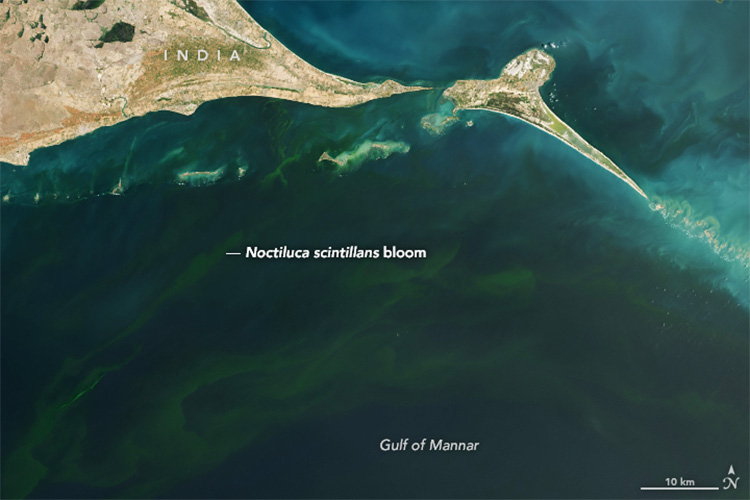
For the past four years, water in the Gulf of Mannar has turned bright green in September and October as the population of a single-celled phytoplankton called Noctiluca scintillans soared. These large blooms of the marine dinoflagellates glow a spectacular shade of blue at night, but their presence can have deadly consequences for marine life by soaking up all the oxygen in the water and causing hypoxia and dead zones, said a report by NASA yesterday.
That’s what was happening on September 23, 2022, when the Operational Land Imager-2 (OLI) on Landsat 9 captured this image of whorls of N. scintillans discoloring waters in northern Sri Lanka and southern India near the Gulf of Mannar Marine Biosphere Reserve. The shallow water in this area normally teems with coral, reef fish, sea turtles, dolphins, dugong, and other marine life. But during N. scintillans outbreaks, fish carcasses line beaches and dead coral skeletons transform reefs.
“We saw particularly severe coral mortality and fish kill in 2019, but it happened in 2021 and 2022 as well,” explained Diraviya Raj, a researcher at the Suganthi Devadason Marine Research Institute in Tamil Nadu, India, and the lead author of a 2020 study about N. scintillans blooms in the Gulf of Mannar. “The 2020 bloom was short and did not harm corals, but the 2021 and 2022 events each lasted for two months, covered large areas, and caused severe damage.”
The earliest reports of N. scintillans blooms causing fish kills in the Gulf of Mannar date back to 1935, with occasional reports of the phenomenon in subsequent decades. However, the regularity and intensity of the blooms since 2019 seem to be something new. “We suspect that climate change has made the N. scintillans bloom an annual occurrence,” Raj said. “The water temperature level has been more than 30°Celsius (86°Fahrenheit) during the blooms, which is unusually high for the Gulf of Mannar in September-October.”
Living staghorn corals are brightly colored, while the dead corals in the photograph above—taken on November 17, 2021, near Manauli Island—had turned white and were covered with algal debris about a month after the bloom started to affect them. Fast-growing corals species such as Acropora, Montipora, and Pocillopora are the most vulnerable to N. scintillans blooms because they require the most oxygen to thrive.
Lines of dead fish, like those shown below, covered beaches on the islands of the Gulf of Mannar and the mainland near Mandapams and Keelakarai when the photo was taken on October 13, 2021. By analyzing water samples, Raj and colleagues confirmed that oxygen-depleted water triggered by the N. scintillans bloom was the cause of the fish kills and coral deaths.
Another team of researchers from the Central Marine Fisheries Research Institute in Mandapam Camp and the Indian Space Research Organization tracking the blooms found that 38 genera of fish were affected by the 2019 bloom and 43 genera by the 2021 bloom. Among them were parrotfish, rabbitfish, pufferfish, lesser sardines, needlefish, and tarpons, they noted in a study published in March 2023.
The 2021 bloom also killed large numbers of animals being raised in finfish farms, explained Ramesh Kumar, the lead author of the study. However, the team thinks it may soon be possible to warn fish farmers of N. scintillans blooms in advance, using improved satellite mapping abilities and new modeling techniques. That may allow farmers to harvest fish before blooms spread to coastal areas and cause widespread damage.













(AFP) Sri Lanka’s maritime authorities were monitoring a fleet of 11 US-sanctioned Iranian oil tankers just off the island’s southern coast, the foreign minister said Wednesday.
The tankers were spotted close to the Galle harbour where an Iranian frigate, IRIS Dena, was sunk by a US submarine in March, killing 104 sailors. Sri Lanka’s navy rescued 32 Iranian sailors from that frigate.
Iranian vessels have been in limbo, unable to return to their home port because of a US blockade.
Sri Lanka’s Foreign minister Vijitha Herath said the tankers were in international waters where they had freedom of navigation.
“These ships are away from our territorial waters… we have no hold on them, nor have we facilitated them,” Herath told AFP.
The military deployed reconnaissance aircraft and patrol boats to monitor the vessels outside Sri Lanka’s 12-nautical-mile territorial waters, a military official told AFP on condition of anonymity.
“There is no indication of any ship-to-ship transfer of oil or illegal discharge of pollutants, so there is no basis for Sri Lankan authorities to take action against them,” the official said.
Many Iranian merchant vessels moved east towards the Strait of Malacca and Singapore due to US sanctions, while several remained near Sri Lankan waters, authorities said.
Sri Lankan officials said Washington had not formally notified Colombo about sanctioned Iranian-flagged vessels

Parliament is to debate next Wednesday the Government’s proposal to abolish the post of Chief of Defence Staff (CDS), with the Second Reading of the Chief of Defence Staff (Repeal) Bill scheduled for September 9.
The Bill seeks to repeal the Chief of Defence Staff Act No. 35 of 2009, which was introduced shortly after the end of the armed conflict.
According to Secretary General of Parliament Kushani Rohanadeera, Parliament will meet from September 8 to 11, with the business for the week approved by the Committee on Parliamentary Business chaired by Speaker Dr. Jagath Wickramaratne.
The debate on the Chief of Defence Staff (Repeal) Bill is scheduled to take place from 11.30 a.m. to 5 p.m. on Wednesday, following questions to the Prime Minister and other parliamentary business.
The CDS post was established under the 2009 Act as part of the country’s higher defence command structure.
On Tuesday, September 8, the House will consider two Orders published in Extraordinary Gazettes under the Motor Traffic Act from 11.30 a.m. to 5 p.m., followed by an Opposition motion at the adjournment.
On Thursday, September 10, Parliament will debate a Resolution under the Women’s Empowerment Act.
The final sitting day of the week, Friday, September 11, has been allocated from 11.30 a.m. to 5.30 p.m. for several Private Members’ Motions.
The motions will cover issues including regulation of the petroleum, fuel and water industries, measures to increase the birth rate, protection of the Diyagama Forest, pension deductions affecting Pirivena teachers, food-crop cultivation in mountainous areas, development of the Kithul industry and the establishment of a Faculty of Medicine at South Eastern University.
Questions at the adjournment will be taken up at the end of each sitting day.
Mass graves across Sri Lanka are tragic and enduring evidence of the failures of successive states, Highways and Transport Minister Bimal Rathnayake said, describing the Chemmani site as a historic symbol of a failed state.
He said the Government had ensured that excavations at the Chemmani mass grave were conducted through a transparent, scientific and lawful process, backed by the necessary funding and judicial and medical resources.
“When we came to power, only skeletal remains recovered from 2009 onwards had been recorded from the Chemmani mass grave. Today, the number has risen to 565,” Rathnayake said.
He attributed the increase to the Government’s intervention, including the allocation of funds, deployment of judicial and medical officers and provision of facilities required to facilitate the investigations.
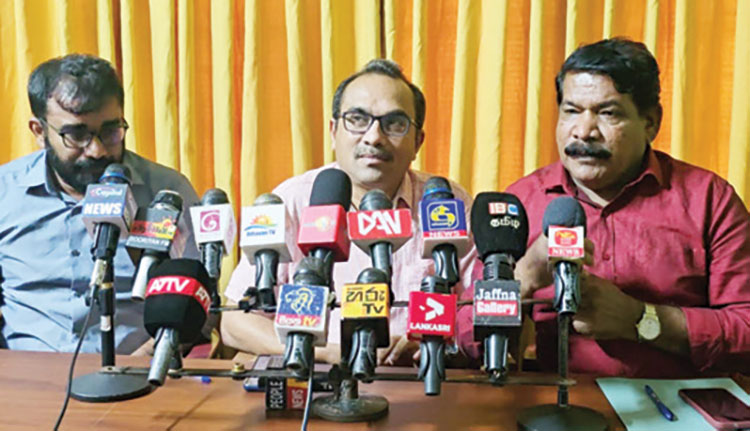
Rathnayake made the remarks at a special press conference held on Thursday (27) at the NPP district office in Jaffna.
He said the Government had also taken steps to subject the excavated remains to forensic examinations in an effort to identify the victims.
The Ministry of Justice was taking measures to identify those responsible for the incidents and pursue legal action against them, he said.
A total of 565 human skeletons had been excavated from the Chemmani site as of Thursday, according to Rathnayake.
Fisheries Minister Ramalingam Chandrasekar and NPP Jaffna District MP K. Ilankumaran also addressed the media.

Lanka tracks 11 US-sanctioned Iranian tankers off coast

House to debate abolition of Chief of Defence Staff post

Mass graves tragic evidence of failed states – Rathnayake

Legal avenues explored to bring back Mahendran, aka Harjan Alexander

Nanda Malini Ascocenda: A flower that carries the name of a legendary voice

Vijita Fernando, literary personality, dies months short of her 100th birthday

‘Dates have the highest sugar content to fight Coronavirus’

Sunday Island 27 December – Headlines

#SundayIsland 17th December – Headlines

Sunday Island – 28th March

Sunday Island Headlines – 21 March

Sunday Island – 21st February – Headlines
-

 News5 days ago
Missing doctor’s body found in Mahiyanganaya
-

 News5 days ago
Australia declines to release Finance Secy Suriyapperuma’s citizenship details
-
 News5 days ago
22A: BASL suggests CJ recuse himself from hearing petitions
-

 News2 days ago
Eight politicians in drug kingpin probe
-

 Editorial6 days ago
Govts. drag feet as undergrads age
-
 Features4 days ago
Insights from Chieftains of Uva: Genealogy of two Kandyan Families – Part II
-

 Features4 days ago
Export diversification: Missing the wood for the trees – Part I
-

 Business2 days ago
Sri Lanka opens up: A new season of direct connectivity