
Midweek Review
Govt. responds in kind to Thuyacontha’s salvo

At the behest of the then late President Ranasinghe Premadasa way back in 1989, the then Election Commission recognised the PFLT (People’s Front of Liberation Tigers) as the political arm of the LTTE. The late Gopalswamy Mahendraraja aka Mahattaya, the LTTE Deputy Leader was its founding leader (He was executed in Dec 1994 on the orders of LTTE leader Velupillai Prabhakaran after being in captivity for 16 months). The then government was ready to give the LTTE an opportunity to contest elections.
By then all other Indian trained Sri Lankan terrorist groups had entered mainstream politics. Fisheries Minister Douglas Devananda (EPDP leader) is just one of them.
The UNP brought him to politics. In fact, the UNP brought several other ex-Tamil terrorist groups, including the PLOTE into mainstream politics. The PLOTE received international attention when it mounted an abortive bid to seize control of the Maldives in early Nov 1988. It too, is represented in parliament today.
The parliament during Mahinda Rajapaksa’s tenure had no qualms in accepting LTTE battlefield commander Karuna Amman responsible for the deaths of thousands of soldiers. Karuna also received a top position in the SLFP while his associate another ex-terrorist Pilleyan serves as a Deputy Minister now.
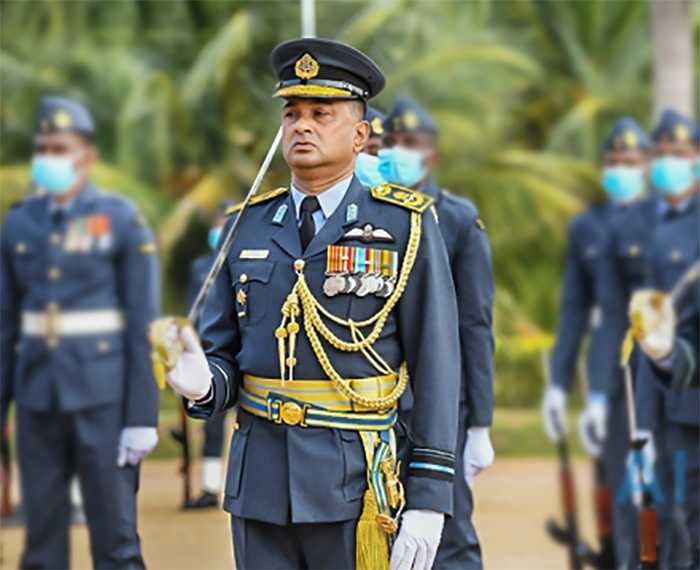
The JVP itself was allowed to re-enter mainstream politics regardless of its murderous past. Therefore, why consider a retired AVM a threat to national security?
The issue at hand is that those who governed this country in the past three decades had caused so much destruction, they fear the emergence of a political power other than them.
That is the crux of the matter.
By Shamindra Ferdinando
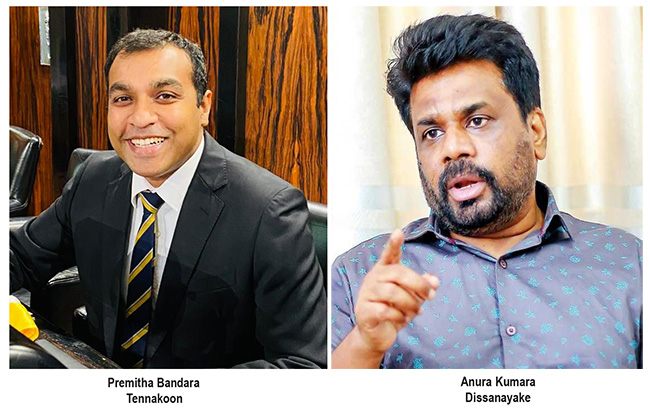
On behalf of the Wickremesinghe-Rajapaksa government, State Defence Minister Premitha Bandara Tennakoon last Friday (24) reacted to accusations over the blacklisting of retired Air Vice Marshal Sampath Thuyacontha.
The Matale District MP declared that Air Force headquarters had no other option but to resort to legitimate counter measures against the threat posed by AVM Thuyacontha.
The officer concerned also served as Sri Lanka’s Defence Attaché in Islamabad after the successful conclusion of the war in May 2009, retired in Nov 2021. His retirement took place a few months before public protests erupted against the then President Gotabaya Rajapaksa over disruption of essential supplies consequent to an unprecedented debt and balance of payment crises.
The former Lieutenant Col. Rajapaksa was caught up in the crisis that had been caused by mismanagement of the economy over the years and especially during the tenures of President Chandrika Bandaranaike Kumaratunga (1994-2005) and she left office leaving a negative growth rate, Mahinda Rajapaksa (2005-2015) and Maithripala Sirisena (2015-2019). However, during the Yahapalana administration the finances were under the UNP control.
Gotabaya Rajapaksa contributed to the calamity by slashing taxes, including VAT with the idea of encouraging growth, but at the worst possible time in the aftermath of debilitating suicide attacks by terrorists on Easter Sunday 2019 and the onset of the COVID pandemic, stubbornly failing to seek IMF help with clear signs of economic trouble and ruination of the agriculture sector by his hasty decision to ban the import of chemical fertiliser and other agro chemicals. The 2019 Easter Sunday carnage debilitated the vital tourism sector and covid-19 pandemic caused further deterioration. However, to be fair to President Mahinda Rajapaksa he achieved much during his tenure. In addition to winning the 30-year war, which many pundits said was something our security forces were incapable of achieving, he successfully embarked on a series of massive development projects with Chinese assistance, including building expressways as never before, an international airport, etc., while fighting the costly war to a finish.
Tennakoon, the youngest ever to serve as the State Defence Minister found fault with the SLAF veteran for causing dissent among the SLAF. The State Defence Minister is an SLPP Matale District MP and one-time minister Janaka Bandara Tennakoon’s son.
Premitha Bandara Tennakoon received ministerial appointment from President Ranil Wickremesinghe on Sept. 08, 2022.
The bone of contention is a fiery speech the AVM delivered on March 05 in Gampaha. Referring to the debarred SLAF officer’s previous speeches, the State Minister declared the Gampaha speech was not acceptable at all.
The State Minister discussed how the retired officer’s actions were in line with the overall JVP-led Jathika Jana Balavegaya (JJB) political strategy that could cause further turmoil in the country by inciting hatred on the government.
MP Tennakoon dealt with the issue at hand against the backdrop of the overthrowing of President Gotabaya Rajapaksa following unprecedented mob violence, which were painted as peaceful protests by interested parties.
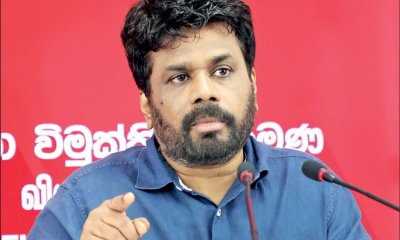
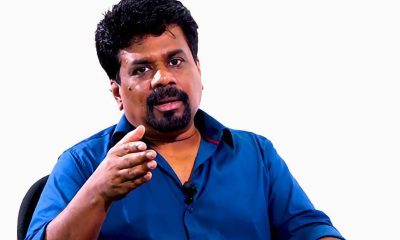
The State Minister in particular pointed to the culpability on the part of the JVP in inciting the public against the then government and security forces. The State Minister was responding to JVP leader Anura Kumara Dissanayake, who raised the issue at hand. Let me leave the JVPer’s rhetoric and just concentrate on the primary issue. The Colombo District MP essentially asked whether ex-military personnel could engage in politics only if they aligned with the incumbent government or those acceptable to the regime.
The JVPer also questioned restrictions imposed on Maj. Gen. Aruna Jayasekera, who led the group of ex-military personnel affiliated to the JJB.
Lawmaker Dissanayake challenged the government over the degrading treatment of a retired senior officer while comparing the latest development with the high profile role played by Defence Secretary Kamal Gunaratne in the run-up to the 2019 presidential election and war winning Army Commander Field Marshal Sarath Fonseka’s role.
Obviously that is the bone of contention. A decorated pilot, who commanded the celebrated No 09 Attack Helicopter Squadron, Thuyacontha is the senior most retired SLAF officer to declare his support directly to the JVP. The move may have caused alarm among the top government leadership as well as the intelligence community in light of the fact the JVP had been responsible for two abortive violent rebellions in the country and both of which had to be crushed by the elected governments then in power after much bloodletting. That is an undeniable fact. Directorate of Provost, SLAF, in a confidential missive, dated March 10, 2023, addressed to all stations blacklisted four personnel (three retired, including Thuyacontha and one discharged). In addition to the renowned pilot, the other blacklisted were Warrant Officer R.H.A. Indika, Sergeant H.A.U.A. Premaratne and Corporal W.A.P.C. Perera. The JJB has vowed to move the Supreme Court against the government move.
Unfortunately, the issue erupted during a UN inspection of the Sri Lankan Army’s capacity to enhance its deployment in Mali, a landlocked country in West Africa.
Restrictions imposed on war winning Sri Lankan military leadership by the UN as well as individual countries such as travel ban on General Shavendra Silva should be examined alongside the other contentious matters. Foreign Minister Ali Sabry, PC, is on record as having said (in response to a query raised by the writer at a Foreign Ministry media briefing) that entire fighting divisions had been targeted by the international community, meaning the Western camp led by the US.
Nalin Siriwardhana formerly of the Navy in a Facebook post strongly backed measures taken against AVM Thuyacontha on the basis that those serving and retired officers engaged in politics for their personal benefit.
Australia-based dual citizen Siriwardhana without hesitation declared that the likes of AVM Thuyacontha should engage in politics without wasting time in a bid to deceive the public. One-time Sri Lanka Telecom employee emphasised that the officer concerned couldn’t have been unaware that such disciplinary measures were routine in the case of those retirees who engage in politics.
Siriwardhana stressed that as there couldn’t be any exceptions, the AVM shouldn’t expect special treatment under any circumstances. The Commander-in-Chief, in this instance, President Ranil Wickremesinghe who also holds defence portfolio enjoys the right to appropriately respond to such unacceptable conduct on the part of retired officers and men.
Retired Lieutenant Siriwardhana figured in a previous Midweek piece (A forgotten episode: Black Sea Tiger raid on Colombo port, published on Oct 12, 2022 /https://island.lk/a-forgotten-episode-black-sea-tiger-raid-on-colombo-port/).
The former Navy officer’s stand should be carefully examined taking into consideration the duplicitous response of successive governments to military men dabbling in politics. That was the issue raised by the JVP leader in Parliament. Before that let me briefly discuss Thuyacontha’s contribution to defeat the LTTE.
A daring pilot
 The Aerial Tribute: The Role of Air Power in Defeating Terrorism in Sri Lanka authored by Dr. Nirosha Mendis at the request of Air Marshal H.D. Abeywickrama
(Feb 27, 2011-Feb 27, 2014). Without doubt, Dr. Mendis’s work is the only available complete account of SLAF’s role in the war with excellent analysis of the role played by different formations and units. The author skillfully dealt with the No 09 Attack Helicopter Squadron and the overall impact the daring unit had on the war.
One of the most thought-provoking brief episodes mentioned therein is serious battle damage suffered by Mi-24 helicopter gunship piloted by the then Wing Commander Thuyacontha, the daring Commanding Officer of the No 09 Squadron, headquartered at Hingurakgoda. This was during Close-Air-Support (CAS) mission over the LTTE stronghold of Mulliyaweli, Mullaitivu during the final phase of the offensive action.
Thuyacontha’s fighting machine was hit 32 times during that battle, one of the fiercest during the Eelam War IV. On the paqrticular day the daredevil CO of the No 09 Squadron flew on the mission from China Bay, Trincomalee and found it difficult to return to the base due to heavy battle damage. Thuyacontha told The Island: “We were short of rockets, therefore Mi-24s couldn’t engage targets from somewhat a safe distance but move closer to engage targets with guns.”
Having received the command of the elite Squadron in 2005, the year before the Eelam War IV erupted with simultaneous LTTE offensives in the North and East, Thuyacontha relinquished command in Sept 2009.
Ex-military role in GR’s strategy
During yahapalana dispensation (2015-2019), ex-military officers openly campaigned for Gotabaya Rajapaksa. Initially, the wartime Defence Secretary didn’t have the anticipated support from some sections of his own family as well as the SLPP but gradually he turned around the situation. Retired officers played a significant role in the overall campaign, but to varying degrees. The writer wouldn’t under any circumstances deny backing the high profile campaign from the very beginning. The yahapalana government never tried to dissuade ex-military personnel from campaigning for Gotabaya Rajapaksa.
Maj. Gen. G.A. Chandrasiri and Rear Admiral Mohan Wijewickrema went a step further by launching a book titled ‘Conflict and Stability’ in support of Gotabaya Rajapaksa. The book launch organised by Gotabaya Rajapaksa’s brainchild Viyathmaga was held in Nov 2016. One-time Northern Province Governor Chandrasiri received the appointment as Chairman, Airport and Aviation Services on Dec 18, 2019. Among those present on that occasion were Vice Admiral Mohan
Wijewickrema, Air Chief Marshal Roshan Goonetileke and Anura Fernando (Later received appointment as Sri Lanka’s Counsel General in Shanghai, China).
Wijewickrema assumed duties on June 12, 2020 as Sri Lanka’s High Commissioner in Pakistan whereas Roshan Gunatileke received appointment as Governor, Western Province on March 24, 2020.
Retired Maj. Gen. Kamal Gunaratne, who made a valuable contribution to Gotabaya Rajapaksa’s campaign, received appointment as Secretary to the Ministry of Defence on Nov 19, 2019.
The author of Road to Nanthikadal spearheaded the propaganda campaign with appearances on television as well. Gunaratne, the former General Officer
Commanding (GoC) of 53 Division was re-appointed Defence Secretary by President Ranil Wickremesinghe.
Former Army Chief of Staff Nanda Mallawarachchi, too, received an appointment from President Gotabaya Rajapaksa while ex-Army Chief Daya Ratnayake was appointed Chairman Ports Authority (SLPA). Post-war commander Ratnayake was unceremoniously removed from that post in June 2021.
Former Navy Commander Admiral Jayanath Colombage received appointment as Secretary to the Ministry of Foreign Affairs in August 2020. Currently, the post-war Navy Commander is Sri Lanka’s Ambassador in Indonesia, while retired SLAF Commander Air Marshal Sumangala Dias serves as Sri Lanka’s top envoy in Malaysia.
It wouldn’t be realistic to list all ex-military personnel who received government appointments both here and overseas.
After Sri Lanka’s triumph over LTTE terrorism in May 2009, the then Mahinda Rajapaksa government opened the doors for more-ex military personnel to enter politics. The government brazenly exploited the situation to its advantage. The UNP-led Opposition, too, likewise, brought in the then General Fonseka into the political ring in late 2009. Fonseka received the backing of a coalition that included both the JVP and the TNA, despite it having recognised the LTTE as the sole representative of Tamil speaking people way back in 2001 and then having blamed Fonseka and his war winning army of committing war crimes after the crushing defeat of the Tigers.
The UNP led move received the blessings of the US. Thanks to revelations made by the Wikileaks, the direct US involvement in the project that brought forward Fonseka as the common presidential candidate cannot be denied.
The US intervened on behalf of Fonseka after he was incarcerated. Sustained US pressure contributed to Fonseka’s subsequent release but he couldn’t come to terms with the UNP subsequently though he received their support at the 2010 presidential poll.
Washington well-known for playing Dr. Jakyl and Mr. Hyde roles world over to maintain its world hegemony, it would be interesting to know the US reaction to the Thuyacontha affair, particularly against the backdrop of perceived US readiness to work with the JVP too. US Ambassador Julie Chung paid a rather unusual courtesy call on JVP leader Dissanayake, MP, and Vijitha Herath, MP, at their Bataramulla headquarters on May 14, 2022. That visit was made at a time when President Gotabaya Rajapaksa was struggling to regain control of the rapidly deteriorating situation. The US Ambassador had no qualms in meeting JVP leaders in spite of accusations the party influenced the campaign directed against the President Gotabaya Rajapaksa, the military and the ruling party.
State Defence Minister Tennakoon didn’t mince his words when he questioned the JVP’s role in May’s gory violence in the aftermath of a SLPP goon attack launched from Temple Trees on protesters outside it and at Galle Face.
Recent declaration made by Tourism Minister Harin Fernando in Badulla that UNP leader Ranil Wickremesinghe spearheaded the campaign at the Presidential Secretariat (old parliament), too, cannot be ignored.
President Wickremesinghe has lambasted Frontline Socialist Party (FSP) for being responsible for violence, a charge vehemently denied by the breakaway JVP faction.
Wickremesinghe went to the extent of naming FSP General Secretary Kumar Gunaratnam as the mastermind in the violent political project.
JJB makes headway
AVM Thuyacontha’s unexpected move received quite a significant public response. The government and the main Opposition still appeared to have failed to comprehend why the public appears to be increasingly appreciative of the JJB. Actually, the JJB with just three MPs including one National List MP in the current parliament is politically insignificant in terms of parliamentary strength. Having ruined the economy over the past several decades leading to declaration of bankruptcy early last year, the major political parties should accept responsibility for creating a perfect environment for the JJB. The JVP/JJB had never been attractive to the military or ex-military though perhaps just an insignificant number of officers and men may have sympathized with their cause.
AVM Thuyacontha or Maj. Gen. Jayasekera wouldn’t probably at least considered voting for the JVP/JJB if not for the ruination caused by major political parties.
Instead of taking remedial measures, at least now, the government has decided to confront the perceived threat from the growing opposition.
The composition of parliament possibly doesn’t reflect the present public sentiment at all. The unceremonious exit of Gotabaya Rajapaksa in last July may have proved that the electorate no longer respected the two mandates received by the ruling SLPP at Nov 2019 presidential and August 2020 parliamentary elections. But the question is whether the entire ouster was instigated and executed from scratch by the West with the help of local quislings as has happened in so many other countries where they have successfully instigated regime changes or attempted them from Chile to Bolivia, Iran, Libya, Syria etc, etc. And they have the audacity to threaten regime change even in Russia!
In spite of incumbent President Ranil Wickremesinghe being legitimately elected by parliament in last July, discontent among the electorate is growing as claimed by the opposition. A major propaganda effort to depict the finalisation of the USD 2.9 bn and the immediate availability of USD 333 mn as a massive victory for the government went awry when State Finance Minister Ranjith Siyambalapitiya admitted that within 24 hours USD 121 mn was paid to India. The government seems to be trapped in its own propaganda and being silly.
Those who are rattled by the JVP/JJB drawing support of the ex-military should pressure the government and the main Opposition to address issues at hand. The only way to thwart the JVP/JJB is to take tangible measures to drastically curb waste, corruption, irregularities and mismanagement. If they bother to peruse proceedings of
Parliamentary watchdog committees, COPE, COPA and COPF, action could be initiated to reverse the situation. Unfortunately, the government and the main Opposition seemed to be driving more people to the JVP/JJB by giving corruption a free hand.



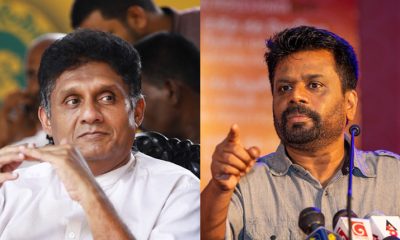

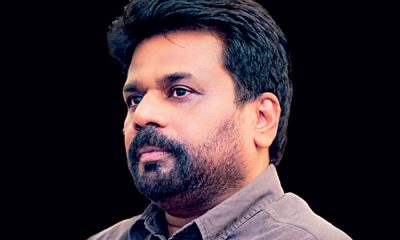

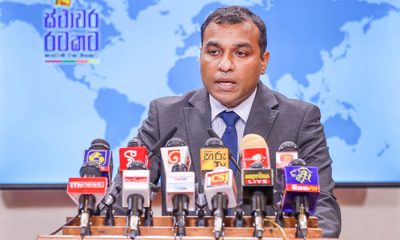

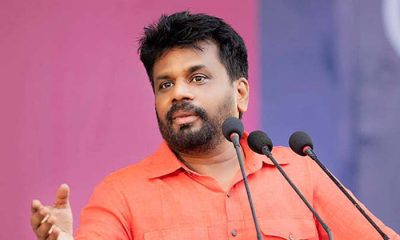

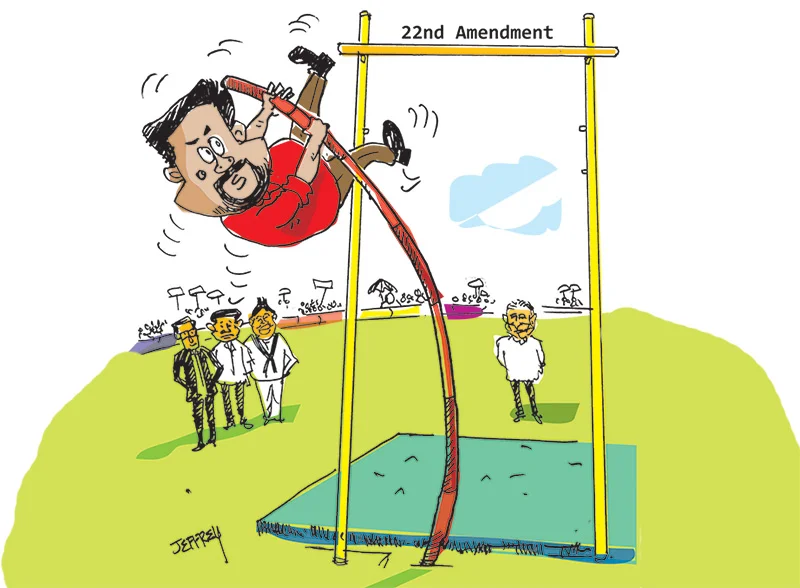
The government’s high profile project to enact the 22nd Amendment failed to secure any tangible support from anyone outside the NPP, in Parliament or outside. In a statement, the Illankai Thamil Arasu Kadchi (ITAK) noted that the proposed amendment concerned the sovereignty of the people and, therefore, required approval through a referendum. The ITAK, a key member of the six-party Political Council of Tamil-Speaking people (PCTSP) and the second largest party in the Northern and Eastern Provinces, other than the NPP, is opposed to President Dissanayake’s move. Tamil Progressive Party (TPA) leader and former Minister Mano Ganeshan, also of the PCTSP, has rejected the 22nd Amendment. The Island learns that all political parties, represented in the PCTSP, are opposed to the proposed Amendment.
The NPP obtained the most seats at the Parliamentary General Election 2024. Other parties that managed to gain seats in Parliament are the Samagi Jana Balawegaya (SJB/40 seats), Ilankai Tamil Arasu Kadchi (ITAK/8 seats), New Democratic Front (NDF/5 seats), Sri Lanka Podujana Peramuna (SLPP/3 seats), Sri Lanka Muslim Congress (SLMC/1), Sarvajana Balaya (SB/1), United National Party (UNP/1), Democratic Tamil National Alliance (DTNA/1), All Ceylon Tamil Congress (ACTC/1), All Ceylon Makkal Congress (ACMC/1), Jaffna – Independent Group 17 (IND17-1) and the Sri Lanka Labour Party (SLLP/1).
Timeline
* March 30, 2026, BASL wrote to Justice and National Integration Minister Harshana Nanayakkara seeking a meeting to discuss 22A
* May 25, 2026, BASL wrote to President Dissanayake seeking a meeting to discuss the same
* July 16, 2026, BASL wrote again to the Justice Minister underscoring the failure on his part and the President to respond to previous letters
* July 27, 2026, NPP executive committee member advocate Lal Wijenayake declared opposition to the government move
* July 29, 2026, BASL met the Justice Minister, sought a meeting with President Dissanayake
* July 31, 2026, Mahanayakes of four Chapters (Nikayas) wrote a joint letter to President Dissanayake urging him not to go ahead with the 22nd Amendment. But, the Mahanayakes refrained from releasing the letter to the media
* August 3, 2026, BASL disclosed the Mahanayakes’ letter to the President. Justice Minister Nanayakkara, accompanied by Health and Media Minister Dr. Nalinda Jayathissa, visited the Mahanayakes to explain the government stand. But, they denied receiving the crucial letter
* August 7, 2026, UN requested President Dissanayake, in no uncertain terms, to abandon the move.
* August 11, 2026, Government admitted receiving the Mahanayakes letter
* August 18, 2026, 22nd Amendment Bill presented in Parliament. Those opposed to the constitutional amendment began filing petitions. The BASL led the way. By 24 August, 21 petitions were filed.
* August 20, 2026, Catholic Bishops’ Conference urged the government not to proceed without adequate consultations.
* August 24, 2026, BASL, in a motion filed in the Supreme Court, suggested that Chief Justice Preethi Padman Surasena recuse from hearing the petitions
By Shamindra Ferdinando
In support of the ruling National People’s Power (NPP) government’s highly contentious move to enact the 22nd Amendment to the Constitution despite worldwide condemnation by eminent jurists, meant to extend the retirement ages of superior court judges, NPP leader and President Anura Kumara Dissanayake will address a series of countrywide meetings.
Dissanayake is also the leader of the Janatha Vimukthi Peramuna (JVP), the main constituent of the governing party.
Justice and National Integration Minister and Attorney-at-Law Harshana Nanayakkara, on 18 August, 2026, tabled the controversial 22nd Amendment Bill in Parliament. Nanayakkara also tabled the Judicature (Amendment) Bill on the same day. That will pave the way for the increase of the retirement ages of High Court judges to 63 years, and District Court and Magistrate Court judges to 62 years. The government wants to increase the retirement ages of Supreme Court and Court of Appeal judges to 67 and 65, respectively.
However, the government has proposed a six-year term for the Chief Justice but he/she will have to retire at the new mandatory retirement age of 67.
Health and Media Minister, as well as Cabinet spokesman Dr. Nalinda Jayathissa, recently announced the decision to launch the high profile propaganda campaign on 5 September. The NPP and JVP leader has vowed to enact the 22nd Amendment, come what may.
Dissanayake, who took over the party leadership on 2 February, 2014, at the 17th convention of the JVP, and formed the NPP in 2019, has indicated that he wouldn’t, under any circumstances, give up the 22nd Amendment. Dissanayake didn’t mince his words when he received a top level delegation of the Bar Association of Sri Lanka (BASL) at the Presidential Secretariat, on 12 August, to discuss the burning issue wracking the country. It would be pertinent to mention that the BASL raised the issue with Dissanayake, on 25 May, after Nanayakkara ignored their first request, made on 31 March.
The Supreme Court will hear over 20 petitions challenging the constitutionality of the 22nd Amendment Bill. Now that the matter is before the Supreme Court, the main opposition Samagi Jana Balawegaya (SJB) shouldn’t have sought to involve the BASL in a futile attempt to educate the NPP parliamentary group. The BASL, too, should know better. The BASL and SJB are among those who moved the Supreme Court. Against that background it would be unthinkable that the NPP parliamentary group wants to listen to BASL. Government activists, on Monday (24), organised a protest outside BASL Secretariat, NO. 153, Mihindu Mawatha, Colombo 12 demanding the resignation of BASL President Rajeev Amarasuriya.
SJB and Opposition Leader Sajith Premadasa clashed in Parliament with the leader of the House Bimal Rathnayake over his bid to bring in the BASL team to address the whole Parliament. NPP National List lawmaker Najith Indika declared on X that “the Opposition Leader couldn’t call all MPs for meetings. BASL either does not follow parliamentary procedure or knows how to manipulate public perception.”
The Supreme Court will receive petitions during two weeks, after the tabling of the Amendment. The Court should inform the Speaker of its determination within three weeks. Parliament will receive that determination ahead of President Dissanayake completing his second year in Office. The last presidential election was held on 21 September 2024.
Dissanayake won a five-year term and in November, the same year, led the party to a resounding victory at the parliamentary poll. The NPP/JVP position is that both Bills can be enacted with a 2/3 majority. With a mammoth 159 seats in Parliament, the government is confident that its political project can be easily achieved. But, the NPP operation has run into significant opposition with the United Nations, throwing its weight behind the BASL-led campaign.
Tabling of the two Bills on 18 August coincided with the 39th anniversary of the JVP grenade attack on the UNP parliamentary group, in the wake of the signing of the Indo-Lanka peace accord in 1987. Ajith Kumara, at that time a minor parliamentary employee, lobbed a hand grenade at the UNP group meeting, chaired by President J.R. Jayewardena. Prime Minister Ranasinghe Premadasa, too, was present. The then National Security Minister Lalith Athulathmudali narrowly escaped death in the attack that took place in the Committee Room 1 of Parliament. Deniyaya MP and Matara District Minister Keerthi Abeywickrema was killed. The writer covered the funeral, held on 22 August, 1987, at the playground of the Morawaka Maha Vidyalaya. Then the young Minister in charge of Youth Affairs and Employment, Ranil Wickremesinghe, was among those who represented the government at the funeral.
Kumara had been recruited as a sweeper by no less a person than the then Secretary General of Parliament, Nihal Seneviratne. Had Kumara been a member of the proscribed JVP at the time he joined the parliamentary staff or did the JVP approach him later?
The Colombo High Court acquitted Ajith Kumara on 12 October, 1990, and released him from custody on 6 August, 1993. Subsequently, the JVP accommodated Ajith Kumara on the party’s politburo and paved the way for him to contest the Sabaragamuwa Provincial Council poll on the JVP ticket. With fat hopes the JVP named him their chief ministerial candidate.
Key Opp demands
Pointing out that the matter before the Supreme Court judges related to them, the BASL requested that a bench consisting of a full court, comprising all the judges, be constituted to determine the constitutionality of the 22nd Amendment Bill. The BASL also requested the Supreme Court to determine that the Bill is inconsistent with Article 3 of the Constitution and required approval by the people at a referendum.
In the alternative, the BASL sought determination that Clause 2 of the Bill is inconsistent with Article 3 of the Constitution and required approval by the people at a referendum and Clause 3 of the Bill is inconsistent with Article 3 of the Constitution and required approval by the people at a referendum.
Essentially, all petitioners have requested for a full court, comprising all Supreme Court judges and a referendum, if ordered, it’ll be the second instance. The first referendum was held in December 1982. The UNP that won an unbeatable 5/6 majority in a 168-member Parliament, at the 1977 parliamentary election, obtained a mandate of the people to extend the life of Parliament by six years. That utterly undemocratic, unreasonable and treacherous act contributed to the overall deterioration of the country. By the time the 1989 parliamentary poll was held, the police, backed by the armed forces, were fighting the JVP in the South, and the Indian Army, deployed in the Northern and Eastern regions, in terms of the Indo-Lanka Accord.
Former External Affairs Minister Prof. G. L. Peiris, convenor of the Joint Opposition grouping, too, moved the Supreme Court against the 22nd Amendment, and General Secretary of the SJB Ranjith Maddumabandara did the same. Altogether there were nearly two dozen petitioners
Ex-Law Professor Peiris has vigorously campaigned against the government move, and the weekly media briefing. held at former President Wickremesinghe’s Flower Road Office, has become the focal point of the Opposition campaign. Peiris insists that the Supreme Court shouldn’t hear the petitions as justices were direct beneficiaries of the proposed Amendment. Therefore, determination should be made at a referendum. In case the Supreme Court decides to hear the petitions, the full court consisting of all judges should be constituted to determine the constitutionality of the 22nd Amendment Bill, the former parliamentarian has asserted.
As repeatedly stressed by Prof. Peiris, two previous determinations by the Supreme Court that the alteration of superior court judges’ retirement ages should be subject to a referendum cannot be disregarded, under any circumstances. One of the determinations is of crucial importance as former Chief Justice Murdhu Fernando (December 2024 to July 2025) served on the three-member bench that made the far reaching announcement in 2022.
But, the BASL made an unexpected move on Monday. Close on the heels of its petition against the 22nd Amendment to the Constitution, the BASL filed a motion in the Supreme Court suggesting that Chief Justice Preethi Padman Suresena recuse from hearing petitions.
Petitioners BASL President Rajeev Amarasuriya and its Secretary Nalin de Silva cited Attorney General as the respondent in a motion filed in terms of Article 121 read with Article 120 of the Constitution to determine whether the Bill, titled “Twenty Second Amendment to the Constitution,” or any part thereof, is required to be passed by a Referendum in terms of Article 83 of the Constitution.
The BASL pointed out that the first Judge of the Supreme Court, who would benefit if this Bill is enacted into law without the process of a referendum, is the Chief Justice, and further that if a referendum is mandated, then that there is a possibility that the Chief Justice may retire before its completion, and if for those reasons, the Chief Justice wished to recuse from hearing this matter, then the petitioners have requested the Chief Justice to constitute a bench comprising of all other judges in Supreme Court.
The maximum number of Supreme Court and Court of Appeal judges are 17, including the CJ and 20 judges ,including the President of the Court of Appeal, respectively. The NPP caused controversy by not filling vacancies among the superior court judges with the Opposition alleging there were four vacancies each. There’ll be another vacancy among the Court of Appeal judges in the first week of September.
The warning issued by the UN following a spate of other statements from various local and international bodies has brought tremendous pressure on the government. Having initially denied any knowledge of a joint letter, dated July 31, addressed to President Dissanayake by the Malwatta, Asgiriya, Amarapura and Ramanna chapters, the government, on 11 August, admitted the President received the letter.
However, the Catholic Bishops Conference publicly commented on this issue, only on 20 August, after all other concerned parties censured the government over the move. A section of the civil society that portrayed the 22nd Amendment as the panacea for a mountain of cases held up in courts had no option but to sing a different tune after the UN warned the NPP government over the pet project that seemed to have backfired. The UN’s position rattled the government and its backers.
18A and 20A
War-winning President Mahinda Rajapaksa enacted 18th Amendment to the Constitution in early September 2010. That despicable political project did away with a two-term time limit for the executive president and expanded presidential powers over independent commissions. That Bill received 161 votes, two more than the NPP parliamentary group. But, 18A didn’t do any good for President Rajapaksa or his party. Maithripala Sirisena, General Secretary of Mahinda Rajapaksa’s party, betrayed him, won the 2015 presidential election, and created an utterly undesirable political environment that, over a period of 10 years, ruined the country’s major political parties.
The emergence of the NPP as the dominant power should be examined taking into consideration the deterioration of the UNP, SLFP and the SLPP. The UNP and SLFP are no longer represented in Parliament while the SLPP that won a commanding 145 seats at the 2020 parliamentary poll was reduced to just three lawmakers in Parliament. SLPP’s National Organiser Namal Rajapaksa was so concerned about the transformation of the political environment he took refuge in the National List. Had he not taken that precaution, he wouldn’t be in Parliament today. While the SLPP deteriorated from 145 seats to just three, the NPP, whose 2020 parliamentary group consisted of just three, including one National List member (Dr. Harini Amarasuriya) ended up taking 159 seats, the best results achieved under the Proportional Representation system introduced in 1989.
Having handsomely won the 2019 presidential election, Gotabaya Rajapaksa brought in the 20th Amendment aimed at further consolidating his hold on power. Basil Rajapaksa, a dual citizen of Sri Lanka and the US, wanted to enter Parliament through the National List. The Rajapaksas removed a particular clause through the 19th Amendment to enable Basil Rajapaksa to enter Parliament. Subsequently, the SLPP accommodated Basil Rajapaksa in the Cabinet as the all-powerful Finance Minister. He succeeded Mahinda Rajapaksa in July 2021. But by then, the national economy had suffered irreparable damage and the 20th Amendment, meant to consolidate executive power, seemed irrelevant. Public protest campaign that received overt and covert US and Indian backing was launched in March 2022, leading to President Gotabaya Rajapaksa’s unceremonious ouster in July of same year due to India and Western backed violent protests.
The 18th Amendment and the 20th Amendment were enacted at the expense of particularly the 17th and 19th Amendments, respectively.
The Frontline Socialist Party (FSP) has alleged that the 22nd Amendment would enable the government to implement its neoliberal programme. The breakaway JVP group has asserted that the government’s sinister project is intended to remove whatever obstacles to its neoliberal strategy.
FSP’s Education Secretary Pubudu Jayagoda said: “A new Fisheries Act will divide the ocean into plots, lease the fish-rich areas to multinational corporations, and deprive local fishermen the opportunity to catch fish in the deep sea. The biggest obstacle to this is the fishermen. A Quality Assurance and Accreditation Commission Act is being drafted to grant state recognition and legality to degree mills. Three thousand schools are going to be closed, depriving children of the fundamental right to education. To do that, every pillar of the state must be brought under government control. A long list can be given: privatising hospital laboratory services, selling off state institutions, bringing forward new repressive laws like the PSTA (Protection of the State from Terrorism Act), and a new Cooperatives Act that snatches away people’s funds—many things like that. Taking the arbitrary power required to execute these into the hands of the executive is the true objective of this constitutional amendment.”
Displaying Gender-Based Issues that Resonate with Our Times
by Dr. Siri Galhenage
Psychiatrist [Retd]
In most of William Shakespeare’s plays, the protagonists are male. He created such memorable characters as Hamlet, Othello, King Lear, Macbeth, Julius Caesar, Prospero, Coriolanus, the monarchs of history plays and many others – heroes as well as villains. This was a reflection of the societal values of the time. Women were not permitted to perform on stage, and all female roles were played by young males – a practice that continued for nearly half a century after Shakespeare’s death. This was so even though Elizabeth 1, the learned female monarch of England and Ireland and a humanist, occupied the throne during most of Shakespeare’s writing life [1580–1613], and extended her patronage to his plays.
Nevertheless, compared with his contemporaries Christopher Marlowe and Ben Jonson, Shakespeare wrote a greater number of plays featuring prominent female characters that drove the narratives, providing insights into intra-psychic, interpersonal, social and moral aspects of life.
I have selected two such female characters from Shakespeare’s plays and another from one of his narrative poems to illustrate this idea, focusing primarily on gender based violence – emotional, physical and sexual – that continues to resonate in our own times. I have also chosen another female character who challenged the gender constraints that imposed by contemporary society.
DESDEMONA in Othello –
A Victim of Morbid Jealousy
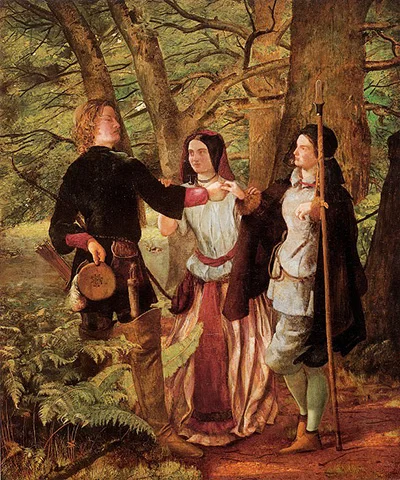
A scene from As You Like It
Jealousy, as a human experience, has many nuances of meaning, ranging from the harmless to the morbid, including delusional forms, with many variations in between. The object of concern in jealousy is the suspicion of unfaithfulness or infidelity on the part of a loved one, commonly a female partner in a marital relationship. In its morbid form, accompanied by intense passion, jealousy has the potential to be destructive and even dangerous, placing the spouse at risk. It is not an uncommon presentation in clinical practice attracting the diagnosis of ‘Othello Syndrome’ although there is disagreement among clinicians about the application of the term.
Othello, a valiant soldier of African heritage in the state of Venice, had no difficulty winning the heart of Desdemona, the attractive young daughter of a prosperous senator. He took her away in defiance of her father’s wish for her to marry into the Venetian nobility. At this point, the Turks were preparing to regain Venetian-held territory in Cyprus, and Othello, recognised for his military prowess, was selected to lead the defence of the territory.
Despite the imminent Turkish attack on Cyprus, Desdemona preferred to remain with her husband rather than stay in Venice. The attack did not eventuate, however, because a violent storm dispersed and destroyed the invading Turkish fleet. The Venetian forces rejoiced, and the occasion provided an added opportunity to celebrate the marriage of Othello and Desdemona.
Casio, a close confidant of Othello, who had been recently promoted to lieutenant, was delegated to supervise the festivities. Cassio’s promotion caused great offence to Iago, who strongly believed that he was better suited to the position. He plotted to take revenge on Othello and Cassio by planting the seed of doubt in Othello’s mind through innuendo and trickery, casting suspicion on Desdemona’s fidelity and on her relationship with good-looking Cassio. Desdemona, a woman of exuberance and humour, became the unwitting focus of Iago’s manipulation.
The dissonance that arose in Othello’s mind eventually reached a climax when he accused his wife of infidelity and became convinced that she should die. Despite Desdemona’s plea for compassion, Othello strangled her to death. On finally gaining insight into the whole saga, Othello fell on his sword beside his wife.
OPHELIA in Hamlet – A Case of Manic Defence in response
to emotional abuse
Hamlet, the Prince of Denmark, takes centre stage in the play of the same name, and his mental processes have been the focus of scrutiny by successive generations of critics.
Young Prince Hamlet is faced with a complex emotional challenge following the sudden death of his father, King Hamlet, he idolised. The late king’s brother, usurper to the throne, hastily marries the widowed queen, denying the young prince his lawful right to sovereignty. Hamlet’s grief is compounded by his outrage towards his mother and his lingering doubts about the circumstances of his father’s death. He lapses into a state of melancholy.
But the impact of Hamlet’s emotional instability and the displacement of his anger onto Ophelia, to whom the prince had professed his love, receive less attention by critics, despite the significant psychological issues raised by her predicament. The episode in which Hamlet directs his anger towards Ophelia – often referred to as the ‘nunnery scene’ – is considered one of the most vicious in all Shakespeare.
Get thee to a nunnery. Why wouldst thou be a breeder of sinners?”…. “If thou dost marry, I’ll give this plague for thy dowry, be thou as chaste as ice, as pure as snow, thou shall not escape calamity. Get thee to a nunnery; go, farewell. Or if thou wilt needs marry, marry a fool, for wise men know well enough what monsters you make of them. To a nunnery go, quickly too. Farewell
Her love for Prince Hamlet was forbidden from the outset by her father, the scheming counsellor, Polonius, and by her brother Laertes; she was obedient to them. With her dignity destroyed by the very person she loved and her father killed, albeit inadvertently by the hand of her lover, she nevertheless reacted with compassion. With her brother away in France, Ophelia is bereft of any meaningful relationships.
With no one left to confide in, her mind had no alternative but to escape reality. She lapsed into a state of mania – a state of ‘fragile happiness’ with underlying deep sorrow; an unconscious defensive operation of the mind known as ‘manic defence’, as described by Melanie Klein [1882-1960], the renowned Austrian Psychoanalyst.
In this state of mind, Ophelia presents herself before the king and queen, singing snatches of song concerning love, death and betrayal. Her behaviour is totally out of character to her formerly demure self. Here are a few excerpts from her verses illustrating what might be described as a ‘flight of ideas’.
How should I your true love know/ From another one? / By his cockle hat and staff/ And his sandal shoon…”
“He is dead and gone, lady/ He is dead and gone/ At his head a grass green turf/ At his heels a stone…
They say the owl was a baker’s daughter. Lord we know what we are, but know not what we may be. God be at your table …
Hey non nonny, nonny, hey nonny/ And in his grave rained many a tear …” “You must sing ’Adown adown’ and you call him adown-a.”
Later, Queen Gertrude, Hamlet’s mother, announced that Ophelia ‘Fell in a weeping brook while making garlands from crow-flowers, nettles, daisies and long purples’, and had made no attempt to save herself. At the graveyard two gravediggers discussed whether she deserves a Christian burial as she appeared to have taken her own life.
LUCRECE – in Shakespeare’s narrative poem The Rape
of Lucrece
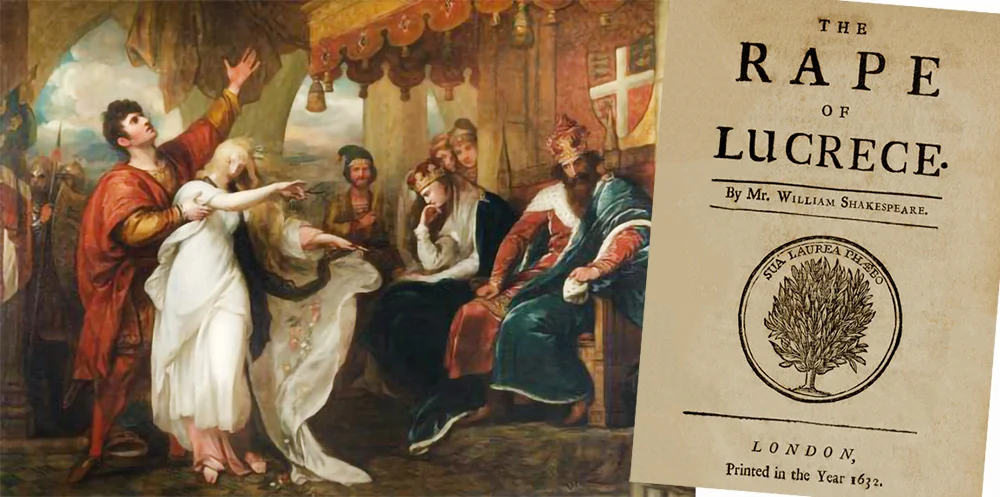
Reworked from a story by the Roman historian Livy, Shakespeare’s innovative narrative poem, first published in 1594, gives access to the mind of a victim of sexual assault. Set in ancient Rome, the poem gives expression to the agony of Lucrece, the gracious wife of a nobleman, following a savage attack upon her by Sextus Tarquinius, the son of the brutal king Lucius Tarquinius of Rome.
During a joyous conversation, a group of young noblemen were commenting on the virtues of their wives when Collatinus extolled the incomparable beauty and chastity of his beloved Lucrece. Aroused by the description of her elegance, young Sextus makes a covert exit, ‘borne by the trustless wings of desire’ in pursuit of his prey –the peerless dame’, ‘weakly fortressed from a world of harm.
Lucrece warmly welcomes her royal guest, who shows no inward ill or outward harm. He praises her husband’s military prowess, ‘pawning his honour to obtain his lust. During the conversation he scans her beauty and burns with sexual desire, yet ‘is madly toss’d between desire and dread. His ambivalence finally gives way to desire. ‘Desire my pilot, beauty my prize/ ‘Then who fears sinking where such treasure lies?’ This said, he advances upon her, ‘like a falcon towering in the skies, that ‘Coutcheth the fowl with his wings’ ‘So under his insulting falcon lies/ Harmless Lucretia’ shade’, trembling with fear, ‘as fowl hear falcon’s bells’. She ‘lies at the mercy of his moral sting’ and finally succumbs ‘To the rough beast that knows no gentle right/ Nor aught obey but his foul appetite’.
Lucrece is shattered, perplexed and grief-stricken by the unexpected assault on her by her honoured guest. ‘I alone must sit and pine/ Seasoning the earth with showers of silver brine’. She weeps, ‘O unseen shame, invisible disgrace/ O unfelt sore, crest wounding private scar’. Her anguish is further expressed through the image of the violated hive. ’My honey lost, and I, a drone – like bee, have no perfection of my summer left/ But robb’d and ransack’d by injurious theft./ In thy weak hive a wand’ring wasp hath kept/ And suck’d the honey which thy chaste bee kept’.
In this state of mourning, Lucrece despatches two messengers: one to her father in Rome and the other to her husband on the battlefield. On their arrival, she reveals the circumstances of her agony and names the individual responsible. She then stabs herself to death.
Their entourage carry her body through Rome and vow to avenge the death of this ‘incomparable woman of chaste’. By public acclaim the reign of Tarquins is overthrown, and the rule of Rome handed over to the consuls.
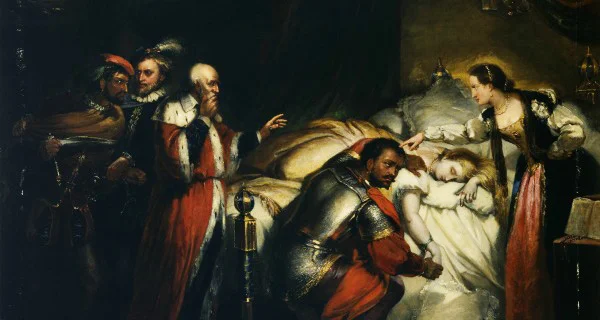
A scene from Othello
ROSALIND in ‘As You Like It’ – Challenging the Gender Constraints
One of the few female characters to play a leading role is Rosalind in ‘As You Like It’. She remains much to the liking of many a theatre goer because of her wit, wisdom and inner strength. Rosalind transcends the constraints imposed on women during the Shakespearean era – constraints that continue to resonate in certain cultures even today.
Two young women of noble birth flee the oppressive court in disguise and seek refuge in the Forest of Arden. Rosalind disguised as a young man, Ganymede, while her devoted cousin Celia adopts the name Aliena. As they depart Celia declares, “Now go we in content/ To liberty, and not to banishment.” Orlando, the object of Rosalind’s affection, also escapes to the forest to evade the hostility of his brother. Unaware of Rosalind’s disguise, he expresses his love by hanging verses in her praise upon the trees. Although Rosalind discovers these poems, she chooses to maintain her disguise, using it as an opportunity to test Orlando’s devotion and explore the nature of love, courtship, and the differing gender expectations. The play reaches a conclusion by Rosalind dropping her disguise, and the two uniting in love.
*****
Gender-based violence is recognised globally as a pervasive violation of human rights and a significant social, cultural and public health concern. Violence against women, including emotional, physical and sexual, varies across societies in form and prevalence, and is often rooted in unequal power relations and social structures that perpetuate male dominance. Gender-based violence requires collective action through education, legal protection, economic empowerment, accessible support services and changes in attitudes and cultural practices. Power and influence should not be allowed to shield the perpetrators.
Art, including dramatic and literary art, serves to illuminate human experience. It allows us to explore emotions, ideas and moral dilemmas that may otherwise remain beyond ordinary expression. Art can entertain and inspire, but it can also challenge our assumptions, evoke empathy, and offer new ways of seeing ourselves and the world around us. In this sense, art is not merely a form of aesthetic pleasure; it is a means of understanding what it means to be human.
Desdemona, Ophelia, Lucrece and Rosalind are among Shakespeare’s more prominent female characters. The first three are innocent victims of male violence in different forms, evoking our empathy and compassion; the fourth challenges the gender assumptions and constraints of the time. Together, they illuminate gender-based issues that are both universal and timeless. In this sense, Shakespeare remains ‘our contemporary’, as Jan Kott, Polish-American literary critic, famously observed.

By Lynn Ockersz
Nature’s not on any vengeance trail….
Rather, from dense forests of the West,
Now all aflame in parts as if in rage,
To South-East Asia’s savaging floods,
And Sri Lanka’s fierce dry spells,
Where man and beast are imperiled,
Nature’s signaling she’s distressed,
Over her custodian’s ravenous lust,
Which unceremoniously gobbles-up,
Her graciously bestowed riches;
‘Take warning; slow down at least now’,
She seems to be chiding her wayward son,
‘Be gentle with me and all my treasures,
And I’ll look to your continuing wellness,
But rein-in your self-destructive fire,
Lest it consumes your willful self in full,
And all I have left in your custodial care.’

Cabinet aporives recruitment of Nursing Instructors for Nursing Schools under the Ministry of Health and Mass Media on Contract Basis
Signing agreement for the establishment of BIMSTEC Technology Transfer Facility in Sri Lanka
The cabinet approves agreement on mutual legal cooperation in criminal matters between the Republic of Sri Lanka and the Republic of Korea

Misbah-ul-Haq resigns as Pakistan selector after Test squad upheaval
Amendment of the Quarantine and Prevention of Diseases Ordinance No. 3 of 1897
Cabinet approves donation of USD One Million to the Government of Nepal

‘Dates have the highest sugar content to fight Coronavirus’

Sunday Island 27 December – Headlines

#SundayIsland 17th December – Headlines

Sunday Island – 28th March

Sunday Island Headlines – 21 March

Sunday Island – 21st February – Headlines
-

 News5 days ago
Eight politicians in drug kingpin probe
-

 Features3 days ago
“Wrap Me Up in My Blazer”— A Gentlemanly Bradby Reminiscence
-

 Business5 days ago
Sri Lanka opens up: A new season of direct connectivity
-
 Features7 days ago
Insights from Chieftains of Uva: Genealogy of two Kandyan Families – Part II
-

 Features5 days ago
Redefining ageing in Sri Lanka
-
 Latest News5 days ago
Nepal-Tibet floods: What happened, what caused them and who is missing?
-

 Editorial7 days ago
Warning of power cuts: El Niño and corruption
-

 Features7 days ago
Export diversification: Missing the wood for the trees – Part I