
Business
Uber Eats brings e-cycles to delivery in Sri Lanka


Uber Eats, Sri Lanka’s most loved food and grocery delivery platform, today brought on board 100 electric cycles on its platform. The e-cycles launched as ‘Voltage Edition’ are manufactured by Lumala, the country’s largest cycle manufacturer, and have been especially designed for deliveries. They have a range of up to 100 kilometers and top speed of up to 30 kilometers per hour. Uber Eats was the first platform to introduce cycle deliveries in Sri Lanka last year.
The e-cycles can cover longer distances than regular bicycles and are easier to maintain than traditional motorbikes. The cycle battery charges in 4 hours: this makes delivery downtime minimum and reduces expenses versus fuel costs. By making it easier to cover a bigger delivery distance radius with lesser effort, delivery partners will be able to potentially make more deliveries and earn more. The initiative is a step forward towards Uber Eats’ global vision of moving all trips to sustainable mobility by 2040.
The announcement was made at an event where Uber Eats sponsored e-cycles worth LKR 42 million for 100 most engaged delivery partners. 90 of these delivery partners were previously using petrol-powered motorbikes while the other 10 were using regular bicycles. The company will also facilitate a 30% discount on the purchase of Lumala e-cycles and 15% discount on spare parts for delivery partners on its platform.
Power & Energy Minister for Sri Lanka, Kanchana Wijesekera, graced the occasion as the Chief Guest, congratulated Uber Eats on its sustainability focus and gave away the e-cycles to select delivery partners. He was joined by the Guest of Honour, Julie J. Cheng, US ambassador to Sri Lanka; along with Mike Orgill, Senior Director, Public Policy & Government Relations, Asia Pacific Region at Uber; and, Pivithuru Kodikara, Interim General Manager, Uber Eats Sri Lanka, among others.
Commenting at the event, Kanchana Wijesekera, Power & Energy Minister for Sri Lanka, said, “Technology-led platforms led a paradigm shift by changing the way people move or order food online. Now, they should focus on another big change by promoting green mobility. We need to reduce dependency on fuel and lower our carbon emissions. Investing and building a green economy is one of our top priorities today. We welcome Uber Eats’ decision to onboard electric cycles and are confident that the company will continue to push sustainable mobility in Sri Lanka.”
Uber Eats had introduced cycle deliveries last year to reduce fuel dependency for delivery partners during the economic crisis. Today, cycle deliveries account for 10 per cent of total deliveries for Uber Eats in Sri Lanka. With e-cycles, Uber Eats takes the next step towards sustainable mobility and paves the way for e-bikes and e-scooters on its platform in the future.
Commenting on the announcement, Mike Orgill, Senior Director, Public Policy & Government Relations, Asia Pacific Region at Uber, said, “We’re committed to Sri Lanka and are continually bringing the best that Uber Eats has to offer to the country. After becoming the first platform to introduce cycle deliveries, we’re onboarding customized e-cycles today in line with our global vision to move to sustainable mobility by 2040. We will soon add e-scooters and e-motorbikes for deliveries as part of our efforts to promote sustainable mobility in the country.”
The Voltage edition e-cycles have been custom designed to compete with electric scooters and motorbikes. They are capable of covering 100+ kilometers on pedal assist on a single charge and can travel 60+ kilometers by throttle full electric cruising. To ensure safer deliveries at all times, they come fitted with day-time running lights and LED Projector and LED Tail Light for nighttime visibility. The e-cycles come fitted with a separate storage at the back for delivery bags that are easy to mount and dismount and reduce motor sound on the roads by being virtually silent.
Recently, Uber Sri Lanka had announced a pilot with Sling Mobility to introduce two-wheeler EVs on its platform. The company will continue to adopt a partnership-led model and join hands with OEMs, fleet partners, EV infrastructure partners, among others to advance sustainable mobility in Sri Lanka.











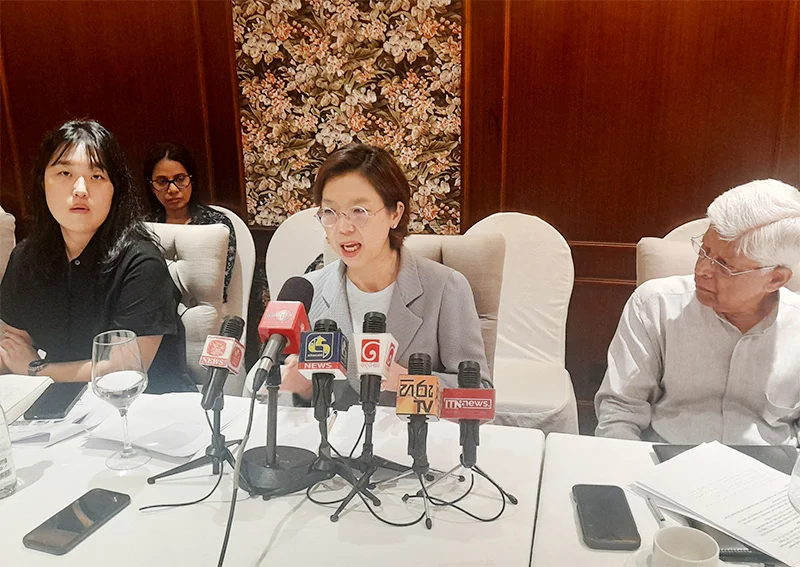
Sri Lanka should mainly focus on upgrading its trade and investment facilitation system while identifying the paramount importance of the issue, South Korean Ambassador to Sri Lanka Miyon Lee said.
The bureaucratic matters—from Customs clearance to tariff lines, licensing, and registration—should be streamlined, she said at a round table forum recently held at the Colombo Club of the Taj Samudra, Colombo. The forum was organized and conducted by the Pathfinder Foundation Sri Lanka and was presided over by its Chairman, Ambassador (Retd) Bernard Goonetilleke.
Ambassador Lee said that the Sri Lankan government and companies must focus on tourism sector development and also find businesses opportunities with Korea.
She also said that if Sri Lanka wants to attract Korean investment into Sri Lanka, Sri Lanka should highly develop its digital sector.
‘On top of that, If Sri Lankan is to sign a FTA or trade agreements, she should focus on niche markets to supply to Korean companies, she explained.
Ambassador Lee added: ‘Korea is highly digital and AI enabled and Sri Lanka needs to concentrate on that as well.
‘Further, it is going to be very important if you will be able to implement all the obligations that are laid out under a WTO agreement.
‘A single window is part of the overall trade architecture that Sri Lanka has to follow.
‘ I think that also follows with the FTA (Free Trade Agreement) negotiations. From Korea’s experience, when we had the financial crisis in 1997, we only pursued WTO negotiations. FTA negotiations came after the financial crisis.
‘The Asia-Pacific Trade Agreement (APTA) is important in this regard.
‘The APTA arrangement includes China, India, Korea, Nepal and Mongolia and 50 percent of Sri Lankan exports to South Korea benefit from the APTA.
‘But other than that, there is not much trade between the two countries. That’s why I think it is going to be very important for Sri Lanka to pursue the RCEP (Regional Comprehensive Economic Partnership) arrangement.
‘Unfortunately, there is not much appetite for upgrading the APTA because we already have separate FTAs with India and China.
‘ We have huge investments in India and in ASEAN countries. I think it would be very important that Sri Lanka uses that kind of opportunity to see if there is any initiative for Sri Lankan companies to provide supplies to Korean companies working in other countries.’
By Hiran H Senewiratne

USD 2.5 million Treasury cyber heist has escalated into a full-blown financial security crisis, with the government scrambling to contain international fallout amid growing fears that multiple foreign debt repayment channels may have been compromised.
In the strongest indication yet of the gravity of the breach, Deputy Finance Minister Dr. Anil Jayantha Fernando told Parliament that investigators had uncovered suspicious irregularities linked to other external payment transactions, including one involving India, suggesting that the cyber intrusion may have extended far beyond the original fraudulent transfer.
The revelation has sent shockwaves through financial and political circles at a time when Sri Lanka is struggling to restore credibility after its historic sovereign default and painful debt restructuring process.
The controversial transfer involved funds earmarked for a debt repayment to Australia Export Finance. However, the money was allegedly diverted into a fraudulent account after what authorities now believe was a sophisticated cyber infiltration targeting Treasury communication and payment authentication systems within the External Resources Department (ERD).
With international confidence hanging in the balance, the Government has moved swiftly to reassure creditors that the incident would not be treated as a sovereign debt default.
Fernando informed Parliament that international debt restructuring advisors had assessed the situation and concluded that the theft constituted a criminal financial breach rather than a deliberate failure by Sri Lanka to honour debt obligations.
Behind the scenes, however, the crisis has triggered an unprecedented multi-agency investigation involving the Criminal Investigation Department (CID), Sri Lanka Computer Emergency Readiness Team (SLCERT), Financial Intelligence Unit (FIU) and foreign law enforcement authorities, including Australian agencies.
Investigators are now carrying out forensic examinations of official email systems, payment authorisation trails, digital devices and Treasury transaction records amid mounting concerns that critical State financial infrastructure may have been exposed to external manipulation.
The scandal has also intensified political tensions, with opposition parties accusing the Government of attempting to downplay the seriousness of the breach while demanding an immediate parliamentary debate and an independent inquiry into Treasury security failures.
Pressure mounted further following the sudden death of an interdicted Finance Ministry official reportedly connected to the ongoing investigation.
Although authorities have not officially linked the death to the fraud probe, the incident has fuelled widespread speculation and heightened public suspicion surrounding the case.
The latest disclosures have raised troubling questions about the vulnerability of Sri Lanka’s public financial systems, particularly as billions of dollars in foreign debt repayments, aid flows and restructuring transactions continue to pass through Government channels under intense international scrutiny.
Financial analysts warn that while creditors may refrain from categorising the incident as a formal default, the cyber heist could still damage Sri Lanka’s credibility unless authorities demonstrate swift accountability, institutional transparency and robust corrective measures.
The Treasury breach is now being viewed not merely as an isolated fraud, but as a major national financial security threat with potentially far-reaching implications for Sri Lanka’s economic recovery and global standing.
By Ifham Nizam
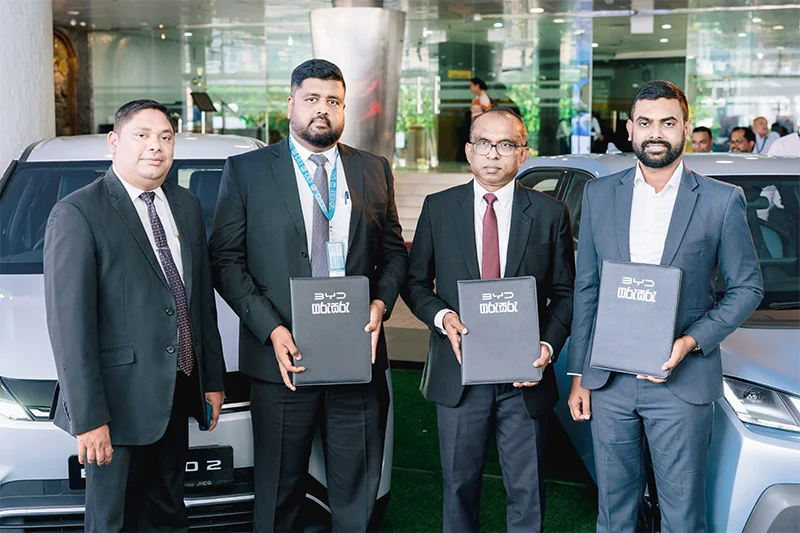
John Keells CG Auto (JKCG Auto), the authorised distributor of BYD and DENZA in Sri Lanka, has launched a campaign in partnership with Bank of Ceylon (BOC) and Sri Lanka Insurance Corporation General Ltd. (SLIC) to accelerate New Energy Vehicles (NEV) adoption among government sector employees.
The initiative, which will run from 4 May to 31 July 2026, is designed to improve accessibility and affordability of NEVs for public servants through a structured set of financing, insurance and ownership support mechanisms.
Open to employees across the government sector, the programme reflects a coordinated effort between industry and national institutions to enable a gradual and practical transition towards cleaner transport options.
As part of the collaboration, JKCG Auto will extend a set of ownership support measures across its BYD and DENZA portfolio, including introductory price considerations, access to home charging infrastructure, and aftersales service support. These are complemented by preferential leasing arrangements facilitated by the Bank of Ceylon, alongside tailored insurance solutions and customer support services from Sri Lanka Insurance Corporation.

Former President Mahinda Rajapaksa has arrived at the Bribery Commission

US in closely-guarded talks to open new bases in Greenland

Trump says Iran ceasefire is on ‘massive life support’

Draw on the cards, but Mominul and Shanto extend Bangladesh’s lead

Miller, Axar and Ashutosh keep Delhi Capital’s IPL alive

Showers above 100 mm are likely at some places in the Western, Sabaragamuwa, Southern, North-western and Northern provinces and in Trincomalee district.

‘Dates have the highest sugar content to fight Coronavirus’

Sunday Island 27 December – Headlines

#SundayIsland 17th December – Headlines

Sunday Island – 28th March

Sunday Island Headlines – 21 March

Sunday Island – 21st February – Headlines
-

 News5 days ago
MIT expert warns of catastrophic consequences of USD 2.5 mn Treasury heist
-

 News2 days ago
Lanka Port City officials to meet investors in Dubai
-

 Editorial5 days ago
Clean Sri Lanka and dirty politics
-

 Editorial4 days ago
The Vijay factor
-

 News3 days ago
SLPP expresses concern over death of former SriLankan CEO
-

 News6 days ago
Development Officer bids Rs. 48 mn for CPC’s V8 at auction
-
 News3 days ago
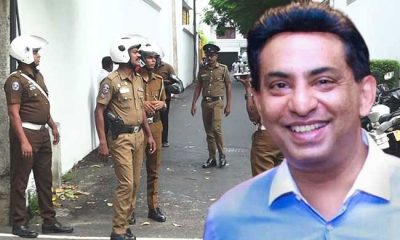
Police inform Fort Magistrate’s Court of finding ex-CEO of SriLankan dead under suspicious circumstances
-
 Opinion6 days ago
Postmortem reports and the pursuit of justice