
Features
Travel and exploration in the jungles, coast and Kataragama

By Douglas B. Ranasinghe
excerpted from from the authorized biography of Thilo Hoffmann
Soon after their marriage, Thilo and Mae began to make extensive journeys through the country, during weekends and holidays. Once, on one of their first, they found themselves at Arugam Bay late in the afternoon. The old resthouse on the dunes consisted of a small trellised veranda, a dining room beyond that, two bedrooms, kitchen and staff quarters. It was already occupied. However, the resthouse keeper and the occupants graciously allowed the Hoffmanns to put up for the night on the veranda.
Before dusk, they went for a drive towards Komari. On their return, a fine male leopard crossed the road just ahead of the car. It was Mae’s first. Back at the resthouse, lit by cosy kerosene lamps, she recounted the episode to their new acquaintances, who were four Sri Lankan hunters, probably planters as Thilo now surmises. After she had finished, one of them in turn, told of an experience with a leopard. During this lengthy and enthusiastic account Thilo absent-mindedly asked – so his wife used to recall – three times: “Was it a bear?”
After the third time Mae lost her temper and upbraided him severely. Since that time, throughout their lives, whenever his attention began to wane she would say: “Was it a bear?”
In their younger years Mae used to join Thilo in almost all his travels in the island. He recalls:
“She had great endurance and stamina. Despite her rather fragile physique she would outwalk me. Together we faced many hardships without any complaints from her, such as tick bites galore, and leeches in wet areas and remote jungle tanks.
He continues:
“Three times I came down with malaria and once with a nasty hepatitis attack. During a memorable three-day walk along the Kala Oya I became infected with amoebiasis, which months later confined me to hospital for one month whilst undergoing emetine treatment. With my friend Marcel Roth (who was then chef at the GFH) I did the 25 mile trek along the left bank through thick riverine jungle, never stepping on the other side of the river which was the Wilpattu National Park.
“We slept on sandy patches, one night in close proximity to a herd of elephants whom we heard throughout. The two of us scrupulously boils the water we drank except once when thirst overpowered our good sense. That is how we contracted amoebiasis. Marcel, as a result, nearly died of a cyst in the liver some time later. We found my Land Rover in an open field about two miles east of Elavankulam, where my appu Velu had it left three days earlier. This was well before the large Rajanganaya reservoir was built further up-river (or the ill-conceived Inginimitiya tank, both areas then teeming with elephants).”
Mae was not only the accountant in the family (see Chapter I) but also the photographer and movie-maker. In 1951 Thilo’s parents, on their first visit to the couple, brought them an American-made Bell and Howell movie camera as a present. Mae and Thilo’s involvement in photography is described in the next Chapter. In 1967, for his 45th birthday, she gave him a fine pair of binoculars, which she could barely afford. It thereafter accompanied him wherever he went.
Dr and Mrs Hoffmann on that visit together with their son and daughter-in-law visited the ruined cities, Kandy and Horton Plains, which was then accessible by car only via Diyagama East Estate off Agarapatana. Over the years both Thilo’s and Mae’s parents visited Ceylon, later Sri Lanka, several times.
So did their brothers and sisters and, later, nephews. They all got to know the island quite well and appreciate its attractions.Memorable incidents were many across the years. A few of these to do with nature and travel are found across this book; two others ‘off beat’ are recounted here.
One day at Kinellan Estate, Ella the Hoffmanns Jr. and Sr. were sitting down to lunch with the Superintendent and his wife in the open veranda. From the ceiling fell a thin stream of liquid on to the plate before Thilo’s father. The food on the table was ruined. The culprit was one of a family of ‘polecats’ (Indian palm civets) which had their home in the roof!
In another of Thilo’s stories, the local fauna again turned on them:
“We were on our way to Arugam Bay where in the dunes the Boyd-Mosses had a romantic abode made mostly of remnants from a demolished tea factory. At that time Durban Boyd-Moss was the superintendent of Baurs’ Chelsea Estate.
“While driving past Tirukkovil my wife spotted a bull being tormented by two men who threw chunks of road ‘metal’ (stone) at it from a heap on the roadside. The bull’s head was tied down to one of its front legs and it was lying on the ground.
“As I was supposed to do something about this, I got down from the car, shouted at the miscreants, took an open pocket-knife to cut the rope, and slowly approached the lying bull from front, making appropriate calming noises. When I touched its head the bull jumped up and charged into my lower legs. I flew up in the air and somersaulted, still holding the open knife. On coming down I lost for a moment all sense of orientation. Then I ran blindly right into a deep wide drain. Here I lay with the bull butting me continuously.
“My brother, a strong man, eventually managed to pull it off me by its loose tethering rope. It then went for the other two men. They ran across the dry paddy fields, leaping over the bunds like in a steeplechase. It was first shock, then great fun for all, except for the bruises and bleeding abrasions, and my brother’s rope burns on legs and arms which became infected and took a long time to heal.”
Milo and Mae travelled for a variety of interests. There was a total eclipse of the sun in June 1955. He took a half-day’s leave and drove with her to Tabbowa.
They waited on the bund of the tank. Around noon, as ‘night’ fell rapidly the singing of birds and the chirping of cicadas ceased. Mimosa plants folded up their leaves, birds were roosting, total silence reigned and the air became chilly. The sun had disappeared behind the moon which was outlined by faint light around its edges. The wonder did not last long, ‘dawn’ broke quickly, and soon the world around was normal again.
A similar, later incident illustrates the conditions in those decades:
“One memorable night, in March 1978, on the southern shore of the Jaffna Lagoon we witnessed the total eclipse of the full moon lying on our camp beds. As we had been en route for some days, we were unaware of the event, and wondered whether we had had one too many!
“This casual and easy way of passing a night outdoors was then possible as there were fewer people, less violence and more jungles. I never experienced the slightest apprehension of danger, be it from humans, or wild animals. I never carried a weapon on these occasions (even in the days when this was permitted). The attitude of the people, especially of the rural population, towards foreigners was then generally friendly and trusting.
“In our travels through the island, we often used to camp overnight at any suitable spot along the route, selected at random. We did not use tents, but just unfolded camp beds, made a fire for cooking and slept under the open sky — all in the dry zone where the weather is predictable. Rivers and tanks offered fine opportunities for bathing and washing. When we stayed longer in one place we used a heavy tarpaulin from one of Baurs’ open lorries. It was stretched over a rope strung between two trees. At one end it reached the ground and, with a trench dug there, gave excellent spacious shelter even in bad weather.
“Places where I remember camping are Kokkilai, Kuchchaveli, the Parangi Aru, the Modaragam Aru, Mail Villu (then in Wilpattu West Sanctuary), Kala Oya, along the road from Puttalam to Anuradhapura (then all in jungle), on the Kumbukkan Oya, Potana, off Galge, at Mullegama, Maha Oya, Inginiyagala and Koddiyar Bay.”
In the earlier decades of the twentieth century, John Still described the northern dry-zone jungles as “the great plains that are now so empty of men”. This is how Thilo first saw them. When he arrived in Ceylon the island had just over six million inhabitants; today there are more than three times that.
For half a century Thilo and Mae, and after her death then he, would continue travelling and exploring all parts of the island, unique in character and variety, including unspoilt and beautiful areas unknown to most Sri Lankans then and now. The knowledge and experience he gained of the country in this way would form the basis for his work in conservation.
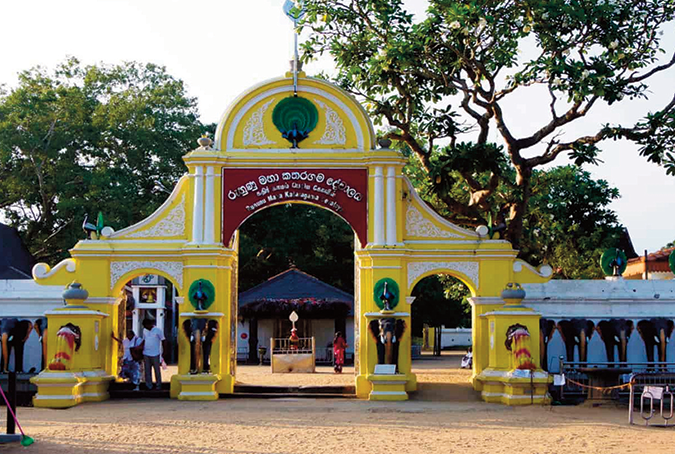
Kataratgama
Thilo records his memories of a famous place, and his thoughts on its transformation:
“I remember vividly an early occasion when my wife and I decided to visit Kataragama for the first time, to watch the annual fire-walking ceremony. This was in 1949, when the event fell on a weekend. I took half-a-day’s leave, as we worked on Saturdays.
“We drove in our open MG to Tissamaharama, where we arrived shortly after noon. From there we walked because during the festival season vehicles were prohibited on the dirt track which led to the holy shrine in the jungle. This kept away idle thrill-seekers, as only genuine pilgrims and serious observers like us undertook the tough 17 km long walk in great heat.
“Only some years later was a jeep track provided via Yodawewa and Katagamuwa, opening the floodgates to sightseers. Today there is a motorable highway. Kataragama has lost its mystic charm and changed beyond recognition. We reached our destination by early evening. Across the Menik Ganga was only a narrow hanging footbridge. There were no pilgrim rests or any other places at which to stay.
“Until late in the night we watched the fascinating scenes and events, moving amongst a multitude of mostly Hindu but also many Buddhist pilgrims. The scenes at the river, the peraheras with one elephant carrying a symbol of God Kataragama (Skanda) to the Valliamma Shrine and back, the devotees with small silver spears stuck through cheeks and tongue and on breast and arms, the kavadi bearers walking on sandals of nails, people rolling on the ground around the main temple, the pujas, the offerings of flowers and fruit, the frenzy and ecstasy in the smoke-filled dimly lit temple itself, with the deafening noise of drums, conch, flute and bells, the smells of burning joss-sticks, incense, camphor and coconut oil and of sweating humanity: these are indelible in my memory, as is the image of a man and a woman who frantically tried to place burning lumps of camphor on their tongues, picking them up with bare fingers from bowls filled with holy ash. All these acts are in fulfillment of vows in penance.
“We watched and moved amongst the crowds till about midnight, when we tried to get some rest at the foot of a large tree. We had brought with us neither food nor drink, and, of course, none were on sale.
The fire-walking was said to start at 3 a.m. on Sunday morning. Hours earlier the fire had been lit, so that when the time came there was a deep bed of red hot embers, left from burning entire logs. Soon people began to assemble around the fire in a wide circle sitting on the ground. We were assigned places right in front. The heat was great and several times we had to move backwards. Preparations continued for quite a while yet, including those of the fire-walking devotees who were kept in a separate abode nearby. My wife and I were the only white people present.
“By about 4 a.m. all was ready, and the first barefoot devotee walked across the bed of embers which was about 35 feet long and six feet wide. Attendants saw to it that all proceeded in an orderly fashion and that the embers were not unduly disturbed. One after another the walkers were sent through the embers, some marching slowly and deliberately, others in a hurry, nearly running, and some quite obviously in a trance. One stumbled and embers were sprayed in all directions. There were about 20 participants and if I remember correctly one or two were women. No burns were reported, and all went well. (Some years later a misguided Christian priest tried it and burned his feet badly.)
“When it was all over daylight began tentatively to break. Exhausted as we were, we began the return walk, another 17 km to Tissa, together with hundreds of pilgrims. I remember a Tamil man who walked ahead of us for some time with his little daughter of perhaps five or six years chanting a religious verse which ended with “Haro hara”, when the girl’s clear silvery voice chimed in. For us this was an enchanting episode.
“A beautiful but hot day was coming up as we trekked along the foot of Vedahitikanda hill. We were dead tired, and my wife almost had to drag me over the last kilometres to our car, which we had left near the Tissa resthouse. For an hour or two we slept in the car, and then I drove all the way back to Colombo. That night we slept like logs, a memorable experience behind us, one of so many similar ones in our long lives ahead.”
“Kataragama was then a truly sylvan shrine with only a few ancient temples and other buildings, a mosque, the Basnayaka’s and the GA’s residences and a row of seasonal shops (’boutiques’), all in a garden of trees. During most of the year the area was left in solitude for wildlife to roam – elephants, sambhur, spotted deer, leopard and bear.
“Today we have a modern ‘Holy City’ in its place with many unnecessary concrete ’embellishments’, lamp-posts, hotels, pilgrim rests, bridges and tarred roads. The avenue between the two main temples is fringed with exotic Tabebuia trees. The whole area now is a great commercial enterprise.
In later years we used to meet Swami Gowripala (Herr Schon-feldt) there and also Kalki Swami (Mike Wilson).”
Lost to modernity
Thilo continues:
“The Ven. Bhikkhu Sumedha, a long-time friend who had grown up in Switzerland, spent his early hermit years as a Buddhist monk at Situlpauwa and at the top of Vedahitikanda. He later obtained higher ordination, and died in Kandy in 2006. On his occasional visits to Colombo, dana was regularly offered at our house.
“Situlpauwa was then a jungle-covered site with only an occasional hermit monk in residence, and wildlife roaming freely through it. Today, as a result of restoration and development, the jungle has given way to concrete, electric lights, noise and commerce.”
During his time in Sri Lanka Thilo has been dismayed to witness such change, in diverse ways, at countless holy and historical places. He adds one example:
“We may perhaps record two different alterations at the famous Koneswaram Temple, on Swami Rock at Trincomalee. The entire temple has been ‘restored’ and renovated, covering under cement and plaster and layers of glossy new paint all traces of its ancient history.
“It is also the site of an act of vandalism. There on a stone pillar was an inscription in high relief recording the death of a young Dutch woman who in the 18th century threw herself over the precipice after watching her lover’s ship sail away. This was chiselled away in the 1980s, a testimony to the prevalent politico-religious chauvinism.
(To be continued)


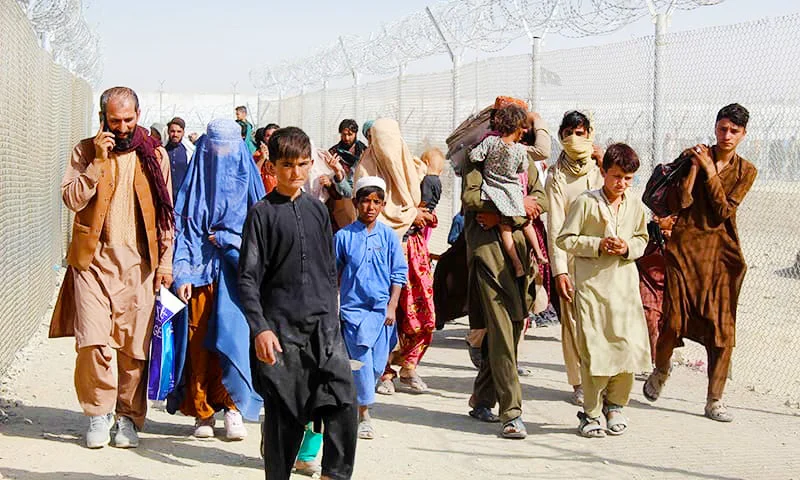
 The mounting mute and unmitigated suffering of the ordinary people of Afghanistan is coming to the fore once again in ongoing efforts by some neighbouring states to deport tens of thousands of Afghan refugees to their country of origin. As in the case of the majority of refugees the world over the Afghan refugees too are caught up in cataclysmic wars and conflicts not at all of their making.
International reports indicate that some six million Afghan refugees have been virtually pressured, to date, to return to Afghanistan by Pakistan and Iran, for instance, on the basis apparently of stringent policies on refugees adopted by the latter. Many refugees are on record that although they are officially identified as of Afghan origin this is the first occasion on which they are seeing the inside of Afghanistan, since thus far they have been living, particularly in Pakistan, as virtual natives of the latter.
‘They are part of the biggest cross border movement of people in recent history, a UNHCR source was quoted saying. However, barring the latter UN agency and a few well wishers, the refugees are being seen as a virtual parasitic and unwanted presence by sections of the publics who have thus far been compelled to have the refugees among them.
The refugees’ haplessness is compounded by the fact that they have been reduced to almost destitution. Having possessed virtually nothing by way of material assets they are getting back to Afghanistan a dis-empowered, dispossessed people.
For well over a century Afghanistan has been at the centre of the big power rivalries of South Asia. The country has been intensely coveted by the majority of major extra-regional powers from the turn of the last century primarily on account of its strategic geographical location, besides some of its natural resources.
Those powers that gain a military foothold in the country would be enabled to bring the majority of Afghanistan’s neighbours within their sphere of influence and power. Some of these are, China, Pakistan, Iran and India. Besides there are the one time Soviet Central Asian Republics, control over whom would be of considerable value, from a number of viewpoints, to expansionist powers.
These attractions account for the appeal Afghanistan has continued to exercise over the majority of extra-regional powers whose presence has proved decisive in the shaping of international politics over the decades. Those powers who have featured majorly and are continuing to do so are, the US, Russia, China and the UK to a lesser degree.
However, the Afghan refugee issue or the ‘Long- suffering’ of the ordinary people of Afghanistan could be considered as having gained exceptional prominence with the Soviet invasion of Afghanistan of 1979.
The latter event needs to be seen as a notable turning point in the last century’s international politics. The initial disintegrative cracks in the Soviet Union were beginning to appear and Islamic fundamentalism was seen by the Soviet authorities as making divisive inroads into their Central Asian Republics.
The influence of Islamic fundamentalism had to be stymied following the Islamic Revolution in Iran in 1979 and Afghanistan came to be seen by the Soviet authorities as a potential hotbed of such religious revolutionary fervour. Thus came about the Soviet invasion of Afghanistan and its subsequent degeneration into a military quagmire for both the Soviet Union and the US.
Thus it was only a matter of time before Afghan refugees began to swell in numbers in neighbouring states. They were haplessly caught up in the ‘cross-fire’ between the Soviet backed Afghan security forces and the Afghan militant resistance which evolved into the Taliban.
As is known, the Afghan resistance came to be armed and backed by the US subsequent to Afghanistan being over-run by the Soviet Union. Thus, Afghanistan became the last proxy war theatre in the long -running Cold War between the US and the Soviet Union. More than a decade of blood-letting convinced the Soviets that there was no choice but to quit Afghanistan.
Thus, to a considerable extent, the Afghan refugees are the victims of big power armed rivalries which are continuing to render the world a most ‘dangerous place’ for ordinary people. The UN agencies seem to be doing their best for the refugees of Afghanistan and most other refugee categories but the continued humiliation of such victims of war would need to be mitigated by the international community to the extent possible. Forcible deportation of refugees in particular may need to be eschewed and outlawed.
Being subjected to an acid test at this juncture is the Universal Declaration of Human Rights (UDHR). It is the latter seminal convention that made the protection of human dignity a cardinal value for the world community.
All those sections that subscribe to international humanitarian law and democratic opinion world wide need to come together, may be under the aegis of the UN, to work out how primacy could be attached to the UDHR and its principal mandate of protecting and perpetuating human dignity and worth.
This is no easy challenge to meet but it needs to be addressed urgently before currently rampant ‘international disorder’ grows well out of control.
The US and Russia are especially obliged to go to the rescue of the Afghan refugees since the Afghan crisis is of their making to a considerable extent but no help could be expected from them because their governments are strongly right wing in orientation. It would be far-fetched to expect of them a strong social conscience.
However, the UN and like-minded organizations need to dialogue strongly with the Taliban regime in Afghanistan with a view to bettering the well being of Afghan civilians. No longer could the lot of the latter be allowed to be dismissed by the Taliban government as ‘an internal matter.’
If the Taliban regime is being assisted by the UN, the former is strongly obliged to be accountable to the international community. The UN would need to non-obtrusively convince the Taliban government that it cannot ignore the essential needs of its civilian populace and the empowering of women forms a central component of this broad programme of work. The UN’s diplomatic finesse needs to come to figure here in a major way.
Refugees everywhere should ideally be re-accommodated in their countries of origin or native lands. However, unless and until their dignity is ensured by governments and other quarters that matter such endeavours would prove to be self-defeating.
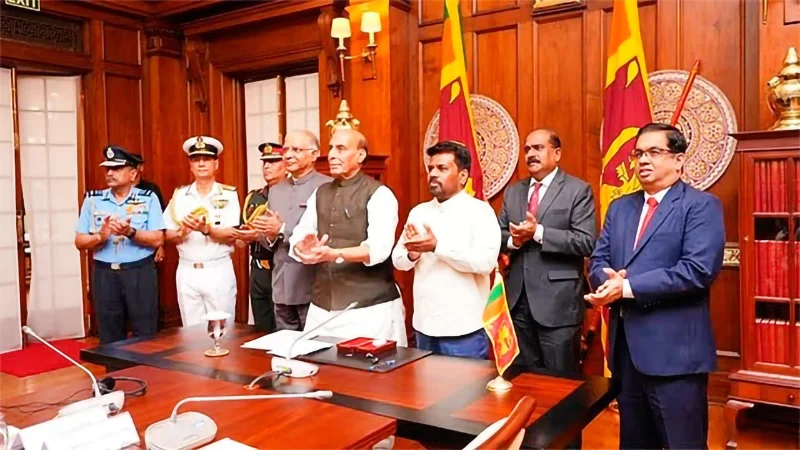
Indian Defence Minister Rajnath Singh’s arrival in Colombo is not a ceremonial call. It is the political face of a security relationship that has been rebuilt, layer by layer, since 2024. Sri Lanka should take the capability on offer, and keep the right to say no.
by Mahil Dole
Senior Superintendent of Police (Retd.)
Indian Defence Minister Rajnath Singh is in Colombo for a three-day official visit, the first by an Indian Defence Minister in 38 years. The last such call was by K. C. Pant in 1988. That long silence itself tells a story. For nearly four decades, defence business between the two neighbours was handled by service chiefs, training colleges and quiet staff talks. New Delhi has now chosen to put a political minister at the centre of the relationship, and to do so immediately after a dense sequence of Indian visits and against a harder contest in the Indian Ocean.
The visit will be read, in Delhi, Beijing and Washington, as a signal. Our task in Colombo is narrower and more serious: to convert the signal into national capability without converting the island into a platform.
Not an isolated visit
Singh’s programme is the latest layer in an unusually concentrated Indian engagement since President Anura Kumara Dissanayake assumed office in September 2024. Prime Minister Narendra Modi’s state visit in April 2025 was the first by any foreign head of government after the new presidency. Seven documents were signed. Among them was the first comprehensive India–Sri Lanka Defence Cooperation Memorandum of Understanding, a five-year umbrella covering joint exercises, training, port calls, humanitarian assistance and disaster relief, information exchange and possible defence-industry cooperation. Either side may terminate it with three months’ notice. That exit clause is not a detail. It is the difference between a structured partnership and a treaty alliance.
What followed was a rhythm, not a one-off. The eighth Annual Defence Dialogue was held in Colombo in June 2025. The Indian Navy Chief called in September 2025. After Cyclone Ditwah, India arrived as a first responder and later announced a reconstruction package of some 450 million US dollars; External Affairs Minister S. Jaishankar came as Special Envoy. In January 2026 the Indian Army Chief, General Upendra Dwivedi, handed over vehicles and training aids, opened a friendship corner at the Defence Services Command and Staff College, and laid a wreath at the IPKF memorial in Battaramulla. The Indian Vice-President visited in April. Foreign Secretary Vikram Misri was in Colombo on 5 August with rupee lines of credit for railways and other priorities. Later that month, Sri Lanka’s Navy Commander, Vice-Admiral Damian Fernando, made his first overseas visit in command, to New Delhi, and met the Chief of Defence Staff, the Defence Secretary and the Navy Chief.
Singh therefore arrives not as a stranger opening a file, but as the political seal on work already in motion. He met President Dissanayaie, who holds the defence portfolio, the Prime Minister and the Defence Secretary. The itinerary also takes in the IPKF memorial, the Defence Ministry, the parliamentary precincts, Gangaramaya Temple, a likely reception on an Indian Navy ship, the National Defence College, and the Sita Amman Kovil in Nuwara Eliya. Indian High Commissioner Santosh Jha has said relations have “never been better” in decades. The visit calendar, at least, is not an invention.
What already stands on the defence floor
It is important to be precise about what already exists, so that we do not mistake institutionalisation for a sudden tilt.
Training is the deepest bond. India is the largest foreign trainer of the Sri Lankan armed forces, offering on the order of a thousand to twelve hundred vacancies a year. One naval accounting records more than two thousand Sri Lankan naval personnel passing through Indian courses over nine years. Shared classrooms produce shared language, shared drills and personal networks that outlast any single government. Reports ahead of this visit point to three new memoranda, one likely on air-defence guns, one on cadet-corps links, and one on cooperation between the Sri Lanka Defence College and Indian defence institutions. If signed, those instruments would push the relationship into the next generation of officers, not only today’s operators.
Exercises are now routine rather than ceremonial. The twelfth edition of SLINEX, the bilateral naval exercise, was held in Colombo from 14 to 18 August 2025, with a harbour phase of professional exchanges and a sea phase of gunnery, boarding, replenishment and communications. MITRA SHAKTI, the army exercise with air elements, held its eleventh edition in Belagavi last November. A fourth bilateral diving exercise was conducted in Colombo in April 2026. The two navies and coast guards continue International Maritime Boundary Line meetings. An Indian Navy Dornier was based here for maritime surveillance from August 2022 to August 2025. A Maritime Rescue Coordination Centre was commissioned with an Indian grant of about six million dollars. INS Vikrant and INS Udaygiri took part in the International Fleet Review marking the Sri Lanka Navy’s seventy-fifth anniversary.
None of this is trivial. None of it, by itself, is alignment. Hardware, hours at sea and staff-college seats are instruments. What they become depends on command, data and political purpose.
National security questions that matter
Three questions should govern Colombo’s handling of the Indian Defence Minister’s visit.
The first is maritime domain awareness. Sri Lanka’s core security geography is not a land frontier. It is the exclusive economic zone and the sea lanes that pass our shores. The live threats are narcotics, people-smuggling, illegal fishing, and the possible relocation of cyber-fraud compounds. Conventional naval war is not on this year’s operational list. Indian help with sensors, hydrography, diving, boarding drills and search-and-rescue is therefore rational. The test is who owns the picture. Shared awareness is useful. Exclusive dependence on one partner’s fusion centre is a vulnerability. Australia’s Disi Rela programme against irregular maritime movement, Japanese passage exercises, and the United States capacity support, cutters, aircraft, humanitarian exercises, already exist. They should remain in the mix. Maritime security should be a Sri Lankan-led coalition of convenience, not an Indian franchise.
The second is the air and coastal defence gap. Talk of Indian air-defence guns is not abstract after the 2026 conflict in West Asia reached our own waters, the sinking of the Iranian frigate IRIS Dena off Galle, and later Iranian hulls lingering near the exclusive economic zone. The government’s public line was the correct one: no combat use of our territory, airspace or waters by any party; humanity first; sailors rescued. That posture only works if the state can see, and if necessary contest, its approaches. Accepting guns, radars or training is compatible with an independent foreign policy if command, basing and rules of engagement remain Sri Lankan. Integrating them into another country’s kill-chain would not be.
The third is internal security. Easter Sunday accountability, narcotics networks that run through ports and prisons, and communal peace are not separate from geopolitics. Partners price political risk. A state that cannot govern its harbours, its financial system and its extremist ecosystems will be offered “help” that looks like tutelage. India’s interest in counter-terror coordination and drugs overlaps with genuine Sri Lankan needs. The discipline required is the same as in any sound intelligence relationship: cooperate on targets; do not outsource the service.
The wreath at the IPKF memorial will be watched, as it was when the Indian Army Chief stood there in January. The years 1987 to 1990 remain raw in our political memory. The only stable line is professional honour to the dead, not a political rehabilitation of an intervention that divided this country.
How the region will read Colombo
India’s motive is not mysterious. Sri Lanka sits on the approaches to India’s southern seaboard. Chinese commercial and dual-use presence at Hambantota and Colombo Port City, and continuing engagement with the People’s Liberation Army Navy, is the backdrop. Pakistani naval units calling at Colombo, including a Chinese-built Hangor-class submarine earlier this year, only sharpen New Delhi’s preference for a denser security habit with us. Neighbourhood First and MAHASAGAR, Mutual and Holistic Advancement for Security and Growth Across Regions, are the language. The operational aim is that extra-regional navies do not treat Sri Lankan harbours as a default logistics base against Indian interests.
Our motive should be equally clear, and different. Geography makes India the permanent neighbour. Crisis behaviour, liquidity and fuel in 2022, the cyclone in 2025, the energy and remittance shock of 2026, has already shifted public sentiment. That is a political fact. It does not require Colombo to adopt India’s threat picture of China, or to freeze other relationships.
A workable posture is polyalignment with a spine. India is the deepest security and connectivity partner, domain awareness, disaster response, training, Trincomalee energy cooperation, grid links and rupee credit, on the condition that ports, exclusive economic zone access and intelligence fusion remain under Sri Lankan law. China remains a major economic and infrastructure partner; new exclusive strategic footholds should not be created, and debt and operational control must stay visible. The United States, Japan, Australia and Europe matter for markets, green shipping, extra training pipelines and non-traditional maritime threats. Ordinary naval diplomacy with Pakistan and others is manners, not signalling.
The government’s stated doctrine, an independent policy that does not favour any country, and territory that will not be used against a third party, is the right public frame. This week will test whether that frame can coexist with deeper, more structured Indian defence cooperation. It can, if the new memoranda are capability contracts with exit clauses, not political alignment documents.
Take help. Keep the choice
Colombo should treat the expected instruments as a capability audit.
On air defence, welcome sensors and guns that Sri Lanka can man, maintain and switch off. Reject any arrangement that requires foreign crews, foreign rules of engagement, or data that only flows one way. In cadet corps and staff colleges, take the training and keep a parallel pipeline with other professional schools so that the officer corps is not a single-source product. On the 2025 Defence Memorandum, measure implementation by Sri Lankan readiness, hours of maritime coverage, time-to-rescue, interdiction rates in the exclusive economic zone, disaster lift, not by the number of Indian ship-days in harbour.
Joint training should emphasise humanitarian assistance, counter-narcotics, hydrography, diving and lawful boarding. Those are the missions that serve the public and do not lock us into someone else’s contingency. Scenarios that only make sense in an India–China or India–Pakistan crisis should be declined politely and firmly.
Defence talks must also be bound to the prosperity agenda. Trincomalee as an energy and industrial node, electricity interconnection, port productivity and cyclone reconstruction are where security cooperation either pays the citizen or looks like militarisation. A Defence Minister’s visit that produces only wreaths and signed paper will be read in the region as alignment. A visit that also moves energy storage, disaster systems and maritime safety will be read as statecraft.
I write as a former police officer who spent a working lifetime on intelligence, counter-terrorism and the unglamorous work of keeping a multi-religious island in one piece. Geography gave us a seat at the table of Indian Ocean commerce and security. Institutions, energy policy, port performance and social cohesion will decide whether that seat produces prosperity, or merely more invitations to other people’s contests.
Singh’s visit should be received with courtesy, used with discipline, and remembered for what it adds to Sri Lanka’s ability to stand on its own water. Take the neighbour’s hand. Keep the island’s choices. Make sure every exercise, every gun and every training slot leaves us more able to say no the next time a great power asks to use our sea, our air or our soil. (18 sources)
This analysis is offered in the interest of national security, institutional reform, and public safety)
The writer is a retired Senior Superintendent of Police. He served as Deputy Director in charge of the Counter Terrorism Desk, State Intelligence Service, and later as Intelligence Coordinator to the Inspector General of Police. He is the author of Security Beyond Enforcement: Practical Approaches for a Safer Nation.
Rediscovery highlights rich, unexplored aquatic biodiversity in Northern Province
By Ifham Nizam
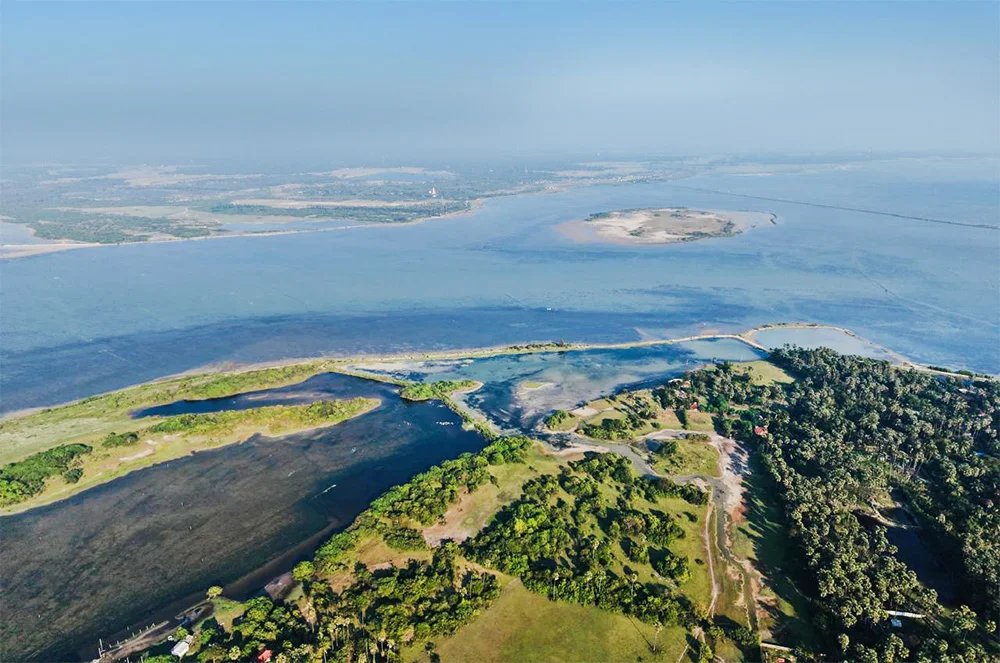
A small fish that vanished from Sri Lanka’s scientific records for nearly 90 years has resurfaced in the waters of Jaffna, providing researchers with a remarkable rediscovery and fresh evidence that the Northern Province still holds significant, unexplored aquatic biodiversity.
The Yellow-stripe Goby, Mugilogobius chulae (Smith, 1932), was recently found in the Karainagar area of Karaitivu Island during a biodiversity survey, almost nine decades after it was last scientifically recorded from Sri Lanka.
The discovery is particularly significant because the species had previously been known from the country only through a single historical specimen collected from Pedduru Thuduwa, Jaffna.
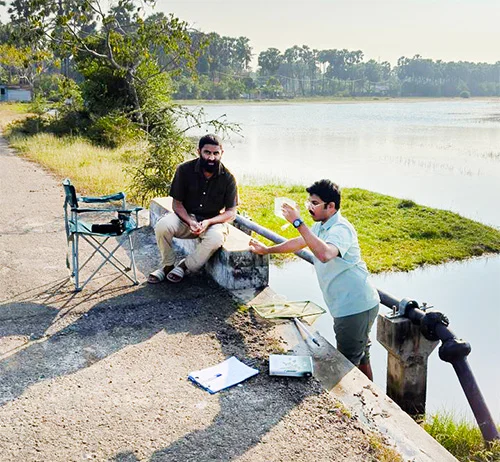
Discovery moment
Research scientist Janamina Bandara, a member of the team that made the discovery, told The Island that the fish was not initially identified as the long-lost species.
“We came across an unidentified Goby during our fieldwork, and it was only after a detailed examination of its external morphology that we were able to establish its identity as Mugilogobius chulae,” Bandara said.
“For us, it was an exciting moment because this species had not been confirmed from Sri Lanka for almost 90 years.”
The fish has a particularly interesting history in Sri Lankan ichthyology.
In 1936, renowned Sri Lankan zoologist P. E. P. Deraniyagala described a new fish from Pedduru Thuduwa in Jaffna in his paper,
“Two New Fishes from Ceylon”, published in The Ceylon Journal of Science.
He named the species Vaimosa valigouva. Subsequent taxonomic revisions established that Vaimosa valigouva was a synonym of Mugilogobius chulae, the currently accepted scientific name of the Yellow-stripe Goby.
However, no further confirmed records emerged from Sri Lanka for decades.
With the species absent from subsequent surveys and inventories, it eventually disappeared from the country’s national fish lists and from much of the scientific literature relating to Sri Lankan fishes.
The prolonged lack of records was also closely linked to the difficulties of conducting biological research in northern Sri Lanka.
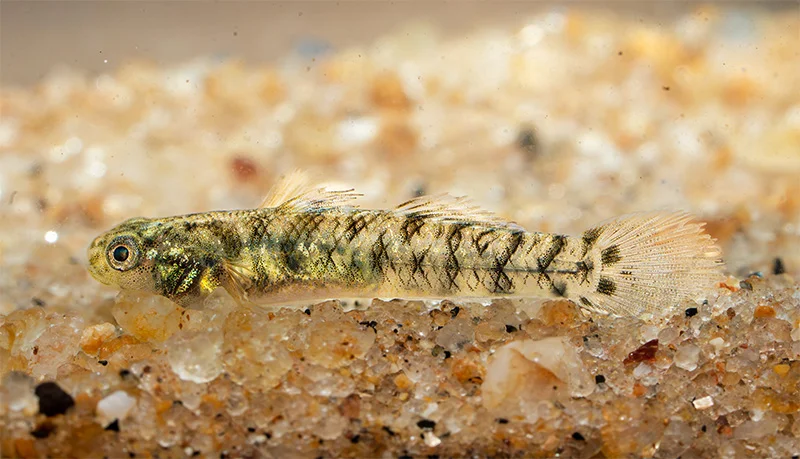
Yellow-stripe Goby, Mugilogobius chulae
For decades, the civil conflict, restricted access, security concerns and limited opportunities for field surveys prevented scientists from systematically investigating many of the region’s aquatic habitats.
Consequently, while considerable advances were made in documenting biodiversity elsewhere in the island, northern Sri Lanka remained comparatively poorly explored.
Bandara said the rediscovery should, therefore, be viewed in a much wider context than the finding of a single fish.
He told The Island: “An absence of records does not necessarily mean that a species is absent. In the case of northern Sri Lanka, there have been enormous gaps in field data because large areas could not be studied systematically for many years.”
“This finding demonstrates how important it is to return to these habitats and carry out detailed surveys. There could be many more species, range extensions and rediscoveries waiting to be documented.”
The research team’s findings did not end with the Yellow-stripe Goby.
During the same study, the researchers also documented the Black-spotted Snubnose Goby, Pseudogobius melanostictus (Day, 1876), providing what they describe as the first confirmed northernmost record of the species in Sri Lanka.
The species had previously been reported mainly from lagoonal and brackish coastal environments in the western part of the country, while recent verified records were limited.
The new finding consequently extends the known geographical range of Pseudogobius melanostictus and adds an important northern record to Sri Lanka’s fish fauna.
Together, the two findings significantly expand the known distribution of both Goby species within Sri Lanka.
They also highlight the importance of small and often overlooked coastal, tidal and inland aquatic habitats in documenting the island’s biodiversity.
Goby species are generally small fishes that occupy a variety of marine, brackish and freshwater environments. Their habitats can include rocky shores, tidal pools, lagoons, estuaries, mangroves and other transitional aquatic ecosystems.
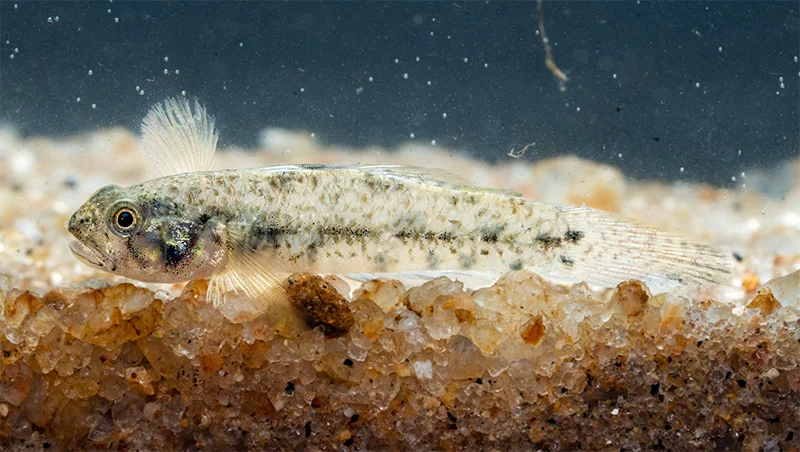
Black-spotted Snubnose Goby, Pseudogobius melanostictus
Because of their small size and preference for habitats that are often overlooked during large-scale biodiversity surveys, some Goby species can remain undocumented for long periods.
The latest research is, therefore, particularly relevant to understanding the aquatic biodiversity of the Jaffna Peninsula and surrounding islands.
According to Bandara, the discovery also demonstrates the importance of combining historical scientific literature with modern field research.
“The old records gave us an important historical reference, while the current fieldwork allowed us to connect that history with what is actually present in these habitats today,” he said.
The rediscovery of Mugilogobius chulae effectively reconnects modern Sri Lankan ichthyological research with Deraniyagala’s 1936 record.
It also establishes the new finding as the westernmost known occurrence of the species in the Indian Ocean, according to the researchers.
The study’s authors — Janamina Bandara, Sahan Randeniya and Aravind Manoj — say their findings underline the need for continued biological surveys in northern Sri Lanka.
The region’s aquatic ecosystems remain insufficiently studied, particularly in areas that were inaccessible or difficult to investigate for extended periods.
Bandara said the team expected that further exploration could produce more unexpected findings.
“We should not assume that we have a complete picture of Sri Lanka’s fish diversity. Particularly in the north, there are habitats that have received very little scientific attention,” he said.
“Every field survey can potentially change what we know about the distribution of a species. That is why continued exploration and proper documentation are so important.
The researchers have expressed particular concern about the need to document such species before changes to their habitats make future identification more difficult.
Coastal development, changes in water quality, habitat degradation and other pressures can affect small aquatic ecosystems, making baseline biodiversity information increasingly important for conservation planning.
The latest study, therefore, provides not merely two new distribution records but also a reminder of the value of maintaining and updating national biodiversity inventories.
The researchers thanked Dr. Helen Larson, Rohan Pethiyagoda, Madhura de Silva, Dr. Kasun Bandara and Neluka Fernando for their assistance with various aspects of the study.

Showers will occur in the Western and Sabaragamuwa provinces and in Kandy, Nuwara-Eliya, Galle and Matara districts.


Sri Lanka reiterates its territory won’t be used against India

UK-led Core Group calls Jaffna mass graves a ‘stark reminder’ but stops short of calling for international accountability

India underscores security and defence in overall partnership with SL

If Sri Lanka wants ‘real’ stability, only one way to achieve it, in a short time

‘Dates have the highest sugar content to fight Coronavirus’

Sunday Island 27 December – Headlines

#SundayIsland 17th December – Headlines

Sunday Island – 28th March

Sunday Island Headlines – 21 March

Sunday Island – 21st February – Headlines
-

 News5 days ago
Namal remanded until Sept. 18 over Airbus deal investigation
-

 Latest News4 days ago
Tharanga creates history with Diamond League crown in Brussels
-

 News4 days ago
Dispute which triggered listed company director being detained at BIA resolved
-

 Features3 days ago
After the parade: What a traffic OIC’s walk-out tells us
-
 Opinion6 days ago
In Memory of Dr Upatissa Pethiyagoda
-

 Editorial5 days ago
Power vs Equality
-
 Latest News6 days ago
SLPP MP Namal Rajapaksa arrested by CIABOC
-
Editorial3 days ago
Arrests as theatre