
News
35% live coral turns H’tota port into model for marine sustainability

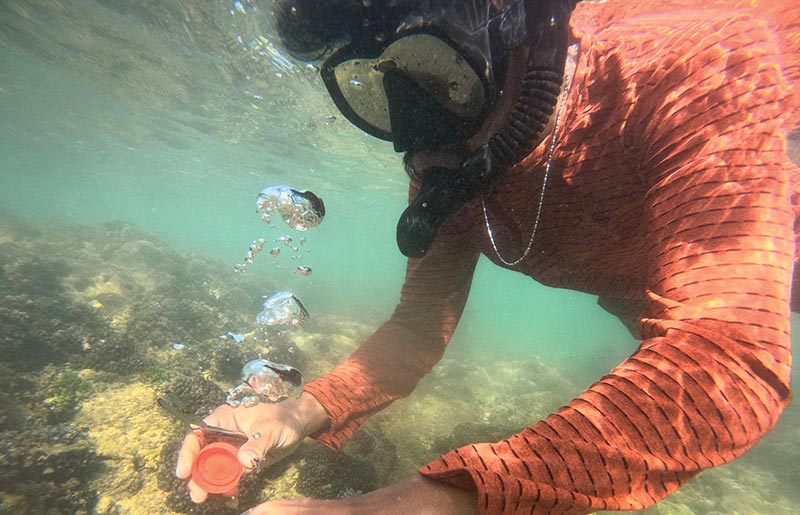
Hambantota International Port (HIP) is redefining what industrial infrastructure can achieve, not just as a logistics hub, but as a thriving marine ecosystem and research site. A recent coral reef study conducted at HIP’s breakwater by the Ocean University of Sri Lanka (OCUSL) has revealed an extraordinary ecological discovery that around 35% of the observed coral coverage in the area is live, positioning HIP as one of the most vibrant artificial reef systems in Sri Lanka.
The text of the HIP statement: “Led by Dr. M.F.M. Fairoz, marine scientist and Senior Lecturer at the Faculty of Fisheries and Ocean Science, the OCUSL team explored the port’s semi-artificial reef system, which has developed within a high-security, low-disturbance zone. This unique setting has allowed coral larvae to successfully settle and grow on the breakwater’s stable substrate.
“It’s like a living laboratory,” said Dr. Fairoz. “This reef is protected from many of the stressors we see in natural coastal areas; no fishing, limited pollution, and a healthy balance of reef-associated species. The fact that 35% of the coral cover is live is a remarkable indicator of the ecosystem’s resilience and health.”
This finding is particularly significant when compared to other coral reef sites in Sri Lanka, many of which have seen live coral coverage drop below 20% due to water pollution, fishing pressure, coastal development and climate change. In contrast, HIP’s sheltered reef system stands as a beacon of hope for reef regeneration and marine biodiversity.
The breakwater reef at HIP is now the second major coral reef protection initiative in the country, following the one at Port City Colombo. However, HIP’s breakwaters, subjected to natural recruitment of reef building corals to a thriving reef system, without extensive artificial intervention, make it especially noteworthy. Researchers recorded a diverse marine community, including several species of hard and soft corals, sponges, and over 20 species of reef-associated fish. These are all strong indicators of a low-pollution, balanced marine habitat.
Dr. Fairoz and his team are now studying how artificial substrates, like the breakwater can be optimised to promote coral settlement and growth, an area gaining global interest as scientists explore coral restoration, reef engineering, and carbon sequestration. “We’re using advanced ecological models to understand energy flow through this system and to identify design principles for future marine infrastructure projects worldwide,” he explained.
The study aligns closely with the Hambantota International Port Group’s (HIPG) broader ESG strategy, integrating biodiversity protection into its operational DNA. HIP’s approach integrates scientific research directly into its long-term sustainability agenda. This commitment supports the United Nations Sustainable Development Goal No.14: Life Below Water.
Wilson Qu, CEO of HIPG said, “Our majority partner, CMPort, believes environmental protection is a global responsibility. Since 2008, CMPort has expanded operations to 25 countries, adapting to local environmental standards while prioritising ecosystem protection. The preservation of HIP’s coral reef is a clear demonstration of this principle in action.”
Five senior OCUSL students participated in the project, contributing to data collection in sediment analysis, fish biomass studies, and coral-microbial interactions. Their findings will be published in international scientific journals, showcasing HIP as a key platform for nurturing the next generation of Sri Lankan marine scientists.
The upcoming phase will see the research team compiling their findings into a comprehensive book, offering data-driven recommendations for ongoing reef protection. Both digital and print editions are planned, ensuring the insights reach local communities, policymakers, and international stakeholders.
“This is more than just a regular commercial port,” concluded Dr. Fairoz. “With 35% live coral coverage, Hambantota International Port proves that even high-functioning industrial zones can support living, breathing marine ecosystems. This is where science, sustainability, port operations and innovation come together.”


Warm Weather Advisory
Issued by the Natural Hazards Early Warning Centre
Issued at 3.30 p.m. on 01 April 2026, valid for 02 April 2026.
The Heat index, the temperature felt on human body is likely to increase up to ‘Caution level’ at some places in the Western, Sabaragamuwa, Southern, Eastern, North-western, Northern and North-central provinces and in Monaragala district.
The Heat Index Forecast is calculated by using relative humidity and maximum temperature and this is the condition that is felt on your body. This is not the forecast of maximum temperature. It is generated by the Department of Meteorology for the next day period and prepared by using global numerical weather prediction model data.

Effect of the heat index on human body is mentioned in the above table and it is prepared on the advice of the Ministry of Health and Indigenous Medical Services.
ACTION REQUIRED
Job sites: Stay hydrated and takes breaks in the shade as often as possible.
Indoors: Check up on the elderly and the sick.
Vehicles: Never leave children unattended.
Outdoors: Limit strenuous outdoor activities, find shade and stay hydrated.
Dress: Wear lightweight and white or light-colored clothing.
Note:
In addition, please refer to advisories issued by the Disaster Preparedness & Response Division, Ministry of Health in this regard as well. For further clarifications please contact 011-7446491.
News
Atmospheric conditions will be favorable for afternoon thundershowers in most parts of the island over the next few days from today (02 April)


WEATHER FORECAST FOR 02 APRIL 2026
Issued at 05.30 a.m. on 02 April 2026 by the Department of Meteorology
Atmospheric conditions will be favorable for afternoon thundershowers in most parts of the island over the next few days from today (02 April)
Misty conditions can be expected at some places in the Central, Sabaragamuwa and Uva provinces during the early hours of the morning.
Showers or thundershowers will occur at several places in the Western, Central, Sabaragamuwa, Southern, Uva, North-western and North-central provinces after 2.00 p.m. Fairly heavy showers above 50 mm are likely at some places in the Western, Central and Sabaragamuwa provinces and in Kurunegala district. Showers may occur in the Southern province and in Ampara, Batticaloa and Monaragala districts in the morning too.
The general public is kindly requested to take adequate precautions to minimize damages caused by temporary localized strong winds and lightning during thundershowers.

… talks with Moscow cover fresh coal supplies
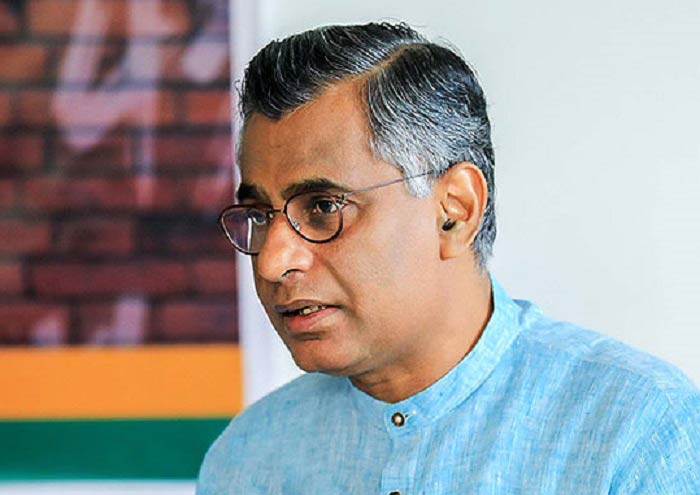
Eksath Janaraja Peramuna leader Patali Champika Ranawaka yesterday (01) said that Sri Lanka would not be able to secure oil from Russia before the reimposition of US sanctions on Russian oil. The former Minister said so at a joint Opposition media briefing in Colombo. He said it wouldn’t be possible to import Russian crude before the 12 April deadline.
Deputy Russian Energy Minister Roman Marshavin was here last week to discuss how the Russian Federation could help Sri Lanka meet its energy needs.
Sources familiar with the challenges faced by Sri Lanka, due to the disruption of crude/gas/refined products supply lines, said that the country’s only refinery needed crude to ensure the operation of the facility.
According to the Energy Ministry, during discussions with the delegation, led by Deputy Minister Marshavin, Sri Lanka was offered refined petrol, diesel and aviation fuel, in addition to crude oil. The discussions also covered the procurement of coal from Russia, according to the Ministry.
In 2025, the NPP government reached an agreement with an Indian supplier to bring in coal from South Africa. However, low-quality South African coal has caused a severe crisis due to the country’s only coal-fired power plant at Norochcholai failing to generate at the required levels, parliamentary sources said, referring to a report submitted by the CEB to the Parliament.
Meanwhile, informed sources said that there had been some discussions between Sri Lanka and India regarding the proposed move by the NPP government to procure oil directly from India.
Ranawaka said that of the six promised crude ships, four wouldn’t be coming, regardless of assurances given by the government. He alleged the government was trying to deceive the public that power cuts were inevitable due to continuing drought but the truth is the low-quality coal that caused the crisis. The recently announced electricity tariff hike, too, was due to the coal fraud, he alleged. (SF)


Atmospheric conditions will be favorable for afternoon thundershowers in most parts of the island over the next few days from today (02 April)

Sri Lanka cannot procure Russian oil before US sanctions return – Champika

Japanese boost for public transport here

2025 GCE AL: 62% qualify for Uni entrance; results of 111 suspended

Arctic link discovered: Lankan scientists trace 8,000 km seabird migration route

‘Dates have the highest sugar content to fight Coronavirus’

Sunday Island 27 December – Headlines

#SundayIsland 17th December – Headlines

Sunday Island – 28th March

Sunday Island Headlines – 21 March

Sunday Island – 21st February – Headlines
-

 Features5 days ago
A World Order in Crisis: War, Power, and Resistance
-

 News6 days ago
Energy Minister indicted on corruption charges ahead of no-faith motion against him
-

 Sports6 days ago
SLC to hold EGM in April
-

 Opinion6 days ago
When elephants fight, it is the grass that suffers
-
 Latest News7 days ago
A strong Technical and Vocational Education and Training (TVET) system equips individuals with practical, relevant, and future-oriented skills helping to innovate responsibly towards a greener and sustainable future – PM
-

 Features6 days ago
Lest we forget
-
 Business6 days ago
Pan Asia Bank empowers export sector as Strategic Partner of NCE Export Awards
-

 News2 days ago
Tariff shock from 01 April as power costs climb across the board