
News
200 km of damaged elephant fences in Polonnaruwa reactivated; urgent repairs underway this week


More than 200 kilometres of electric elephant fencing damaged by Cyclone Ditwah in the Polonnaruwa Wildlife Zone have already been restored, as authorities race this week to rebuild sections that were completely destroyed, amid growing concerns over elephant deaths and escalating human–elephant conflict.
Out of the total 1,100 km of electric fencing protecting the Polonnaruwa Wildlife Zone, over 340 km were damaged by the cyclone, leaving large areas of forest boundaries exposed. Conservationists warn that broken fences have historically led to elephants straying into villages, resulting in fatal encounters, retaliatory attacks, and avoidable elephant deaths.
A special high-level discussion to assess the environmental impact of Cyclone Ditwa on wildlife and forest conservation zones in the Polonnaruwa District was held on December 16 at the Giritale Wildlife Centre. The meeting was chaired by Deputy Minister of Environment Anton Jayakody and attended by senior officials from the Department of Wildlife Conservation, Forest Department, and disaster management authorities.
Officials informed the meeting that 200 km of damaged fences have already been restored to full operational capacity, with priority given to conflict-prone areas where elephants frequently cross into human settlements. These emergency repairs, officials said, were critical to preventing further elephant fatalities and protecting rural livelihoods.
The meeting also revealed that 50 km of elephant fences had been completely destroyed by the cyclone. Deputy Minister Jayakody directed relevant institutions to immediately provide materials and logistical support to complete the construction of 10 km of new electric fencing within this week, as an urgent first phase.
Stressing that damaged fences often become death traps rather than safeguards, the Deputy Minister warned that delays in restoration could lead to elephants being shot, electrocuted, or killed using explosives, as well as to loss of human life.
Participants highlighted that extreme weather events, now occurring with greater frequency, are undermining conservation infrastructure and intensifying human–elephant conflict across the dry zone. They called for stronger, climate-resilient fencing systems and continuous maintenance rather than reactive repairs after disasters.
Polonnaruwa is among Sri Lanka’s most vulnerable districts for human–elephant conflict, and officials reiterated that rapid, effective restoration of electric fences remains one of the few proven measures to reduce elephant deaths and protect both wildlife and communities.
By Ifham Nizam ✍️

News
New High-Definition (HD) Television Studio at the University of Vocational Technology handed over to students with the participation of the Prime Minister


The newly equipped television studio, which had remained an incomplete component of the media complex constructed for the practical training of students at the University of Vocational Technology (UoVT), Ratmalana, was officially handed over to the students on Tuesday (26 May) with the participation of Prime Minister Dr. Harini Amarasuriya, following the installation of modern technological equipment and studio production facilities.
Following the opening of the television studio, several newly established affiliated centres aimed at expanding students’ practical and academic activities were also declared open.
Accordingly, a broadcasting studio providing opportunities for students to launch a range of educational services, including a web radio channel, an Artificial Intelligence Research Laboratory, and a Centre for Gender, Equity and Equality were inaugurated during the occasion.
Coinciding with the event, laptop computers were donated to support the uninterrupted continuation of the educational activities of students in at several schools affected by the recent floods and other natural disasters. In addition, the “UoVT Greening Policy,” formulated with a comprehensive understanding of technology and environmental inter connectivity, was officially launched during the occasion.
Following this policy, all construction and development activities within the university are expected to be carried out based on green concepts, with the goal of transforming the university into a carbon-neutral environmental unit by the year 2030.
One of the key objectives of this initiative is to encourage students pursuing vocational education to engage more actively in employment opportunities within industries that prioritise green concepts and sustainability.
Following the event, the Prime Minister also engaged in a discussion with representatives of the university student unions.
The event was attended by the Deputy Minister of Vocational Education Nalin Hewage, Secretary to the Ministry of Education, Higher Education and Vocational Education Nalaka Kaluwewa, Vice Chancellor of the University of Vocational Technology, Professor K.M.G. Prasanna Premadasa, along with several distinguished invitees.
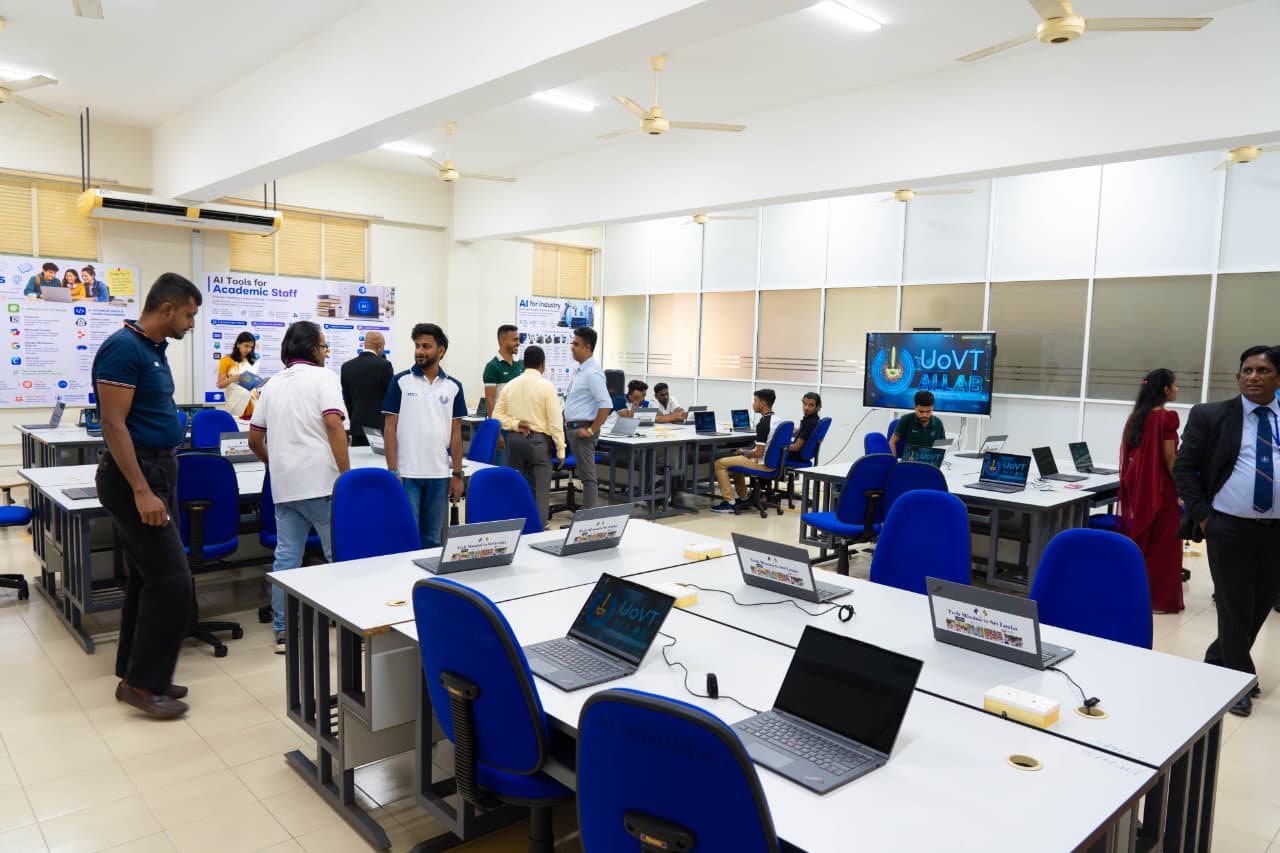
[Prime Minister’s Media Division]


Sri Lanka’s banking sector has provided a collective and categorical assurance that it remains stable, resilient, and secure despite a few recent isolated incidents of financial fraud, emphasising that these developments do not pose a threat to the safety of customer deposits or the overall integrity of the financial system.
While acknowledging that such incidents have understandably generated some concerns, the industry has reiterated that it is addressing these matters comprehensively and that it is well equipped to manage and mitigate these challenges. This assurance was conveyed in a statement issued to the media by the Sri Lanka Banks’ Association (SLBA), which represents all licensed commercial banks in the country.
Addressing recent reports of financial fraud and cyber-related incidents that have drawn heightened public attention, the Association underscored the strength of the sector’s fundamentals and the effectiveness of ongoing regulatory oversight and risk management frameworks.
“Recent reports of financial fraud and cyber-related incidents have understandably received public attention. Industry leaders and regulators emphasise, however, that the banking sector remains fundamentally strong, resilient, and well equipped to withstand such challenges, without compromising its core stability or the security of customer deposits,” the Chairman of the SLBA Sanath Manatunge stated.
He noted that while many social media posts are either misleading or carry inaccurate information, some recent cases, including electronic fund transfer fraud, have raised important questions about digital security. However, these incidents represent only a very small proportion relative to the substantial institutional capital buffers maintained by banks. Importantly, depositors are assured that customer funds remain secure, with any such losses being absorbed through institutional capital buffers rather than public deposits.
Other cybercrime cases reported in recent months, including phishing-related fraud which are not directly connected to the banking industry and hence do not manifest any vulnerabilities in the system, however underscore the evolving and increasingly sophisticated nature of digital threats faced by financial systems worldwide, the Chairman said, but stressed that these are isolated incidents and do not reflect systemic weaknesses across the banking industry.
Reinforcing this position, the Central Bank of Sri Lanka has confirmed that all licensed banks continue to maintain capital adequacy and liquidity ratios well above minimum regulatory requirements, the Association pointed out. The regulator has also reiterated its readiness to provide temporary liquidity support if required, ensuring the uninterrupted stability of the financial system.
“Sri Lanka’s banking sector collectively manages trillions of rupees in assets, supported by diversified portfolios and robust governance frameworks. This scale, combined with prudent risk management practices, provides a strong foundation for absorbing shocks while maintaining public confidence,” Manatunge said.
At the same time, the industry is actively strengthening its defences against emerging threats. Banks are continuously enhancing cybersecurity frameworks through investments in advanced Fraud Risk Management Systems, more rigorous monitoring protocols, and independent forensic audits. These efforts are complemented by ongoing regulatory and parliamentary initiatives aimed at strengthening governance, accountability, and transparency across the sector.
Recognising that customer awareness is a critical line of defence, banks have also intensified public education initiatives focused on safe digital practices. These include guidance on password security, phishing prevention, and the secure use of QR codes and other digital payment tools.
The SLBA noted that cyber fraud is not unique to Sri Lanka, with similar incidents reported in major economies around the world. In these markets, banking systems have remained stable, supported by strong regulatory oversight and continuous adaptation to emerging risks. Sri Lanka’s banking industry is demonstrating comparable resilience, with swift corrective measures and vigilant supervision reinforcing confidence in the system.
While recent incidents have highlighted certain challenges in the environment, the benefits of digital banking far outweigh such concerns, Manatunge added, reiterating that Sri Lanka’s financial sector remains robust, well-capitalised, and subject to close regulatory oversight. These incidents are isolated in nature and do not indicate systemic failure, and the corrective measures already underway are expected to further strengthen the sector’s resilience against future threats.
The SLBA concluded: “Sri Lanka’s banks continue to stand as pillars of stability, safeguarding customer deposits while supporting the country’s economic progress. We urge customers to remain vigilant in their own digital practices, even as the industry continues to enhance the safeguards that protect them.”

Most of the country’s major rivers remained at normal levels despite intermittent overnight rainfall, according to the Irrigation Department’s Hydrology and Disaster Management Division early Tuesday.
However, officials warned that the Kuda Ganga at Kalawellawa (Millakanda) had reached the “Alert” level and was showing a rising trend following heavy rainfall in the catchment areas.
Irrigation Department Director of Hydrology and Disaster Management, Eng. L.S. Sooriyabandara, said the department was closely monitoring the situation, particularly in low-lying areas vulnerable to sudden flooding.
“The majority of river basins are still within normal limits, but the Kuda Ganga has shown a notable increase due to rainfall recorded in upstream regions. Residents living near vulnerable riverbanks should remain vigilant,” he told The Island yesterday.
According to the Irrigation Department’s 3.00 a.m. hydrological update, the Kuda Ganga at Kalawellawa recorded a water level of 5.10 metres, above the alert threshold of 5.00 metres, with rainfall of 24.3 mm recorded during the previous 18 hours.
Hydrology officials noted that although several rivers in the south-western wet zone experienced moderate rainfall, water levels in major rivers including the Kelani, Kalu, Gin and Nilwala remained within safe margins.
The Kelani Ganga at Hanwella recorded 3.87 metres, while the Kalu Ganga at Ratnapura stood at 4.58 metres — both remaining well below flood levels.
Meanwhile, the Maguru Ganga at Magura received one of the highest rainfall readings at 56.8 mm, while the Kalu Ganga basin at Ratnapura received 51.8 mm during the 18-hour observation period.
A senior Disaster Management Centre (DMC) official said there was no immediate flood threat in most districts, but local authorities had been advised to remain alert due to the prevailing unstable weather conditions.
“We are coordinating with the Irrigation Department and district disaster management units. At present there is no major flood situation, but people in low-lying and landslide-prone areas should pay attention to weather advisories,” the official said.
The Department of Meteorology has forecast further showers in several parts of the country, particularly in the Western, Sabaragamuwa and Southern provinces.
Officials urged the public to avoid unnecessary travel through flood-prone roads during heavy rain and to stay updated through official weather and disaster management bulletins.
By Ifham Nizam

Explosive top orders in focus as Rajasthan Royals face bogey team Sunrisers Hyderabad

New High-Definition (HD) Television Studio at the University of Vocational Technology handed over to students with the participation of the Prime Minister

Multiple people killed and others missing after chemical explosion at US paper mill

Dozens killed in Lebanon as Israel intensifies strikes

Showers will occur at times in the Western, Sabaragamuwa and North-western provinces and in Galle, Matara, Kandy and Nuwara-Eliya districts

Banking sector claims its integrity intact despite ‘isolated incidents of fraud’

‘Dates have the highest sugar content to fight Coronavirus’

Sunday Island 27 December – Headlines

#SundayIsland 17th December – Headlines

Sunday Island – 28th March

Sunday Island Headlines – 21 March

Sunday Island – 21st February – Headlines
-

 Business5 days ago
Historic launch of CCWE Fashion Week & International Summit 2026
-
 Opinion6 days ago
Murder of Ehelepola family, Bogambara Wewa and Sightings of Wangediya
-
 News6 days ago
Steps underway to safeguard Sri Lanka’s maritime heritage
-

 News2 days ago
Police probe underway to ascertain links between criminals deported from UAE and local politicians
-

 Features3 days ago
The NPP’s pivot to the past
-

 News3 days ago
All-New GRAVITE launches at LKR 6.99 Mn
-

 Opinion5 days ago
The need to reform Buddhist ecclesiastical order
-

 Editorial6 days ago
A play without its protagonist