
Foreign News
1,329 tiny snails released on remote island

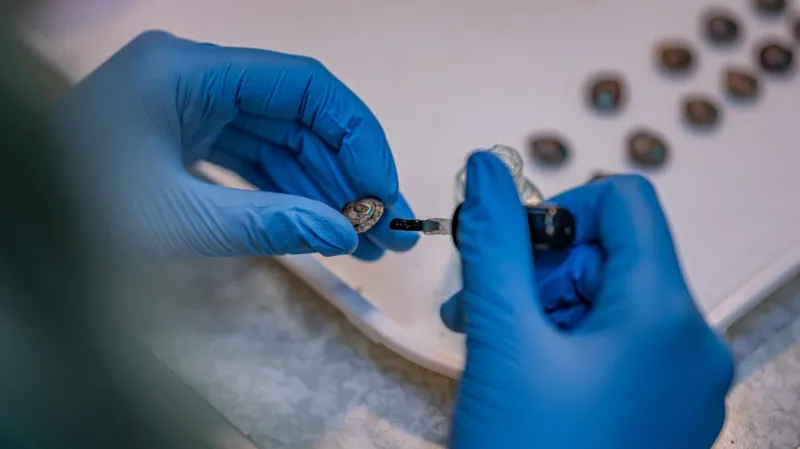
More than 1,300 pea-sized, critically endangered snails that were bred in a zoo have been set free to wander (very slowly) on a remote Atlantic island.
The release brings two species of Desertas Grande Island land snails back to the wild. Prior to this they were believed to be extinct – neither species had been spotted for a century.
When a team of conservationists found a small population surviving on the rocky cliffs of Desertas Grande island, close to Madeira, they mounted a rescue effort.
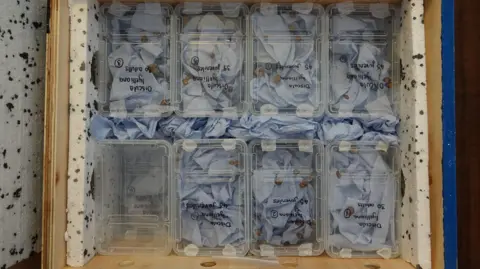
The snails were brought to zoos in the UK and France, including Chester Zoo, where a home was created for them in a converted shipping container.

The tiny molluscs are native to the windswept, mountainous island of Desertas Grande, just south-east of Madeira. Habitat there has been destroyed by rats, mice and goats that were brought to the island by humans.
It was thought that all these invasive predators had eaten the tiny snails to extinction. Then a series of conservation expeditions – between 2012 and 2017 – proved otherwise.
Conservationists discovered just 200 surviving individuals on the island.
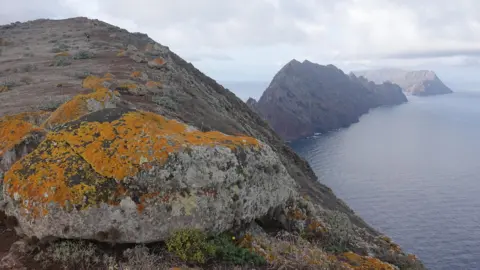
Those snails were believed to be the last of their kind, so they were collected and brought into captivity.
At Chester Zoo, the conservation science team made a new home for 60 of the precious snails. The right food, vegetation and conditions were recreated in miniature habitat tanks.
1,329 snail offspring, bred at the zoo, have now been marked with identification dots – using non-toxic pens and nail varnish – and transported back to the wild for release.
“It’s a colour code,” said Dinarte Teixeira, a conservation biologist at Madeira’s Institute for Nature Conservation and Forests. “This will allow us to spot them and track where they disperse to, how much they grow, how many survive and how well they adapt to their new environment.”
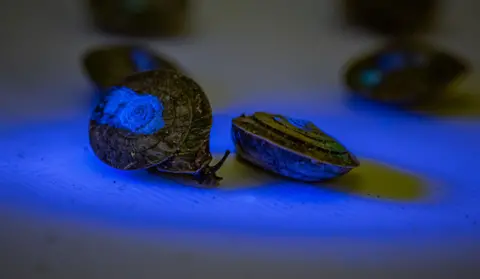
A wild refuge has been restored for the snails on Bugio, a smaller neighbouring island in the Ilhas Desertas (Desert Islands) archipelago. Bugio is a nature reserve and invasive species have been eradicated there.
Gerardo Garcia from Chester Zoo said that the reintroduction was “a major step in a species recovery plan”.
“If it goes as well as we hope, more snails will follow them next spring. It’s a huge team effort which shows that it is possible to turn things around for highly threatened species.”

“These snails are such an important part of the natural habitat [on the islands they come from],” explained Heather Prince from Chester Zoo. As well as being food for other native species, she explained, snails break down organic matter and bring nutrients to the soil.
“They help plants grow. All of that is dependent on the little guys – the insects and the snails that so often get overlooked.”
[BBC]


Australian police have seized 2.7 tonnes of cocaine – the country’s largest ever such bust – from an underground bunker system in western Sydney.
The drugs, with an estimated street value of A$816m (£433m, €500m), were found on Friday in compartments concealed beneath false floors in three shipping containers at a property in Londonderry.
Two men aged 21 and 25, who allegedly attempted to flee from police, were arrested at the scene and charged with possessing a commercial quantity of an unlawfully imported border-controlled drug.
Police say the cocaine was smuggled into Australia via the small town of Midge Point in North Queensland on the orders of an organised crime group.
The two men, who were remanded in custody after appearing in court on Saturday, face life in prison if convicted.
Police said the raid on the Londonderry property was part of “Operation Minjiang” which was launched in May after 40kg of cocaine was found floating in the water off a boat ramp at Midge Point.
Another six people in Queensland and New South Wales were arrested and charged as part of investigations sparked by the find, police said last week.
An alleged “mother vessel” suspected of being part of the smuggling operation has also been detained in Solomon Islands.
Despite its remoteness, Australia is a lucrative market for the drugs trade, with cocaine typically fetching around A$300 per gram, according to an illegal drugs monitoring system run by the University of New South Wales.
Australians and New Zealanders also have the highest cocaine use rates in the world, according to last year’s UN World Drug Report.
Australian Federal Police Commander Stephen Jay said the alleged plot showed “how highly organised and determined these criminal networks are, and the extreme lengths they are willing to go to in pursuit of profit.
“Investigations into the origin of the drugs remain ongoing, and we will work with our international and domestic law enforcement partners to identify the criminal syndicates and anyone else involved in facilitating this alleged attempted drug import.”
(BBC)
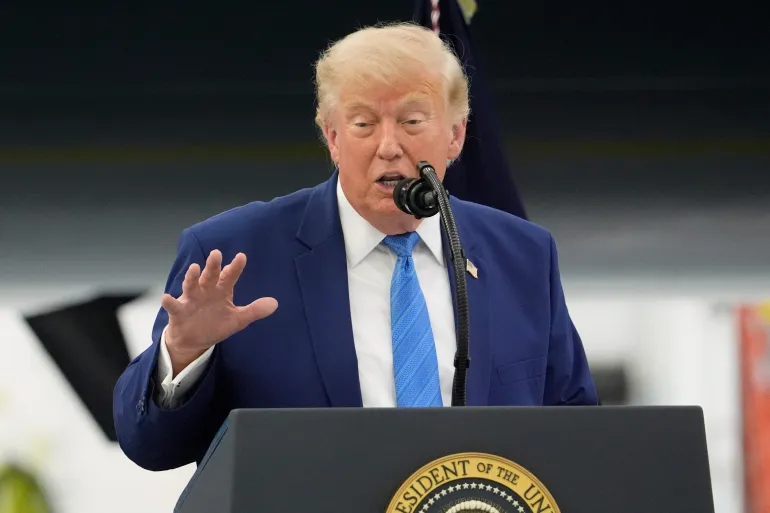
United States President Donald Trump has pledged there will be no tolls for passage through the Strait of Hormuz, unless they are collected by his own country.
Trump’s statement, made in a Saturday afternoon post on Truth Social, is the latest sign that a recently signed memorandum of understanding (MOU) may be unravelling.
“There will be NO TOLLS in the Hormuz Strait for 60 days during the Cease Fire Period, and there will be NO TOLLS after the 60 day period has expired,” Trump wrote, “unless they are imposed by and for the United States of America.”
Since the US and Israel launched a war against Iran on February 28, Iran has successfully used the Strait of Hormuz as a pressure point, closing the strategic waterway to traffic.
But under the terms of Wednesday’s ceasefire memorandum, the strait is supposed to reopen for an interim period of 60 days. During that time, Iran is barred from charging vessels for passage.
On Saturday, however, Iran’s joint military command said it had closed the Strait of Hormuz, citing a “clear breach” of the memorandum’s commitments.
US Central Command (CENTCOM), the agency that oversees military operations in the region, denied that report and maintained that the traffic continues to flow through the waterway.
The Strait of Hormuz has long been a flashpoint in the conflict between the US and Iran. Nearly 20 percent of the world’s oil and natural gas is transported through the strait, as well as about 30 percent of the global fertiliser trade.
Closure of the strait has caused global fuel costs to soar and has tested agricultural sectors across the world.
Trump had responded to Iran’s chokehold over the strait by imposing a US naval blockade on Iran’s ports in the region.
But that naval blockade was lifted under the terms of Wednesday’s memorandum. The deal also paused fighting on all fronts in the regional conflict, including in Lebanon.
The memorandum, though, was not intended as a long-term deal. It serves as a launching point for negotiations on key issues, including the future of Iran’s nuclear programme.
Several points of divergence also went unaddressed in the memorandum. Nowhere does the memo say that future tolls cannot be collected from the strait after the 60-day period expires.
Before the war, there was no charge for passage through the strait. Trump himself said in an interview with The New York Times that the waterway should remain “permanently toll-free”.
But he appeared to reverse course in Saturday’s post, once again floating the possibility that the US could extract tolls in the strait, while barring Iran from doing so.
No fees should be levied, Trump wrote, “unless they are imposed by and for the United States of America, should the deal not be completed”.
He explained that such a charge would compensate the US “for services rendered as the Guardian Angel to the countries of the Middle East for purposes of both past, present, and future reimbursement of costs”.
Trump used similar language in his New York Times interview earlier this week, floating the US becoming “the guardian of the Middle East” in exchange for 20 percent of its revenue.
Saturday’s post is not the first time Trump has mused about the US imposing tolls in the strait, either.
In April, for instance, he discussed the idea with reporters, saying, “What about us charging tolls? I’d rather do that than let them have them. Why shouldn’t we? We’re the winner. We won.”
There has been no indication that Trump’s plans have been officially presented to countries in the region, many of whom have struck a careful balance in their dealings with both the US and Iran during the war.
Iranian officials, meanwhile, have repeatedly said they will not rule out imposing tolls in the strait, framing the issue as a matter of sovereignty and regional negotiation. The strait sits between Iran and Oman.
Further discussions are expected on the matter in the coming weeks.
But such negotiations have been thrown into jeopardy amid ongoing Israeli military operations in Lebanon, which threaten to violate Wednesday’s ceasefire memorandum.
Iran claimed that Saturday’s closure of the strait was a result of new Israeli attacks in southern Lebanon, which killed dozens of people after the ceasefire was announced.
[Aljazeera]

The US government says it will stop funding programmes in South Africa intended to tackle the spread of HIV and Aids.
More than eight million South Africans are living with HIV – the highest number of any country in the world.
The US State Department appeared to link the decision to South Africa’s alleged failure to protect the white-minority Afrikaner community – an allegation the South African government has repeatedly rejected.
South Africa’s health ministry responded by saying that though it had not been informed of this decision, it had “long been working on a self-reliance plan”.
Until 2025, the US was supporting South Africa’s efforts to deal with the virus with an estimated $400m (£300m) a year through the President’s Emergency Fund for Aids Relief (Pepfar).
But since the inauguration of President Donald Trump, relations between the two countries have increasingly soured.
Shortly after he came into office, Trump issued an executive order alleging that “countless” South African policies dismantled equal opportunities and fuelled violence “against racially disfavored landowners”.
This is disputed by the South African government, which says its Black Economic Empowerment policy is needed to correct economic inequality dating from the apartheid era.
The executive order also highlighted South Africa’s case against Israel at the International Court of Justice and its links to Iran.
The White House said that given these “unjust and immoral practices”, further aid to South Africa would not be provided.
Trump has also falsely alleged that there is a “white genocide” taking place in South Africa, which has led to the administration setting up a refugee programme for Afrikaners – descendants of western Europeans who settled in southern Africa in the 17th Century. They are now just about the only refugees being allowed into the US.
The genocide claim has been widely discredited.
Pepfar funding, which had been providing about a fifth of South Africa’s total spending on HIV programmes, got a reprieve last October with what was called a “bridge plan”.
But a US State Department official has confirmed that a “phased drawdown” of Pepfar funding would now start.
This was because of “South Africa’s failure to make demonstrable progress on policy requests by the administration”, the official said.
The intention of the US government was to “foster self-reliance” and reduce dependency on American funding, they added, pointing out that “South Africa is a middle-income country and is more than capable of supporting its own health programs”.
South Africa’s health ministry has said that while Pepfar contributed to the country’s HIV programme, the provision of life-saving antiretroviral drugs was funded entirely separately, with most coming from the government.
Attempts to mend US-South Africa relations have floundered. These include a high profile White House meeting between Trump and South African President Cyril Ramaphosa just over a year ago when the US president confronted his counterpart with his claims of white persecution.
The US also boycotted the G20 meeting, a gathering of the world’s major economies, hosted by South Africa last November.
[BBC]

Largest ever cocaine bust in Australia after police raid underground bunker

Mohamed Salah scores as Egypt beat New Zealand for first World Cup win

Lamine Yamal scores first World Cup goal as Spain thrash Saudi Arabia

Shahidi sanctioned for running on the pitch during Chennai ODI

Kapp’s 81* seals South Africa’s come-from-behind win against India

Belgium see red in goalless World Cup draw with Iran in Los Angeles

‘Dates have the highest sugar content to fight Coronavirus’

Sunday Island 27 December – Headlines

#SundayIsland 17th December – Headlines

Sunday Island – 28th March

Sunday Island Headlines – 21 March

Sunday Island – 21st February – Headlines
-

 News7 days ago
Beijing Capital Airlines to resume flights to Colombo signalling boost to tourism
-
 Features6 days ago
Killing of Colombo’s ancient trees — a warning on UN’s World Desertification Day – 17 June
-

 News4 days ago
Creditor receives USD 2.5 mn as Lankan public bears loss from theft of Treasury funds
-

 News3 days ago
Creditor not yet paid
-
 News3 days ago
Consumers bearing 22% tax burden despite 18% VAT claim: Dr. Harsha de Silva
-
 Opinion5 days ago
Beyond diagnosis: A strategic design for 7% growth by 2029 (Part I)
-

 Opinion7 days ago
Fifty years after Soweto uprising
-
 News6 days ago
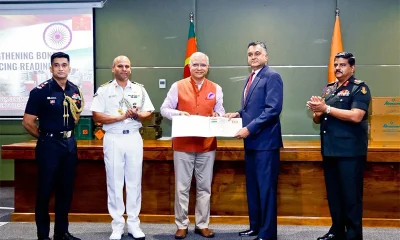
India provides military stores worth USD 5.5 mn to SL