
Latest News
WWC 2025: Radha shines in washout between India and Bangladesh

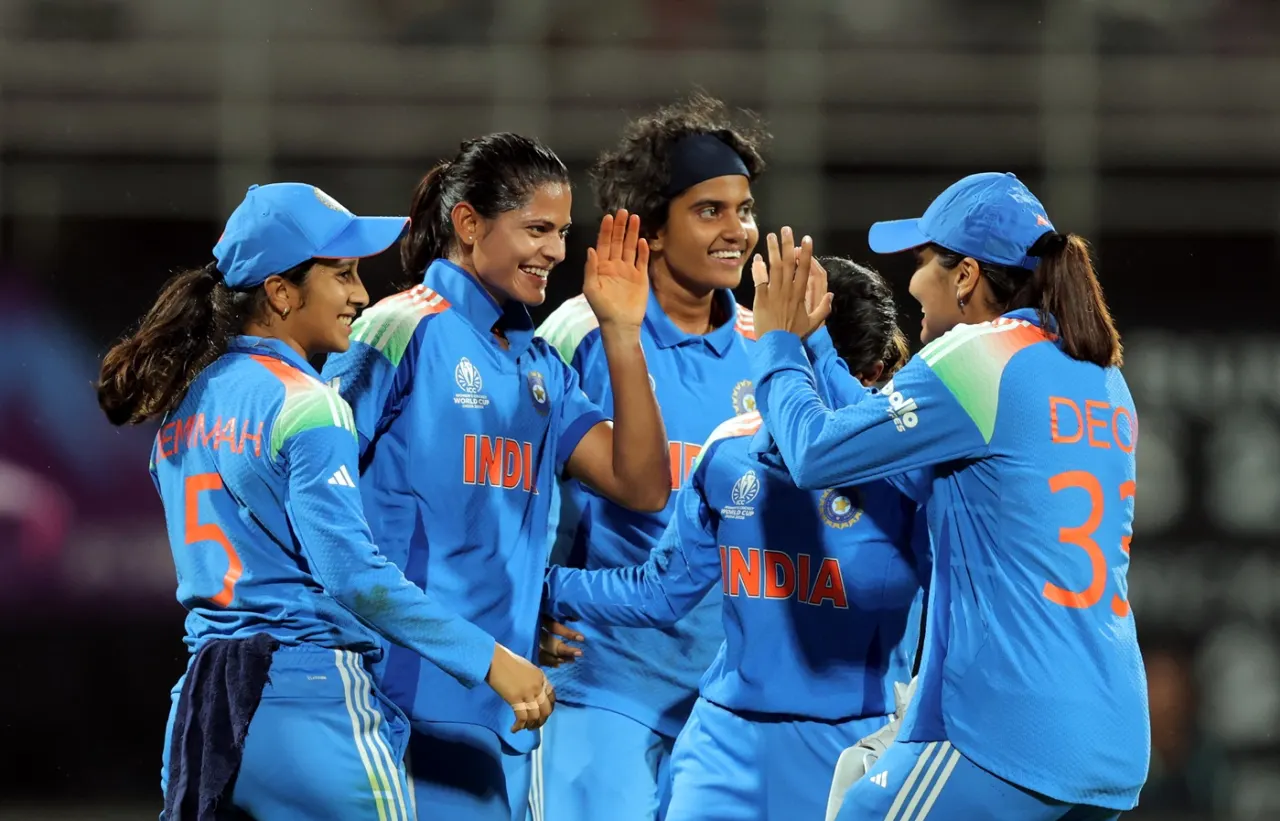
Unseasonal rain washed out the final group stage match of the Women’s World Cup with India well-poised to complete a big win over Bangladesh. The weather played more games than the cricketers after the start of play was delayed for two hours, which initially reduced the match to 43-overs-a-side. A further two-hour stoppage 12.2 overs into Bangladesh’s innings made it a 27-overs-a-side match and India were set a revised target of 126.
They were on track at 57 for 0 in the ninth over but more showers meant the minimum 20 overs could not be completed.
With more rain forecast for the rest of the week in Mumbai, this match may have been a taste of things to come, especially for India’s semi-final against Australia on Thursday but that could be the least of their concerns. Opening batter Pratika Rawal suffered an injury to her knee and ankle while fielding and could not take her place at the top of the line-up in the chase. With a three-day turnaround before the knockout, she is being monitored by the Indian medical staff. In Rawal’s absence, Amanjot Kaur partnered Smriti Mandhana in the chase.
That India had such a modest target was largely due to their left-arm spinners, who shared five wickets between them. Radha Yadav, playing in her first match of the tournament, picked up 3 for 30 while Shree Charani iced the cake with 2 for 23 included. Only four Bangladesh batters got into double-figures as they stumbled to 119 for 9 in 27 overs.
Bangladesh were under pressure from the first ball when Renuka Singh produced an inswinging yorker that tested Sumaiya Akter’s defence. She finished the over with a wide ball outside off that Sumaiya slashed at, only to find Charani at short third. Deepti Sharma opened the bowling from the other end but had to wait until the tenth over to break through. She went around the wicket to Rubya Haider and induced a leading edge which was caught at mid-off.
There were 17 more balls bowled as the drizzle became a downpour and players were taken off the field at 5.50pm. Heavy rain followed and it looked increasingly unlikely the game could go ahead by 8.05pm, but the weather cleared leaving the players to deal with a wet ball.
Sharmin Akhter should have been run out when she thought a single was on even as Nigar Sultana sent her back from more than halfway down. Jemimah Rodrigues’ throw was good but Charani could not collect cleanly. Four overs later, Radha made no mistake. Sharmin hit the ball to her at point. Nigar, from the non-striker’s end, ran and Radha’s clean pick-up and throw found her short of her ground.
Bangladesh also struggled to find the boundary on resumption and it took 41 balls before they breached it with Sobhana Mostary taking advantage of a hint of width to cut Deepti for four. She stayed on the back foot to pull Radha through midwicket and inject some intent into the innings. Bangladesh were 73 for 3 after 20 overs and set up to go big.
Mostary took back-to-back boundaries off Deepti at the start of the 21st over and then Sharmin joined in. She swung hard and sent the ball towards long-on, where Rawal ran to collect but injured herself and had to be helped off the field.
Harleen Deol took a simple catch at mid-off when Mostary attempted to force the issue and hit Radha over the top. She was dismissed for a 21-ball 26 and featured in Bangladesh’s highest partnership of 38.
Shorna Akter was bowled by Amanjot before Nahida Akter swiped across the line and was bowled by Radha. Substitute fielder Arundhati Reddy sprinted in from deep midwicket when Sharmin slog-swept Charani, then flung herself forward as she took the catch. Later in the over, Radha over-ran trying to field the ball and also seemed to tweak an ankle. It didn’t stop her bowling the penultimate over and picking up her third wicket as Rabeya Khan was bowled.
Bangladesh collapsed from 91 for 3 to 117 or 9, which meant their total could hardly be considered competitive, even with Rawal unavailable. Marufa Akter found swing, and sometimes too much, but India established their chase when Amanjot short-arm pulled her with exquisite timing for the first boundary. Mandhana helped herself to a series of fours off Nishita Akter, using her feet well against the spin. After they had each faced 15 balls, Mandhana was on 23, and Amanjot just 7. They were both also dropped by Sultana, who could not hold on to difficult chances: Mandhana on 28 off Nahida, Amanjot on 15 off Rabeya.
The rain returned after that chance and the captains shook hands at 10.20pm. Bangladesh gained a point, which allowed them leapfrog Pakistan into seventh place, on net run-rate.
Brief scores: Match abandoned
India Women 57 for 0 in 8.4 overs (Mandhana Ismail 34*, Amanjot Kaur 15*) vs Bangladesh Women 119 for 9 in 27 overs (Sharmin Akhter 36, Sobhana Mostray 26; Radha Yadav 3-30, Shree Charani 2-23)
[Cricinfo]


Donald Trump had been warning for months that a Supreme Court decision like this would be catastrophic.
If the court curtailed his ability to impose these tariffs, he had said, it would be an “economic and national security disaster”.
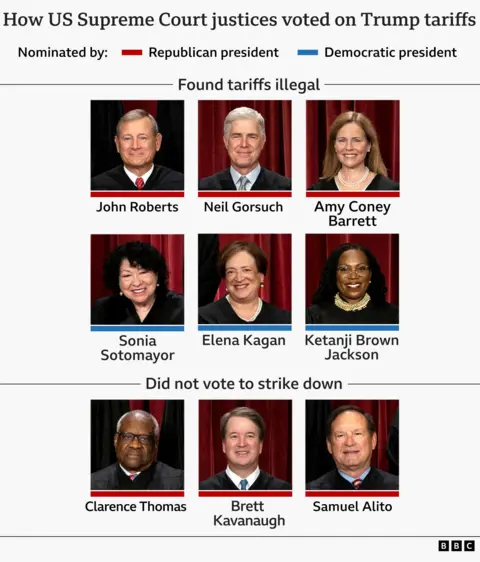
A six-justice majority of the Supreme Court, in ruling against the president on Friday, didn’t care much about his concerns.
Congress, not the president, has the power to impose tariffs, the justices ruled. And nothing in the law that the president based his tariffs on, the Emergency Economic Powers Act of 1977, delegated such sweeping powers to Trump.
The court’s decision represents a rare check on this president’s broad use of executive authority.
A majority of the justices over the past year have shown a willingness to allow Trump to press ahead with his agenda, particularly on immigration and reshaping the federal government, even as legal challenges work their way through the court system.
This case, which was fast-tracked through the court system as an emergency, slams the door on one such expansive use of presidential authority.
With several other major cases involving controversial uses of executive power, such as efforts to end birthright citizenship and to dismiss a Federal Reserve governor based on alleged improprieties, this may not be Trump’s only setback in the coming months.
At the very least, this decision weakens Trump’s hand when trying to force other nations to make concessions to the US and tarnishes his veneer of invincibility.
Weakness begets weakness, and America’s trading partners may be emboldened to take a tougher line with the US now that the president’s tariff powers have been curtailed.
It also opens up the possibility that the Trump administration may have to give back much of the tariff revenue it collected over the past year.
While the justices left this thorny issue to be decided by a lower court, Brett Kavanaugh in his dissent warned that the process is likely to be a “mess”.
The Trump administration had plenty of time to prepare for Friday’s decision.
Supreme Court precedent, and the attitude of many of the justices when the case was argued in court last November, indicated that an adverse outcome for the president was quite possible.
Jamieson Greer, Trump’s top trade adviser, said last month that the White House has “a lot of different options” on how to proceed if the tariffs were struck down.
“The reality,” he said, “is the president is going to have tariffs as part of his trade policy going forward.”
The other options that could be at Trump’s disposal are more limited, however.
They require government agencies to produce detailed reports to justify imposing tariffs, and they have limits on their scope and duration.
Gone are the days when the president could threaten, or enact, triple-digit tariffs with the wave of a pen or the click of a Truth Social post.

New tariffs will require a longer lead-in time before they are imposed.
That could limit the kind of economic disruption that took place when the president announced his expansive “Liberation Day” tariffs last year, and would give other nations more time to prepare their responses.
If Trump wants to restore his free hand to impose new tariffs, he could always ask Congress for the kind of explicit authorisation that the Supreme Court has said is necessary. But with narrow Republican majorities in the House and Senate, and midterm elections looming, the success of such a move seems unlikely.
In fact, some of Trump’s conservative allies in Congress may be breathing somewhat easier with this decision.
The president’s tariffs – and the costs they have imposed on consumers – have been unpopular among many Americans. Republican candidates in battleground states and congressional districts would have been open to Democratic attacks for supporting Trump’s policies.
That area of vulnerability has been reduced for now.
Friday’s decision will set up an awkward moment on Tuesday, when Trump delivers his annual State of the Union Address to a joint session of Congress. Traditionally, many of the Supreme Court justices sit in the front row of the chamber.
The president, after spending months issuing dire warnings against the court, could stand eye-to-eye with the justices who eroded one of the key pillars of Trump’s second-term agenda.
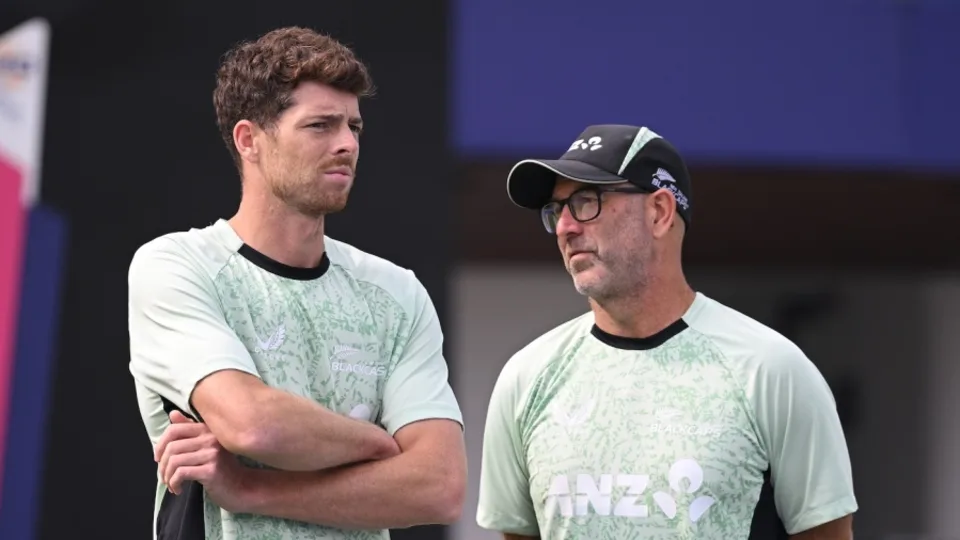
41: That’s the number of times New Zealand and Pakistan faced each other across formats in a 30-month period between October 2022 and April 2025. Twenty four of those meetings came in T20Is, with the sides compensating for a tour which New Zealand abandoned in 2021, citing security concerns by piling on as many bilateral engagements as is it was possible to fit in a calendar.
Aside from a T20 World Cup semi-final in Sydney in 2022, none of those games mattered as much as the one in Colombo on February 21. Both sides have much convincing to do as credible title-contenders after a group stage which saw them ease past lower-ranked teams while getting thumped by the one powerhouse they played. In New Zealand’s case, it was South Africa who gave them a battering, while Pakistan were left similarly bruised by an Indian side that has otherwise not quite hit its straps.
For New Zealand, the biggest challenge is the switch of venue. They played all of their games in Chennai and Ahmedabad, and relied on a balance between seam and spin that leaned towards the former, with Mitchell Santner the only frontline spinner and Rachin Ravindra or Glenn Phillips chipping in with the odd over. In Colombo, that balance is likely to reverse as the slower bowlers take centre stage, something Pakistan have deployed so effectively in most of their matches.
Santner’s men have not tinkered much with the batting order, which has held up remarkably well for the most part. Against weaker oppositions, some combination of openers Finn Allen and Tim Seifert, or top order batters Ravindra and Phillips, have showcased enough firepower to ease home. Opposition attacks have also struggled to puncture their way through, with New Zealand losing just 14 wickets in four games, the second fewest for any side in this tournament.
Unlike New Zealand, Pakistan know this city intimately well by now. Three of their four games may have been played at the SSC – the other Colombo ground – but their match against India here at the RPS was, like Saturday’s contest, also an evening game, giving them a valuable read into the pitch and conditions. It is the venue they used more spin on than any other, with captain Salman Ali Agha suggesting that would only continue in the Super Eight.
Pakistan’s top order has the explosiveness to blow teams away, even if they have struggled to translate that potential with form for Saim Ayub. Sahibzada Farhan at the other end has taken on the mantle for powerplay run-scoring as runs for Agha having dried up before the game against Namibia, and Babar Azam no nearer to maximising his ability. That fragility too quickly brings up a middle order comprising too many bowling allrounders or the untested Khawaja Nafay, a situation that led to a near-defeat against the Netherlands and a decisive defeat against India.
This is two teams situated among the middle powers of this World Cup, eager to demonstrate they’re better than what they managed against true superpowers like India and South Africa. What matters, ultimately, is which of them can show they’re better than the middle power they face off against on Saturday.
Jacob Duffy takes a wicket against Pakistan every 10.5 deliveries. Among bowlers with at least 15 scalps against Pakistan, no one in the world matches that strike rate. Eighteen of his 62 wickets have come against Saturday’s opponents, at an average of 12.77, comfortably the best amongst teams he has played more than five games against. The catch, however, is that all but one of those wickets have come in New Zealand, in conditions very different to what’ll be in front of him at the Premadasa in Colombo. But Hardik Pandya, who boasts an almost equally impressive record against Pakistan, did not find this very venue an impediment against bowling effectiveness against Pakistan. Duffy will hope to have similar success.
Abrar Ahmed was, arguably harshly, dropped against Namibia after an off-day against India. But his longer-term form makes it unlikely he will stay out of the side again in the raised stakes of the Super Eight. He was Pakistan’s second-highest wicket-taker in 2025, and at the Asia Cup last year, his economy rate of 5.36 in spin-friendly conditions was by far the most miserly in the tournament. All of that points to the India game being an aberration, with Pakistan needing him at his best for the business stages. He was Pakistan’s best bowler in the two series against Sri Lanka and Australia prior to this World Cup, and how he responds to the wake-up call of his axing may go some distance to determining the fate of Saturday’s game.
Abrar Ahmed is expected to come back into the side, but Pakistan will not want to make wholesale changes to a team that delivered so handsomely in their must-win game against Namibia.
Pakistan: Sahibzada Farhan, Saim Ayub, Salman Ali Agha (capt) Babar Azam, Khawaja Nafay, Shadab Khan, Usman Khan (wk) Mohammad Nawaz/Faheem Ashraf, Salman Mirza, Usman Tariq, Abrar Ahmed
New Zealand will take a late call on Lockie Ferguson, who gets into Sri Lanka on Friday night after being granted paternity leave. It will be interesting to see how New Zealand manage to incorporate more spin into their XI to reconcile with Sri Lankan conditions. That might bring Ish Sodhi in for his first game this World Cup.
New Zealand: Tim Seifert (wk), Finn Allen, Rachin Ravindra, Glenn Phillips, Mark Chapman, Daryl Mitchell, Mitchell Santner (capt), Jimmy Neesham, Matt Henry, Ish Sodhi Jacob Duffy
[Cricinfo]
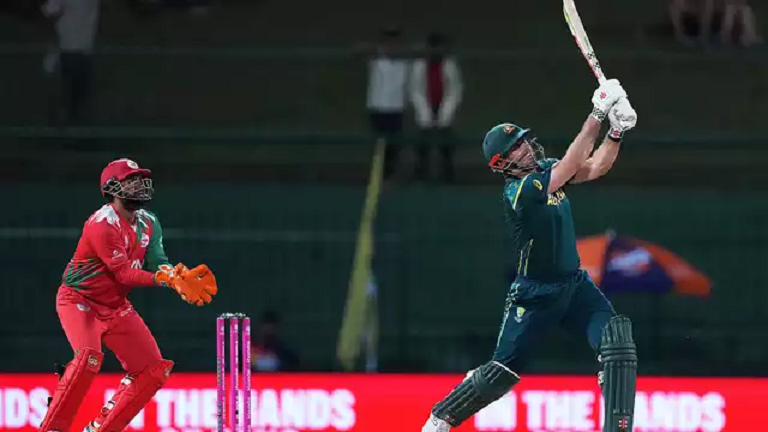
Oman 104 in 16.2 overs (Jatinder Singh 17, Karan Sonavale 12, Hammad Mirza 16, Wasim Ali 32; Marcus Stoinis 1-16, Nathan Ellis 1-14, Adam Zampa 4-21, Glenn Maxwell 2-13, Xavier Bartlett 2-27) lost to Australia 108/1 in 9.4 overs (Mitchell Marsh 64*, Travis Head 32, Josh Inglis 12*; Shakeel Ahmed 1-29) by 9 wickets

Tariffs ruling is major blow to Trump’s second-term agenda

New Zealand meet familiar opponents Pakistan at spin-friendly Premadasa

Bowlers, Marsh orchestrate consolation Australia win

Development activities in schools within plantation areas should be carried out in coordination with District Coordinating Committees – PM

Asos co-founder dies after Thailand apartment block fall

BCB central contracts: Taskin, Mushfiqur demoted; no player in A+ category

‘Dates have the highest sugar content to fight Coronavirus’

Sunday Island 27 December – Headlines

#SundayIsland 17th December – Headlines

Sunday Island – 28th March

Sunday Island Headlines – 21 March

Sunday Island – 21st February – Headlines
-

 Life style6 days ago
Marriot new GM Suranga
-

 Business5 days ago
Ministry of Brands to launch Sri Lanka’s first off-price retail destination
-

 Features6 days ago
Monks’ march, in America and Sri Lanka
-

 Features6 days ago
The Rise of Takaichi
-

 Features6 days ago
Wetlands of Sri Lanka:
-

 News6 days ago
Thailand to recruit 10,000 Lankans under new labour pact
-

 News6 days ago
Massive Sangha confab to address alleged injustices against monks
-

 Sports2 days ago
Old and new at the SSC, just like Pakistan