
Sports
World Cup 2022: Vittorio Pozzo’s legacy and a record that might finally be under threat


When Didier Deschamps leads his France side out to face England in their World Cup quarter-final on Saturday, he will be hoping to take a further big step towards becoming only the second manager to retain the trophy. Just two nations have managed to win back-to-back men’s World Cups, Italy in 1934 and 1938 and Brazil in 1958 and 1962, but with the Selecao job changing hands between successes, former Azzurri coach Vittorio Pozzo stands alone.
Nicknamed Il Vecchio Maestro (the Old Master) in coaching circles, Pozzo was considered a visionary of the time and is credited as one of the minds behind the Metodo formation, the earliest example of the 4-3-3 we recognise today.Yet far from being revered as the only manager to win the men’s World Cup twice, Pozzo remains relatively little known. And there is a reason for that.
“It’s deliberate that few people know who he is,” says historian Dr Alex Alexandrou, the chair and co-founder of the Football and War network.
“If you think about post-1945 Italy, and how Fifa and the Italian Football Federation project and promote themselves, the one thing they didn’t want to do was give credence to Pozzo and what happened during the 1930s, because there is a significant link with the far right and fascism.”
Despite Pozzo first taking charge of the national team for the 1912 Olympics – before fascists rose to power in Italy – and never being a member of the National Fascist Party, his story is inextricably linked to the far right movement that culminated in Benito Mussolini’s dictatorship.
The four stars proudly emblazoned on Italy’s national team shirt to symbolise their quartet of World Cup wins acknowledge the victories of 1934 and 1938, but there’s still some unease around them.
“There’s this slight sort of smell, if you like, after the war, and Pozzo isn’t as famous or exulted as he might be because he won his trophies under a fascist regime,” explains Italian football expert John Foot in his new book How to Win the World Cup.
“He wasn’t forced to do that; he participated in that. The players gave the fascist salute and there was a lot of rhetoric around them, so it’s a problem in terms of Italy. Do those World Cups even count?”
Sport historian Prof Jean Williams adds: “A lot of people describe Pozzo as capitulating to the regime – he goes along with it rather than standing up to it.
“Unless you were going to leave the country, it was very difficult to avoid, in the same way that a lot of young men would have become part of the Hitler Youth [in Nazi Germany] because it was essentially their version of the boy scouts.”
Dr Alexandrou agrees: “I don’t think Pozzo had much time for politics per se or even for the fascists, but he loved his football and he had to survive in that regime. He did what he felt he had to do in order to do the job he wanted to do, which was to manage.”
Mussolini’s fascist government had quickly identified the value of a strong association with football after seizing power in 1922 and its involvement with Italy’s national game deepened as the country became a dictatorship.
Money was poured into the sport in search of the best possible chance of success on the international stage, with Serie A reorganised in 1929 to create stronger competition and help develop players that could compete at the top level. Militia general Giorgio Vaccaro was installed as the head of the Italian Football Federation. But when it came to the national team, Pozzo was the poster boy.
Italy were World Cup hosts in 1934. The country’s rulers considered it crucial that they win, thereby reaffirming fascism’s strong nationalist values and conveying the image of a modern and assertive nation to the rest of the globe.Although a combination of Pozzo’s tactical approach and a partisan home crowd would help Italy’s chances of glory, there were also rumours of foul play – with Mussolini allegedly meeting with tournament referees the night before key matches.
Although no corruption was ever proved, opponents complained of officials’ leniency towards the Azzurri’s physicality. Swiss referee Rene Mercet was even suspended by his own football association following claims he made several controversial decisions as Italy squeezed past Spain in a heated quarter-final replay.
Despite the accusations, there was no doubt Pozzo’s tactical ingenuity had an impact. The Italians conceded only three times in five matches – particularly impressive given the comparatively free-scoring nature of the time. The coach’s preference for playing with four defenders and a holding midfielder gave them a stronger footing in the face of the popular 2-3-5 formation. (BBC Sports)
“We start to see the beginnings of the catenaccio defence where the centre-half is a kind of stopper,” Williams explains.
“Under Pozzo, instead of a centre-half being the one that spread the ball around, the midfield became more important, with a holding midfielder and an attacking midfielder, or inside rights and lefts, as they were called in those days.”
Pozzo can in another sense be seen as a forefather to the modern international manager in his insistence on having full control over team selection. Previously many national sides were chosen by appointed committees, but Pozzo said the best chance of success was for the coach to take responsibility – something Sir Alf Ramsey also did upon becoming England manager in 1963.
This meant Pozzo could call upon the oriundi, a term used to describe foreign-born people with Italian descent, to bolster his side’s ranks. Within that diaspora, he called up Luis Monti, who had played in the 1930 World Cup final for Argentina, and Raimundo Orsi, another former Argentina player who would score for Italy in the 1934 final, a 2-1 victory over Czechoslovakia.
This wasn’t universally popular among the fascist regime, but the prospect of forming a stronger national side tipped the debate in Pozzo’s favour. His new-look side were well organised, treated matches like battles and would stop at nothing to win. Training camps were punctuated with strong nationalistic messages and the squad treated almost as if they were soldiers, with exercises such as marches through the woods commonplace.
Pozzo continued to develop his approach in the ensuing four years, leading Italy to victory at the 1936 Olympics in Berlin and becoming the first manager to win a World Cup on foreign soil in France in 1938.
Facing a vocal anti-Italian crowd in their opening match of the tournament against Norway in Marseille, Pozzo and his players held a fascist salute as an act of defiance and refused to lower their arms until the jeers died down. Upon lowering their salute the noise began again, with Pozzo barking the order to raise their arms once more.
As Italy progressed through the tournament, a quarter-final meeting with hosts France only further dialled up the political tension and a kit clash saw the Azzurri, changed from their usual blue shirts, opting to play in all black rather than their second colour, white, on orders from above.
By now Italy carried a little more creativity to go with their clout, with Giuseppe Meazza growing in influence in the centre of Pozzo’s carefully constructed midfield. The captain was instrumental as the holders dispatched France 3-1; he then scored the winner from the penalty spot against Brazil in the semi-final; and in the final he teed up Luigi Colaussi and Silvio Piola as the forwards scored twice each in a 4-2 win over Hungary.
The significance of a second consecutive World Cup victory wasn’t lost on the fascist government back home, with a myth emerging that Mussolini sent a telegram to the team on the eve of the final saying “win or die”. It’s a detail that has never been confirmed.
But it would prove to be the end of Pozzo’s World Cup story. The outbreak of the World War Two meant the tournament didn’t return until 1950, by which time he had been relieved of his duties and banned from Italian football because of his association with the now-overthrown fascist government.
Pozzo went on to become a well-respected journalist covering the Italian national team for daily newspaper La Stampa, but he would never return to the dugout. He died in December 1968, aged 82.
“Pozzo was obviously a very good leader and very good at mobilising and motivating his teams,” Foot continues in How to Win the World Cup.
“He saw football as war and used national rhetoric around international tournaments. It was like war had been transported onto the pitch.”
(BBC Sports)


by Reemus Fernando
A combined bowling effort and top order batting anchord by Ranmith Senarath powered Nalanda to a vital six wickets win over St. Joseph’s in the Under-19 Division I Tier A Limited Overs Tournament match at Campbell Place on Friday.
Ranmith struck an unbeaten 51 to steer the team to victory in the 30th over as Nalanda completed their group matches unbeaten.
Earlier they beat Thurstan (155) by seven wickets, St. Servatius’ Matara (187) by four wickets and Gurukula (113) by nine wickets.
Ranmith’s composed knock which came in 69 balls included six boundaries and a six.
Nadul Jayalath provided an aggressive start with 27 off 23 balls, including five boundaries, while Nemindu Akmeemana contributed 25 off 41 deliveries. Lithum Wijekumara added 14, and Rusandu Silva remained unbeaten on eight.
St. Joseph’s, batting first, struggled to build momentum and were restricted to 135 for nine in 47.2 overs. Pamoda Dalpadado top-scored with 36 off 59 balls, while Kavith Fernando made 24 and Vishwa Peiris contributed 17 off 63 deliveries.
Nalanda’s bowlers maintained control throughout the innings, with Santhul Wijeyarathne leading the attack with two wickets for 19 runs from nine overs. Osanda Pamuditha, Nadul Jayalath, Rusandu Silva, Methuka Perera, Sadew Indeepa and Lithum Wijekumara claimed a wicket apiece.

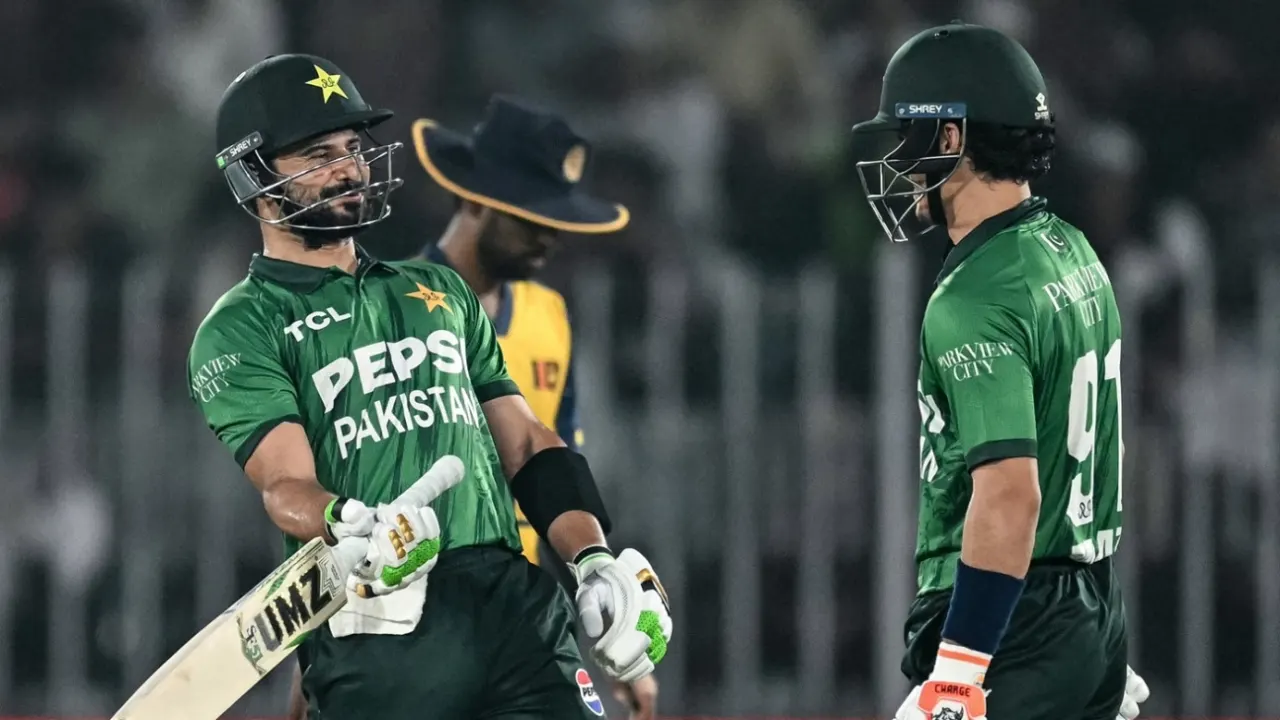
Sahibzada Farhan celebrated his ascension to the captaincy in grand style, smashing a 53-ball 89 that blazed his side to a comprehensive win in the first T20I against Sri Lanka . After Sri Lanka won the toss in Rawalpindi and somewhat curiously opted to set a target, the 182 they put up was made to look inadequate by a bellicose Pakistan’s showing up top that put up 70 in the powerplay and scarcely slowed down after. Maaz Sadaqat, who needed just 28 balls to bring up his half-century, put up a 92-run stand with Farhan after Fakhar Zaman’s cameo up top, flaying a lacklustre bowling attack.
Pakistan’s efforts with the ball were altogether more impressive, if sullied by bursts of untidiness that saw a whopping 29 extras conceded. But they reined Sri Lanka in from time to time, stifling their momentum and keeping the score within chasing range. Mohammad Imran’s 2-21 on debut was the pick of the bowling efforts, and while Lahiru Udara kept Sri Lanka afloat almost single-handedly with 91 off 55, the support he needed from the other end never quite came.
When Sri Lanka batted after winning the toss, it took Kamil Mishara nine deliveries to get off the mark. By the end of the fourth over, Sri Lanka were scoring at a run-a-ball, and had lost two wickets. Pakistan, by contrast, took just 2.2 overs to match that score; by the end of the sixth, they had powered through at dazzling speed thanks to Farhan and Zaman’s onslaught.
Sri Lanka took far too long to begin taking advantage of the powerplay. They struggled to find their timing, the powerplay littered with multiple plays and misses, and extravagant, low-percentage shots that bore no fruit. While they did launch a bit of a recovery in the final two overs, the slow start would end up proving costly as Sri Lanka left runs on the table.
To say Mohammad Imran wasn’t the most exciting debutant from Pakistan this game would be stating the obvious. That title belonged to Razaullah – the fast-bowling, six-hitting, sharp-jawed Edgbaston slayer Razaullah – who appears to have parlayed his stunning Test debut into white-ball call-ups. Imran, who also made his Test debut in that game and ended up being a footnote, instead found his feet in T20I cricket in Rawalpindi today.
Opening the bowling alongside Naseem Shah, he was the more effective bowler, utilizing sideways movement that more than made up for a lack of pace. He conceded just the one run in his opening over and 19 in three powerplay overs. As Sri Lanka found their feet at the halfway stage of the innings, Farhan turned back to him and Imran did not disappoint his captain. He struck with his first delivery upon return and allowed just two in the over, halting Sri Lanka’s momentum once more and capping a stellar debut.
Sri Lanka will want to move quickly on from this game, but to wipe it completely from the record would be a disservice to their opener. Confronted with a decent bowling attack on an off-day for his fellow batters, Udara almost batted through the Sri Lankan innings, playing just about every role a batter can in T20 innings.
He was the flashy starter, before shepherding his side through the early stages of the powerplay. He became an anchor for a bit before churning through the gears in the latter half of the powerplay. At times, he did so with strokes so classical they could be set to music, especially pleasing when he made some room and cleared extra cover off both pace and spin.
While support from Kamindu Mendis and Dasun Shanaka existed, it was fleeting. Soon enough, those wickets would fall, leaving Udara with the delicate dance of keeping the run rate up without letting the innings implode. That was especially true – and shown to be crucial at the death – because Sri Lanka were arguably playing a batter too light. When he finally holed out in the penultimate over, Sri Lanka ended up losing three wickets in five balls, the innings petering out on a surface where batting inadequacy was always going to be punished.
Scores:
Pakistan 187 for 6 in 18.5 overs (Sahibzada Farhan 89, Fakhar Zaman 21, Maaz Sadaqat 50, Khawaja Nafay 12*; Nuwan Thushara 1-32, Dushmantha Chameera 1-40, Eshan Malinga 2-33, Maheesh Theekshanan 2-36) beat Sri Lanka 182 for 8 in 20 overs (Lahiru Udara 91, Kamindu Mendis 23, Dasun Shanaka 18; Naseem Shah 3-36, Mphammad Imran 2-21, Rasaullah 1-29, Shadab Khan 1-33, Saim Ayub 1-17) by 4 wickets
[Cricinfo]
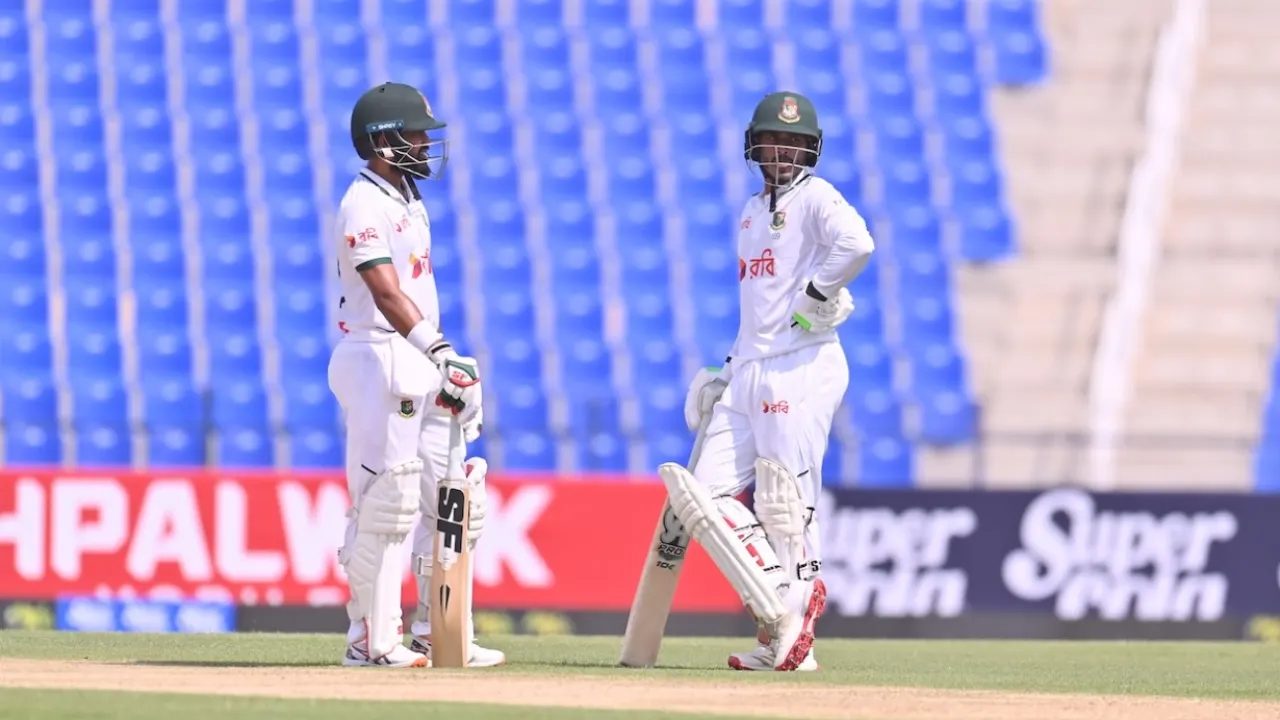
Afghanistan’s pace attack fought back late in the day as Bangladesh went to stumps on 317 for eight on day one in Abu Dhabi.
Mohammad Saleem, Yamin Ahmadzai and Ismat Alam combined to take seven out of the eight wickets that fell on the day. For Bangladesh, Shadman Islam, Tanzid Hassan and Litton Das made fifties.
Saleem targeted the shorter length after lunch, while Ahmadzai found success pitching the ball fuller. Ismat, meanwhile, bowled within himself and was rewarded with the wickets of both set batters Tanzid and Mehidy Hasan Miraz as he drew errors from each.
Tanzid was Bangladesh’s enforcer earlier in the day, hitting eight fours and four sixes in his 71-ball 83 in the first session. He looked set to get to a century in the first session, only for Ismat to thwart his charge.
Later, Shadman Islam and Litton Das struck fifties on either side of Bangladesh’s mini collapse. They lost three wickets for just four runs after they were 221 for two in the second session.
Bangladesh 317 for 8 in 84 overs (Shadman Islam 67, Tanzid Hasan 83, Litton Das 53; Yahmin Ahmadzal 2-62 , Mohmmad Saleem 3-70, Ismat Alam 2-20) vs Afghanistan
[Cricinfo]

Sri Lanka ITEC Alumni Association formally launched

Measures underway to protect Diyagama Forest as a Reserve — Deputy Minister of Environment

Showers or thundershowers will occur in most parts of the island after 1.00 p.m.

NPP govt. reminded of its responsibilities as US warship leaves Colombo

CERT: Beware of foreign Uni. scams on social media

Shiranthi receives treatment at National Eye Hospital

‘Dates have the highest sugar content to fight Coronavirus’

Sunday Island 27 December – Headlines

#SundayIsland 17th December – Headlines

Sunday Island – 28th March

Sunday Island Headlines – 21 March

Sunday Island – 21st February – Headlines
-

 Features6 days ago
The first woman in the foreign service or Ceylon Overseas Service it was then called
-

 News5 days ago
Geneva takes up Sallay’s case and govt. ignores opportunity to answer accusations
-

 Foreign News7 days ago
Ten injured after car crashes into rugby supporters in Australia
-

 News6 days ago
Nearly 20 Iranian tankers stranded off Lanka amid US sanctions
-

 Features4 days ago
Preventing grievances from becoming communal
-

 Sports2 days ago
Nissanka absence opens door for Sri Lanka’s young guns
-

 Features5 days ago
Sri Lanka Cricket Bill: Governance reform is not yet a cricket strategy
-

 News3 days ago
Gnansara Thera to be assigned to prison printing section: Officials