
News
Wimal warns of Western interventions,Indian agenda as situation deteriorates

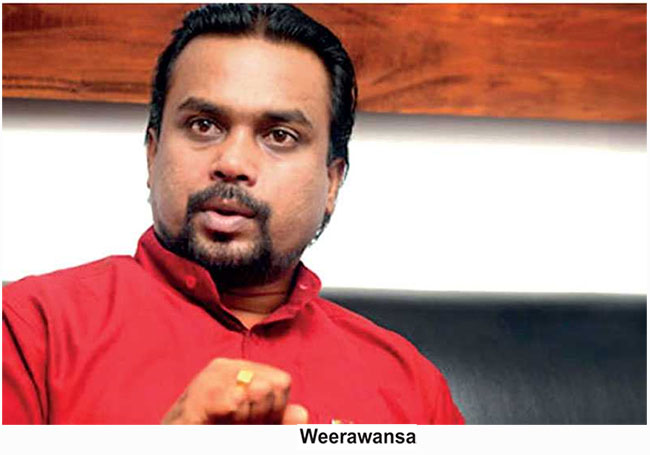
… frowns on mismanagement of relations with Russia
By Shamindra Ferdinando
National Freedom Front (NFF) leader and MP Wimal Weerawansa has warned that the current politico-economic-social crisis could lead to foreign military interventions.
Appearing in a Hiru TV programme on Monday night, the former industries Minister declared that Western powers could intervene on the basis of the ‘responsibility to protect’ (R2P) doctrine.
The Colombo District lawmaker said so when he dealt with possible scenarios in case the much touted IMF debt restructuring programme failed to materialize. The police and the armed forces wouldn’t be able to deal with the situation efficiently, the MP said, recalling how the May 09 violence changed Sri Lanka’s image overnight.
President Gotabaya Rajapaksa sacked Weerawansa along with his Cabinet colleague Udaya Gammanpila, in the first week of March this year. They were sacked soon after a group of rebel lawmakers presented an alternative action plan consequent to a split in the ruling SLPP over the finalization of the Yugadanavi deal.
MP Weerawansa said that international media coverage compared the situation here with that of South Sudan. The NFF leader said that the Indian Army would probably lead the foreign military deployment here.
Commenting on India’s renewed interest in Kachchativu island south-west of Delft, MP Weerawansa explained how Sri Lanka could end up like Bhutan and Nepal where Indian currency is widely accepted. The former minister alleged that it was a different kind of take-over.
Appreciating the financial support extended by India at Sri Lanka’s hour of need, lawmaker Weerawansa asserted that the political environment was so dicey, powerful external elements and their local agents undermine and manipulate the hapless country.
Asked whether the NFF was happy to see the back of Basil Rajapaksa, who recently quit his National List seat in Parliament, lawmaker Weerawansa emphasized how Premier Ranil Wickremesinghe could sustain the former finance minister’s agenda.
The MP examined the current developments and various external interventions in the context of ‘Quad’ alliance comprising the US, Japan, Australia and India. The one-time JVP heavyweight said that foreign powers may find developments here conducive for their overall plans. Therefore, the government and the Opposition should not in any way contribute to destabilization projects underway, MP Weerawansa said, warning of dire consequences unless those in authority responded to the threat.
The ex-minister alleged that there hadn’t been a proper assessment of the crisis so far. Therefore, the government responses to the developments could be either late or irrelevant at the point they were taken, MP Weerawansa said.
MP Weerawansa said that Sri Lanka could seek assistance from friendly countries without primarily depending on India. Accusing the incumbent dispensation of having antagonised China, Japan and Russia, MP Weerawansa discussed how former finance Minister Basil Rajapaksa followed an agenda inimical to Sri Lanka. Asserting that UNP leader Wickremesinghe was capable of executing Basil Rajapaksa’s strategy, MP Weerawansa reiterated previously denied unsubstantiated accusations directed at Sri Lanka’s High Commissioner in New Delhi, Milinda Moragoda.
Referring to ‘Pathfinder’ organization established by Moragoda in 2008, MP Weerawansa alleged that Sri Lanka had been snared in a clandestine US operation. The former minister said President Gotabaya Rajapaksa couldn’t absolve himself of responsibility for the situation. The Parliamentary High Posts Committee cleared former Minister Moragoda nominated by President Gotabaya Rajapaksa as Sri Lanka’s HC in New Delhi with the rank of a Lankan Cabinet Minister.
MP Weerawansa said that the growing Indian role here should be examined against the backdrop of the IMF deliberately delaying much needed assistance as happened at the height of the war.
Commenting on Western attempts to isolate Russia, especially in the wake of the invasion of Ukraine, MP Weerawansa pointed out Sri Lanka’s pathetic failure to seek closer trade ties. The former minister commended several countries, including India and Vietnam for conducting their relations with Russia prudently.
Referring to the recent detention of an Aeroflot flight following an order issued by the Commercial High Court of the Western Province, MP Weerawansa questioned the role played by a section of lawyers in the ongoing crisis. According to him, since the eruption of violent protests at Mirihana on March 31, some lawyers had acted in a manner supportive of violent elements. The former minister alleged that powerful external elements were busy causing a conflict among the executive, legislature and the judiciary.
Declaring that UNP leader Wickremesinghe had been a beneficiary of the forex crisis, MP Weerawansa said that though Basil Rajapaksa served as the finance minister several weeks less than a year (July 2021 to June 2022) he played a much wider role from the very beginning of Gotabaya Rajapaksa’s government from behind the scene.
MP Weerawansa regretted their failure to prevent Basil Rajapaksa’s entry into Parliament on the National List. The NFF chief described Basil Rajapaksa as New Delhi’s man and went on to blame the Rajapaksa clan for the irreparable damage caused by the SLPP founder. MP Weerawansa expressed shock and dismay over five Rajapaksas, namely Mahinda, Chamal, Basil, Namal and Shashendra serving in the Cabinet, in addition to President Gotabaya Rajapaksa, too, being a member.
Appreciating the pioneering role played by the Galle Face protest campaign, MP Weerawansa said that the movement had transformed itself into something else and was pursuing a destructive agenda. The former minister urged political parties represented in Parliament and other interested parties outside to realize the danger in promoting lawlessness. Those who created chaos, too, often fall prey to the destructive elements, the former minister said, urging the judiciary to be mindful of its role.
Referring to corruption allegations directed at politicians, MP Weerawansa questioned the conduct of senior officials as well. The former minister said that M.C. Ferdinando, who had been embroiled in a simmering controversy over the Mannar wind power project given to India’s Adani Group was among a group of influential officials who exercised authority over major deals. MP Weerawansa claimed that former Secretary to the President Dr. P.B.J. Jayasundera delayed the finalization of the Colombo Port City Economic Commission for the benefit of someone who handled legal matters. If President Gotabaya Rajapaksa managed to finalize the agreement within three months as promised to the Chinese, some investments could have taken place much earlier, the MP said.
The former minister recalled how India won the contract for Colombo West terminal after the Colombo East Terminal project went awry. India was determined to secure the Mannar project for obvious reasons, MP Weerawansa said, urging the government to be cautious in its endeavours.
The NFF Leader lambasted a section of the SLFP for giving up their struggle for personal benefit. Naming Senior Vice President of the SLFP Nimal Siripala de Silva as one of the beneficiaries of the utterly corrupt political party system, MP Weerawansa said that the SLFP played a critical role in Wickremesinghe receiving the premiership. He also accused the SLFP of deceiving the President.






Latest News
Sun directly overhead Chilaw, Bingiriya, Halmillawewa, Panduwasnuwara, Gokarella, Kawudupelella, Koppaveli and Kirankulam about 12:12 noon. today (09)


On the apparent northward relative motion of the sun, it is going to be directly over the latitudes of Sri Lanka from the 05th to 15th of April this year.
The nearest areas of Sri Lanka over which the sun is overhead today (09th) are Chilaw, Bingiriya, Halmillawewa, Panduwasnuwara, Gokarella, Kawudupelella, Koppaveli and Kirankulam about 12:12 noon.
Latest News
Heat Index at Caution Level in the Western, Sabaragamuwa, Southern, Eastern, North-western, Northern and North-central provinces and in Monaragala district

Warm Weather Advisory
Issued by the Natural Hazards Early Warning Centre
Issued at 4.30 p.m. on 08 April 2026, valid for 09 April 2026.
The Heat index, the temperature felt on human body is likely to increase up to ‘Caution level’ at some places in the Western, Sabaragamuwa, Southern, Eastern, North-western, Northern and North-central provinces and in Monaragala district.
The Heat Index Forecast is calculated by using relative humidity and maximum temperature and this is the condition that is felt on your body. This is not the forecast of maximum temperature. It is generated by the Department of Meteorology for the next day period and prepared by using global numerical weather prediction model data.

Effect of the heat index on human body is mentioned in the above table and it is prepared on the advice of the Ministry of Health and Indigenous Medical Services.
ACTION REQUIRED
Job sites: Stay hydrated and takes breaks in the shade as often as possible.
Indoors: Check up on the elderly and the sick.
Vehicles: Never leave children unattended.
Outdoors: Limit strenuous outdoor activities, find shade and stay hydrated.
Dress: Wear lightweight and white or light-colored clothing.
Note:
In addition, please refer to advisories issued by the Disaster Preparedness & Response Division, Ministry
of Health in this regard as well. For further clarifications please contact 011-7446491.

The Auditor General has warned that delays in coal procurement and continued reliance on suppliers of questionable standards could disrupt the supply of electricity.
The special audit report on coal imports was presented to Parliament on Tuesday (07) by Bimal Ratnayake, Leader of the House, at the commencement of proceedings.
However, Opposition MPs complained to Speaker Dr Jagath Wickramaratne that copies of the report had not been distributed to Members of Parliament. Responding to the complaint, the Speaker said it was the responsibility of the Parliamentary Secretariat to ensure the report was provided to MPs.
The special audit, requested by the Committee on Public Enterprises (COPE), examined the coal procurement process of the Lanka Coal Company for the Lakvijaya Power Plant and purchases planned for the 2025/2026 season.
The audit revealed several irregularities in the tender process. It found that the laboratory issuing quality reports at the loading port for the controversial supplier Trident Company had its licence cancelled. The report also disclosed that at the time advertisements were published calling for tenders,the company had not completed its registration but was awarded the tender. In addition, three other suppliers who had not confirmed their registration were allowed to submit bids.
Coal shipments for the Lakvijaya Power Plant are tested at both loading and unloading ports. According to the audit, Mitra SK South Africa had been appointed to conduct testing at the loading port, but due to the absence of accreditation the task was assigned to PT Mitra SK Analisa Testama Samarinda, an Indonesian firm whose licence had been cancelled on December 29, 2025. Auditor General S. Jayarathne has noted that the audit could not confirm whether the licence had been renewed by March 31, 2026, and that all 12 shipment reports issued at the loading port lacked accreditation.
The report has further pointed to discrepancies between loading port laboratory reports and data recorded at the plant’s main control unit. Despite the availability of alternative verification methods, the Lanka Coal Company failed to use them to confirm the accuracy of the reports.
The audit also highlighted that no coal shipments were brought to Sri Lanka between November 13 and December 30, 2025, despite the need to secure maximum stocks during that period.
As a result of the shortage, an emergency procurement was carried out on March 18 this year, selecting Taranjot Resource Pvt Ltd. as the supplier. However, the Auditor General revealed that this company had failed within the previous 36 months to supply coal with the required calorific value of 5,900 or above to the Lakvijaya Power Plant.
The report warns that delays in coal imports and dependence on suppliers with questionable standards could adversely affect the continuous supply of electricity from the plant.
The National Audit Office of Sri Lanka has further estimated that the use of substandard coal has caused losses amounting to nearly Rs. 2.24 billion.
According to the report, losses incurred from individual shipments included more than Rs. 160 million from the first vessel (consignment No. 456), over Rs. 90 million from the second vessel (No. 457), more than Rs. 310 million from the third vessel (No. 458), and over Rs. 150 million from the fourth vessel (No. 459). Additional losses included nearly Rs. 180 million from the fifth vessel (No. 460), about Rs. 30 million from the sixth vessel (No. 461), over Rs. 240 million from the seventh vessel (No. 462), more than Rs. 390 million from the eighth vessel (No. 463) and over Rs. 390 million from the tenth vessel (No. 464).
The report has also noted that because the available coal stocks cannot generate electricity at the plant’s full capacity of 300 megawatts, additional power may have to be obtained from alternative sources. The estimated additional energy requirement for this purpose is 76,354,087 kilowatt-hours, the report has pointed out.
By Saman Indrajith

PSL 2026: Iftikhar’s all-round show seals last-ball win for Zalmi

BCCI curbs movement of benched IPL players in latest rules

Prasidh trumps Miller in last-ball finish as Gujarat Titans clinch thriller

Greece to ban social media for under-15s from next year

Showers will occur at a few places in the Western, Sabaragamuwa and North-western provinces and in Galle, Matara, Kandy, Nuwara-Eliya and Mannar districts after 2.00 p.m.

Sun directly overhead Chilaw, Bingiriya, Halmillawewa, Panduwasnuwara, Gokarella, Kawudupelella, Koppaveli and Kirankulam about 12:12 noon. today (09)

‘Dates have the highest sugar content to fight Coronavirus’

Sunday Island 27 December – Headlines

#SundayIsland 17th December – Headlines

Sunday Island – 28th March

Sunday Island Headlines – 21 March

Sunday Island – 21st February – Headlines
-

 Features5 days ago
Ranjith Siyambalapitiya turns custodian of a rare living collection
-

 News5 days ago
Global ‘Walk for Peace’ to be held in Lanka
-

 News3 days ago
Lankan-origin actress Subashini found dead in India
-

 Features5 days ago
Beyond the Blue Skies: A Tribute to Captain Elmo Jayawardena
-
 Opinion7 days ago
Hidden truth of Sri Lanka’s debt story: The untold narrative behind the report
-

 Features5 days ago
Aspects of Ceylon/Sri Lanka Foreign Relations – 1948 to 1976
-

 Business17 hours ago
Hayleys Mobility introduces Premium OMODA C9 PHEV
-

 Features7 days ago
The Ramadan War