
News
Will America be able to achieve its sinister objectives in Sri Lanka? Prof.Tissa Vitarana

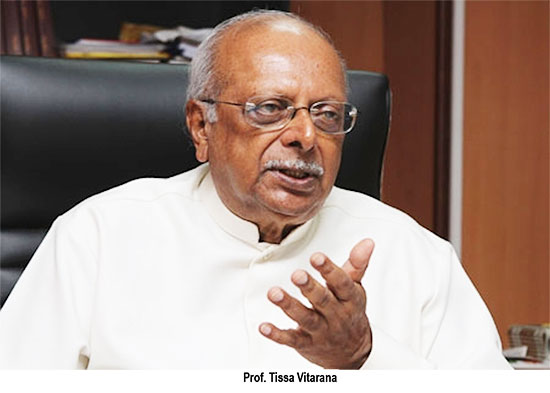
One recollects that the UNP-led “Yahapalanaya” Government was on the verge of signing the MCC and SOFA agreements with the US Government after having signed the periodic ACSA agreement. The latter was signed at regular intervals to enable military exercises to be conducted in Sri Lanka and to receive military assistance from the USA. This was renewed at regular intervals and therefore it was a routine, but the MCC and SOFA agreements are new developments. These were a result of the only American military base in the Indian Ocean rim located at Diego Garcia being given back to the country that it belong to, the Mauritius, by virtue of a verdict given by the International Criminal Court (ICC). According to the MCC agreement the strip of land extending from Colombo and Katunayake to Trincomalee harbour was to be given to the USA to construct a means of rapid transport (rail and road) and the door would also be open for American companies to freely operate within our country. This would naturally lead to domination of our economy as well. The SOFA agreement would enable any American soldier in uniform with gun in hand to enter our country bringing any type of arms as luggage. Sri Lankan Customs would not be able to even examine them, leave alone charging any duty. The US Army personnel would have full use of all Ports and Airports and right to enter any of our Government premises at any time. In other words Sri Lanka would become a virtual colony of the USA and its military base. But these two agreements could not be signed because of the defeat of the “Yahapalanaya’’ Government at the Presidential and General Elections.
It was generally accepted that the present Government would not sign the two agreements and that the danger was passed. But a series of events should make us reconsider whether this danger may be forced upon us in the near future. The Sri Lankan economy has been run down to the lowest level in its history since independence. 60% of families are living below the poverty line and the level of malnutrition has grown to 18.3%(an MRI survey about 7 months ago). Many families have only one meal and that too without adequate nutrition. Children are suffering badly. I regret my proposal to give highest priority to feeding those who are hungry made to the higher authorities has been ignored.
A major cause for the above situation is the high cost of living. It has soared due to Covid 19 virus epidemic on top of the global economic crisis. But what is surprising is that the Government has allowed the traders to fix the price without any control or justification. To make matters worse the Government has not intervened to bring down the cost of living by measures that have succeeded in the past. For example during the Coalition Government of 1970-75 which strengthened the cooperative system thereby linking producer cooperatives with consumer cooperatives, so that essentials were available at a reasonable price without any profit. This was supported by the Food Control Department and the Marketing Department which also directly bought from the producer and delivered through sales outlets to the consumer, only adding on the actual cost. There was no profiteering. Automatically the traders too had to bring their prices down as well.
The people are suffering due to unwise decisions (e.g. the fertilizer problem which has badly affected the farmers). The major blunder has been the dollar crisis which has led to shortages of imported items that have affected all layers of society as well as the many industries that depend on imported inputs. The lack of fuel, gas, imported food and medicines has led to shortages resulting in long queues and to disruption of the whole transport system. Many people have lost their jobs as a result. This dollar crisis has led to our Foreign Reserves falling from US dollars 8 billion to less than 1 billion. The rating agencies such as Fitch and Moody have dropped Sri Lanka to the lowest level, a single C, as being on the verge of bankruptcy. Our importers are badly affected as the Letters of Credit (LC’s) are no longer accepted, so that orders are only acted on when dollars are directly paid to the suppliers. This means a delay of several months even if dollars are sent. But the reality is that the importers are unable to get dollars from local banks. Our foreign debt is said to have reached 52 billion US dollars and the annual payment for interest etc. (debt servicing) is in the region of US dollars 6 billion per year. The Government has not made use up to now of the various methods that are available to escape from this situation. For example re-structuring the economy by negotiating a moratorium on the debt payments. For instance it is possible to negotiate for a postponement of the annual debt servicing for a period of about 5 years. This would save us about 30 billion dollars starting from the next payment due in June this year. This money can be used to provide the people’s needs from abroad and also develop the economy. A very surprising feature is that no serious effort is being made to have such an arrangement with our main creditor, China.
Instead we are now signing an agreement with the IMF and a begging mission has gone to Washington, USA. This will only make matters worse as in addition to getting into deeper debt we are likely to be subject to their conditions which include the neoliberal policy of unlimited imports. The main cause of our dollar crisis is the fact that the Government when it began to be faced with the emerging dollar crisis failed to severely restrict the imports (which cost more than twice our export earnings) to narrow the adverse foreign trade gap. There should have been strict banning of the import of all non-essentials so that the outflow of the dollars would be minimized. There should have been more support to the organizations that I set up to promote the SMEs, like the 243 Vidatha Centers, to provide technology to support SMEs, one in each administrative division around the country. In the 5 years that I was Minister of Science and Technology the outcome had been the development of 231,000 SMEs. To support large scale industry as well as the SMEs, I set up a Nano Technology Centre in Homagama (which happens to be the 18th Nano Technology Centre in the world, which even India had not done). While the Government talks of cutting down imports and promoting local industries, there has been no serious attempt to promote this technology transfer mechanism.
The complaint of many Ministers that various decisions are taken without their knowledge suggest that there is a section of the bureaucracy, possibly supported by some politicians, who are controlling the Economy according to a plan determined by the USA to disrupt our economy to the point where we may be forced to accept any terms and even sign the MCC and SOFA agreements. The fact that both the Executive President and the former Finance Minister are American citizens further complicates the situation. Thus the proposal to set up an Interim Government for a period of 6-8 months to restore the economy and stabilize the social and economic situation in the country, if done effectively, as proposed by the group of 11 decedent political parties may provide a way out. But this will not be easy and certainly it would need a firm hand and the active support of the people.

Latest News
Heat Index at Caution Level in the Northern, North-central, North-western, Western, Sabaragamuwa, Eastern and Southern provinces and in Monaragala district


Warm Weather Advisory
Issued by the Natural Hazards Early Warning Centre
Issued at 3.30 p.m. on 15 April 2026, valid for 16 April 2026.
The Heat index, the temperature felt on human body is likely to increase up to ‘Caution level’ at some places in the Northern, North-central, North-western, Western, Sabaragamuwa, Eastern
and Southern provinces and in Monaragala district.
The Heat Index Forecast is calculated by using relative humidity and maximum temperature and this is the condition that is felt on your body. This is not the forecast of maximum temperature. It is generated by the Department of Meteorology for the next day period and prepared by using global numerical weather prediction model data.
Effect of the heat index on human body is mentioned in the above table and it is prepared on the advice of the Ministry of Health and Indigenous Medical Services.
ACTION REQUIRED
Job sites: Stay hydrated and takes breaks in the shade as often as possible.
Indoors: Check up on the elderly and the sick.
Vehicles: Never leave children unattended.
Outdoors: Limit strenuous outdoor activities, find shade and stay hydrated.
Dress: Wear lightweight and white or light-colored clothing.
Note:
In addition, please refer to advisories issued by the Disaster Preparedness & Response Division, Ministry of Health in this regard as well. For further clarifications please contact 011-7446491

The Indonesian Navy Sailing Ship KRI BIMA SUCI – 945 arrived at the Port of Colombo on a goodwill visit on 15 Apr 2026 and was welcomed by the Sri Lanka Navy (SLN) in compliance with time-honoured naval traditions.
The vessel’s arrival is a key highlight of the ASEAN Plus Cadet Sail (APCS) – 2026 programme , accompanying a diverse contingent of Navy cadets from 26 different nations alongside their Indonesian counterparts.
The ship is commanded by Commander SUGENG HARIYANTO. Meanwhile, Officer Under-trainees of the Sri Lanka Navy are expected to participate in various programmes aboard the
ship and naval personnel observe its operational functions during its stay in the island.
Furthermore, the ship’s crew is scheduled to take part in programmes organized by the Sri Lanka Navy to enhance camaraderie between the two navies, as well as visit several tourist attractions in the country.
News
PM initiates children into learning at the auspicious time while observing New Year traditional customs and rituals

The Sinhala and Tamil New Year cultural festival, organized by the Ministry of Buddha Sasana, Religious and Cultural Affairs, was held on Tuesday (14) in Gampaha under the patronage of Prime Minister Dr. Harini Amarasuriya, with the performance of traditional auspicious customs and rituals.
In accordance with tradition, during the Punya Kalaya (inauspicious time), the Prime Minister visited the Medagama Sri Sunandarama Viharaya in Gampaha and participated in religious observances and received blessings from Venerable Thunmodara Samitha Thero, a member of the Karaka Sangha Sabha of the Sri Lanka Ramanna Maha Nikaya and the Chief Incumbent of the Medagama Sri Sunandarama Dharmaduta Piriven Viharaya.
The traditional observances of the Sinhala and Tamil New Year cultural festival were held at the residence of Darshana Weerasinghe in Gampaha. Marking the auspicious time for commencing work, and upon the invitation of the host family, the Prime Minister planted a sapling within the premises. Concurrently, Minister of Buddha Sasana, Religious and Cultural Affairs, Dr. Hiniduma Sunil Senevi, and Minister of Foreign Affairs and Tourism, Vijitha Herath, joined the PM.
Subsequently, the Prime Minister joined children in engaging in traditional folk games.
At the auspicious time for engaging work and educational activities, the PM participated with children in reading and writing, guiding them and symbolically marking the commitment to advancing the educational development of the nation’s children.
Thereafter, the Prime Minister and other distinguished guests observed the traditional customs of exchanging greetings, transactions and gifts with the host family, and joined them to partake in the customary New Year meal.
Extending New Year greetings to all citizens, the Prime Minister expressed her gratitude to all Sri Lankans, both at home and abroad, for their contributions in overcoming and effectively managing the various challenges faced by the country.
Speaking at the occasion, Minister Dr. Hiniduma Sunil Senevi stated that the Sinhala and Tamil New Year festival symbolizes renewal and purity, and reflects the energy of the sun. He also conveyed his wishes for a peaceful and prosperous New Year for all.
The occasion was attended by the Deputy Minister of Finance and Planning and Minister of Labour, Dr. Anil Jayantha; Deputy Minister of Labour, Mahinda Jayasinghe; Member of Parliament for the Gampaha District, Ruwan Mapalagama; along with the Gampaha District Secretary, Mayor, Divisional Secretaries, and a large number of government officials.
(Prime Minister’s Media Division)

Heat Index at Caution Level in the Northern, North-central, North-western, Western, Sabaragamuwa, Eastern and Southern provinces and in Monaragala district

Pakistani army chief in Tehran amid bid to restart US talks

Sri Lanka repatriates 238 Iranian sailors stranded after US torpedo attack

Indonesian Navy Sailing Ship KRI BIMA SUCI – 945 makes port call in Colombo

PM initiates children into learning at the auspicious time while observing New Year traditional customs and rituals

Navy seize an Indian fishing boat poaching in seas north of Mannar

‘Dates have the highest sugar content to fight Coronavirus’

Sunday Island 27 December – Headlines

#SundayIsland 17th December – Headlines

Sunday Island – 28th March

Sunday Island Headlines – 21 March

Sunday Island – 21st February – Headlines
-

 News4 days ago
CEB orders temporary shutdown of large rooftop solar systems
-

 News7 days ago
AG: Coal procurement full of irregularities
-
 Features4 days ago
From Royal College Platoon to National Cadet Corps: 145 years of discipline, leadership, and modern challenges
-

 Business6 days ago
Israeli attack on Lebanon triggers local stock market volatility
-

 Business7 days ago
Hayleys Mobility introduces Premium OMODA C9 PHEV
-

 Business6 days ago
HNB Assurance marks 25 years with strategic transformation to ‘HNB Life’
-
 Latest News3 days ago
PNS TAIMUR & ASLAT arrive in Colombo
-

 Sports7 days ago
DS to face St. Anthony’s in ‘Bridges of Brotherhood’ cricket encounter