
Midweek Review
Will 2023 be a year of further economic-political-social crisis?

By Shamindra Ferdinando
A steady stream of press releases, issued during 2022, by Colombo-based diplomatic missions, UN and its agencies, and those representing INGOs, depicted a pathetic picture of Sri Lanka. They dealt with financial and material assistance, provided on Sri Lanka’s request, and also in line with international response to the developing crisis here.
Ruling Sri Lanka Podujana Peramuna (SLPP), and other political parties, represented in Parliament, seemed to be blind to the rapidly developing crisis, especially against the backdrop of the country continually being denied the USD 2.9 bn IMF loan facility.
Having secured ‘staff level’ agreement on Sept. 01, various government spokespersons expressed confidence in obtaining the first tranche, by end of 2022. That hasn’t materialized.
It would be pertinent to mention that the agreement, on the urgently needed facility, has been held up, pending necessary approval of the overall plan by Beijing and New Delhi. The Treasury and the Central Bank are obviously uncertain when the much desired agreement can be finalized.
Foreign media releases highlighted Sri Lanka’s growing dependence on international assistance. Let me first discuss a statement, dated Dec. 19, issued by the World Food Programme (WFP). Carol Taylor, Communications Associate, WFP, Colombo, in a two-page statement, dealt with the food crisis, with the focus on Dustin Shiau, Senior Regional Programme Officer of the U.S. Agency for International Development (USAID)’s Bureau for Humanitarian Assistance (BHA).
Having to receive humanitarian assistance, 12 years after the successful conclusion of the war against the Liberation Tigers of Tamil Eelam (LTTE), underscored Sri Lanka’s plight.
Referring to the USAID official’s visit to one-time LTTE bastion, Mullaithivu, Taylor asserted the population there is among the worst affected. During the war, the WFP provided significant assistance to those trapped in LTTE held areas, particularly in the Vanni region.
According to Taylor, the US has provided USD 20 mn, in 2022, and of that USD 13 mn (approximately Rs 4.7 bn) enabled them to assist the needy, recently. Declaring that the WFP project got underway, in June, just ahead of President Gotabaya Rajapaksa’s ouster, the operation intended to provide food and nutrition assistance to 3.4 mn people.
Taylor estimated they had so far reached one mn people, including schoolchildren, benefited by the free meal programme.
The WFP press statement has substantiated assertions made by the international community as regards the developing economic-political-social crisis here. The government and the Opposition continued to play politics with an unprecedented national calamity caused by mismanagement of the economy, waste, corruption and irregularities.
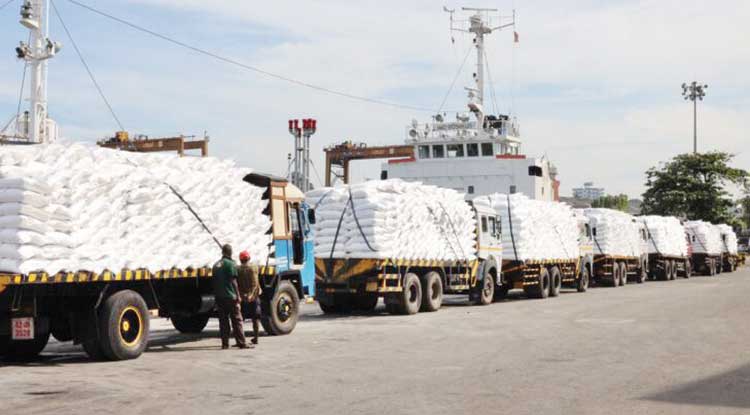
Cash-strapped Sri Lanka received USAID financial assistance, amounting to USD 46 mn, to procure 9,300 tonnes of urea. The first consignment reached Sri Lanka in December.
Those in political authority should be ashamed, particularly because they failed to initiate a programme to purchase paddy. In spite of the intervention of President Wickremesinghe and Prime Minister Dinesh Gunawardena, the Wickremesinghe-Rajapaksa government never released funds, required to buy paddy. Agriculture Minister Mahinda Amaraweera owed an explanation as to whether the incumbent government has ceased the purchase of paddy. If so, there is no point in maintaining the Paddy Marketing Board (PMB) at taxpayers’ expense, while the private sector dominates the market.
The first consignment of urea, received in December, was meant to meet the requirement of 193,000 smallholder paddy farmers, in Jaffna, Mullaithivu, Mannar, Vavuniya, Anuradhapura, Trincomalee, Batticaloa and Moneragala districts. Additional stocks are expected, early next year, and, altogether, one million farmers are expected to receive fertiliser, procured by the Food and Agriculture Organization (FAO), on behalf of the USAID.
Addressing a small gathering, at the Colombo Port, US Ambassador Julie Chung declared that they have announced over USD 240 million in new assistance and additional loans for small businesses over the last year.
In the absence of a cohesive plan, with the Wickremesinghe-Rajapaksa government ensnared in a political crisis, the international community has stepped in. Sri Lanka currently lacks the wherewithal to at least start re-building the economy. Instead, those who ruined this country, over the years, are now preoccupied trying to play the role of its saviour, having brought the once proud nation to its knees.
The hapless Sri Lankan public should be eternally grateful for top South Korean official, Cho Sung Lea, for publicly issuing a warning to Social Empowerment Minister, Anupa Pasqual, for being late for a scheduled meeting at the Ministry, on Dec 21. South Korea Disaster Relief Foundation (SKDRF) President Cho Sung Lea took the State Minister to task for being 30 minutes late for a scheduled meeting in Colombo. The South Korean declared that with the likes of Pasqual, Sri Lanka has no hope of overcoming the continuing crisis. Lea emphasized the pivotal importance of the public having faith in their political leadership.
We will refrain from commenting on how lily white South Korean politicians, including top ones, have been over the years, for the moment, for our politicians often, without doubt, take everyone for granted, no sooner they become important ministers, having become drunk with power.
Having entered parliament from the Kalutara district, Pasqual, a senior member of civil society group Yuthukama, switched his allegiance to President Ranil Wickremesinghe by accepting a portfolio.
Perhaps, the South Korean should be invited to address Sri Lanka’s Parliament, possibly the mother of all problems in the country. Governor of the Central Bank, Dr. Nandalal Weerasinghe, in a hard hitting speech, delivered in Parliament on August 31, squarely held the irresponsible and reckless political party system responsible for the current crisis.
High profile Chinese agenda
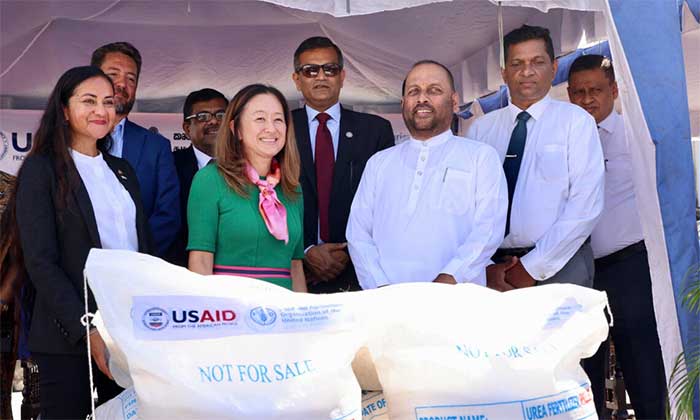
US Ambassador Julie Chung at the Colombo Port where she officially handed over a large stock of fertiliser to Agriculture Minister Mahinda Amaraweera and (below) lorries loaded with bags of fertliser (pics courtesy US embassy, Colombo)
The situation is so bad, Sri Lanka has been compelled to ask for, and accept, whatever is offered by the international community. A range of assistance, offered, included stocks of rabies vaccines. India and Germany provided the funding needed to purchase rabies vaccines.
Throughout this year, China provided significant assistance as Sri Lanka struggled to cope up with increasing difficulties. Despite having haughtily questioned Chinese intentions here, with the Yahapalana government causing serious row, and the crisis over the rejected carbon fertiliser shipment, during Gotabaya Rajapaksa administration, Sri Lanka, over the past two years, received significant Chinese assistance.
The political leadership here should be aware that foreign assistance does not come without strings attached. A Defence Ministry press release, dated Dec. 21, dealt with a financial grant amounting to Rs 5 mn, received by that Ministry, from the Chinese Embassy.
Following a joint request made by State Defence Minister, Premitha Bandara Tennakoon, and Defence Secretary, Gen. (ret.) Kamal Gunaratne, the Defence Ministry has received a Rs 5 mn grant for the utilization for the development of the National Cadet Corps (NCC).
The latest Chinese grant, received for the benefit of the NCC, is part of the overall funding programme, covering several important fields, including agriculture and fisheries.
Recently, China announced their decision to donate school uniform material, worth USD 13.51 million, to meet 70 percent of Sri Lanka’s requirement, in 2023. According to a Chinese Embassy statement, the first batch of material is already on its way to Sri Lanka. The first batch contains 2,374,427.5 meters of white shirt/ frock material, 350,031.5 meters of white trouser material, 150,003.5 meters of blue trouser material and 138,134 meters of saffron coloured robe material for monks.
In a twitter message, the Chinese Embassy said that the total length of the material is about 10 times the distance from Colombo to Jaffna. China also supports a free midday meal programme for schoolchildren. Much to the relief of farmers and fishers, China provided 10.6 mn liters of diesel, to be distributed among the two badly affected communities. This was part of the RMB 500 mn (USD 76 mn) emergency grant China voluntarily extended to Sri Lanka. In addition, Sri Lanka sought to convince China to provide a credit line for fuel. China made the offer during Gotabaya Rajapaksa’s presidency (between the March 31 protests – outside the President’s private residence, at Pangiriwatte, Mirihana – and the May 09 attacks on the Galle Face and Kollupitiya protesters). Initially, China declared a 200 RMB grant and later made an additional commitment, amounting to a further RMB 300 mn. The total grant was meant for the urgent purchase of medicine, food, fuel and other essentials.
The Chinese announcement was made in the wake of Sri Lanka suspending debt repayment on April 12. But Agriculture Minister Amaraweera brashly declared that China was responding to a request by President Ranil Wickremesinghe.
China has gradually enhanced its role in the Northern and Eastern Provinces, since the last presidential election, in late 2019. The continuing political-economic-social crisis has facilitated the Chinese agenda as the government has no option but to accept whatever assistance is granted as it couldn’t meet even the basic needs of the population. The executive, the legislature and the judiciary are enmeshed in controversies, at different levels, as the country plunges further into abyss.
Beijing underscored its expanding interests in the Northern and Eastern regions by its Deputy Chief of the Chinese Embassy Hu Wei undertaking a three-day visit in the second week of this month. Wei was there to supervise the distribution of fuel, 9,000 metric tons of rice, among students from underprivileged families, and 100 sets of solar lights to 38 schools across the Eastern Province.
Chinese Ambassador Qi Zhenhong toured the North in December, last year, at the time the economy was experiencing difficulties, though the public were yet to feel it. (Mirihana was to erupt four months later). During the high profile visit, the Chinese envoy took a boat ride to the Adam’s Bridge, widely referred by the Indian media as ‘Rama Setu’, a row of limestone shoals across the narrow Palk Strait between Mannar and Rameswaram, in Tamil Nadu. Some interested parties raised concerns over Qi Zhenhong’s visit to the North, against the backdrop of the suspension of a solar energy project that was to be carried out in three Jaffna islands, with ADB funding.
New Delhi’s strategy on track
In spite of the absence of sustained protests, since UNP leader Ranil Wickremesinghe’s election, through a parliamentary vote, as the President, in July, this year, the country is still in a deeply troubled state. It would be a grave mistake, on the part of the government, to believe that the absence of long queues, for basic services, didn’t mean the end of the crisis. In fact, the continuing power cuts, and the possibility of much longer electricity interruptions, on a daily basis, coupled with the unprecedented hike in power tariffs, can trigger protests.
The recent meetings the Research and Analysis Wing Chief, Samant Goel, had in Colombo with President Wickremesinghe and Basil Rajapaksa, who wields political power over the ruling Sri Lanka Podujana Peramuna (SLPP), meant how concerned New Delhi is with developments here. Obviously the Indian Spy Chief’s visit underlines their interest here as the Wickremesinghe-Rajapaksa government struggles to cope up with daunting challenges.
Having invested here, heavily, over the years, especially having provided much needed financial assistance, this year, that prevented the total collapse of the Colombo administration, New Delhi is obviously deeply committed to further consolidate its position in this tiny nation. India provided extraordinary financial support, prompting India basher JVP leader Anura Kumara Dissanayake to publicly appreciate New Delhi’s response to the crisis here.
But, China poses quite a challenge, having had the opportunity, over the years, to develop a network of friends at the right places. One-time Foreign Secretary, Shivshankar Menon, who had served in Colombo as High Commissioner (1997-2000), dealt with this issue in ‘Choices: Inside the Making of India’s Foreign Policy’, launched in Oct. 2016.
In spite of President Wickremesinghe’s repeated declaration that his government wouldn’t take sides in international or regional conflicts, Sri Lanka is embroiled in a China-US battle for supremacy. Sri Lanka is caught up in ‘Quad,’ strategy. The four-nation security and political alliance, comprising the US, India, Japan and Australia, is pursuing an anti-China agenda. The developing economic-security-social crisis has weakened Sri Lanka’s defences. Therefore, the country is susceptible to Chinese, as well as Quad strategies.
Former Minister, Prof. Tissa Vitharana’s recent declaration that the US may revive its efforts to secure Sri Lanka’s consent for the once-rejected MCC (Millennium Challenge Corporation) as well as SOFA (Status of Forces Agreement), shouldn’t be disregarded as ramblings of an old man.
During the Yahapalana administration (2015-2019), the US sought to finalize MCC, SOFA and ACSA (Acquisition and Cross Servicing Agreement) though Washington managed to secure ACSA, thanks to the then President Maithripala Sirisena’s support. A much weaker Sri Lanka is now a playground for big players, as political parties, represented in Parliament, pulled in different directions, for their own survival, without thinking of the greater good of the country.
Sri Lanka’s relations with Quad member Japan suffered irrevocable damage as a result of the unilateral cancellation of the Japanese-funded Light Rail Transit (LTR) project, in Sept. 2020, a month after the Sri Lanka Podujana Peramuna (SLPP) obtained a near two-thirds seats at the last parliamentary elections. The cancellation of the project, without consultations, angered the Japanese who could have provided significant assistance at the onset of the financial crisis here. Japan went to the extent of ignoring Sri Lanka’s specific requests for an urgent loan facility though some assistance was provided later.
Contrary to former Chairman of the Committee on Public Enterprises (COPE) Prof. Charitha Herath’s claim that the decision to call off the LTR project remains a mystery, the National Audit Office has revealed the existence of a Cabinet memorandum, dated Sept. 24, 2020, in this regard.
Having unilaterally suspended debt repayment, on April 12, 2022, Sri Lanka enters unchartered financial territory in the New Year with the hope a consensus can be reached on the USD 2.9 bn IMF facility as soon as possible early next year. But, Sri Lanka’s hopes remain largely dependent on Indian and Chinese acceptance of the overall plan. Regardless of Sri Lanka’s plight, the response of India and China would be largely influenced by their overall strategies.
Unfortunately, Sri Lanka (Government and Opposition) lacked a tangible action plan to face the daunting challenges in the coming year. Both seemed unprepared to face the crisis and unexpected developments can cause further destabilization. The recent allegations, pertaining to former lawmaker Prof. Ashu Marasinghe, following the release of a video by Adarsha Karadana, who had been living with him, is a case in point. There is absolutely no need for the writer to repeat what is now in the public domain. But, let me repeat what Karadana, who had been living with Prof. Marasinghe, who switched sides after having entered the political scene with the intervention of Wimal Weerawansa, speculated about the Wickremesinghe-Rajapaksa government granting the former National List MP top diplomatic positing. Let us hope the government would prove Ashu Marasinghe’s ex-paramour wrong.






Having failed on multiple occasions to reach consensus with the LTTE, Sri Lanka, finally, during President Mahinda Rajapaksa tenure, launched all-out war. The LTTE lasted two years and 10 months. In spite of warnings regarding a long drawn out hit and run campaign, the group couldn’t reorganise. The rest is history
By Shamindra Ferdinando
The recent award of the 2026 Nobel Peace Prize to South African jurist and former United Nations High Commissioner for Human Rights Navanethem Pillay, 85, drew global attention to Sri Lanka’s successful war against the separatist Liberation Tigers of Tamil Eelam (LTTE). Sri Lanka brought the war to an end a year after Pillay succeeded Louise Arbour (2004 to 2008) as UN Human Rights Chief.
Congratulating Pillay, the only UN Human Rights chief to win the Nobel Peace Prize, Dr. Jehan Perera, on behalf of the National Peace Council (NPC), issued a press release which was aptly headlined, citing the main obvious agenda of the NGO lobby – ‘Nobel Peace Prize to Navanethem Pillay is reminder to Sri Lanka of unfinished commitments’ (https://island.lk/nobel-peace-prize-to-navanethem-pillay-is-reminder-to-sri-lanka-of-unfinished-commitments-npc/)
Pillay currently serves as a temporary judge on the International Court of Justice (ICJ), presiding over the case where Myanmar is under investigation for perpetrating genocide.
The Global Tamil Forum (GTF), too, cheered, stating that for the Tamil people in Sri Lanka, Ms. Pillay’s contribution, during her tenure as United Nations High Commissioner for Human Rights, holds particular significance. The UK headquartered GTF stated: “At a time when the grave allegations of war crimes and crimes against humanity, committed in Sri Lanka, risked being forgotten or marginalised, she helped ensure that accountability remained firmly on the international agenda. Her call for an international investigation marked an important moment in the continuing struggle for truth and justice for the victims and survivors of the Sri Lankan conflict. Although meaningful justice remains elusive to this day, the international attention sustained through these efforts continues to offer hope to victims, survivors and their families. (https://www.newswire.lk/2026/10/13/gtf-congratulates-navi-pillay-on-nobel-peace-prize-recalls-her-calls-for-sri-lanka-war-crimes-probe/)
The Tamil Guardian, too, applauded Pillay’s intervention in Sri Lanka (https://www.tamilguardian.com/content/nobel-laureate-navi-pillay-and-long-fight-hold-sri-lanka-account). Did the Norwegian Nobel Committee meticulously examine Pillay’s role in Sri Lanka? Comprehensive examination of her role is of critical importance as Norway-led mostly one sided peace process here created mayhem.
Let us discuss the Office of the United Nations High Commissioner for Human Rights during the period Pillay held the top post, from 2008 to 2014. Her term commenced on 01 September, 2008, as the LTTE was resisting a multi-pronged ground offensive, targeting Kilinochchi, which the group considered as its administrative headquarters, after the loss of Jaffna peninsula, during the 1995/1996 period.
Pillay’s Office hadn’t been worried as the LTTE continued to boast it held the upper hand in the northern theatre of operations. The Tamil Diaspora, too, remained confident of the fighting prowess of the LTTE, though Mahinda Rajapaksa’s government sustained the offensive, while all self-appointed pundits said Sri Lankan security forces were incapable of defeating the LTTE, including some of our so-called expert columnists here, who were actually cheerleaders for the Western agenda. Pillay was obviously deceived. Geneva wasn’t really bothered about the situation on the ground in spite of the fighting formations making slow but steady progress.
Those who believed in the LTTE’s battlefield invincibility were jolted when the Army regained Kilinochchi on 02 January, 2009. The often repeated myth was shattered. The armed forces achieved the notable target two months short of two years after the launch of their Vanni campaign. The loss of Kilinochchi made the outcome of the Eelam war a foregone conclusion.
The government disregarded the LTTE’s repeated warnings that Colombo would be bombed if the Army attempted to regain Kilinochchi. The fall of Kilinochchi, just four months after Pillay’s new appointment, should have galvanized Geneva. Unfortunately, Geneva failed to act swiftly and decisively. Had Geneva, with the backing of Sri Lanka peace co-chairs, namely the US, Norway, Japan and EU, brought real pressure on the LTTE the final onslaught on the Vanni east front could have been averted. Thousands of lives could have been saved. But, Geneva pursued its own agenda, regardless of the LTTE resorting to gathering large-scale civilian human shields.
It would be pertinent to mention that Pillay herself conceded, in March, 2009, that the LTTE used civilians as human shields, shot those who left and forcibly recruited people, including children, to fight. But, in her capacity as the UN Human Rights chief, she stopped short of demanding the immediate release of civilians held as human shield. Perhaps, Pillay’s Indian Tamil origin discouraged her from making such a call. Those who applauded the Nobel Peace Prize for Pillay should examine their own response to the LTTE’s widespread use of civilian shields and children in combat operations during the January-May 19, 2009 period.
UN inaction
The UN obviously responded to the then developing situation in Sri Lanka on the presumption that the armed forces lacked the wherewithal to bring the war to a successful conclusion. Pillay and then UN Secretary General South Korean Ban-ki moon misjudged the situation in Sri Lanka.
Both appeared to have believed the LTTE myth, floated by the West, that in spite of heavy battlefield beatings, it had the military depth to halt the armed forces offensive. Reappraisal of UN operations here could easily establish Ban-ki moon and Pillay’s predecessor Louise Arbour never really sought to pressure the LTTE not to prolong the bloodshed by literally backing its crazy demands. In fact, the UN failed to realise that the liberation of the entire Eastern Province by the second week of July 2007 may pave the way for a determined government bid to regain the entire Vanni region.
The UN, obviously, failed to take into consideration the launch of the Vanni offensive in March 2007, months ahead of the conclusion of major operations in the Eastern theatre.
Seeing how the UN has been behaving in places like Gaza, West Bank, Lebanon and elsewhere, luckily for us Mahinda Rajapaksa stuck to his guns, but the West is now exacting revenge from that family through its proxies.
The UN secretly negotiated for the release of two UN workers held by the LTTE in the Vanni. The Colombo-based UN bigwigs kept the incident under wraps believing that the LTTE would eventually free them.
In spite of the UN Headquarters receiving information regarding the incident, an influential section of the Colombo-based diplomatic community strived to resolve the dispute without bringing it to the notice of the government. The UN office in Colombo should have brought the incident immediately to the notice of the government.
The LTTE accused Tamil UN staffers of helping Tamils flee the LTTE-held region. Civilians began fleeing the region amidst signs that fighting could be intensified.
The UN brought the detention of UN workers to the notice of the government after all its efforts failed to convince the LTTE. The LTTE is believed to have detained UN workers for about a month. We haven’t heard of the UN ever seeking punitive action against the LTTE. The responsibilities of the Office of the High Commissioner for Human Rights cannot be discussed without examining the overall UN response to the Sri Lanka war.
The UN turned a blind eye to the forcible recruitment of children by the LTTE. Ban Ki-moon or Pillay never bothered to revisit the agreement that had been finalised during President Chandrika Bandaranaike Kumaratunga’s tenure. The agreement worked out among the government, the UN, the ICRC and the LTTE was meant to stop the despicable practice of deploying child soldiers.
An unprecedented agreement
Had the UN taken meaningful measures to ensure the implementation of the agreement, the war wouldn’t have lasted so long. There had never been a similar agreement during the conflict here. Interestingly, none of those demanding accountability, on the part of the government of Sri Lanka, never bothered to push for the implementation of the unprecedented agreement, finalised by the then UNSG Kofi Atta Annan’s Special Representative, Olara Otunnu, in early May, 1998 (UN, LTTE to discuss modalities with strap line Pledge to stop using children in combat – The Island, May 11, 1998). Otunnu visited the Vanni, with the blessings of the then Foreign Minister Lakshman Kadirgamar, to discuss the arrangement with a British citizen, of Sri Lankan origin, Anton Balasingham, who was also the official Tiger Theoretician, and Thamilselvam.
At the conclusion of Otunnu’s weeklong visit, the UN mission, in Colombo, proudly declared that political advisor Balasingham, and Political Wing leader, Thamilselvam, had, on behalf of LTTE leader Velupillai Prabhakaran, assured an immediate stop to using children in combat operations.
A jubilant Otunnu declared, in Vavuniya, that the LTTE had agreed for the setting up of a mechanism to monitor commitments made to the UN (Tigers agree to end use of chidren below 18 in combat – The Island, May 9, 1998). Having succeeded Boutros Ghali as UN Chief, in 1997, Annan intervened in Sri Lanka though his predecessor did absolutely nothing to end the bloodshed in Sri Lanka. However, at the time of the disastrous Indian intervention here, Pérez de Cuéllar had been at the helm at the UN. Unfortunately, Annan failed to implement the agreement. Foreign Minister Kadirgamar quite rightly urged the LTTE to adhere to the agreement.
A skeptical Kadirgamar told the writer that it was the UN’s responsibility to ensure the implementation of the agreement. Kadirgamar asserted that it was nothing but propaganda as the LTTE couldn’t sustain its war effort without fresh cadres joining the depleted fighting formations (Transform commitments into action, Government urges LTTE – The Island, May 9, 1998). Otunnu had been the first foreign official to hold talks with the LTTE, with Sri Lanka’s blessings, since the Gandhi assassination, in May, 1991. Perhaps, the LTTE used the UN to boost its image in the wake of the US designating the group, in the previous year, as a Foreign Terrorist Organisation.
Salient points of the UN-LTTE agreement:
* The LTTE promised to immediately stop deployment of children under 18 years of age. The group also promised to end the recruitment of children, below the age of 17 years.
* The LTTE assured not to interfere with those war displaced families wanting to return to areas under government control. In addition, the LTTE promised to allow Muslims, driven out by them, in late 1990, to return to their villages. (The LTTE at gunpoint ordered the entire Muslim population to vacate the Northern Province in late Oct/Nov 1990).
* The UN also received an assurance from the LTTE that it wouldn’t interfere with the distribution of relief supplies among the war affected population, particularly those living in areas under its control.
* The LTTE pledged to adhere to the Convention of the Rights of the Child. The group promised to take measures to educate its fighting cadres, as well as other units as regards the Convention.
* The LTTE assured that it would review its military strategies as regards operations directed at civilians and other non-military targets.
The UN never acknowledged its failure to ensure the implementation of any of the commitments made by the LTTE. In fact, the LTTE continued to violate promises made to the UN until the military eradicated the conventional fighting capability of the group, in May, 2009. The LTTE lasted for 11 more years after having taken the UN for a ride. Wouldn’t it be appropriate to launch a thorough study on the conflict to ascertain the UN’s failure here?
CBK’s 1994/95 effort
The NPC used the award of Nobel Peace Prize to Navanethem Pillay to remind the world of Sri Lanka’s unfinished commitments. The NPC that had been in operation since February ’95 is aware of the escalation of fighting after the LTTE broke the ceasefire (cessation of hostilities) negotiated during Kumaratunga’s presidency. Having won the parliamentary polls, Kumaratunga held talks (Oct. 04 to April 1995) but the LTTE resumed attacks in the third week of April.
The global community didn’t come to Sri Lanka’s rescue. Multiple devastating attacks stunned the country. The LTTE sank two Shanghai ii class fast gunboats at the gunboat pier at the Navy dockyard, Trincomalee harbor, on 19 April, and brought down two Avros over Palaly air base a week later. Those who backed that peace effort simply moved away, leaving unprepared Sri Lanka to face an unprecedented new threat of heat seeking missiles. The LTTE intention was clear. It intended to cut off the Jaffna peninsula. In the absence of Sri Lanka losing the overland Main Supply Route (MSR) to the peninsula, denial of sea and air supply routes could have a devastating impact on the military deployed there.
Norway, which had been a major sponsor of the NPC, from the onset of its ‘operations’, was among the countries involved in Kumaratunga’s disastrous effort. The government and the LTTE agreed on the formation of four peace monitoring committees, headed by foreigners, following talks in Jaffna on 24 January, 1995. The ICRC arranged the meeting that led to the consensus on four committees consisting of five persons – two representatives each from the government and the LTTE and foreign heads. The ICRC politely declined to head one of the committees, while Norway (Audun Holm and Johan Gabrielson), Canada (retired Major General. C. Milner) and the Netherlands (retired Lt. Colonel Paul Henri Horsting) accepted the responsibility. When the LTTE resumed Eelam War 111, with the sinking of China-supplied fast gunboats and transport aircraft procured from the UK, foreign heads of so-called peace monitoring committees quietly left the country.
The LTTE never actually allowed the peace committees to function though their foreign heads were granted a rare opportunity to meet LTTE leader Velupillai Prabhakaran on 05 February, 1995, in Jaffna.
From the very beginning, the Kumaratunga peace bid was destined to fail. The LTTE caused obstacles. The international community tolerated. The British allowed the terrorist group’s International Secretariat to function from London, even after it assassinated former Indian Premier Rajiv Gandhi while he was campaigning in Tamil Nadu during the Indian general election of 1991.
Later, the LTTE demanded that there should be six peace monitoring committees. The government promptly agreed but failed to realise that the group was preparing to deliver a strategic blow. The LTTE maximized the opportunity to win concessions. It wanted the government to do away with restrictions on fuel, cement and iron while another major contentious issue was the troops deployed at Komar point-Pooneryn sector. Anyway, the resumption of war, in April, 1995, caught Kumaratunga’s government by surprise, after having blindly trusted the LTTE, and the so-called international community, led by the West.
But, Kumaratunga taught the LTTE an unforgettable lesson when the armed forces brought back the entire Jaffna peninsula, under government control, during operations conducted in 1995/96. In spite of a devastating attack on Elephant Pass, in 2000, after having evicted the Army from its bases south of Elephant Pass up to Kilinochchi, the LTTE could never re-capture Jaffna.
In Nov, 2008, the Jaffna-based fighting formations moved southwards of Muhamalai, two months after Pillay received the appointment as UN Human Rights chief. By then, the Task Force I (later elevated to 58 Division) had recaptured the Kandy-Jaffna A 9 road, stretch from Kilinochchi northwards to Elephant Pass ,where the Army suffered a humiliating defeat in 2000.
Under Pillay’s leadership, too, like her predecessors, the Office of Human Rights Commissioner essentially pursued an agenda hostile to Sri Lanka. It couldn’t stomach the LTTE’s impending defeat. Pillay conveniently failed to acknowledge that Sri Lanka went on the offensive after having exhausted all avenues to end the conflict through dialogue. During Pillay’s tenure as the UN Human Rights chief, the organisation pathetically failed to address accountability issues. Like her predecessors and successors, Pillay, too, never acknowledged that whichever party in power, the government couldn’t have succumbed to the LTTE’s tactics.
The UN in Colombo had been so involved with the LTTE and literally became part of its operation. The mission here refrained from alerting New York immediately of the abduction of UN workers, accused of helping Tamil civilians to enter government held area in 2007. This happened weeks after the newly raised 57 Division launched operations in March, 2007, west of Vavuniya, with the objective of taking Madhu. That division had been tasked to regain Kilinochchi. The Task Force I launched operations in Sept 2007.
The UN had ample time and opportunities to make a meaningful intervention. Instead of compelling the LTTE to give up terrorism, it mollycoddled the group. The UN never really questioned the LTTE regarding its relentless efforts to eliminate Tamil groups who previously carried weapons. Pillay pursued her predecessor Louise Arbour’s approach that allowed the LTTE to continue fighting. Western governments, civil society as well as the UN until the very end believed the LTTE could turnaround the battlefield status. It was not to be.
A brief missive sent by war time Norwegian Ambassador in Colombo, Tore Hattrem, to the then National List MP and presidential advisor Basil Rajapaksa revealed a halfhearted Norwegian bid to secure the release of civilians held by the LTTE. Pillay couldn’t have been unaware of this but she obviously turned a blind eye to the developing situation. Her March statement didn’t make any impact, by then, the government was hell-bent on destroying the LTTE, for once and for all.
The following is the text of the letter headlined Offer/proposal to the LTTE dated Feb. 16, 2009: “I refer to our telephone conversation today. The proposal to the LTTE on how to release the civilian population now trapped in the LTTE controlled area has been transmitted to the LTTE through several channels. So far there has been regrettably no response from the LTTE and it does not seem to be likely that the LTTE will agree to this in the near future.”
Norway never pushed the influential Tamil Diaspora, in Norway, to pressure the LTTE leadership to give up its meaningless resistance. Thanks to Wikileaks, the world knows the ICRC believed the Army could have finished off the LTTE much faster if it didn’t take the civilian factor into consideration on the Vanni east front.
Midweek Review
A call for professional dignity, political responsibility, and intelligent conflict resolution
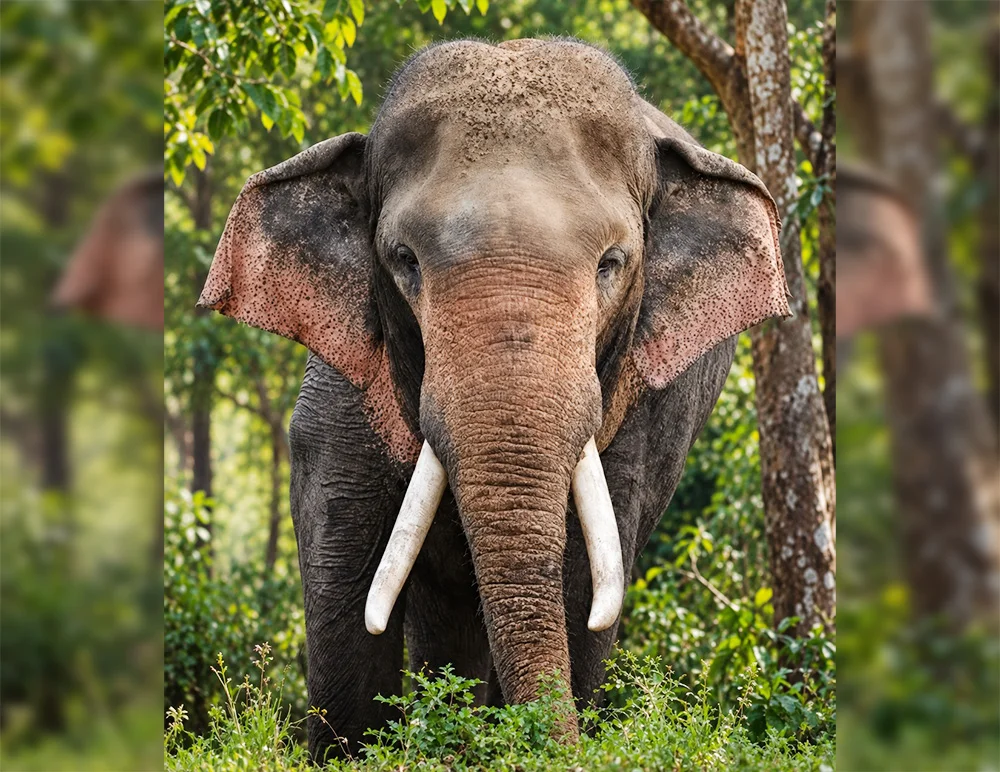
The Tusker Tragedy:
by Prof. MPS Magamage
Wildlife veterinarians in Sri Lanka work under extremely challenging conditions, often with limited facilities, inadequate emergency support systems, and no sufficient life insurance or occupational protection commensurate with the risks they face. Yet, when an unfortunate incident occurs, these professionals are expected to accept accountability, sometimes without adequate institutional support or recognition of the practical constraints under which they work.
The situation is further complicated by internal institutional inequalities and interprofessional conflicts within departments. These issues must be acknowledged and addressed if we are to build a more effective, accountable, and supportive wildlife conservation system. Political negligence and irresponsible or disrespectful statements by political leaders can further aggravate an already sensitive human–elephant conflict. This escalating tread of killing giants in Sri Lanka is the best example for political incompetence, poor statements and political incorrectness.
When farmers feel neglected, frustrated, and unsupported, tensions may escalate, putting both human lives and wildlife at risk. Elephants may be chased, harassed, or even shot as a consequence of these escalating tensions Accountability must be accompanied by institutional responsibility, professional respect, and adequate resources. It is neither fair nor constructive to demand accountability from frontline professionals while overlooking the systemic failures, inadequate facilities, and lack of support that constrain their work.
The death of Tusker Kawanthissa should therefore be a wake-up call for all stakeholders not an opportunity for political confrontation, public condemnation, or professional divisions. Politicians, wildlife authorities, veterinarians, farmers, conservationists, and wildlife enthusiasts must recognise that emotional reactions and accusatory statements will not resolve these complex problems.
What Sri Lanka needs now is an intelligent, evidence-based, and collaborative approach that strengthens wildlife veterinary services, improves emergency response mechanisms, provides appropriate occupational protection, supports affected farming communities, and promotes effective human–elephant conflict mitigation.
We must also encourage respectful dialogue and cooperation among professionals within and across institutions. Differences of opinion are inevitable, but they should be resolved through constructive discussion, scientific evidence, transparent investigations, and fair administrative procedures not confrontation or personal attacks.
Protecting wildlife veterinarians, safeguarding farmers, and conserving elephants are interconnected responsibilities. None should be sacrificed to political interests, institutional rivalries, or public pressure.
Let the tragedy of Kawanthissa become an opportunity to reform the system, strengthen professional unity, and develop sustainable solutions. The way forward is not confrontation, but leadership, accountability, compassion, and collective responsibility.
The writer is a Professor of Livestock Production, Veterinarian, and former Dean of the Faculty of Agricultural Sciences, Sabaragamuwa University of Sri Lanka. He previously served as Chairman of the National Livestock Development Board of Sri Lanka.
A Fulbright Scholar, Indian Science Research Fellow, Australian Endeavour Fellow, and Visiting Professor at the University of Nebraska–Lincoln, USA, he has extensive international experience in Veterinary Medicine, animal biotechnology, reproductive biology, livestock production, higher education, research, and academic leadership.
magamage@agri.sab.ac.lk/mmagamage2@gmail.com

Beyond Rhetoric:
by Sasanka Perera
(The writer is on X as @sasmester)
 On October 15, 2026, the Chinese government-owned China Merchants Port Holdings submitted a regulatory filing to the Hong Kong Stock Exchange, formally implementing a mutual settlement agreement with the Sri Lanka Ports Authority and local partner, Access Engineering. With it, the process to wind down the US$ 392 million South Asia Commercial and Logistics Hub project began. The Sri Lankan media and policy circles in general reacted with predictable alarm. Much of the fallout was framed, and I believe correctly, as a matter of Sri Lanka’s persistent struggle to convert foreign direct investment approvals into operational reality.
As a country attempting to address fragile post-crisis economic recovery, the loss of this project provides a sobering reality check on commercial execution, institutional reliability, and the finite nature of investor patience. In April 2023, the proposed 530,000-cubic-meter logistics complex inside the Port of Colombo was hailed as a game-changer. It was conceived as a 50-year build-operate-transfer agreement. In this scheme, China Merchants Port Holdings held a 70% equity stake alongside 15% each for the Sri Lanka Ports Authority and Access Engineering. According to the original plans, the facility was expected to modernise bonded warehousing, free-zone processing, and cold storage, firmly cementing Colombo’s regional transshipment standing. It even secured Strategic Development Project status according to the provisions in the Strategic Development Projects Act No. 14 of 2008 (and Strategic Development Projects [Amendment] Act, No. 26 of 2025) granted by the Cabinet of Ministers with the concurrence of the Minister of Finance. In this particular case, the project also received a long-term corporate tax holiday.
Despite these concessions and clearances, three years after the initial agreement was signed, nothing concrete materialised on the ground. The joint venture remained trapped in a maze of unfulfilled conditions, unresolved land-allocations, regulatory delays, and lingering fiscal liabilities. The most serious of the latter was an unresolvable US$3.9 million Value Added Tax assessment. Confronted with mounting maintenance costs and the inability of the project to move beyond the signing phase, the partners executed an ‘amicable consultation and neutral handling’ termination, which was embedded in the agreement. Under the settlement terms, shareholders agreed to dismantle the corporate structure and recover roughly 80% of their paid-in equity. Rather than emanating from a politico-ideological problem, this was a cold, pragmatic business decision driven by risk management and fiscal prudence.
Local business reporting and opinions have debated whether the project’s demise represents a regulatory failure, an unavoidable commercial exit or a governmental failure. One side of the domestic debate emphasises institutional inertia. Critics have highlighted what appears to be inter-departmental difficulties between the Ministry of Finance, the Inland Revenue Department, and port administrators which generated paralysing ambiguity over potential future tax positions and statutory clearances. From this perspective, the venture died a ‘death by paper,’ demonstrating how Sri Lanka’s state machinery continues to sabotage its own economic recovery without even realizing it by creating unpredictable operating environments. This is nothing new and is something the present government has inherited from years of previous practice and has not been able to resolve so far.
The counterargument in the public discourse points to commercial pragmatism and shifting market timing. Proponents of this view note that holding equity in a non-operational venture indefinitely makes no financial sense when global maritime logistics costs and trade routes change rapidly and consistently. In this view, exiting with an 80% capital recovery was a routine corporate decision to mitigate against further loss. Another argument, shared by the government’s political opponents, simply claims the project signed during the Ranil Wickremesinghe presidency failed due to the present government’s incompetence. This argument is too simplistic, even though the government has not fully worked out how to streamline these kinds of projects that might be beneficial to the country.
The more credible arguments, in the end, come to the same conclusion. That is, the project failed due to external forces. This tends to mask the state’s failure to deliver legal clarity and institutional coordination, which are essential in these situations. Winding the project down creates several immediate problems for Sri Lanka. First, in global logistics, timing and operational predictability are crucial. Terminating a US$ 392 million venture indicates to international capital that even high-profile, government-backed deals can stall indefinitely. Second, under the settlement terms, the Sri Lanka Ports Authority faces a net cash outlay of approximately US$ 17.4 million to facilitate the capital refund to its partners. These are public funds that should ideally have been directed toward capital upgrades or even public services. But now, they must instead be used to wind up a failed entity. Third, as rival transshipment hubs in the region expand their capacity, it is criminal that Sri Lanka has wasted years trying to work out a project-related future of port land while logistics infrastructure only remained on paper. This is a situation that a country keen on recovering from debt, chronic economic crises and reinventing itself from its ‘Banana Republic’ persona from the immediate past cannot afford.
As the Sri Lanka Ports Authority prepares to re-tender the vacant 13-acre port parcel under an alternative private-investment model, policymakers must digest the hard lessons of this collapse if the government is serious about foreign direct investment. To begin with, statutory permits, land leases, and environmental clearances must be finalised before executing binding joint ventures with foreign capital. On the other hand, there must be established clarity on issues such as what percentage of profits must be reinvested or spent in Sri Lanka, how much can be taken out of the country, what percentage of personnel can come from abroad and so on. Similarly, it is necessary to eliminate all tax ambiguities before signing an agreement. In other words, free-zone incentives and tax exemptions under special investment frameworks must be legally and clearly reconciled across all government departments to prevent late-stage tax liabilities and other avoidable complications.
This includes clarity on what taxes must be paid and what will be waived off and for what period of time. These parameters must be created based on comparable practices elsewhere in the world. Finally, investors should be provided with a single, empowered facilitation body capable of clearing administrative hurdles rather than forcing investors to navigate across different bureaucratic hurdles. Sri Lanka can always learn from more successful experiments in this regard from other parts of the world. These should be in place as matters of policy and principle and not as ad hoc decisions taken from project to project. All these are already part of the conversations in Colombo’s business circles and indicate nothing new. These principles should also include clarity on what areas of the local economy and business infrastructure would not be open to foreign investment for strategic reasons, whether build-operate-transfer agreements should continue beyond a specific period of time, taking into consideration what would be left by the time the transfer period comes, and so on.
The cancellation announced on October 15, 2026, should serve as a wake-up call for Sri Lanka’s economic decision-makers in particular and the government in general. Attracting global capital requires far more than political rhetoric, ceremonial launch events, long-term tax holidays, and high-level diplomatic performances. It demands smooth operational execution, legal certainty, and reliable public administration. If Sri Lanka is to secure its place as a leading maritime and logistics hub and as a dependable investment destination in general, it must resolve its internal administrative bottlenecks. Until then, major investors will continue to walk away when the cost of waiting outweighs the promise of doing business. Or, they might not be attracted to Sri Lanka as an investment destination in the first place.

Crystal Palace urged to retire bald eagle mascot

Little time to unpack as India open in Christchurch

Senior England players to miss Sri Lanka T20Is for WPL 2027

Bangladesh and Nepal to host Women’s Under-19 T20 World Cup from January 21 to February 6

Showers above 100 mm are likely at some places in the Western, Sabaragamuwa, Central, North-western, Northern and Southern provinces and in Anuradhapura district.

Low-quality coal causes power cuts: Ex-LECO Chief

‘Dates have the highest sugar content to fight Coronavirus’

Sunday Island 27 December – Headlines

#SundayIsland 17th December – Headlines

Sunday Island – 28th March

Sunday Island Headlines – 21 March

Sunday Island – 21st February – Headlines
-

 Features4 days ago
Kotahena:A Small Enclave, An Extraordinary Legacy
-
 News5 days ago
Asgiri Mahanayake calls for immediate release of Gnanasara Thera
-

 News3 days ago
Record 1,600 students take Russian Classical Ballet examination in Sri Lanka
-
 News7 days ago
AC President recuses himself from hearing prison attire case pertaining to Gnanasara Thera
-
 News6 days ago
Naval officer testifies Yoshitha received Rs. 5.15 mn in salaries during SLN service
-
 News4 days ago
Karannagoda pushed for £24,536 for Yoshitha’s UK training, Court told
-

 Editorial6 days ago
Saving Anojan: Beyond Executioner’s Blade
-
 News7 days ago
CID informs Fort Magistrate’s Court investigation into money laundering case against Namal completed