
Opinion
Send in clowns and be damned!


The Director-General of the Sri Lanka Tourism Develop Authority has given the thumbs up sign to the Director General of Health and IGP to allow foreign tourists to travel across districts/provinces in Sri Lanka through ‘bubble tourism’. This is despite the fact that Sri Lanka’s Immunology and Molecular Medicine authorities have now identified six new Covid-19 variants in Sri Lanka. These include variants from Denmark, Europe, Middle East, Nigeria and South Africa, including the deadly Indian B.1.617.
A golden wand of protection seems to attend the path of these foreign visitors across the island, while the public is prohibited from venturing into or through such areas to prevent the spread of the virus. It is an irrefutable fact that when foreign tourists are ferried across the Island and allowed to visit the provinces, there is an entourage of locals to assist them at their accommodation, in transport and at places of tourist interest. One of the first Covid-19 patients in Sri Lanka was a Tour Guide! The policy of ‘back to business as usual’, sporadic restrictions, onus of self-protection and ‘never mind the consequences’ has hitherto yielded horrendous results.
The cost of opening the country’s borders to foreign tourists from January 2021, with some short-term gains to hoteliers, has boomeranged on the nation’s production, manufacture and general socio economic well- being. Each new morning new widows and infants howl and mourn the deaths of loved ones. Death Rate and total Covid cases in Sri Lanka have now reached phenomenal levels. Hospitals cannot cope with the rising numbers of patients, who are being accommodated in makeshift sheds and warehouses, or asked to remain in their homes sans medical attention!
Who is really calling the shots in controlling the pandemic that has now reached crisis proportions in Sri Lanka? Does the Minister of Tourism, Prasanna Ranatunga, have special qualifications and abilities in the medical field, to warrant such decisions and directives to be given across the board by his petty minions and willing sycophants in the government bureaucracy? Is he not aware that the practice of bubble tourism is between countries that have relatively small incidence of Covid, as in the case of Australia and New Zealand, holding strong track records of implementing consistently rigorous anti-covid restrictions and regulations? Is not the Director General of Tourism, Ms. Kirmali Fernando, whose husband owns and runs Tourist Hotels, properly advised on the practices around the world? Or is short term pecuniary gain more important than ordinary human lives? In Sri Lanka ” a land like no other” when Ukraine was in a lockdown situation, their tourists were hosted in Sri Lanka.
According to the WHO, the coronavirus variant was first identified in India last year and was classified as a variant of global concern, with some preliminary studies showing that it spreads more easily and is increasingly classified as a variant of concern at a global level. WHO statistics reveal a sharp linear rise in the new Covid cases in India commencing from March 2021, even while our ‘Health Experts’ in the Tourism Ministry were encouraging and further promoting Bubble Tourism Agreements with India until late April 20, 2021
The recent fiasco in Piliyandala saw the local MOH up in arms over the blatant idiotic interference by the Minister Lokuge, in giving counter orders against the Ministry of Health and opening up Covid-19 areas, possibly due to requests of business cronies among his constituents. The subsequent death rate due to Covid in Piliyandala bears ample testimony to the demented exertions of this politico.
Blustering, blundering politicians apart, what of the high-powered Committees, consisting of retired senior government servants, expert medical personnel, deciding to administer the First Dose of anti-Covid-19 AstraZeneca Vaccine to approx. 9 lakhs of the population, while only retaining 03 lakhs for the Second Dose! Surely it is common sense to spread the vaccine in a manner that ensures that both doses are given during the prescribed period of at least 10 weeks! The logic of entering into a signed contract for supply of AstraZeneca to be given for the second dose, and opening a letter of credit, does not seem to have entered into the calculations of those charged with such responsibilities, who perhaps have reached the age of Dementia or careless indifference!
There was enough time to secure the required stock of AstraZeneca from January 2021, if not for political will considering that the Budget of December 2020 had no provision for anti-covid vaccines! Leaving the approx 600,000 of people particularly in the over 60 age group in dire straits, after their first dose of AstraZeneca, which cannot be mixed with other vaccines now available in the market, is tantamount to criminal negligence, breach of trust and inequitable governance. Even in the midst of such severe bungling, there are some politicos trying to pour down Vaccine Cocktails, hitherto never tried or tasted in other parts of the developed world, down the throats of these unfortunate victims.
The cronyism and nepotism rampant in the numerous and now commonplace accounts of people with ‘influential connections’’ getting the vaccine over others, shows a moral impoverishment of the country. It is a fact that today there are those who work in the front line of infection in their respective workplaces, who have not been given priority in the administration of the vaccine. However, Notables, VIPs and Politicians and their allies are given pride of place in getting the scarce second dose of the AstraZeneca, irrespective of the fact that this is considered more appropriate for senior citizens above the age of 55 or 60.
It is a time that the Public has seen through the lies, sheer hypocritical terminology and slanted data that might have hitherto lulled them towards the so-called resurgence of the virus in the “Avurudu Pokura”. Some amusing but insidious half-truths, and concealments are worth mentioning. The media gave the impression for a long time that the deaths were due to underlying conditions of non-communicable diseases such as diabetes and high blood pressure when the causative agent was Covid 19. The undeniable truth is that had it not been for the Covid-19 virus, those with underlying diseases might have lived to a ripe old age with the medications! It is only now, with the escalating deaths and ensuring chaos in the health sector, that the real causative agent of those afflicted with Covid-19 is being acknowledged as Covid pneumonia! The crass negligence of garment factory owners in the Brandix cluster, and resultant probe into criminal negligence is without any progress and lies hidden and dormant. The reluctance to admit that there was a community wide transmission across the island, and the continued lies that this is confined in the main to the Western Province, and that every case could be traced back to the Brandix or Peliyagoda Fish Market clusters is now a sad laughing matter!
Those of us who watched the TV news in the time leading up to the present crisis are privy to the spectacle of the representatives of the people (Politicians), at the pinnacle of power, neglecting to follow simple guidelines such as wearing a mask, avoiding crowded meetings, etc. The subtle interplay of attributing a particular age group to the Covid-19 casualty, the balancing of numbers of positive cases and deaths with limited PCR, and the relative lack of a Geographical Information System by which selective and targeted lockdowns could be imposed in severely affected areas, have contributed to maintaining a fog index over the actual situation prevailing in the country.
A nation that has seen its own Minister of Health and other politicians expound the virtues of a fake decoction called “Dhammika Peniya” as a possible Covid-19 preventive, cannot be too surprised thereafter to witness any worse inanities and tragic bungles!
In conclusion, a nation that with renewed hope changes its political pillow for a new government be it, SLFP, Yahapalanaya, alias SJB, Podujana Peramuna, appears to be doomed to certain abject disillusionment. The truth is plain to see. Any apolitical citizen can now realise that whether there be bond scams, major bribery and corruption charges, criminal negligence on terrorist massacres, the policy of no real remedial action, talk only and a series of commission reports, parading on remand, will be the final product. Except for some sprats down the line, the kingpin will continue their rampage. It is said that there is a certain camaraderie and wheeler dealing even amongst those who represent the people on either side of the divide in Parliaments. Where there is neither honour, principle nor true love of country and its people, in a system that is replete with sycophant”public” servants and moribund self-serving intelligentsia, the dark prescription still is “Send in the Clowns and be damned”.
SONALI WIJERATNE
Kotte


Sri Lanka is now grappling with the aftermath of the one of the gravest natural disasters in recent memory, as Cyclone Ditwah and the associated weather system continue to bring relentless rain, flash floods, and landslides across the country.
In view of the severe disaster situation, Speaker Jagath Wickramaratne had to amend the schedule for the Committee Stage debates on Budget 2026, which was subsequently passed by Parliament. There have been various interpretations of Budget 2026 by economists, the business community, academics, and civil society. Some analyses draw on economic expertise, others reflect social understanding, while certain groups read the budget through political ideology. But with the country now trying to manage a humanitarian and economic emergency, it is clear that fragmented interpretations will not suffice. This is a moment when Sri Lanka needs a unified, responsible, and collective “national reading” of the budget—one that rises above personal or political positions and focuses on safeguarding citizens, restoring stability, and guiding the nation toward recovery.
Budget 2026 is unique for several reasons. To understand it properly, we must “read” it through the lens of Sri Lanka’s current economic realities as well as the fiscal consolidation pathway outlined under the International Monetary Fund programme. Some argue that this Budget reflects a liberal policy orientation, citing several key allocations that support this view: strong investment in human capital, an infrastructure-led growth strategy, targeted support for private enterprise and MSMEs, and an emphasis on fiscal discipline and transparency.
Anyway, it can be argued that it is still too early to categorise the 2026 budget as a fully liberal budget approach, especially when considering the structural realities that continue to shape Sri Lanka’s economy. Still some sectors in Sri Lanka restricted private-sector space, with state dominance. And also, we can witness a weak performance-based management system with no strong KPI-linked monitoring or institutional performance cells. Moreover, the country still maintains a broad subsidy orientation, where extensive welfare transfers may constrain productivity unless they shift toward targeted and time-bound mechanisms. Even though we can see improved tax administration in the recent past, there is a need to have proper tax rationalisation, requiring significant simplification to become broad-based and globally competitive. These factors collectively indicate that, despite certain reform signals, it may be premature to label Budget 2026 as fully liberal in nature.
Overall, Sri Lanka needs to have proper monitoring mechanisms for the budget. Even if it is a liberal type, development, or any type of budget, we need to see how we can have a budget monitoring system.
Establishing a National Budget Performance and Evaluation Office
Whatever the budgets presented during the last seven decades, the implementation of budget proposals can always be mostly considered as around 30-50 %. Sri Lanka needs to have proper budget monitoring mechanisms. This is not only important for the budget but also for all other activities in Sri Lanka. Most of the countries in the world have this, and we can learn many best practices from them.
Establishing a National Budget Performance and Evaluation Office is essential for strengthening Sri Lanka’s fiscal governance and ensuring that public spending delivers measurable value. Such an office would provide an independent, data-driven mechanism to track budget implementation, monitor programme outcomes, and evaluate whether ministries achieve their intended results. Drawing from global best practices—including India’s PFMS-enabled monitoring and OECD programme-based budgeting frameworks—the office would develop clear KPIs, performance scorecards, and annual evaluation reports linked to national priorities. By integrating financial data, output metrics, and policy outcomes, this institution would enable evidence-based decision-making, improve budget credibility, reduce wastage, and foster greater transparency and accountability across the public sector. Ultimately, this would help shift Sri Lanka’s budgeting process from input-focused allocations toward performance-oriented results.
There is an urgent need for a paradigm shift in Sri Lanka’s economy, where export diversification, strengthened governance, and institutional efficiency become essential pillars of reform. Establishing a National Budget Performance and Evaluation Office is a critical step that can help the country address many long-standing challenges related to governance, fiscal discipline, and evidence-based decision-making. Such an institution would create the mechanisms required for transparency, accountability, and performance-focused budgeting. Ultimately, for Sri Lanka to gain greater global recognition and move toward a more stable, credible economic future, every stakeholder must be equipped with the right knowledge, tools, and systems that support disciplined financial management and a respected national identity.
by Prof. Nalin Abeysekera ✍️

The recent Cyclone Ditwah struck South and Southeast Asia in an unprecedented way, causing floods, landslides, deaths, displacement of thousands, and severe soil degradation. For many in Sri Lanka, the disaster is seen as a natural event that the government should have anticipated. Yet, the reality is that small countries like ours have little power to prevent disasters of this scale. Despite contributing minimally to global carbon emissions, we are forced to bear the consequences of ecological harm caused largely by wealthier nations. Excessive consumption and profit-driven production in capitalist economies fuel climate change, while the Global South suffers the resulting losses in lives, homes, and livelihoods. The dead, the disappeared, and the displaced from Cyclone Ditwah demand climate justice—a justice that addresses structural inequality, exploitation of nature for profit, and the failure of global powers to take responsibility.
The Role of Excessive Consumption
The environmental crisis is driven by excessive consumption, particularly in developed countries. Cars, electronics, clothing, and other consumer goods require immense energy to produce, much of it from fossil fuels such as coal, gas, and oil. The transportation of raw materials and finished products adds further emissions, while waste from overconsumption ends up in landfills, releasing methane, a potent greenhouse gas. This cycle of consumption, production, and waste underscores a systemic problem: climate change is not merely an environmental issue, but a symptom of an economic system built on profit, not sustainability.
Market-Based “Solutions” and Greenwashing
Neoliberal economies are not silent in the face of climate change—they perform “sustainability” while offering superficial solutions. Many corporations engage in green branding to appear environmentally responsible, even as their practices remain unchanged. Carbon trading, for example, allows companies to buy and sell the right to emit CO₂ under a capped system. While intended to reduce emissions, it often commodifies pollution rather than eliminating it, enabling wealthy actors to continue environmentally harmful practices. Since many developing countries do not strictly enforce carbon caps, wealthy corporations often relocate their factories to these regions. Meanwhile, the burden of “reductions” is shifted to marginalised communities, turning these areas into pollution havens that endure the worst effects of climate disasters despite contributing the least to the problem. Market-based solutions, therefore, frequently reinforce existing inequalities rather than addressing the structural causes of climate change.
International Agreements and Structural Limitations
The global community has reached multiple climate agreements, including the UNFCCC (1992), the Kyoto Protocol (1997), and the Paris Agreement (2015). Yet these agreements remain constrained by capitalist agendas and weak enforcement mechanisms. Most rely on voluntary national commitments, peer pressure, and reporting transparency rather than legally binding obligations. Countries can submit inadequate Nationally Determined Contributions (NDCs) and remain technically compliant, rendering the agreements more symbolic than transformative. While not entirely ineffective, international agreements often prioritise narrative performance over real structural change, allowing wealthy nations to avoid meaningful responsibility for emissions and ecological harm.
Climate Justice and Social Inequalities
Climate change is inseparable from social injustice. Marginalised communities—those affected by poverty, colonial histories, racial discrimination, or gender inequality—face the greatest risks from environmental disasters. These populations generally lack safe housing, and even when warned to evacuate, they have few resources or means to recover from disasters. General climate policies, which have been influcned by capitalist agendas, that focus solely on emissions reduction or “green” initiatives fail to address these deeper inequalities. True climate action must empower communities, redistribute wealth, and integrate social justice with environmental sustainability. Only by tackling the structural drivers of both inequality and ecological harm can we move toward genuine climate justice.
Conclusion
Cyclone Ditwah and other climate disasters are reminders that the effects of environmental degradation are unevenly distributed. The Global South pays a heavy price for the consumption patterns and industrial practices of the Global North. Market-based solutions, superficial sustainability initiatives, and weak international agreements are insufficient to address the systemic roots of climate change. Achieving climate justice requires a fundamental rethinking of economic priorities, social structures, and global responsibility—placing people and the planet above profit.
The author is a postdoctoral fellow at Harvard Divinity School.
by Anushka Kahandagamage ✍️
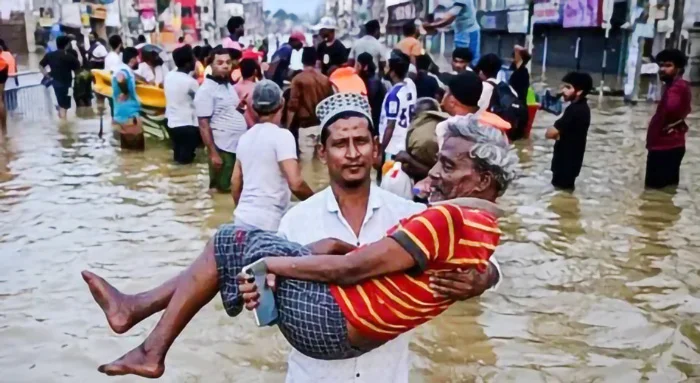
The Tsunami of 2004 struck our coasts, but the recent Cyclone Ditwah has delivered an unprecedented blow, devastating and traumatising the entire country. President Anura Kumara Dissanayake rightly called it the “largest and most challenging natural disaster” in Sri Lanka’s history.
The toll is staggering: Over 600 people were confirmed dead, with hundreds still missing. More than 2 million citizens – nearly one in ten people—have been affected. 41,000 to 86,000 houses are damaged or completely destroyed. The damage is widespread, with 22 of the island’s 25 districts declared disaster-affected areas. A provisional economic damage estimate reaching up to USD 7 billion—a figure that instantly consumes about 7% of our national GDP. This was not merely a natural disaster; it was a crisis amplified by systemic failure, culminating in a catastrophe that now demands a radical, long-term policy response.
Unlike the Tsunami, the destruction to our vital inland infrastructure—roads, bridges, railway lines, and power networks—has been colossal, crippling the nation’s ability to recover. Over 25,000 members of the tri-forces have been mobilised, and the nation rightly hails their courageous and relentless efforts in rescue and relief. They should now be graduated from ‘Rana Viruvo’ to RUN VIRUVO considering the efforts they are still putting into the relief operations in this unprecedented calamity. But the scale of the rebuilding effort requires a permanently sustained unified national mechanism, perhaps learning from their rich experiences.
Why did devastation reach this cataclysmic level?
Unlike a sudden earthquake/Tsunami, a cyclone’s path is largely traceable. Yet, the “post-mortem” on Ditwah reveals a horrifying truth: the storm’s devastation was amplified by our own institutional failures.
The India Meteorological Department (IMD) which runs the Regional Specialised Meteorological Centre (RMSC) monitors the oceans in this region and issues alerts for cyclones. It serves all the regional countries — Bangladesh, Maldives, Myanmar, Oman, Pakistan, Sri Lanka and Thailand. The RMSC first predicted the formation of a depression as early as November 13 and issued an alert over the possibility of a cyclone forming on November 20. From November 23 onwards, IMD/RMSC had been routinely sharing frequent weather updates with Sri Lanka.
Robust models from the India Meteorological Department and the RMSC provided ample warnings of the depression and subsequent cyclonic intensification. Some of these predictions by the RMC and even the BBC forecasted rainfall over 300- 400 mm which could go up to even half a meter per day. True to their forecasts, Matale tragically received unprecedented rainfall of around 520 mm, triggering fatal landslides. Ditwah’s impact was worsened by its unusually slow movement over the island which sustained heavy rainfall over several days.
The Governance Gap
The critical breakdown occurred between the scientific prediction and the state’s executive arm. Warnings, if not taken seriously or acted upon, become meaningless data points. The core issue is a fragmented disaster management system that lacks the “unified command structure” required for real-time data sharing and rapid deployment. As one analyst noted, the disaster delivered a hard lesson: we entered one of our worst natural disasters in decades without a functioning national strategy and with a severe deficit in “adaptive capacity.
Scientific forecasts were not translated into an appropriate, urgent disaster preparedness program by the Sri Lankan state apparatus. Public reports indicate that national preparedness was woefully short of what was needed. The warnings failed to translate into a coherent, proactive response into an appropriate disaster preparedness action program on the island. This failure points directly to long-standing institutional deficits.
The Strategic Imperative: Dedicated Workforce for a $7B Recovery
President Anura Kumara Dissanayake rightly emphasised that restoring public life requires a unified operational mechanism that goes beyond normal state administration. To tackle this immense task, the Government has established a ‘Rebuilding Sri Lanka Fund’ to finance the medium- and long-term recovery, including essential infrastructure and public health issues.
This newly established ‘Rebuilding Sri Lanka Fund’ addresses the financial cost, but it does not solve the fundamental manpower crisis which is a key bottleneck in retarding the progress of this formidable undertaking. Rebuilding 247 kilometers of impacted roads, restoring two-thirds of unusable railway lines, clearing hundreds of landslides, and repairing crucial irrigation systems demands a sustained, disciplined, and massive workforce that normal state administration simply cannot provide. Furthermore, with the changing climate, events of this nature and magnitude may be more frequent in the future.
As such, there is a moral call to a strategic imperative. The immediate, ad-hoc spontaneous public volunteerism is commendable, but the scale of the task ahead requires a permanent, non-partisan national investment in human resources. The time for piecemeal recovery programs is over. Ditwah has forced the issue of structural accountability and national capacity onto the policy agenda.
A Call for Mandatory National Service
One of the most responsible paths forward is to utilise this crisis to institutionalise a robust National Service System, transforming a generation of youth into a standing army for climate resilience and nation-building. To fail to do so would be to guarantee that the next storm will bring an even higher price.
Sri Lanka cannot afford to be unprepared again. The solution is to immediately mobilise and, for the long term, institutionalise the patriotic energy of our youth into a robust, structured National Service System. This service should be more than just disaster relief; it is a long-term investment that will:
i) Build the Nation: Provide a rapid-response labour force for future disasters, infrastructure projects, and conservation efforts.
ii) Forge Character: Instill essential skills like discipline, leadership, accountability, and responsibility in our youth, thereby contributing to lower rates of substance abuse and crime.
iii) Strengthen Unity: Promote social cohesion and reinforce national identity by having youth from all backgrounds work together for a common cause.
The legal framework for such a move already exists. The Mobilisation and Supplementary Forces Act, No. 40 of 1985, already gives the government the powers to issue a National Service Order to enlist people in a National Armed Reserve. This mechanism can be adapted to establish a non-military, civilian-focused service.
Sri Lanka already has a government supported National Volunteer Service affiliated to her Social Services Department. It coordinates volunteers, develops management systems, and works with partners like the UN volunteers. This service can be improved and upgraded to tackle challenges in natural and/or human induced disasters which are going to be more frequent with greater intensity, at times.
In the immediate term, the large number of existing volunteers dispersed all over the island need to be engaged as understudy groups, working directly alongside the armed forces and government departments in the recovery process which is already happening in a number of instances.
Ditwah is our wake-up call for longer-term strategic planning and policy reforms. Alongside reacting to catastrophes in a piecemeal manner in the short-term, we must systematically start building a resilient nation with a vision for the future. Investing in a structured, mandatory Civilian National Service is the only way to safeguard our future against the inevitable challenges of climate change and to truly rebuild Sri Lanka.
Globally over 60 countries have national service portfolios mostly of military nature. Both Germany and France have recently reintroduced their national services to meet their own specific needs. In the US, the National Community Service centers around the Corporation for National and Community Service (CNCS), a federal agency that runs programs like AmeriCorps and Senior Corps, mobilising millions of Americans in service to address needs in education, disaster relief, environment, and more, fostering civic duty and offering educational awards for service.
Incorporate National Service into Educational Reforms
We must mobilize our youthful energy into a national service portfolio unique to our own needs giving due recognition to our history, geography and culture. As a long-term investment, this should be initiated while children are still in school, preparing them mentally and physically to contribute to nation-building.
A well-designed National Volunteer Community Service would instill discipline and foster essential skills like leadership, responsibility, and mutual respect, while contributing at the same time to national development. We can tailor this service to tackle our unique challenges in public safety, disaster relief, and environment conservation.
Existing school programmes like scouting and cadeting can be innovatively transformed to lay a sound foundation for this life-changing National Service for all schoolchildren. According to the initial estimates of UNICEF, over 275,000 children are among the 1.4 million people affected both physically and mentally who need careful rehabilitation.
The current educational reforms are an ideal platform to impart crucial values in patriotism and introduce essential skills like time management, discipline, and accountability. This system could not only build successful individuals but also help decrease social issues like substance abuse and crime among youth.
In the immediate future, to meet the demands of the recovery effort now, currently available volunteers should be engaged as understudy groups, working alongside the armed forces and government departments involved in the rebuilding process. The long-term investment in a Mandatory National Service, on the other hand, will strengthen our national identity and contribute to the “unified operational mechanism” the President has called for.
The author can be contacted at nimsavg@gmail.com
by Emeritus Professor
Nimal Gunatilleke

Lakbima Rice Mills (Pvt) Ltd donates Rs 100 million to the ‘Rebuilding Sri Lanka’ Fund

England security in airport clash with camera operator

Sethmika stars as Sri Lanka under 19s crush Nepal by 8 wickets

Advisory for severe lightning issued to the Districts of Kaluthara, Rathnapura, Galle and Matara

Pregnant Mothers to receive Rs 5000 Nutrition Allowance in December

640 deaths, 211 missing as at 6:00AM today (13)

‘Dates have the highest sugar content to fight Coronavirus’

Sunday Island 27 December – Headlines

#SundayIsland 17th December – Headlines

Sunday Island – 28th March

Sunday Island Headlines – 21 March

Sunday Island – 21st February – Headlines
-

 Features4 days ago
Finally, Mahinda Yapa sets the record straight
-

 News6 days ago
Over 35,000 drug offenders nabbed in 36 days
-
 News5 days ago
Cyclone Ditwah leaves Sri Lanka’s biodiversity in ruins: Top scientist warns of unseen ecological disaster
-
 Features7 days ago
The Catastrophic Impact of Tropical Cyclone Ditwah on Sri Lanka:
-

 News6 days ago
Rising water level in Malwathu Oya triggers alert in Thanthirimale
-
 Features4 days ago
Handunnetti and Colonial Shackles of English in Sri Lanka
-
 Business3 days ago
Cabinet approves establishment of two 50 MW wind power stations in Mullikulum, Mannar region
-

 Business6 days ago
Sri Lanka betting its tourism future on cold, hard numbers