
Opinion
Send in clowns and be damned!


The Director-General of the Sri Lanka Tourism Develop Authority has given the thumbs up sign to the Director General of Health and IGP to allow foreign tourists to travel across districts/provinces in Sri Lanka through ‘bubble tourism’. This is despite the fact that Sri Lanka’s Immunology and Molecular Medicine authorities have now identified six new Covid-19 variants in Sri Lanka. These include variants from Denmark, Europe, Middle East, Nigeria and South Africa, including the deadly Indian B.1.617.
A golden wand of protection seems to attend the path of these foreign visitors across the island, while the public is prohibited from venturing into or through such areas to prevent the spread of the virus. It is an irrefutable fact that when foreign tourists are ferried across the Island and allowed to visit the provinces, there is an entourage of locals to assist them at their accommodation, in transport and at places of tourist interest. One of the first Covid-19 patients in Sri Lanka was a Tour Guide! The policy of ‘back to business as usual’, sporadic restrictions, onus of self-protection and ‘never mind the consequences’ has hitherto yielded horrendous results.
The cost of opening the country’s borders to foreign tourists from January 2021, with some short-term gains to hoteliers, has boomeranged on the nation’s production, manufacture and general socio economic well- being. Each new morning new widows and infants howl and mourn the deaths of loved ones. Death Rate and total Covid cases in Sri Lanka have now reached phenomenal levels. Hospitals cannot cope with the rising numbers of patients, who are being accommodated in makeshift sheds and warehouses, or asked to remain in their homes sans medical attention!
Who is really calling the shots in controlling the pandemic that has now reached crisis proportions in Sri Lanka? Does the Minister of Tourism, Prasanna Ranatunga, have special qualifications and abilities in the medical field, to warrant such decisions and directives to be given across the board by his petty minions and willing sycophants in the government bureaucracy? Is he not aware that the practice of bubble tourism is between countries that have relatively small incidence of Covid, as in the case of Australia and New Zealand, holding strong track records of implementing consistently rigorous anti-covid restrictions and regulations? Is not the Director General of Tourism, Ms. Kirmali Fernando, whose husband owns and runs Tourist Hotels, properly advised on the practices around the world? Or is short term pecuniary gain more important than ordinary human lives? In Sri Lanka ” a land like no other” when Ukraine was in a lockdown situation, their tourists were hosted in Sri Lanka.
According to the WHO, the coronavirus variant was first identified in India last year and was classified as a variant of global concern, with some preliminary studies showing that it spreads more easily and is increasingly classified as a variant of concern at a global level. WHO statistics reveal a sharp linear rise in the new Covid cases in India commencing from March 2021, even while our ‘Health Experts’ in the Tourism Ministry were encouraging and further promoting Bubble Tourism Agreements with India until late April 20, 2021
The recent fiasco in Piliyandala saw the local MOH up in arms over the blatant idiotic interference by the Minister Lokuge, in giving counter orders against the Ministry of Health and opening up Covid-19 areas, possibly due to requests of business cronies among his constituents. The subsequent death rate due to Covid in Piliyandala bears ample testimony to the demented exertions of this politico.
Blustering, blundering politicians apart, what of the high-powered Committees, consisting of retired senior government servants, expert medical personnel, deciding to administer the First Dose of anti-Covid-19 AstraZeneca Vaccine to approx. 9 lakhs of the population, while only retaining 03 lakhs for the Second Dose! Surely it is common sense to spread the vaccine in a manner that ensures that both doses are given during the prescribed period of at least 10 weeks! The logic of entering into a signed contract for supply of AstraZeneca to be given for the second dose, and opening a letter of credit, does not seem to have entered into the calculations of those charged with such responsibilities, who perhaps have reached the age of Dementia or careless indifference!
There was enough time to secure the required stock of AstraZeneca from January 2021, if not for political will considering that the Budget of December 2020 had no provision for anti-covid vaccines! Leaving the approx 600,000 of people particularly in the over 60 age group in dire straits, after their first dose of AstraZeneca, which cannot be mixed with other vaccines now available in the market, is tantamount to criminal negligence, breach of trust and inequitable governance. Even in the midst of such severe bungling, there are some politicos trying to pour down Vaccine Cocktails, hitherto never tried or tasted in other parts of the developed world, down the throats of these unfortunate victims.
The cronyism and nepotism rampant in the numerous and now commonplace accounts of people with ‘influential connections’’ getting the vaccine over others, shows a moral impoverishment of the country. It is a fact that today there are those who work in the front line of infection in their respective workplaces, who have not been given priority in the administration of the vaccine. However, Notables, VIPs and Politicians and their allies are given pride of place in getting the scarce second dose of the AstraZeneca, irrespective of the fact that this is considered more appropriate for senior citizens above the age of 55 or 60.
It is a time that the Public has seen through the lies, sheer hypocritical terminology and slanted data that might have hitherto lulled them towards the so-called resurgence of the virus in the “Avurudu Pokura”. Some amusing but insidious half-truths, and concealments are worth mentioning. The media gave the impression for a long time that the deaths were due to underlying conditions of non-communicable diseases such as diabetes and high blood pressure when the causative agent was Covid 19. The undeniable truth is that had it not been for the Covid-19 virus, those with underlying diseases might have lived to a ripe old age with the medications! It is only now, with the escalating deaths and ensuring chaos in the health sector, that the real causative agent of those afflicted with Covid-19 is being acknowledged as Covid pneumonia! The crass negligence of garment factory owners in the Brandix cluster, and resultant probe into criminal negligence is without any progress and lies hidden and dormant. The reluctance to admit that there was a community wide transmission across the island, and the continued lies that this is confined in the main to the Western Province, and that every case could be traced back to the Brandix or Peliyagoda Fish Market clusters is now a sad laughing matter!
Those of us who watched the TV news in the time leading up to the present crisis are privy to the spectacle of the representatives of the people (Politicians), at the pinnacle of power, neglecting to follow simple guidelines such as wearing a mask, avoiding crowded meetings, etc. The subtle interplay of attributing a particular age group to the Covid-19 casualty, the balancing of numbers of positive cases and deaths with limited PCR, and the relative lack of a Geographical Information System by which selective and targeted lockdowns could be imposed in severely affected areas, have contributed to maintaining a fog index over the actual situation prevailing in the country.
A nation that has seen its own Minister of Health and other politicians expound the virtues of a fake decoction called “Dhammika Peniya” as a possible Covid-19 preventive, cannot be too surprised thereafter to witness any worse inanities and tragic bungles!
In conclusion, a nation that with renewed hope changes its political pillow for a new government be it, SLFP, Yahapalanaya, alias SJB, Podujana Peramuna, appears to be doomed to certain abject disillusionment. The truth is plain to see. Any apolitical citizen can now realise that whether there be bond scams, major bribery and corruption charges, criminal negligence on terrorist massacres, the policy of no real remedial action, talk only and a series of commission reports, parading on remand, will be the final product. Except for some sprats down the line, the kingpin will continue their rampage. It is said that there is a certain camaraderie and wheeler dealing even amongst those who represent the people on either side of the divide in Parliaments. Where there is neither honour, principle nor true love of country and its people, in a system that is replete with sycophant”public” servants and moribund self-serving intelligentsia, the dark prescription still is “Send in the Clowns and be damned”.
SONALI WIJERATNE
Kotte

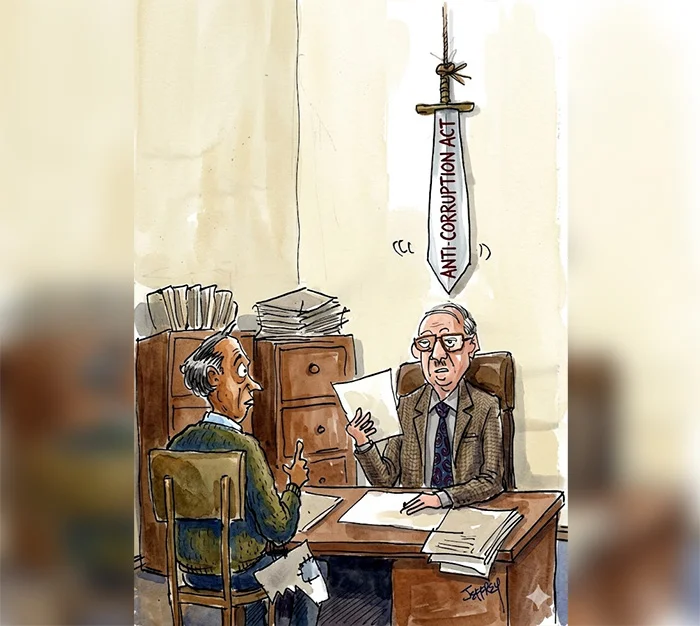
Reform of the Anti-Corruption Act – Part III
by A Special Correspondent
(Continued from yesterday)
The most dangerous job in Sri Lanka today is that of a public servant. Even those who have never taken a bribe or enriched themselves unlawfully, can still be accused of corruption by ‘causing a loss to the government’ and all public servants now live with the constant possibility of arrest and prosecution while holding office or even after retirement. This is a developmenthat has taken place in the past several years due to misguided policies and bad politics.
When the Central Bank was set up in 1949 under the guidance of John Exeter of the US Federal Reserve, the following provision was included in the Monetary Law Act of 1949.
“47.(1) No member of the Monetary Board or officer or servant of the Central Bank shall be liable for any damage or loss suffered by the bank unless such damage or loss was caused by his misconduct or wilful default. (2) Every member of the Monetary Board and every officer or servant of the Central Bank shall be indemnified by the bank from all losses and expenses incurred by him in or about the discharge of his duties, other than such losses and expenses as the board may deem to have been occasioned by his misconduct or wilful default.”
Until 1994, Section 47 provided all the protection that Central Bank officials needed. But after Section 70 was introduced to the Bribery Act in 1994, and ‘causing a loss to the government’ became an offence amounting to corruption, even Central Bank officers technically lost their immunity. Acts that cause a loss to the government are very much a part of the Central Bank’s functions. If the Central Bank allowed the Rupee to depreciate, the cost of servicing foreign debt goes up and causes a loss to the government. A slight increase in the interest rate increases the cost of servicing government debt and causes a loss to the government.
The only reason that officers of the Central Bank were not prosecuted under Section 70 after 1994 was because nobody got the bright idea of making a complaint against them. As pointed out earlier, Section 70 remained dormant for many years after 1994. However, the dogs were let out after 2015 and today, no public servant is safe. In the post-2015 era, petitioners have gone to courts arguing that an economic crisis was precipitated because a government reduced taxes, did not allow the Rupee to depreciate, and delayed seeking IMF assistance. Now, there is nothing to stop another set of petitioners from going to courts arguing that yet another economic crisis has been precipitated because of high taxes, a depreciating Rupee, and strict IMF conditions!
So, public servants including Central Bank officials who play a major role in economic decision making are exposed and vulnerable. The Monetary Law Act of 1949 was replaced by the Central Bank Act of 2023 and Section 47 of the old Monetary Law Act still continues to exist in a way in the Central Bank Act of 2023 in the form of Sub-section (1) of Section 121.
Jail time for public servants
However, there is a crucial difference between Section 47 of the old Monetary Law Act and Section 121 of the 2023 Central Bank Act because the new provision has been promulgated to suit the new era of criminal charges and jail time even for public servants who have not taken bribes or enriched themselves unlawfully.
While Sub-section (1) of Section 121 of the new Central Bank Act encapsulates the essence of the old Section 47, the Central Bank Act of 2023 has a new Subsection (2) of Section 121 which basically states that if an officer of the Central Bank is faced with an investigation or court proceedings, the Central Bank will meet the legal costs of that officer. This legal aid comes with the proviso that if any wrongdoing is proven, the offender will have to reimburse the money spent to the Central Bank.
It should be borne in mind that under the present law, the wrongdoing that needs to be proven under is not that the said Central Bank officer took bribes or enriched himself, but of having caused a loss to the government. So in reality, there is no protection for Central Bank officers who have no option but to cause losses to the government as a part of their day to day duties especially when it comes to exchange rate and interest rate management.
While Section 121(2) of the 2023 Central Bank Act thoughtfully provides for the legal costs of Central Bank officers under investigation or prosecution, it has not provided for the time that officer will have to spend in remand prison. For the sake of completeness, there should have been a Sub-section (3) to Section 121 stipulating that if an officer of the Central Bank under investigation or prosecution ends up in remand prison, a peon of the Central Bank will be assigned to take food and other essentials to the remand prison on a daily basis!
At least the Central Bank Act of 2023 has explicit provisions to help their employees with legal support if the need arises. But other public servants in less well-paid, less powerful branches of the public service or state institutions have no such safeguards. What is necessary is to prevent bribe-taking and unlawful enrichment by public servants but this has to be done without undermining the decision-making and problem-solving powers of public servants and thereby paralysing the entire system of governance.
As we saw in the previous article, the Indian system allows those who bear actual responsibility for running the country to decide whether a prosecution or an investigation into the conduct of an official is warranted in the circumstances if there is no evidence of bribe taking or unlawful enrichment. That enables those running the country to act on irregularities without undermining the system of governance.
However, in Sri Lanka, governments led by short-sighted and small-minded people have a tendency to come into power with their garments hitched up high, and perform various ill-advised antics to please the gallery. Hence, what works as a safeguard in India may actually be turned into an instrument of political persecution in Sri Lanka with every succeeding government mindlessly sanctioning investigations and prosecutions against holders of high office in the previous government.
In Sri Lanka, when power changes hands, the winner-takes-all and commonsense, far-sightedness and even the medium to long term self-interest of the winners themselves, go out of the window resulting in a ‘monkey with a razor blade’ situation. The Sri Lankan public service is too weak to be able to hold things steady and they too tend to get carried away by whatever political wind may happen to be blowing at a given time.
The elusive sense of balance and proportion
However, all is not lost. From the time of independence until Section 70 of the Bribery Act was introduced in 1994, public servants could be prosecuted only for actually taking bribes or possessing unexplained wealth. Even after Section 70 was introduced in 1994 to prosecute a public servant for corruption by causing a loss to the government even if there was no bribe taking or unlawful enrichment, prosecutions under this provision were not instituted for many years. So, there is a history of rational behaviour in Sri Lanka as well. What is necessary is to find some balance and a sense of proportion when it comes to public servants who take bona fide decisions that are open to interpretation as ‘causing a loss to the government’ even though that person has not taken bribes or enriched himself unlawfully in the process.
In some instances, a decision taken by a public servant may benefit some individual and it may cause a loss of revenue, loss of property or a need to make a payout on the part of the government. A given set of circumstances would require remedies within a certain range. In making such a decision, the rationale therefor and any precedents would obviously be recorded by the public servant. If a complaint is received, an internal board of inquiry should be able to ascertain whether there was anything unusual in the decision taken.
If redacted versions of such internal inquiry reports are made publicly available, anyone who is not satisfied with the conclusion should be able to challenge it with the board of inquiry, the CIABOC, the police the courts or even in the media. When an allegation relates to a loss incurred by the government and there is no evidence of bribe taking or undue enrichment, there should be some sort of a halfway house without an all-powerful external inquisitor rushing into the matter with arrests, imprisonment, investigations and prosecutions. Unless something is done to address this issue, what we are staring at, is creeping governmental paralysis over a period of time.
(Concluded)

The terrorist war, which was launched in the 1970s to create a separate state, was ruthless and created political and economic instability. Sri Lankan governments, during this period, were pushed, and sometimes forced, by internal and external forces to talk ‘peace’ with the terrorist faction. The terrorists made use of the peace initiatives and strengthened their forces by procuring arms, recruiting personnel and exploding bombs in the city centres and massacring civilians
But Sri Lankan forces, who were determined to defeat the terrorist group, continued to exert pressure on the enemy with unparalleled heroism. President Mahinda Rajapaksa, too, was determined to get rid of the ferocious enemy and with the then Secretary of Defence, Gotabaya Rajapaksa, senior officers of the Army, the Navy and the Airforce, planned a full-scale operation to wipe out the enemy.
The LTTE killed many Tamil political leaders and also took with them more than 25,000 Tamil civilians, by force, as a human shield, when they retreated to the East. The civilians were finally liberated by the Sri Lankan armed forces. Many thousands of Tamil children were recruited as child soldiers, depriving them of their innocent childhood. Some were trained as suicide bombers. Many of them were killed in the battles while the remaining ones were rehabilitated by the Sri Lanka government.
When the situation changed for the better, after 18th May, 2009, one of the darkest chapters of Sri Lankan history was ended by the war heroes, assisted by the Police, and the members of the civil defence force.
Finally, around 7,000 members of the armed forces sacrificed their lives, while nearly 30.000 members were injured. The nation should be ever grateful to these war heroes who survived and liberated the land and others who were killed and also injured fighting for the land.
RANJITH SOYSA

On May 15, newspapers reported a tragic incident in Wilgamuwa: a 56‑year‑old father and his 25‑year‑old daughter were killed in a wild elephant attack while travelling on a bicycle. The father had been on his way to drop his daughter at her workplace when they were attacked by the elephant.
Who will compensate the family of these two innocent persons, who were travelling in a legitimate and peaceful manner?
If a person kills an elephant to protect his life, property, or plantation, there is an immediate hue and cry, and prosecution follows. Yet, when poor villagers are killed or maimed by elephants, the victims’ families are left devastated, often losing their breadwinners who struggled daily to provide for them.
Why does our legal system and state regulation fail to work reciprocally?
Should not the same urgency and accountability apply when human lives are lost?
D Rajapaksha

At least 10 dead as huge floods sweep southern and central China

Ebola outbreak may be spreading faster than first thought, WHO doctor warns

Sooryavanshi’s stunning 93 takes Rajasthan Royals closer to IPL playoffs

Showers in the Western, Sabaragamuwa, Northern, North-western and Southern provinces and in Anuradhapura, Kandy and Nuwara-Eliya districts

Govt. committed to fulfilling aspirations of war heroes who liberated country: AKD

H’tota elephant management reserve essential to halt ecological destruction and rising human-elephant conflict – Minister Patabendi

‘Dates have the highest sugar content to fight Coronavirus’

Sunday Island 27 December – Headlines

#SundayIsland 17th December – Headlines

Sunday Island – 28th March

Sunday Island Headlines – 21 March

Sunday Island – 21st February – Headlines
-

 Features3 days ago
Sri Lankan Airlines Airbus Scandal and the Death of Kapila Chandrasena and my Brother Rajeewa
-
 News4 days ago
Lanka’s eligibility to draw next IMF tranche of USD 700 mn hinges on ‘restoration of cost-recovery pricing for electricity and fuel’
-
 News3 days ago
Kapila Chandrasena case: GN phone records under court scrutiny
-

 News3 days ago
Rupee slide rekindles 2022 crisis fears as inflation risks mount
-
 Opinion6 days ago
Electricity tariffs have skyrocketed: Can further increases be prevented?
-

 Business3 days ago
Expansion of PayPal services in Sri Lanka officially announced
-
 Features5 days ago
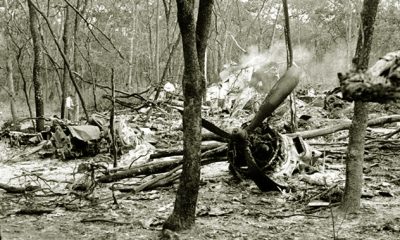
Mysterious Death of United Nations Secretary General Hammarskjöld
-

 News3 days ago
Court orders further arrests in alleged USD 42 Mn NDB fraud case