
Business
Wedgefishes and Guitarfishes in Sri Lanka: The Urgent Need for Conservation


Wedgefishes and guitarfishes are among the ocean’s most misunderstood and overlooked animals. They are ancient, gentle, shark-like rays that glide quietly through the shallow coastal waters. Although their bodies resemble sharks, they are not sharks but rays, with bodies made of a cartilaginous skeleton belonging to the order Rhinopristiformes.
Wedgefishes and guitarfishes inhabit inshore waters on the continental shelf, particularly in enclosed bays, estuaries, and coral reefs, and are primarily found in warm-temperate to tropical inshore continental seas. With their flattened heads, long, tapered tails, and calm, deliberate movements, they are peaceful animals that live close to the sea floor, gently moving through the water.
Wedgefishes and guitarfishes represent one of the most threatened groups of marine vertebrates globally. They rest on mud, sand, or rough bottoms and feed on benthic invertebrates, crustaceans, and small bottom-dwelling fish, playing a crucial role in maintaining the trophic functioning of soft-sediment ecosystems. Their distinctive appearance, coastal distribution, and shark-like bodies make them extremely vulnerable to capture in different types of fisheries, especially gillnets used in shallow waters. Slow growth, late maturity, and low reproductive rate further limit their ability to recover from exploitation and make them even more vulnerable, making every new pup precious.
Sri Lanka is home to eight officially recorded Rhinopristiformes species, including two wedgefishes (Rhina ancylostoma and Rhynchobatus australiae) and five guitarfishes (Glaucostegus granulatus, Acroteriobatus variegatus, Rhinobatos annandalei, Rhinobatos lionotus, and Rhinobatos punctifer), underscoring the country’s significance as a regional biodiversity hotspot for shark-like rays. Except for Rhinobatos punctifer, all are listed as Critically Endangered on the IUCN Red List due to population declines driven by overfishing in artisanal fisheries, underpinned by limited management. Many of these species have declined drastically, with sawfishes now considered locally extinct.
Fishing pressure remains high along Sri Lanka’s coastal shelf, where artisanal gillnets and longlines operate daily. Whilst both guitarfish and wedgefish are incidentally caught and retained for sale in local markets, wedgefish are especially vulnerable as their meat is more highly valued locally and their fins are in high demand internationally, leading them to be deliberately targeted in fisheries. Apart from overfishing, habitat change and degradation are major drivers of population declines in species distribution and abundance. The shallow coastal habitats of these species are often subject to high levels of human activity, resulting in habitat degradation or loss due to pollution, mangrove clearance, and coastal or riverine developments.
In Sri Lanka, six Important Shark and Ray Areas (ISRAs) have been established along the coastline in response to high landings of sharks and rays, with guitarfish driving the designation of the Pasikuda and Kalkuda ISRA, which has frequent landings of Acroteriobatus variegatus, and the Palk Bay ISRA, which has frequent landings of Glaucostegus granulatus. However, despite being classified as Critically Endangered and experiencing severe population declines in Sri Lankan waters, these species still receive no legal protection, highlighting a significant conservation concern. The situation calls for immediate, coordinated action. There is an urgent need for systematic landing-site monitoring, improved species identification, and clear documentation of local and export trade to strengthen CITES non-detriment findings. Protecting critical coastal habitats and implementing national conservation measures are essential steps to allow populations to stabilise and recover. As Sri Lanka lies within an important biodiversity region for rhino rays, proactive conservation is not only needed but imperative to prevent these species from vanishing entirely, an outcome that has already unfolded for sawfish in many tropical nations.
-

- Pile of live Bengal Guitarfish (Rhinobatos annandalei) at the market
-
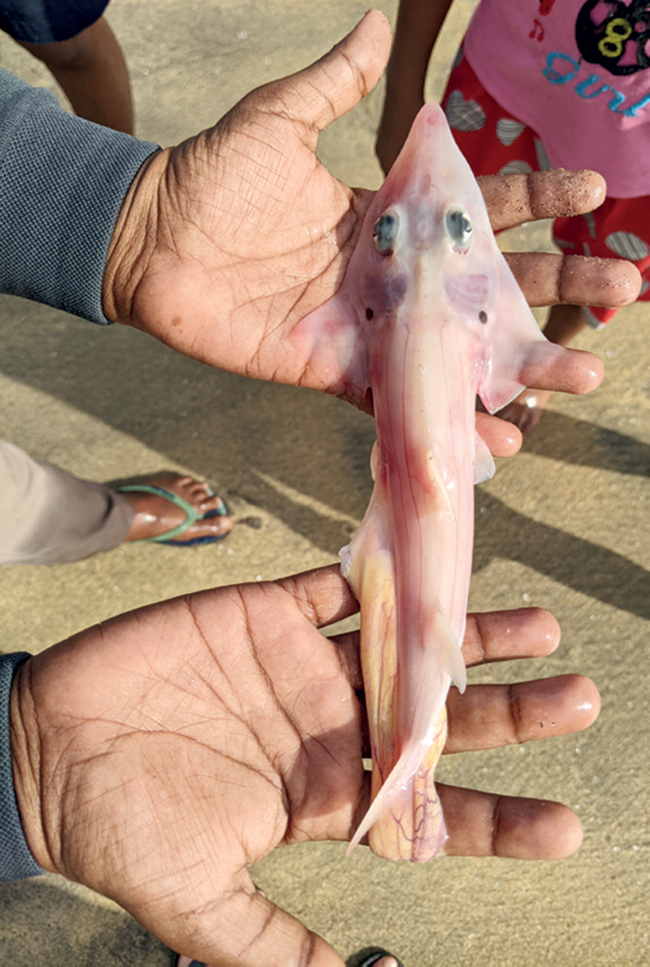
- Unborn wedgefish pup
-

- A dog feeding on the head of a Bowmouth Guitarfish (Rhina ancylostomus
-

- Wedgefish catch from an OFRP boat, with fins and heads removed
-
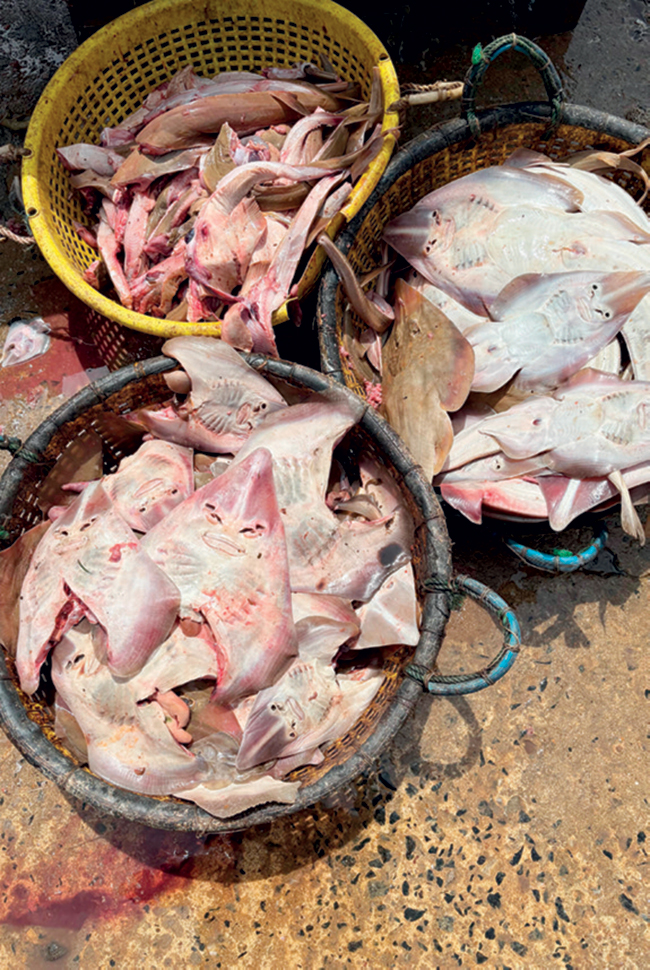
- Pile of guitarfish being processed in the market for dry fish production



The National Business Facilitation Centre (NBFC), which is being established under the Presidential Secretariat with the aim of removing administrative and regulatory barriers that exist among government institutions in relation to investment and industry and expediting these processes, will be opened tomorrow (22).
The centre is being established on the President’s initiative with the aim of bringing about a positive transformation in the industrial sector. The centre will provide solutions to issues that arise in dealing with the government machinery when starting and operating a business, while also coordinating with the relevant government institutions to provide the necessary facilities.
The “ViYASA” National Business Facilitation Centre (NBFC) has been established at Building C-80, Hector Kobbekaduwa Mawatha, Colombo 07, and is headed by Senior Additional( Secretary to the President, Seevali Arukgoda.
The centre will be opened under the patronage of Minister of Labour and Deputy Minister of Finance and Planning Dr Anil Jayantha Fernando and Minister of Industry and Entrepreneurship Development Sunil Handunnetti, with the participation of Secretary to the President Dr Nandika Sanath Kumanayake.
The website https://nbfc.presidentsoffice.gov.lk is also scheduled to be officially launched on the occasion.
President’s Media Division)
By Sanath Nanayakkare
Artificial intelligence and automation present serious challenges for workers – such as job consequences seen in docks and rail systems – and emphasises that workers cannot simply stop technological progress. By gathering young trade unionists in Sri Lanka, the ITF aims to establish key principles for engaging with technology, ensuring workers have a strong voice at the bargaining table, and encouraging constructive social dialogue with corporations and governments.
These compelling words from ITF General Secretary Stephen Cotton underscored the urgent reality facing modern labor as rapid technological advancements sweep across global industries.
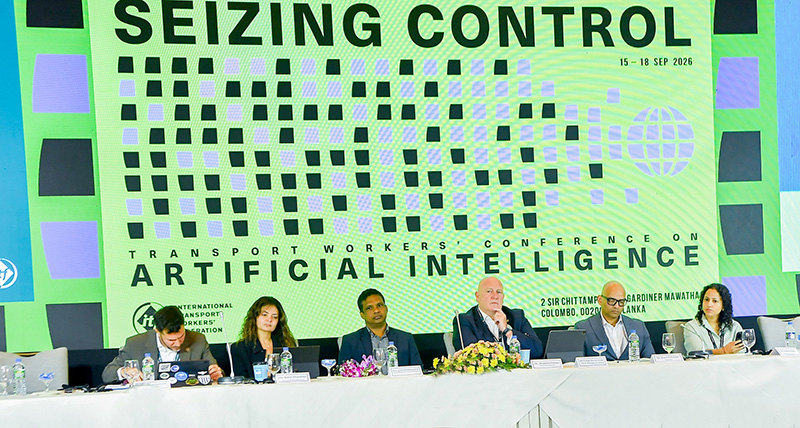
Confronting this shifting landscape head-on, the International Transport Workers’ Federation (ITF), in partnership with the National Union of Seafarers of Sri Lanka (NUSS), convened a ground-breaking conference on artificial intelligence in Colombo from September 15–17.
As the ITF’s first-ever AI-focused global conference and the first of its kind hosted in Sri Lanka, the landmark event marked a critical milestone in balancing technological innovation with worker-centered safeguards.
Representing over 16.6 million transport workers worldwide, the ITF designed the gathering to tackle the multifaceted impacts of AI on safety, operations, workforce development, and governance. Rather than resisting progress, the conference focused on proactive engagement, establishing guiding principles to protect workers’ rights and privacy both at sea and on land.
Key discussions centred on sharing best practices for upskilling and reskilling transport personnel, ensuring that human oversight remains central to AI-driven logistics, routing, and maintenance.
Reflecting on the historic nature of the event, Boa Athu, CEO of National Union of Seafarers Asia Pacific, noted that the conference represented a monumental moment as AI emerges as a permanent fixture of contemporary life.
Highlighting NUSS’s pride in hosting the event in Colombo, Athu emphasised that AI offers transformative potential when guided by strong social dialogue, equitable access to training, and robust governance safeguards.
Ultimately, the Colombo conference demonstrated that the future of transport must be shaped by those who keep the world moving. By uniting international labour leaders, affiliates, port operators, and regulators, the event laid a vital foundation for inclusive policy frameworks that champion fair labour standards, securing a powerful voice for workers in an automated tomorrow.

By Sanath Nanayakkare
As Sri Lanka experiences a surge in visitors from its largest tourist market, India, a modern administrative hurdle has emerged at Bandaranaike International Airport (BIA).
While nations like India and Pakistan have successfully transitioned to fully digital driving licences and cashless ecosystems, Sri Lanka’s Department of Motor Traffic counter still requires a physical card to issue temporary local permits, The Island Financial Review learns.
This mismatch creates significant friction for independent travelers who rely entirely on smartphones and cloud-stored credentials. Tourists turned away at the airport – and sometimes redirected to the Werahera office in vain – find themselves unable to legally rent and drive vehicles. Consequently, this policy gap harms local car rental operators, causes tourist frustration, and deprives the government of valuable permit revenue.
The situation highlights a distinct irony: Sri Lankan motorists easily travel abroad using International Driving Permits that are readily accepted in India and Pakistan, yet local infrastructure cannot reciprocate due to outdated verification systems.
Recognizing the problem, Department of Motor Traffic officials have noted that upgrades and new equipment are currently in the works to integrate foreign digital platforms.
For a nation aggressively pursuing a national digitalisation drive, rapidly modernising these transport protocols is essential to keeping pace with global travelers and unlocking the full potential of its tourism economy.

“ViYASA” National Business Facilitation Centre (NBFC) to be opened tomorrow (22)

Court of Appeal Judge M. Sri Mevan Anthony Edirimannasuriya Corea appointed as Acting President of the Court of Appeal

President instructs expediting further measures concerning Sivarasa Anojan, sentenced to death in Saudi Arabia

It’s Shafali vs Athapaththu as Sri Lanka seek to stop India juggernaut

Trophy row unlikely to repeat in Japan

Powerful explosions at Syrian army site near Aleppo injure at least four

‘Dates have the highest sugar content to fight Coronavirus’

Sunday Island 27 December – Headlines

#SundayIsland 17th December – Headlines

Sunday Island – 28th March

Sunday Island Headlines – 21 March

Sunday Island – 21st February – Headlines
-

 News5 days ago
US embassy won’t comment on IGP’s probe into joint drug raid
-

 News4 days ago
Bid for Basil’s extradition nears final stage: Police
-

 News3 days ago
Shanakiyan urges urgent action over reported death sentence for Lankan in Saudi Arabia
-

 Features7 days ago
The emptying university: why are academics leaving?
-

 Business5 days ago
All-new Bolero MaXX unveiled in Sri Lanka
-
 Opinion7 days ago
Who committed genocide and created mass graves in Sri Lanka?
-

 News2 days ago
Namal Rajapaksa Buddhist gambit fails, bail denied
-
 Opinion5 days ago
A journalist who wrote across the divide